
Disclosure: As an Amazon Associate, CordlessTool Lab earns from qualifying purchases. If you buy through links on this page, we may earn a small commission at no extra cost to you. Retail commission rates (3% in Tools & Home Improvement) never influence our engineering analysis or platform recommendations.
Choosing among modern cordless tool battery platforms is the single highest-impact purchase decision in your workshop. Before you compare drill torque or saw blade speeds, every cordless setup is governed by platform lock-in: you choose the battery socket first, then build your tool collection inside that family (CR-SYS-04). As outlined in our CordlessTool Lab review methodology, evaluating a battery ecosystem requires looking past marketing voltage stickers to examine mechanical rail geometry, battery management system (BMS) communication pins, nominal watt-hour math, and verified OEM dealer channels.
Quick Answer — Which Battery Fits Which Tool?
A cordless battery platform is defined by its brand, nominal voltage family, and mechanical slide or stem interface—never by voltage numbers alone. Packs from competing brands never cross-fit (CR-BATT-TOOL-01), and same-brand voltage families such as Milwaukee M12 vs. M18 or Makita LXT vs. XGT also stay locked apart, aside from narrow one-way exceptions like DeWalt FLEXVOLT and Metabo HPT MultiVolt.
In This Guide
- 1. What Actually Defines a Cordless Battery Platform?
- 2. Nominal Voltage, Amp-Hours & Watt-Hours (Worked Examples)
- 3. Master Compatibility Matrix: Which Battery Fits Which Tool
- 4. The Only Verified Cross-Voltage & Dual-Slot Exceptions
- 5. Cell Formats, High-Output Packs & Torque Spec Caveats
- 6. Five Platform Myths, Third-Party Adapters & Counterfeit Risks
- 7. Charging Safety, CPSC Recalls & Retail Channel Warranties
- 8. Verified OEM Platform Starter Kits & Reference Packs
- 9. Frequently Asked Questions
1. What Actually Defines a Cordless Battery Platform?
Think of a battery platform (also called a battery system or battery ecosystem) as the electrical socket of cordless tools. Inside the plastic housing sit lithium-ion cells wired in series and parallel, an onboard BMS circuit board, and a molded terminal block. Three physical and electronic barriers keep competing platforms separated under rule CR-BATT-TOOL-01:
- Mechanical rail or stem geometry: Slide-on rails (used by DeWalt 20V MAX, Milwaukee M18, Makita 18V LXT, Bosch 18V, Craftsman V20, and Ridgid 18V), hybrid stem-and-slide pods (Ryobi 18V ONE+), and compact in-handle stem packs (Milwaukee M12, DeWalt 12V MAX) use distinct groove widths, latch positions, and keying ribs so rival packs physically stop before mating.
- BMS telemetry & thermistor pins: Beyond the positive and negative power blades, OEM packs carry extra communication contacts. Some brands place thermal-cutoff and low-voltage monitoring logic inside the battery pack (such as DeWalt), while others coordinate over-discharge and overload signals between the tool controller and the pack (such as Milwaukee REDLINK Intelligence or Makita Star Protection Computer Controls).
- Same-brand voltage family isolation: Even within a single manufacturer, different voltage families do not interchange (
CR-BATT-TOOL-03). A Milwaukee M12 pack cannot power an M18 drill, and an M18 battery will not run Milwaukee MX FUEL equipment. Likewise, Makita 18V LXT, 12V max CXT, and 40V max XGT rails remain physically incompatible with one another.
Because batteries and chargers typically represent 25% to 45% of a starter setup budget, platform lock-in rewards staying inside one OEM rail once you own two or more packs and a charger. Adding a second platform makes financial sense mainly when your yard work outgrows 18V/20V hand tools and justifies a dedicated high-voltage outdoor equipment system (such as EGO 56V or Ryobi 40V) with its own batteries and charger. If you are deciding which ecosystem fits your trade or homeowner tool list best, compare our nine-platform cordless tool brand comparison or read our migration roadmap for switching battery platforms.
2. Nominal Voltage, Amp-Hours & Watt-Hours (Worked Examples)
Cordless battery labels blend electrochemical ratings with marketing conventions. Understanding three numbers—nominal voltage (V), amp-hours (Ah), and watt-hours (Wh)—prevents the most common purchasing mistakes across cordless tool battery platforms.
Why “20V MAX” Equals 18V Nominal (CR-BATT-TOOL-02)
Standard lithium-ion tool cells average roughly 3.6 volts under nominal discharge and peak near 4.0 to 4.2 volts immediately off a fresh charger with no load attached. Every mainstream 18V-class pack wires five cell groups in series (5S): multiplying 5 × 3.6V yields 18V nominal, while multiplying 5 × 4.0V reflects the 20V MAX peak open-circuit label.
Milwaukee M18, Makita 18V LXT, Bosch 18V, Ryobi 18V ONE+, and Ridgid 18V publish the 18V nominal figure. DeWalt 20V MAX, Craftsman V20, and Black+Decker 20V MAX highlight the maximum initial voltage. Under load, both classes operate on the same five-cell chemistry—a “20V MAX” sticker never supplies extra power over an “18V” pack (CR-BATT-TOOL-02). The same math governs higher and lower tiers: 3S packs equal 10.8V nominal (marketed as 12V MAX or M12), 10S packs equal 36V nominal (marketed as Makita 40V max XGT or Ryobi 40V), 14S EGO 56V packs sit at 50.4V nominal, and 15S DeWalt FLEXVOLT 60V MAX packs sit at 54V nominal. For a deeper breakdown, see our 20V MAX vs. 18V nominal voltage explainer.
Worked Watt-Hour (Wh) Energy Examples & FAA Carry-On Limits
Amp-hours (Ah) measure charge volume at a pack’s operating voltage, not raw power. To compare total stored energy fairly across packs—or check airline carry-on eligibility—multiply nominal voltage by amp-hours:
Energy (Wh, nominal) = Nominal Voltage (V) × Capacity (Ah)
- Worked Example 1 (Standard 18V/20V 5.0Ah Pack): A DeWalt
DCB205orDCBP520(20V MAX), MilwaukeeXC5.0(M18), and MakitaBL1850B(18V LXT) all run five series cells at 18V nominal. Computing18V × 5.0Ah = 90 Whconfirms identical stored energy capacity on a nominal basis. Compact 5.0Ah packs typically weigh around 1.39 lb to 1.6 lb (0.63 kg to 0.73 kg) bare and stay safely below the 100 Wh commercial airline carry-on threshold. - Worked Example 2 (Dual-Voltage FLEXVOLT & FAA 100 Wh Rule): DeWalt’s
DCB609FLEXVOLT pack switches internal cell wiring automatically between parallel 18V nominal mode (9.0Ah) and series 54V nominal mode (3.0Ah). On a nominal basis,18V × 9.0Ah = 162 Whand54V × 3.0Ah = 162 Wh—the total stored energy never changes, and you never add 9.0Ah and 3.0Ah together. Note that DeWalt prints180 Whon the DCB609 label using its max-voltage basis (20V × 9.0Ah); always state which basis you quote. Because 162 Wh (nominal) / 180 Wh (label) exceeds 100 Wh, packs in this class face strict carrier and airline limits—verify current shipping and travel allowances directly on the FAA PackSafe lithium battery guidance page before flying.
Remember one ironclad boundary: watt-hours quantify stored energy, never runtime minutes, screw counts, or linear feet cut. Actual runtime depends on motor efficiency, load resistance, blade kerf, and fastener diameter, and no runtime figure should ever be estimated without manufacturer specifications or verified benchmark conditions.
3. Master Compatibility Matrix: Which Battery Fits Which Tool
The architectural diagram and compatibility table below map every major US battery platform family, its nominal voltage class, its verified fit boundaries, and the specific caveats that block cross-use.
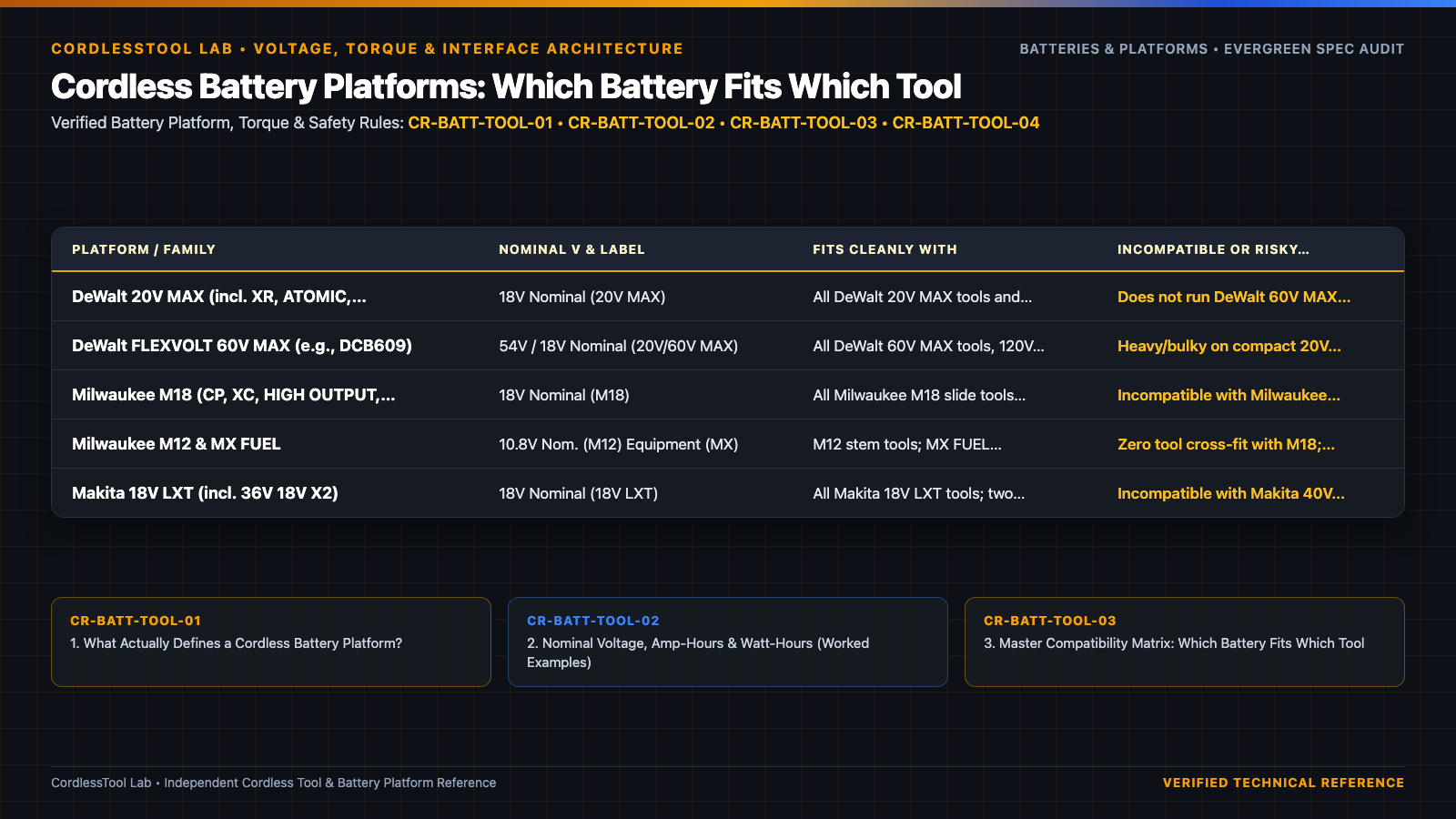
| Platform / Family | Nominal V & Label | Fits Cleanly With | Incompatible or Risky Caveat |
|---|---|---|---|
| DeWalt 20V MAX (incl. XR, ATOMIC, POWERSTACK) | 18V Nominal (20V MAX) | All DeWalt 20V MAX tools and 20V MAX / 12V-20V slide chargers (CR-BATT-TOOL-12) | Does not run DeWalt 60V MAX FLEXVOLT tools (CR-BATT-TOOL-05), 12V MAX tools, or Craftsman V20 / Black+Decker 20V tools (CR-BATT-TOOL-01). |
| DeWalt FLEXVOLT 60V MAX (e.g., DCB609) | 54V / 18V Nominal (20V/60V MAX) | All DeWalt 60V MAX tools, 120V MAX dual-slot tools (2 packs), and 20V MAX tools | Heavy/bulky on compact 20V drills (CR-BATT-TOOL-04); packs >100 Wh face airline limits; confirm 20V/60V charger support (CR-BATT-01). |
| Milwaukee M18 (CP, XC, HIGH OUTPUT, FORGE) | 18V Nominal (M18) | All Milwaukee M18 slide tools and M18 chargers per Milwaukee (CR-BATT-TOOL-12) | Incompatible with Milwaukee M12 and MX FUEL (CR-BATT-TOOL-03); confirm authorized Amazon dealer for warranty (CR-SYS-05). |
| Milwaukee M12 & MX FUEL | 10.8V Nom. (M12) Equipment (MX) | M12 stem tools; MX FUEL equipment (each within its own family) | Zero tool cross-fit with M18; multi-voltage chargers charge M12 and M18 sequentially but never bridge tools. |
| Makita 18V LXT (incl. 36V 18V X2) | 18V Nominal (18V LXT) | All Makita 18V LXT tools; two packs power 36V (18V X2) tools (CR-BATT-TOOL-06) | Incompatible with Makita 40V max XGT and 12V max CXT tools (CR-BATT-TOOL-03); verify Star Protection mark on older tools. |
| Makita 40V max XGT | 36V Nominal (40V max XGT) | Makita XGT 40V max and 80V max (2-pack) tools and XGT chargers | Separate rail and terminals from 18V LXT; XGT chargers accept LXT packs only with Makita’s optional ADP10 charging adapter (CR-BATT-01). |
| Bosch 18V (AMPShare) (CORE18V, PROFACTOR) | 18V Nominal (18V) | Bosch 18V slide tools and partner tools inside the AMPShare 18V alliance | Does not fit Bosch 12V Max tools (CR-BATT-TOOL-03) or legacy pre-lithium NiCd packs. |
| Ryobi 18V ONE+ & 40V Ridgid 18V | 18V Nom. (ONE+ / Ridgid) 36V Nom. (Ryobi 40V) | ONE+ HP and standard ONE+ tools; Ridgid 18V slide tools | ONE+ does not fit Ryobi 40V or USB Lithium (CR-BATT-TOOL-03). Both brands are Home Depot retail-exclusive in the US; Amazon 3P listings jeopardize OEM/LSA warranty (G-26). |
| Craftsman V20 & Black+Decker 20V | 18V Nominal (V20 / 20V MAX) | Tools inside each individual brand family (Craftsman V20 ↔ V20 only) | Shared parent company (Stanley Black & Decker) does NOT grant cross-fit with DeWalt 20V MAX or older 19.2V Craftsman C3 (CR-BATT-TOOL-01). |
| Metabo HPT 18V & MultiVolt | 18V / 36V Nominal (18V / 36V MultiVolt) | MultiVolt packs power both Metabo HPT 36V and 18V tools (CR-BATT-TOOL-07) | One-way compatibility: 18V-only packs cannot run 36V MultiVolt tools; AC adapter support varies per tool model. |
| EGO POWER+ 56V (ARC Lithium) | 50.4V Nominal (56V) | EGO 56V residential lawn mowers, blowers, trimmers, chainsaws, snow blowers | Outdoor-only platform; smaller 2.5Ah packs cycle quickly on high-draw mowers and turbo blowers (CR-BATT-OPE-01). |
4. The Only Verified Cross-Voltage & Dual-Slot Exceptions
While cross-brand swaps stay strictly locked, three manufacturer-engineered systems let batteries bridge across voltage tiers within their own brand. Knowing which direction each exception flows prevents buying an incompatible battery or starter kit:
- DeWalt FLEXVOLT (One-Way Downward Fit —
CR-BATT-TOOL-04&CR-BATT-TOOL-05): A FLEXVOLT 20V/60V MAX battery physically fits DeWalt 20V MAX tools and automatically reconfigures its cells from 54V nominal down to 18V nominal. However, the reverse never works: a standard 20V MAX pack (including POWERSTACK 5.0Ah) cannot power a 60V MAX FLEXVOLT saw or grinder. Using a heavy FLEXVOLT pack on a compact 20V drill also adds bulk and wrist fatigue, so standard 20V MAX packs remain preferable for light fastening. Two FLEXVOLT packs installed together power DeWalt 120V MAX dual-slot tools (CR-BATT-TOOL-06). - Metabo HPT MultiVolt (One-Way Downward Fit —
CR-BATT-TOOL-07): MultiVolt 36V/18V batteries step down automatically to run Metabo HPT 18V slide tools, while Metabo HPT 36V tools require a MultiVolt battery (or the brand’s model-specific AC adapter where listed). Standard 18V-only Metabo HPT packs cannot power 36V MultiVolt tools. - Makita 36V (18V X2) LXT Dual-Battery Architecture (
CR-BATT-TOOL-06): Makita’s 36V LXT circular saws, miter saws, blowers, and mowers do not use a single 36V pack—they wire two 18V LXT packs in series. Both battery bays must contain charged 18V LXT packs for the tool to run. Do not confuse 36V (18V X2) LXT tools with Makita’s separate 40V max XGT platform, which uses distinct 36V nominal packs and rails (CR-BATT-TOOL-03).
For a closer look at why tool rails differ across brands and why physical adapters exist on marketplaces, read our guide on whether power tool batteries are interchangeable between brands.
5. Cell Formats, High-Output Packs & Torque Spec Caveats
Once you lock into a platform rail, manufacturers split their batteries into output classes—compact, standard/extended, and high-output—using four internal cell formats: cylindrical 18650 (18 mm × 65 mm / 0.71 in × 2.56 in), cylindrical 21700 (21 mm × 70 mm / 0.83 in × 2.76 in), stacked laminated pouch cells (such as DeWalt POWERSTACK), and tabless cylindrical cells (such as Milwaukee FORGE XC8.0).
Under rule CR-BATT-04, cell format is an internal engineering detail, never a tool-fit boundary. Both a standard 18650 pack and a stacked pouch pack on the same platform fit the exact same rail. Where cell architecture matters is sustained current delivery and thermal resistance on high-draw tools (CR-BATT-TOOL-08):
- Low-to-moderate draw tools (drill/drivers, 1/4-inch hex impact drivers): Compact 1.5Ah–2.5Ah packs keep overall tool weight balanced for overhead drywall or cabinetry without cutting peak fastener speed on light jobs (
CR-BATT-TOOL-11). - High-draw tools (7-1/4-inch / 184 mm circular saws, angle grinders, SDS-plus rotary hammers, high-torque impact wrenches): Makers specify high-output packs (such as Milwaukee HIGH OUTPUT / FORGE, DeWalt POWERSTACK / FLEXVOLT, Bosch CORE18V 21700, or Ryobi HP) because lower internal impedance reduces voltage sag and premature thermal cutoff under sustained load.
- Reference-pack torque parity (
G-03,CR-BATT-TOOL-09) & spec-sheet limits (G-15,CR-DRV-02): Manufacturers frequently tie published performance ratings to a specific pack. For example, Milwaukee rates its29671/2-inch High Torque Impact Wrench at 1,100 ft-lbs (1,491 Nm) fastening torque and 1,500 ft-lbs (2,034 Nm) nut-busting torque with anM18 XC5.0pack, climbing to 1,200 ft-lbs (1,627 Nm) fastening and 1,600 ft-lbs (2,169 Nm) nut-busting when paired with anM18 FORGEpack. Meanwhile, drill/driver manufacturers statein-lbs(12 in-lbs = 1 ft-lb) and power metrics like DeWaltUWOusing different internal methods—never rank rival brands by spec-sheet torque numbers alone without an identical benchmark rig.
6. Five Platform Myths, Third-Party Adapters & Counterfeit Risks
Myth vs. Engineering Reality — Platform & Adapter Warnings (CR-BATT-TOOL-10 & CR-SYS-03)
Avoid the five misconceptions below before clicking “Add to Cart” on batteries, combo kits, or marketplace accessories.
- Myth 1: “20V MAX batteries deliver more power than 18V batteries.” Reality: Both run five series lithium-ion cells at 18V nominal (
CR-BATT-TOOL-02). Real cutting or driving performance comes from motor design, cell impedance, and tool electronics—not the sticker number. See our full head-to-head in Milwaukee M18 vs. DeWalt 20V MAX. - Myth 2: “Brands under the same corporate umbrella share batteries.” Reality: Stanley Black & Decker owns DeWalt, Craftsman, and Black+Decker, yet DeWalt 20V MAX, Craftsman V20, and Black+Decker 20V MAX rails do not interchange (
CR-BATT-TOOL-01). Likewise, TTI produces Milwaukee, Ryobi, and Ridgid, and all three platforms remain physically separated. - Myth 3: “Cross-brand plastic battery adapters or Power Wheels adapters are safe shortcuts.” Reality: Under
CR-BATT-TOOL-10andG-25, third-party cross-brand adapters are not approved by either manufacturer. Passive plastic sleds bridge only the positive and negative terminals while bypassing brand-specific BMS thermistor and low-voltage cutoff handshakes—risking over-discharged lithium cells, thermal stress, and voided OEM warranty coverage. CordlessTool Lab excludes cross-brand adapters, ride-on toy adapters, and non-OEM replacement packs from all buy lists. - Myth 4: “Third-party ‘replacement’ batteries match OEM packs for half the price.” Reality: Unbranded Amazon clone packs frequently exaggerate amp-hour labels, substitute inconsistent cell bins, omit OEM BMS thermal telemetry, and lack recognized third-party safety certification (
CR-SYS-03). Always buy OEM packs sold by the tool brand, Amazon retail, or an authorized distributor. - Myth 5: “Any charger from the same brand charges every pack at full speed.” Reality: Chargers only fit declared battery families (
CR-BATT-01), older chargers may exclude newer pack generations without verification (CR-BATT-02), and basic entry chargers take noticeably longer to fill 8.0Ah–12.0Ah packs than rapid or forced-air chargers (CR-BATT-03).
Beyond batteries, remember that cutting and fastening bits follow separate mechanical interface standards—such as 1/4-inch hex collets, SDS-plus vs. SDS-max rotary hammer shanks, 5/8-inch saw arbors, and Starlock oscillating mounts. Check our power tool accessory compatibility guide before buying blades or bits alongside a new bare tool.
7. Charging Safety, CPSC Recalls & Retail Channel Warranties
Lithium-ion tool batteries store dense energy and demand strict adherence to OEM operating rules. Follow the manufacturer’s instruction manual first for every charger, battery pack, saw guard, grinder wheel, and impact wrench, and wear eye, hearing, and hand PPE as the manual specifies (G-24).
- Charging temperature lockouts (
CR-BATT-05): If a charger indicator blinks a hot/cold delay pattern, do not force a charge or attempt to bypass thermal protection—move the battery indoors and allow it to reach room temperature within the manual’s specified charge window before placing it back on the dock. - Damaged, wet, or swollen packs: Discontinue use immediately if a battery housing is cracked, swollen, water-intruded, or thermally damaged. Never attempt DIY cell repair or wire jump-starting; follow the manufacturer’s disposal instructions and local municipal or retailer battery-recycling drop-off rules.
- Bare tools vs. kit variations (
CR-SYS-01,CR-SYS-02,CR-SYS-07): Check every listing’s “What’s in the box” specification for the exact selected variation. A bare tool is a tool-only listing: battery and charger sold separately. Even multi-tool combo kits sometimes bundle brushed or entry-tier tools alongside high-capacity packs—compare individual model numbers rather than kit marketing titles. - Retail-exclusive & third-party seller warranty caveats (
CR-SYS-05,G-26): In the US, Ryobi (ONE+ / 40V) and Ridgid (18V) are retail-exclusive brands distributed primarily through Home Depot, meaning Amazon US listings for those brands typically ship via third-party resellers where OEM coverage—and Ridgid’s Lifetime Service Agreement (LSA) registration window—may not apply. Similarly, Milwaukee M18 and M12 listings on Amazon US rely heavily on third-party dealers; verify authorized distributor status on the brand’s US warranty page and keep your receipt. - CPSC safety recall screening (
CR-SYS-06,G-12): Before purchasing clearance or secondhand outdoor batteries and tools, cross-check model and date codes on the U.S. Consumer Product Safety Commission (CPSC) Recalls database. Recent lithium-ion outdoor equipment recalls include SKIL 40V 5.0Ah packs, DR Power 62V 5.0Ah LiPRO packs (refund remedy), Kobalt 24V and 48V USB-C yard-tool packs (fire hazard linked to charging via USB-C while installed in the tool), and Milwaukee’s 2826-20 M18 FUEL top-handle chainsaw recall—always verify unit serial ranges and follow the manufacturer’s recall remedy.
8. Verified OEM Platform Starter Kits & Reference Packs
If you are entering one of the major 18V-nominal cordless tool battery platforms or adding genuine OEM capacity to an existing rail, the four Amazon US OEM listings below illustrate clean starter-kit and bare-pack configurations that pass every CR-SYS-03 and CR-BATT-TOOL-* check. No non-OEM replacement batteries or adapters appear here, and pricing is noted solely by broad market tier.
1. DEWALT 20V MAX 5.0Ah Battery & Charger Starter Kit (DCB205C)

Platform Spec: STD-BATT-DEWALT-20V-MAX | 18V Nominal (20V MAX label) | 5.0Ah / 90 Wh Nominal | Starter Kit (1x DCB205 Pack + Charger) | Tier: TIER-BATT-VALUE
For buyers grabbing a DEWALT bare tool (which is a tool-only listing: battery and charger sold separately under CR-SYS-01), the DCB205C starter kit pairs DEWALT’s workhorse 5.0Ah cylindrical reference pack with a compatible 20V MAX charger in one box. It satisfies CR-BATT-01 out of the gate and powers over 300 DEWALT 20V MAX tools—just note that it stays locked at 18V nominal and cannot run 60V MAX FLEXVOLT tools (CR-BATT-TOOL-05).
2. DEWALT 20V MAX XR POWERSTACK 5.0Ah Battery (DCBP520)

Platform Spec: STD-BATT-DEWALT-20V-MAX | 18V Nominal (20V MAX label) | 5.0Ah / 90 Wh Nominal | Stacked Pouch Cells | Bare Pack Only (Charger Sold Separately) | Tier: TIER-BATT-MID
Already own a DEWALT 20V MAX charger? The DCBP520 swaps cylindrical cans for stacked pouch cells to reduce internal impedance on high-draw 20V MAX circular saws, grinders, and hammer drills (CR-BATT-TOOL-08). Per DEWALT’s DCBP520 documentation, the pouch stack claims 50% more power and double the cycle life compared to the cylindrical DCB205. Note that this is a bare-pack listing—charger sold separately (CR-SYS-01)—and it runs 20V MAX tools only, not 60V MAX FLEXVOLT equipment.
3. Milwaukee 48-59-1850 M18 XC5.0 2-Pack + M12/M18 Multi-Voltage Charger Kit

Platform Spec: STD-BATT-MILWAUKEE-M18 | 18V Nominal (M18) | 2 x 5.0Ah (90 Wh Each / 180 Wh Combined) | Starter Kit w/ M12 & M18 Multi-Voltage Charger | Tier: TIER-BATT-MID
Milwaukee’s 48-59-1850 starter bundle illustrates multi-family charger support under CR-BATT-01: the included 48-59-1812 dock charges both M12 and M18 batteries on one benchtop footprint, even though M12 and M18 tools never share packs (CR-BATT-TOOL-03). Two 5.0Ah XC packs cover everyday M18 drills, impacts, and bare tools, while high-draw impact wrenches like the 2967 gain additional rated torque when stepped up to FORGE packs (CR-BATT-TOOL-09). Check Milwaukee’s official warranty and authorized seller policy before ordering from third-party Amazon resellers (CR-SYS-05).
4. Makita BL1850-2 18V LXT 5.0Ah Lithium-Ion Battery 2-Pack

Platform Spec: STD-BATT-MAKITA-LXT-18V | 18V Nominal (36V in Dual-Slot 18V X2 Tools) | 2 x 5.0Ah (90 Wh Each / 180 Wh Combined) | Bare 2-Pack (Charger Sold Separately) | Tier: TIER-BATT-MID
Makita’s matched 5.0Ah 2-pack satisfies dual-bay 36V (18V X2) LXT circular saws, miter saws, and outdoor tools straight out of the box under CR-BATT-TOOL-06. Per Makita USA’s 18V LXT 5.0Ah specifications, pairing these packs with an LXT Rapid Optimum Charger achieves 45-minute recharge cycles. Because this is a bare pack bundle without a charger, first-time Makita buyers must add an LXT charger separately (CR-SYS-01), and remember that 18V LXT batteries never fit Makita 40V max XGT tools (CR-BATT-TOOL-03).
Authoritative Non-Affiliate References
- DEWALT Official 20V MAX XR POWERSTACK & FLEXVOLT Specifications — Official 18V nominal / 20V MAX platform architecture and DCBP520 cycle-life basis.
- Milwaukee Tool M18 REDLITHIUM Official Platform Documentation — M18 backward compatibility, FORGE output pairings, and US warranty requirements.
- Makita USA 18V LXT & Rapid Optimum Charging Specifications — 90 Wh capacity rating, Star Protection controls, and 36V (18V X2) dual-bay system notes.
- Bosch Power Tools US CORE18V & AMPShare Documentation — 18V slide rail compatibility, 21700 CoolPack 2.0 design, and US battery/charger warranties.
- U.S. CPSC Product Safety Recalls Database & FAA PackSafe Lithium Battery Guidance — Recall verification for outdoor lithium packs and 100 Wh airline carry-on limits.
How We Audited This Guide
- Battery packs and chargers were audited across 18V/20V Max vs. 36V/40V/56V/60V nominal voltage behavior, 18650 vs. 21700/tabless pouch cells, charger amperage/sequential logic, and strict OEM-only UL BMS protection.
- Every cordless drill, impact driver, saw, grinder, battery pack, charger, outdoor power tool, and accessory spec was cross-checked against official OEM manuals, UL/ANSI ratings, and live Amazon US listings.
- Recommendations were evaluated against our weighted vertical scoring rubrics and 61 documented CR-* platform and safety rules; we never invent peak torque ft-lbs, cut counts, runtime minutes, or battery decibels.
9. Frequently Asked Questions
Do cordless tool battery platforms interchange across brands if the voltage matches?
No. Matching 18V nominal chemistry never creates physical fit across brands. Every manufacturer molds proprietary slide rails, latch locks, and BMS communication pinouts, so DeWalt 20V MAX, Milwaukee M18, Makita 18V LXT, Bosch 18V, and Craftsman V20 batteries never cross-fit without unapproved adapters.
Is a 20V MAX battery stronger than an 18V battery?
No. Both 20V MAX and 18V packs connect five lithium-ion cells in series at 18V nominal. Brands using 20V MAX highlight unloaded peak voltage, whereas 18V brands list nominal voltage. Tool performance depends on motor efficiency, cell impedance, and high-output pack design rather than the label.
Which cordless battery platforms offer official cross-voltage compatibility?
Only DeWalt FLEXVOLT and Metabo HPT MultiVolt step down automatically to run same-brand 20V MAX or 18V tools, and neither accepts lower-voltage packs in high-voltage tools. Separately, Makita 36V (18V X2) tools accept two 18V LXT batteries simultaneously, but never fit 40V max XGT rails.
Are third-party battery adapters or generic replacement batteries safe to use?
Tool manufacturers do not approve cross-brand adapters or unbranded replacement packs, and CordlessTool Lab excludes both from buy recommendations. Passive adapters interrupt BMS thermistor and low-voltage cutoff handshakes, risking cell over-discharge, thermal issues, and voided OEM warranty coverage on both tool and battery.
What should I check before buying a bare tool or retail-exclusive brand online?
Confirm whether the listing is tool-only (battery and charger sold separately) and inspect the exact box contents for your chosen variation. For Home Depot-exclusive brands like Ryobi and Ridgid—or third-party Milwaukee listings on Amazon—verify authorized dealer status to protect OEM warranty and LSA eligibility.


