
Disclosure: As an Amazon Associate, CordlessTool Lab earns from qualifying purchases. If you buy through links on this page, we may earn a small commission at no extra cost to you. Standard retail commission rates (3% in Tools & Home Improvement) never alter our compatibility rules, safety disclosures, or hardware picks.
When you shop for drill bits, saw blades, grinding wheels, or replacement trimmer spools, power tool accessory compatibility follows the exact opposite rule of cordless battery platforms. While battery rails lock you inside one brand, accessories cross tool brands freely whenever their mechanical interface standard, maximum speed rating, and guard specification match. Under our CordlessTool Lab specification and safety audit methodology, the interface standard—not the logo printed on the package—decides whether a bit, blade, wheel, or chain fits safely and performs as intended.
Quick Answer — How Power Tool Accessory Compatibility Works
Power tool accessories interchange across brands when their mechanical standard matches: 1/4-inch hex collets (CR-ACC-DRV-01), 5/8-inch or 20 mm saw arbors (CR-ACC-SAW-02), 5/8-11 UNC or X-LOCK grinder mounts (CR-ACC-GRD-03), and rated RPM ceilings. Ignore vague "universal fit" labels (CR-ACC-01), keep multi-head yard couplers brand-locked (CR-ACC-OPE-05), and follow the tool manual first.
In This Accessory Compatibility Guide
- 1. Why "Universal Fit" Fails Without a Named Interface Standard
- 2. Drills, Impact Drivers, Rotary Hammers & Impact Wrenches (Shanks & Anvils)
- 3. Circular Saws, Jigsaws, Reciprocating Saws & Starlock Multi-Tools
- 4. Angle Grinder Spindles, RPM Ceilings & Type 27 vs. Type 1 Guards
- 5. Outdoor Power Equipment: Trimmer Line, Chainsaw Triplets & Couplers
- 6. Master Accessory Compatibility Matrix & Engineering Diagram
- 7. High-Draw Battery Energy (Wh), Reference Packs & Torque Spec Parity
- 8. Myth vs. Engineering Reality, CPSC Recalls & Seller Caveats
- 9. Verified Cross-Brand OEM Accessory Sets
- 10. Frequently Asked Questions
1. Why "Universal Fit" Fails Without a Named Interface Standard
Open any marketplace search for saw blades or oscillating attachments and you will immediately see listings stamped "universal fit for all major brands." Under compatibility rule CR-ACC-01, "universal fit" is a marketing claim, never a mechanical specification. An accessory earns cross-brand compatibility only when its packaging names a concrete interface standard—such as a 1/4-inch (6.35 mm) hex shank, an SDS-plus (10 mm / 0.39 in) slotted shank, a 5/8-inch (15.88 mm) saw arbor, a STARLOCK multi-tool socket, or a 5/8-11 UNC grinder spindle thread.
Because toolmakers share standardized fastener and cutting geometries across the North American market, a DeWalt impact-rated driver bit fits cleanly inside a Milwaukee or Makita impact driver, and a Diablo carbide framing blade fits a DeWalt, Milwaukee, or Ryobi 7-1/4-inch (184 mm) circular saw. At the same time, two critical traps trip up buyers every day:
- Mechanical fit does not equal operational rating: A chrome hand-tool socket clicks onto a 1/2-inch (12.7 mm) impact wrench anvil, and a thin-wall wood drill bit fits a 3-jaw chuck, yet neither is rated for heavy impacting loads or high-speed masonry percussion.
- Accessories cross brands; batteries never do: Unlike shanks and arbors, battery rails and battery management system (BMS) telemetry remain proprietary. Never treat cross-brand accessory compatibility as justification for third-party cross-brand battery adapters (
CR-BATT-TOOL-10) or non-OEM replacement battery packs (CR-SYS-03), both of which CordlessTool Lab excludes from all purchase recommendations. - Omitted ratings disqualify safety-critical consumables: Any circular saw blade or angle grinder wheel listing that hides its maximum rated RPM or arbor/spindle size fails compatibility screening immediately (
CR-ACC-SAW-03,CR-ACC-GRD-02).
2. Drills, Impact Drivers, Rotary Hammers & Impact Wrenches (Shanks & Anvils)
Drilling and fastening tools look similar from across a workshop, yet they rely on four distinct accessory interfaces. Matching the wrong shank or drive anvil causes immediate rejection—or premature bit failure under rotational impact.
1/4-Inch Hex Collets vs. 3-Jaw Chucks (CR-ACC-DRV-01, -02, -06)
Every mainstream cordless impact driver uses a quick-release 1/4-inch (6.35 mm) hex collet (STD-SHANK-HEX-1-4). Under hard rule CR-ACC-DRV-01, impact drivers accept 1/4-inch hex-shank bits only. Round-shank twist drill bits and three-flat drill bits cannot lock into a hex collet; if you own only an impact driver and want to bore pilot holes, buy drill bits machined onto a 1/4-inch hex shank with a power groove rather than attempting to force round shanks into a collet or unrated sleeve.
For driving screws and lag fasteners with an impact driver, rule CR-ACC-DRV-02 recommends impact-rated driver bits engineered with a torsion zone and tougher tool steel. Standard hardened insert bits designed for drill/drivers physically fit a 1/4-inch hex collet, yet they twist, cam out, or snap far sooner under repeated rotary impacts. If you are building out a dedicated driver kit, compare verified torsion-zone sets in our best impact driver bit set guide. Note also the practical difference between short 1-inch (25.4 mm) insert bits (which require a magnetic bit holder in most collets) and 2-inch (50.8 mm) or longer power bits that lock directly into the collet.
Traditional drill/drivers and hammer drills use a keyless 3-jaw chuck rated for either 3/8-inch (9.5 mm) capacity on compact 12V-class tools or 1/2-inch (12.7 mm) capacity on full-size 18V/20V models (CR-ACC-DRV-06). A 3-jaw chuck clamps round, 3-flat, and 1/4-inch hex shanks cleanly as long as the shank diameter is less than or equal to the chuck’s maximum jaw opening. When boring holes larger than 1/2 inch in wood or mild steel, look for reduced-shank twist bits or hole-saw arbors machined down to a 3/8-inch or 1/2-inch shank—while verifying that the drill’s manual permits that cutting diameter and following side-handle instructions on high-torque binds.
SDS-Plus vs. SDS-Max Rotary Hammers (CR-ACC-DRV-03)
In concrete, brick, and block masonry, standard percussion hammer drills struggle on frequent or large-diameter anchors, escalating the job to a piston-driven rotary hammer (CR-DRV-01). Rotary hammers drop traditional 3-jaw chucks in favor of slotted SDS (Slotted Drive System) holders that allow the bit to reciprocate axially while transmitting rotational torque. Under hard rule CR-ACC-DRV-03, SDS-plus and SDS-max shanks never interchange:
- SDS-plus (10 mm / 0.39 in shank): Uses two open drive grooves and two closed locking-ball grooves; standard across nearly all cordless 18V/20V rotary hammers for anchor holes and light chipping.
- SDS-max (18 mm / 0.71 in shank): Heavy demolition and large core-drilling shank found on high-voltage cordless hammers; physically too large for SDS-plus holders (and SDS-plus bits cannot lock into SDS-max holders unless the tool manufacturer supplies a dedicated adapter).
Never clamp an SDS bit into a standard 3-jaw drill chuck expecting rotary-hammer performance, and see our full SDS-plus vs. SDS-max compatibility breakdown for shank dimensions and masonry bit selection.
Impact Wrench Square Anvils & Socket Ratings (CR-ACC-DRV-04, -05, CR-DRV-03)
Impact wrenches deliver high-amplitude rotational blows through a square drive anvil—most commonly 3/8-inch (9.5 mm) on compact wrenches, 1/2-inch (12.7 mm) on automotive mid- and high-torque wrenches, or 3/4-inch (19.1 mm) on heavy-equipment models (with 7/16-inch / 11.1 mm hex quick-change anvils on utility lineman wrenches). Under rule CR-ACC-DRV-04, socket drive must match the tool’s anvil unless you insert an impact-rated adapter, which adds length and slight rotational wobble that can trim delivered torque. On 1/2-inch square anvils, note the retention style: friction rings (hog rings) prioritize rapid one-handed socket swaps, whereas detent pins lock sockets more securely for overhead or structural steel work.
Just as critical, rule CR-ACC-DRV-05 distinguishes socket metallurgy: always pair an impact wrench with thicker-walled, black-finish impact sockets (commonly chrome-molybdenum / Cr-Mo alloy steel) rather than thin-walled chrome-vanadium hand-tool sockets, following the socket maker’s impact rating and wearing eye protection as the tool manual specifies. Finally, remember rule CR-DRV-03: an impact wrench is not a torque-measuring instrument. Run wheel lug nuts and safety-critical fasteners snug, then final-tighten to the vehicle or fastener manufacturer’s specification using a calibrated torque wrench.
3. Circular Saws, Jigsaws, Reciprocating Saws & Starlock Multi-Tools
Saw accessory compatibility spans rotary arbors, reciprocating tangs, and 3D oscillating mounts. Across every saw category, matching the physical mount is only step one—blade diameter, tooth geometry, and maximum RPM limits carry equal weight.
Circular, Miter, Table & Track Saw Arbors (CR-ACC-SAW-01, -02, -03, -07)
Every rotary saw enforces three hard compatibility checks before you tighten the arbor bolt:
- Rated blade diameter (
CR-ACC-SAW-01): Common US cordless sizes include6-1/2-inch (165 mm)and7-1/4-inch (184 mm)circular saws,8-1/4-inch (210 mm)compact table saws, and10-inch (254 mm)or12-inch (305 mm)miter saws. Never install a blade larger than the saw guard and manual allow, and fit smaller-than-rated diameters only if the manual lists them. - Arbor hole & diamond knockout (
CR-ACC-SAW-02): Most US circular, miter, and table saws use a 5/8-inch (15.88 mm) round arbor. Many 7-1/4-inch framing blades include a stamped diamond knockout inside the 5/8-inch center hole—leave that diamond knockout intact for standard 5/8-inch arbors, and punch it out only for worm-drive-style saws with a diamond arbor per the blade maker’s instructions. Conversely, many European-platform plunge track saws use a 20 mm (0.79 in) arbor; never mount a 20 mm blade loosely onto a 5/8-inch spindle or force an unapproved reducer bushing. Reducer bushings are acceptable only where the saw’s manual explicitly permits them. - Maximum RPM & accessory type (
CR-ACC-SAW-03,-07): The blade’s stamped maximum RPM rating must meet or exceed the saw’s no-load RPM rating. Furthermore, follow ruleCR-ACC-SAW-07: wood-cutting circular saws are engineered for carbide-tipped wood blades, whereas dedicated metal-cutting circular saws use purpose-built cermet/carbide metal blades. Never fit abrasive cut-off wheels or diamond masonry wheels onto a standard circular saw unless the saw manufacturer expressly authorizes that accessory type in the manual.
Once diameter, arbor, and RPM pass, pick blade tooth count or TPI qualitatively for the cut (CR-ACC-SAW-04): lower tooth counts clear kerf chips rapidly for framing and rip cuts, while higher tooth counts deliver cleaner edges in plywood, trim, and laminate—consulting the blade maker’s chart for exact material ranges.
Jigsaws, Reciprocating Saws & Starlock Multi-Tools (CR-ACC-SAW-05, -06)
In handheld reciprocating and oscillating saws, interface compatibility breaks into three clear rules:
- Jigsaws (
CR-ACC-SAW-05): Most modern cordless jigsaws accept T-shank blades with locating ears that lock into tool-free clamps. Older or entry-level set-screw jigsaws may use U-shank blades, which lack T-shank locking wings and will not seat in T-shank-only clamps. Always verify your jigsaw’s clamp spec before ordering multi-packs. - Reciprocating saws: Nearly all cordless reciprocating saws share the standardized 1/2-inch (12.7 mm) universal tang, making physical blade fit almost universal across brands. Here, compatibility centers on matching blade metallurgy and TPI (wood pruning, bi-metal nail-embedded demolition, or fine-tooth metal pipe) to the job (
CR-ACC-SAW-04). - Oscillating multi-tools — STARLOCK vs. Open-Back (
CR-ACC-SAW-06): Bosch and Fein developed the three-dimensional STARLOCK interface in three progressive power tiers:STARLOCK,STARLOCK PLUS, andSTARLOCK MAX. Compatibility moves strictly downward: standard STARLOCK blades fit STARLOCK, STARLOCK PLUS, and STARLOCK MAX tools, and PLUS blades fit PLUS and MAX tools, whereas aSTARLOCK MAXblade will not fit a base STARLOCK or STARLOCK PLUS tool. Separately, older open-back ("OIS universal") blades fit non-STARLOCK tools (and sometimes require a brand-supplied washer or adapter on quick-change heads). Read our dedicated STARLOCK vs. STARLOCK PLUS vs. MAX mount guide before stocking up on multi-tool blades.
4. Angle Grinder Spindles, RPM Ceilings & Type 27 vs. Type 1 Guards
Angle grinders spin thin abrasive discs, flap discs, diamond masonry blades, and knotted wire wheels at high peripheral speeds—meaning accessory compatibility here is an explicit safety boundary governed by manufacturer instructions (G-24) and OSHA hand and portable power tool guidance.
- US 5/8-11 UNC vs. M14 × 2 vs. X-LOCK (
CR-ACC-GRD-03): Mainstream US 4-1/2-inch (115 mm), 5-inch (125 mm), and 6-inch (150 mm) cordless angle grinders use a threaded 5/8-11 UNC spindle. Flat or depressed-center wheels with a 7/8-inch (22.2 mm) center hole mount via the grinder’s inner flange and outer lock nut, while hubbed wire wheels and diamond cup wheels thread directly onto the 5/8-11 shaft. Watch out for marketplace listings carrying M14 × 2 threads—that is a non-US metric spindle standard sold in Europe and grey-market imports that will not thread onto US 5/8-11 grinders. Bosch’s tool-free X-LOCK snap interface requires X-LOCK-stamped accessories (verify per-model whether any standard 7/8-inch wheel support exists; most X-LOCK tools are X-LOCK-only). - Wheel diameter & guard clearance (
CR-ACC-GRD-01): Never install a 5-inch or 6-inch wheel on a grinder rated for 4-1/2-inch wheels, and never remove or modify the wheel guard to squeeze in an oversized disc. - Rated wheel RPM (
CR-ACC-GRD-02): Confirm the stamped maximum RPM on every grinding disc, cut-off wheel, and wire cup equals or exceeds the grinder’s maximum no-load RPM (for variable-speed grinders, always compare against the highest speed setting). - Type 27 vs. Type 1 guard rule (
CR-ACC-GRD-04): Depressed-center grinding wheels and flap discs pair with an open-side Type 27 grinding guard, whereas flat straight cut-off wheels require a closed-side Type 1 cut-off guard (or clip-on cut-off shroud where specified in the manual). Many bare-tool grinder kits ship only with a Type 27 guard—check the box contents (CR-SYS-02) and obtain the OEM Type 1 guard before running cut-off wheels.
5. Outdoor Power Equipment: Trimmer Line, Chainsaw Triplets & Couplers
Cordless yard equipment relies on tighter model-specific tolerances than workshop drivers and circular saws. Treating outdoor consumables as generic "one-size-fits-all" parts leads directly to jammed trimmer heads, thrown chains, or mismatched shaft couplers.
- String trimmer line & spools (
CR-ACC-OPE-01,-02): Trimmer heads specify a maximum line diameter—commonly0.080 inch (2.0 mm)on compact 18V/20V trimmers,0.095 inch (2.4 mm)on mid/heavy cordless trimmers (such as the EGO ST1623T), and0.105 inch (2.7 mm)on commercial heads. Exceeding the head’s rated diameter causes binding inside eyelets and premature feed failure, while thinner line feeds cleanly with lighter cutting aggression. Meanwhile, pre-wound replacement spools are strictly head-specific (CR-ACC-OPE-02); check whether your trimmer takes a proprietary spool cartridge or uses bulk line in a load-and-wind head like EGO POWERLOAD. - Chainsaw chain triplet & approved bars (
CR-ACC-OPE-03,-04): Never buy a replacement chainsaw chain by bar length alone. You must match all three chain dimensions—pitch (commonly3/8-inch low profileon cordless saws), gauge (0.043 inch / 1.1 mmor0.050 inch / 1.3 mm), and exact drive-link count—alongside the saw’s bar mount pattern and manufacturer-approved bar lengths. Longer bars than approved slow chain speed and accelerate battery depletion. - Multi-head attachment couplers (
CR-ACC-OPE-05): Attachment-capable power heads—such as EGO Multi-Head, Milwaukee M18 FUEL QUIK-LOK, and Ryobi Expand-It—use brand-engineered drive shafts, alignment pins, and locking collars. Attachment heads fit only their own coupler ecosystem unless a manufacturer expressly documents cross-brand compatibility on its US spec sheet.
6. Master Accessory Compatibility Matrix & Engineering Diagram
The engineering reference diagram and lookup table below consolidate every major tool-to-accessory interface standard, verified fit scope, and hard stop or safety caveat across drilling, sawing, grinding, and outdoor equipment.
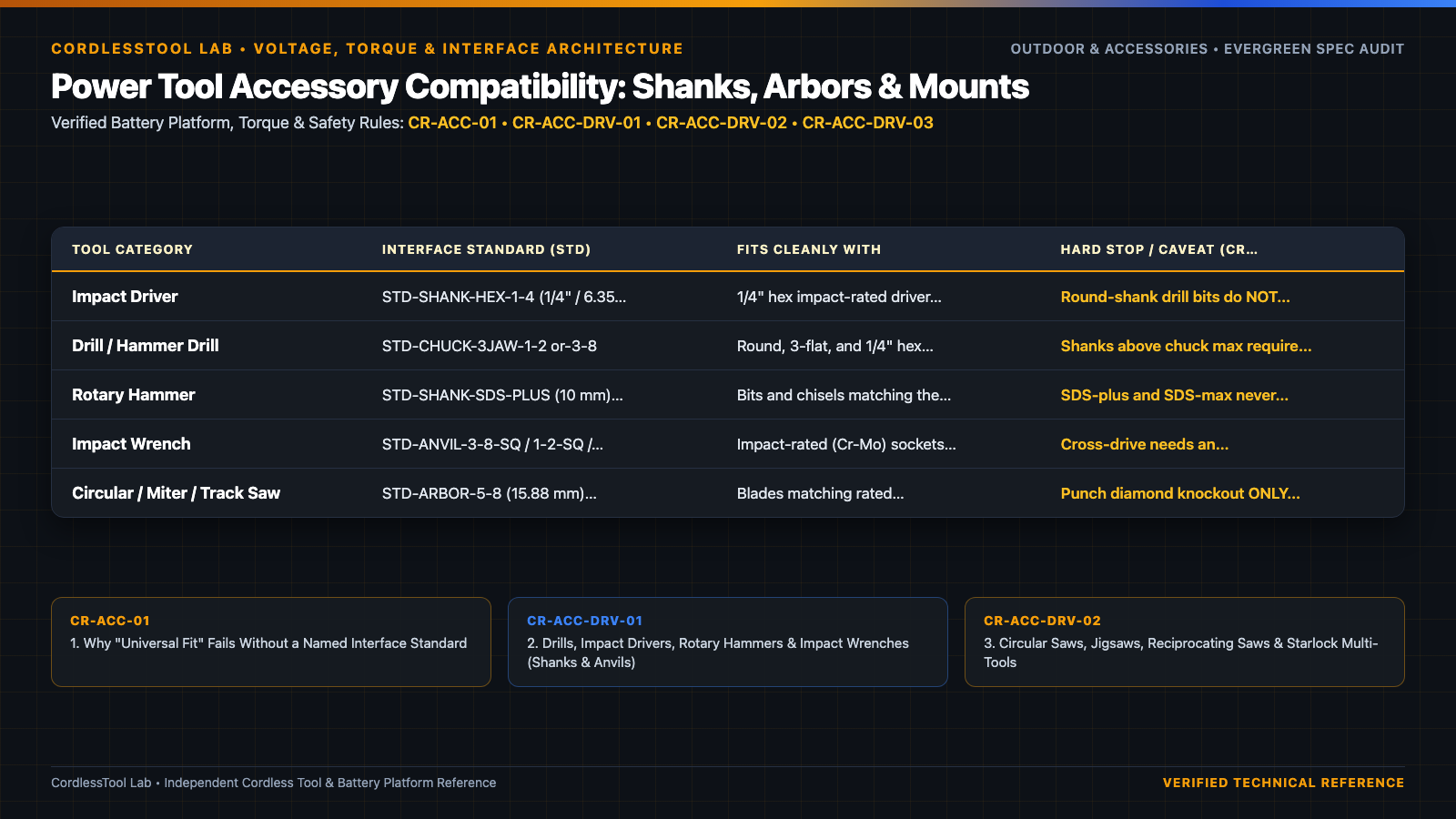
| Tool Category | Interface Standard (STD) | Fits Cleanly With | Hard Stop / Caveat (CR Rule) |
|---|---|---|---|
| Impact Driver | STD-SHANK-HEX-1-4(1/4" / 6.35 mm hex) | 1/4" hex impact-rated driver bits, nut setters, hex-shank drill bits | Round-shank drill bits do NOT lock in collets (CR-ACC-DRV-01); non-impact bits snap sooner (CR-ACC-DRV-02). |
| Drill / Hammer Drill | STD-CHUCK-3JAW-1-2 or -3-8 | Round, 3-flat, and 1/4" hex shanks ≤ chuck max (1/2" or 3/8") | Shanks above chuck max require reduced-shank bits (CR-ACC-DRV-06); 3-jaw chuck is not a rotary hammer (CR-DRV-01). |
| Rotary Hammer | STD-SHANK-SDS-PLUS (10 mm)STD-SHANK-SDS-MAX (18 mm) | Bits and chisels matching the tool’s exact SDS holder | SDS-plus and SDS-max never cross-fit without a maker-listed adapter (CR-ACC-DRV-03). |
| Impact Wrench | STD-ANVIL-3-8-SQ / 1-2-SQ / 3-4-SQ / 7-16-HEX | Impact-rated (Cr-Mo) sockets matching the anvil drive | Cross-drive needs an impact-rated adapter (adds wobble, CR-ACC-DRV-04); avoid chrome hand sockets (CR-ACC-DRV-05); verify final torque with a torque wrench (CR-DRV-03). |
| Circular / Miter / Track Saw | STD-ARBOR-5-8 (15.88 mm)STD-ARBOR-20MM / DIAMOND-KO | Blades matching rated diameter, exact arbor, material, and RPM ≥ saw | Punch diamond knockout ONLY for worm-drive saws; bushings only if manual allows (CR-ACC-SAW-02); no abrasive wheels on wood saws (CR-ACC-SAW-07). |
| Jigsaw & Recip Saw | STD-JIG-T-SHANK / U-SHANKSTD-RECIP-UNIVERSAL-SHANK | T-shank blades on modern jigsaws; 1/2" universal tang on recip saws | U-shank and T-shank clamps differ (CR-ACC-SAW-05); match TPI to wood, nail-embedded wood, or metal (CR-ACC-SAW-04). |
| Oscillating Multi-Tool | STD-OMT-STARLOCK / PLUS / MAX / OPEN-BACK | Same or lower STARLOCK class; open-back blades on compatible heads | One-way downward chain: MAX blades do NOT fit STARLOCK or PLUS-only tools (CR-ACC-SAW-06). |
| Angle Grinder | STD-THREAD-5-8-11 / STD-XLOCKType 27 & Type 1 Guards | Wheels ≤ rated diameter and ≥ grinder max RPM on 5/8-11 or X-LOCK | Flag non-US M14 spindles (CR-ACC-GRD-03); Type 1 cut-off wheels require a Type 1 guard (CR-ACC-GRD-04); never remove guards (CR-ACC-GRD-01). |
| Trimmer, Chainsaw & Power Head | 0.080"/0.095"/0.105" LinePitch/Gauge/Links & Coupler | Line ≤ head max; exact chain triplet + approved bar; same-system heads | Thicker line jams heads (CR-ACC-OPE-01); spools are head-specific (CR-ACC-OPE-02); EGO Multi-Head, QUIK-LOK & Expand-It stay separate (CR-ACC-OPE-05). |
7. High-Draw Battery Energy (Wh), Reference Packs & Torque Spec Parity
Even when an accessory matches every physical shank, arbor, or spindle rule, cordless tool performance still depends on the battery pack powering the motor—and understanding how manufacturers publish pack energy and torque specifications prevents costly miscalculations.
Worked Battery Energy & Voltage Parity Example (CR-BATT-TOOL-02, 03 §3.4(e)): First, never assume a "20V MAX" tool outperforms an "18V" tool simply from the marketing label. DeWalt 20V MAX and Craftsman V20 state peak unloaded initial cell voltage (5 series cells × ~4.0V = 20V MAX), whereas Milwaukee M18, Makita 18V LXT, Bosch 18V, and Ryobi 18V ONE+ state 18V nominal voltage (5 × 3.6V = 18V). Under load, both run on the same 18V nominal chemistry. To compare stored energy fairly across packs on a platform, multiply nominal voltage by amp-hours (Ah):
Stored Energy (Wh, nominal) = Nominal Voltage (18V) × Pack Capacity (5.0Ah) = 90 Wh
Notice what 90 Wh does and does not tell you: on the same battery platform, a 90 Wh 5.0Ah pack holds twice the stored energy of a 45 Wh 2.5Ah compact pack, yet you must never convert watt-hours into estimated minutes or cuts per charge without manufacturer specifications or verified benchmark conditions (G-01). Under rule CR-BATT-TOOL-08, high-draw accessories—such as 7-1/4-inch (184 mm) framing blades ripping pressure-treated lumber, large SDS-plus masonry bits, angle grinder flap discs, and 1/2-inch high-torque impact sockets—place heavy current demand on cells. Pairing high-draw tools with compact 1.5Ah or 2.0Ah packs often triggers early thermal or voltage-sag cutouts; stepping up to high-output packs (such as Milwaukee HIGH OUTPUT / FORGE, DeWalt POWERSTACK / FLEXVOLT, or Bosch CORE18V) preserves sustained load delivery.
Reference-Pack Torque Method & Spec Parity (G-03, G-15, CR-BATT-TOOL-09, CR-DRV-02): Whenever you evaluate tool specs alongside heavy accessories, note both the measurement unit (in-lbs for drills and impact drivers, where 12 in-lbs = 1 ft-lb, and ft-lbs or Nm for impact wrenches) and the reference battery pack tied to the rating. For example, Milwaukee rates its 2967 M18 FUEL 1/2-inch High Torque Impact Wrench at 1,100 ft-lbs (1,491 Nm) fastening torque and 1,500 ft-lbs (2,034 Nm) nut-busting torque with an M18 XC5.0 battery, climbing to 1,200 ft-lbs (1,627 Nm) fastening and 1,600 ft-lbs (2,169 Nm) nut-busting with an M18 FORGE pack. Across competing brands, however, spec-sheet torque figures are never directly comparable: DeWalt publishes maximum brake torque alongside UWO/MWO power ratings, whereas Milwaukee and Makita use their own internal fastening methods (CR-DRV-02). Never rank rival tool brands by incompatible spec-sheet torque numbers (G-15).
8. Myth vs. Engineering Reality, CPSC Recalls & Seller Caveats
Myth vs. Engineering Reality — Five Costly Accessory Mistakes
• Myth: "Universal oscillating blades fit every multi-tool." Reality: Open-back blades do not replace true 3D STARLOCK interfaces, and STARLOCK MAX blades do not fit base STARLOCK or PLUS-only tools (CR-ACC-SAW-06).
• Myth: "Chrome hand sockets work fine on a 1/2-inch impact wrench." Reality: Chrome hand sockets are not rated for impacting; use thicker-walled black impact sockets rated by the socket maker (CR-ACC-DRV-05).
• Myth: "You can clamp round drill bits in an impact driver collet." Reality: Impact driver collets accept 1/4-inch hex shanks only—never round shanks (CR-ACC-DRV-01).
• Myth: "Because bits cross brands, third-party battery adapters are harmless." Reality: Cross-brand battery adapters drop BMS thermal and cutoff signals and risk voided warranties (CR-BATT-TOOL-10, G-25).
• Myth: "Thicker trimmer line gives any weed eater more cutting power." Reality: Line exceeding the head’s maximum rating jams inside feed eyelets and strains the motor (CR-ACC-OPE-01).
Manufacturer-Instruction-First Safety & CPSC Recalls (G-24, G-12, CR-SYS-06): Every guard, blade, grinder wheel, chainsaw chain, impact wrench, battery pack, and charger carries hard operating boundaries. Always follow the tool and accessory manufacturer’s instruction manual first, wear eye, hearing, respiratory, and hand PPE as the manual specifies, and never bypass a saw blade guard, riving knife, grinder guard, chain brake, or battery thermal cutoff. Before buying replacement fittings or outdoor accessories, screen model numbers on the U.S. Consumer Product Safety Commission (CPSC) Recalls database. Notably, owners of affected Makita cordless grease guns covered by the 2025 Makita cordless grease-gun hose recall should follow the official CPSC/Makita recall remedy for a free replacement hose rather than substituting unverified aftermarket hoses. Likewise, check official recall serial ranges for the Milwaukee 2826-20 M18 FUEL top-handle chainsaw and affected Ryobi 40V hedge trimmers, following each maker’s official repair or replacement instructions.
Bare-Tool Listings, Set Variations & Authorized Sellers (CR-SYS-01, CR-SYS-02, CR-SYS-05, G-26): While accessories work across tool brands, buying the powered tool itself requires checking kit scope and channel warranty rules. Single cordless tools frequently ship as bare tools—a tool-only listing: battery and charger sold separately—and multi-piece accessory listings often bundle different piece counts under shared product pages (CR-SYS-02), so verify the exact variation box contents before checkout. Finally, remember US retail-channel rules when shopping on Amazon US: Ryobi and Ridgid are Home Depot retail-exclusive brands in the US, meaning Amazon offers ship via third-party resellers where OEM coverage—including Ridgid’s Lifetime Service Agreement (LSA) registration—may be declined. Milwaukee M18 and M12 tools and accessories on Amazon US also see heavy third-party reseller volume, so check authorized distributor status on Milwaukee’s official US warranty support page and retain your purchase receipt.
9. Verified Cross-Brand OEM Accessory Sets
To illustrate how named interface standards translate into real cross-brand purchases, the four verified Amazon US OEM accessory sets below cover everyday 1/4-inch hex driving, impact-driver hex drilling, and 1/2-inch square-drive impact wrench work. Each set names its mechanical standard and impact rating explicitly—and fits competing tool brands cleanly within its interface class.
1. DEWALT 40-Piece FlexTorq Impact-Ready Driver Bit Set (DWA2T40IR)

Interface Spec: STD-SHANK-HEX-1-4 (1/4" / 6.35 mm Hex) | Impact-Rated Torsion Zone | 40-Piece Set | Tier: TIER-ACC-MID ($25–$75)
DeWalt’s DWA2T40IR set pairs Phillips, square, Torx, slotted, and nut-driver profiles on standardized 1/4-inch (6.35 mm) hex shanks with a torsion zone engineered to absorb peak impact-driver torque spikes (CR-ACC-DRV-02). Because 1/4-inch hex is cross-brand, this set locks into DeWalt, Milwaukee, Makita, Bosch, Ryobi, or Craftsman impact drivers and 3-jaw drill chucks alike. Confirm the selected Amazon variation matches the 40-piece DWA2T40IR case contents (CR-SYS-02).
2. Milwaukee Shockwave Impact Duty 60-Piece Driver & Drill Bit Kit (48-32-4097)

Interface Spec: STD-SHANK-HEX-1-4 (1/4" / 6.35 mm Hex) | Impact-Rated Bits + Hex-Shank Drill Bits | 60-Piece Set | Tier: TIER-ACC-MID ($25–$75)
Milwaukee’s 48-32-4097 kit combines impact-duty fastening bits with 1/4-inch hex-shank twist drill bits in a single case—solving rule CR-ACC-DRV-01 cleanly when you carry only an impact driver and need pilot-hole capability without a 3-jaw drill. Like all 1/4-inch hex accessories, it fits any brand’s 1/4-inch hex collet. When ordering Milwaukee products on Amazon US, verify authorized seller status for warranty support (CR-SYS-05, G-26).
3. Makita B-65399 Impact Gold 14-Piece Titanium 1/4-Inch Hex Drill Bit Set

Interface Spec: STD-SHANK-HEX-1-4 (1/4" / 6.35 mm Hex Shank) | Impact-Rated Twist Drill Bits | 14-Piece Set | Tier: TIER-ACC-VALUE (under $25)
For tradespeople and DIYers who already stock driver bits and specifically need round-hole drilling inside a 1/4-inch hex collet, Makita’s B-65399 Impact Gold set machines 14 titanium-coated drill bits directly onto 1/4-inch hex shanks. It satisfies both CR-ACC-DRV-01 (proper hex shank for impact drivers) and CR-ACC-DRV-06 (clean clamping inside 3/8-inch and 1/2-inch 3-jaw drill chucks across all tool brands).
4. DEWALT 23-Piece 1/2-Inch Drive Metric & SAE Impact Socket Set (DWMT74739)

Interface Spec: STD-ANVIL-1-2-SQ (1/2" / 12.7 mm Square Drive) | Impact-Rated Metric & SAE Sockets | 23-Piece Set | Tier: TIER-ACC-MID ($25–$75)
Built for 1/2-inch square-anvil cordless impact wrenches across Milwaukee, DeWalt, Makita, Ryobi, and Bosch platforms, DeWalt’s DWMT74739 covers common SAE and metric fasteners with impact-rated socket walls (CR-ACC-DRV-04, CR-ACC-DRV-05). Remember to verify the exact fastener torque spec on automotive lug nuts or suspension bolts and complete final tightening with a calibrated torque wrench (CR-DRV-03).
Authoritative Non-Affiliate References
- DEWALT US Accessories Catalog & Specifications — Official 1/4-inch hex, circular blade arbor, and impact-rated socket specifications.
- Bosch Power Tools US — Official STARLOCK oscillating interface classes and X-LOCK tool-free grinder wheel system documentation.
- Milwaukee Tool US Warranty & Support — Authorized seller warranty eligibility and M18 / M12 / QUIK-LOK platform specifications.
- OSHA Hand and Portable Power Tools Standards — Federal workplace safety guidance for abrasive wheel guards, inspections, and PPE.
- U.S. Consumer Product Safety Commission (CPSC) Recalls — Official federal database for cordless tool, battery, and hose recall remedies.
How We Audited This Guide
- Outdoor power equipment and tool accessories were verified across battery Ah runtime fit, string trimmer bump-feed vs. blower CFM ratings, carbide tooth geometry, Impact Rated vs. chrome socket steel, and ANSI blade guard safety.
- Every cordless drill, impact driver, saw, grinder, battery pack, charger, outdoor power tool, and accessory spec was cross-checked against official OEM manuals, UL/ANSI ratings, and live Amazon US listings.
- Recommendations were evaluated against our weighted vertical scoring rubrics and 61 documented CR-* platform and safety rules; we never invent peak torque ft-lbs, cut counts, runtime minutes, or battery decibels.
10. Frequently Asked Questions
Are power tool bits and saw blades interchangeable across brands?
Yes, whenever the mechanical interface standard and speed rating match. DeWalt, Milwaukee, Makita, Bosch, and Diablo bits and circular blades interchange across brands as long as shank size, arbor diameter (such as 5/8 inch vs. 20 mm), blade diameter, and maximum RPM meet the tool manual’s limits.
Can I use round-shank drill bits in an impact driver?
No. Impact drivers use a 1/4-inch (6.35 mm) quick-release hex collet that cannot clamp round shanks. To drill pilot holes with an impact driver, choose titanium or black-oxide twist drill bits built on a 1/4-inch hex shank, or use a standard 3-jaw chuck drill/driver.
Do STARLOCK oscillating blades fit every multi-tool?
No. STARLOCK compatibility steps downward only: base STARLOCK blades fit STARLOCK, STARLOCK PLUS, and STARLOCK MAX tools, while STARLOCK MAX blades do not fit base or PLUS-only tools. Non-STARLOCK oscillating tools typically require open-back universal blades or a brand-supplied adapter.
What is the difference between 5/8-11 UNC, M14, and X-LOCK angle grinders?
Mainstream US threaded angle grinders use a 5/8-11 UNC spindle, whereas M14 × 2 is a non-US metric thread that will not screw onto US spindles. Bosch X-LOCK grinders replace threads with a tool-free snap mount that accepts X-LOCK-stamped discs and wire wheels.
Do string trimmer spools and multi-head yard attachments swap across brands?
Replacement spools and multi-head couplers are usually brand- and head-specific. Stay at or below your trimmer head’s maximum line rating (such as 0.080 or 0.095 inch), match chainsaw chain pitch, gauge, and drive links, and keep EGO Multi-Head, Milwaukee QUIK-LOK, and Ryobi Expand-It attachments on their matching power heads.


