
Disclosure: As an Amazon Associate, CordlessTool Lab earns from qualifying purchases. If you buy through links on this page, we may earn a small commission at no extra cost to you. Standard retail commission rates (3% in Tools & Home Improvement) never influence our compatibility rules or hardware evaluations.
If you already own a cordless drill or circular saw and spot a bare tool on sale from a rival brand, the immediate question is simple: are power tool batteries interchangeable between manufacturers, or even between different voltage lines from the same maker? As explained in our cordless tool battery platforms hub guide, every cordless tool ecosystem behaves like a proprietary electrical socket. Even when two brands share identical 18V nominal lithium-ion chemistry—or share the same parent corporation—physical rail locks and electronic communication pins keep batteries strictly separated.
Quick Answer — Are Power Tool Batteries Interchangeable?
No. Power tool batteries are not interchangeable across major brands (CR-BATT-TOOL-01), even at matching 18V nominal ratings, and same-brand voltage tiers like M12 vs. M18 or LXT vs. XGT also stay locked apart (CR-BATT-TOOL-03). The only direct OEM exceptions are downward-compatible dual-voltage packs like DeWalt FLEXVOLT and Metabo HPT MultiVolt, plus Bosch’s partnered AMPShare 18V alliance.
In This Compatibility Guide
- 1. Three Barriers That Keep Brand Batteries From Interchanging
- 2. Corporate Siblings & Voltage Labels: Why 20V MAX Still Won’t Fit 18V
- 3. Same-Brand Voltage Traps & The Only Verified OEM Exceptions
- 4. Master Battery Interchangeability Matrix
- 5. Energy Math (Wh), High-Draw Output & Torque Spec Parity
- 6. Third-Party Battery Adapters & Non-OEM Clone Risks
- 7. Charging Safety, CPSC Recalls, Bare Tools & Channel Warranties
- 8. Verified OEM Platform Packs & Starter Kits
- 9. Frequently Asked Questions
1. Three Barriers That Keep Brand Batteries From Interchanging
Inside almost every modern 18V-class cordless tool battery sit five lithium-ion cell groups wired in series (5S), paired with a printed circuit board and a molded terminal housing. Electrically, a fresh 5S lithium pack delivers the exact same nominal voltage whether the plastic shell is yellow, red, teal, or neon green. Yet under rule CR-BATT-TOOL-01, batteries and tools are never interchangeable across competing brands because manufacturers enforce three deliberate engineering locks:
- Molded slide rails, stems, and latch keys: DeWalt 20V MAX, Milwaukee M18, Makita 18V LXT, Bosch 18V, Craftsman V20, and Ridgid 18V all use slide-on shoes, but each manufacturer molds distinct rail widths, rib spacing, and retention latch cutouts. Meanwhile, Ryobi 18V ONE+ retains its iconic stem-and-slide hybrid tower (“pod”) to preserve backward compatibility with older ONE+ tools, and compact 12V systems such as Milwaukee M12 and DeWalt 12V MAX use in-handle stem packs.
- Proprietary BMS protection placement and terminal pinouts: A cordless battery interface does far more than pass positive (
+) and negative (-) DC current. Extra communication blades carry thermistor temperature readings, pack identification signals, and low-voltage cutoff commands. Crucially, brands split those duties differently: DeWalt builds primary low-voltage and over-discharge monitoring inside the battery pack itself, whereas Milwaukee (REDLINK Intelligence) and Makita (Star Protection Computer Controls) rely on active electronic handshakes between the tool controller and the pack’s battery management system (BMS). - Charger dock gating (
CR-BATT-01&CR-BATT-02): Chargers enforce the same rail and pinout locks as tools, plus charging-current limits and temperature sensors. Even within a single brand, older chargers may exclude newer high-output or pouch-cell pack generations unless the manufacturer’s compatibility chart explicitly lists support.
2. Corporate Siblings & Voltage Labels: Why 20V MAX Still Won’t Fit 18V
Two recurring misconceptions lead shoppers to expect interchangeability where none exists: shared corporate ownership and matching voltage numbers.
First, owning tools made by the same parent conglomerate never guarantees a shared battery rail. Stanley Black & Decker owns DeWalt, Craftsman, and Black+Decker, yet DeWalt 20V MAX, Craftsman V20, and Black+Decker 20V MAX batteries are physically keyed to prevent cross-insertion. Likewise, Techtronic Industries (TTI) manufactures Milwaukee, Ryobi, and Ridgid tools, yet Milwaukee M18 slide packs, Ryobi 18V ONE+ stem packs, and Ridgid 18V packs never interchange. Each brand maintains separate tooling, terminal spacing, and BMS telemetry to segment pro, prosumer, and homeowner warranties and retail channels.
Second, marketing voltage labels mask electrochemical parity. Under rule CR-BATT-TOOL-02, DeWalt’s “20V MAX” and Craftsman’s “V20” measure peak no-load voltage right off the charger (~4.0V per cell × 5 series cells = 20V), whereas Milwaukee M18, Makita 18V LXT, Bosch 18V, Ryobi 18V ONE+, and Ridgid 18V state 18V nominal voltage (~3.6V per cell × 5 = 18V). Under real cutting or fastening loads, both label styles run at the exact same 18V nominal chemistry. A 20V MAX sticker never provides automatic power superiority, and matching 18V nominal chemistry never lets one brand’s pack slide onto a competitor’s tool. For the complete cell-level breakdown, read our 20V MAX vs. 18V nominal voltage explainer.
3. Same-Brand Voltage Traps & The Only Verified OEM Exceptions
Even staying loyal to one tool logo does not make every battery in that brand’s aisle interchangeable. Rule CR-BATT-TOOL-03 warns that different voltage families within the same brand remain strictly isolated—with only a handful of manufacturer-engineered exceptions:
- Milwaukee (M12 ↔ M18 ↔ MX FUEL): Zero tool cross-compatibility across families. Compact M12 stem packs (10.8V nominal) run M12 tools only, M18 slide packs (18V nominal) run M18 tools only, and heavy MX FUEL packs run MX FUEL equipment only. While Milwaukee states backward compatibility across M18 packs and M18 tools (
CR-BATT-TOOL-12), and sells multi-voltage chargers such as the48-59-1812that charge both M12 and M18 batteries on separate bays (CR-BATT-01), the tool sockets never bridge. - Makita (12V max CXT ↔ 18V LXT ↔ 40V max XGT): Makita’s three voltage tiers use distinct rails and terminals. An 18V LXT battery cannot run a 40V max XGT saw or 12V max CXT drill. Watch out for one classic naming trap under
CR-BATT-TOOL-06: Makita’s 36V (18V X2) LXT saws and yard tools achieve 36V nominal by requiring two 18V LXT batteries inserted simultaneously—both slots must hold charged LXT packs, and those tools have no overlap with 40V max XGT packs. (Makita offers an optionalADP10adapter strictly for charging LXT batteries on certain XGT chargers, never for cross-fitting tools.) - DeWalt FLEXVOLT (One-Way Downward Exception —
CR-BATT-TOOL-04&CR-BATT-TOOL-05): DeWalt FLEXVOLT 20V/60V MAX batteries automatically reconfigure internal cell groups between parallel 18V nominal mode and series 54V nominal mode. As a result, a FLEXVOLT pack fits and runs DeWalt 20V MAX tools (with added weight and bulk on compact drills), and two FLEXVOLT packs together power DeWalt 120V MAX dual-slot tools. However, the rule is strictly one-way: standard 20V MAX batteries—including compact and 5Ah POWERSTACK packs—cannot power 60V MAX FLEXVOLT tools, and DeWalt 12V MAX stem packs sit on an entirely separate platform. Check our FLEXVOLT in 20V MAX tool fit guide for model-by-model ergonomics notes. - Metabo HPT MultiVolt (One-Way Downward Exception —
CR-BATT-TOOL-07): Metabo HPT MultiVolt 36V/18V slide batteries automatically step down to power Metabo HPT 18V tools, while 36V MultiVolt tools require a MultiVolt pack (or the maker’s model-specific AC adapter where supported). Standard 18V-only Metabo HPT packs cannot run 36V MultiVolt tools. - Ryobi (USB Lithium ↔ 18V ONE+ ↔ 40V): Ryobi 18V ONE+ HP batteries are backward-compatible with 18V ONE+ tools (and older 18V NiCd-era ONE+ tools per Ryobi’s platform promise, excluding legacy NiCd packs on modern high-draw expectations), but 18V ONE+ packs never fit Ryobi 40V outdoor tools or 4V USB Lithium gadgets.
- Bosch 18V & AMPShare Alliance (Brand-Partnered Exception): Bosch 18V slide packs (including CORE18V) fit Bosch 18V tools—not Bosch 12V Max tools—and are also engineered to share the official AMPShare 18V multi-brand alliance across partnered specialist toolmakers. That is a formal, manufacturer-validated alliance with shared BMS specs, not a bridge to DeWalt, Milwaukee, Makita, or Ryobi.
If you are still deciding which single ecosystem covers your drills, saws, and outdoor gear with the fewest compromises, compare all nine major US systems in our best cordless power tool brand comparison.
4. Master Battery Interchangeability Matrix
The engineering reference visual and compatibility lookup table below summarize every major US battery family, its nominal voltage class, what it fits cleanly, and the hard stops or caveats that block cross-use.
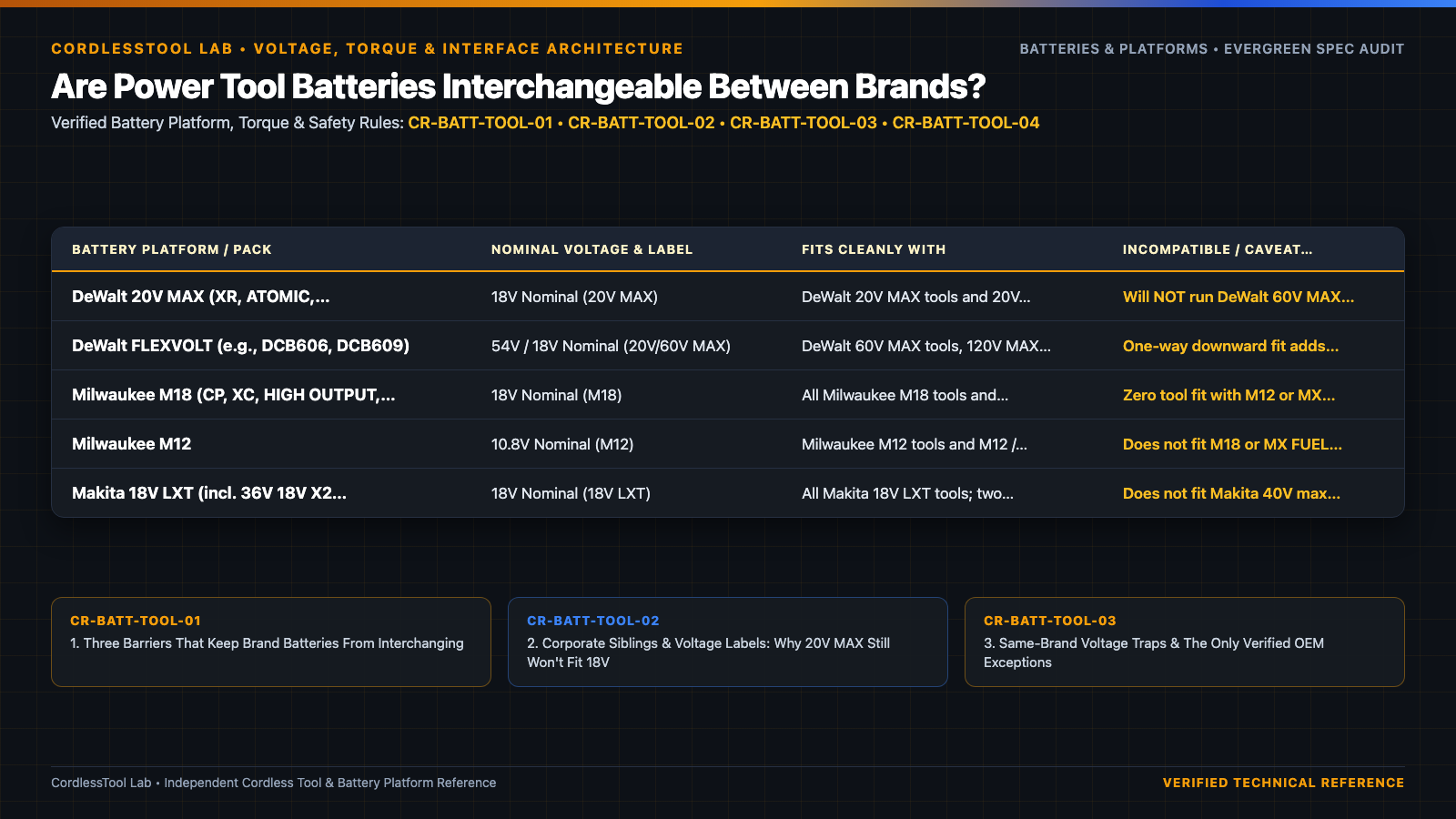
| Battery Platform / Pack | Nominal Voltage & Label | Fits Cleanly With | Incompatible / Caveat (CR Rule) |
|---|---|---|---|
| DeWalt 20V MAX (XR, ATOMIC, POWERSTACK) | 18V Nominal (20V MAX) | DeWalt 20V MAX tools and 20V MAX / 12V-20V slide chargers (CR-BATT-TOOL-12) | Will NOT run DeWalt 60V MAX FLEXVOLT tools (CR-BATT-TOOL-05), 12V MAX tools, Craftsman V20, or Black+Decker 20V (CR-BATT-TOOL-01). |
| DeWalt FLEXVOLT (e.g., DCB606, DCB609) | 54V / 18V Nominal (20V/60V MAX) | DeWalt 60V MAX tools, 120V MAX dual-slot tools (×2), and 20V MAX tools | One-way downward fit adds bulk/weight on compact 20V drills (CR-BATT-TOOL-04); packs >100 Wh carry airline limits. |
| Milwaukee M18 (CP, XC, HIGH OUTPUT, FORGE) | 18V Nominal (M18) | All Milwaukee M18 tools and M18 chargers per Milwaukee (CR-BATT-TOOL-12) | Zero tool fit with M12 or MX FUEL (CR-BATT-TOOL-03), Ryobi ONE+, or Ridgid 18V; verify authorized Amazon seller (CR-SYS-05). |
| Milwaukee M12 | 10.8V Nominal (M12) | Milwaukee M12 tools and M12 / M12-M18 chargers | Does not fit M18 or MX FUEL tools; multi-voltage chargers do not convert M12 packs for M18 tools. |
| Makita 18V LXT (incl. 36V 18V X2 tools) | 18V Nominal (18V LXT) | All Makita 18V LXT tools; two packs power 36V (18V X2) tools (CR-BATT-TOOL-06) | Does not fit Makita 40V max XGT or 12V max CXT tools (CR-BATT-TOOL-03); verify Star Protection mark on older tools. |
| Makita 40V max XGT | 36V Nominal (40V max XGT) | Makita XGT 40V max and 80V max (×2) tools and XGT chargers | Separate rail and terminals from 18V LXT; XGT chargers take LXT packs only via Makita’s optional ADP10 charging adapter. |
| Bosch 18V (CORE18V) | 18V Nominal (18V) | Bosch 18V tools and partnered 18V AMPShare alliance tools | Does not fit Bosch 12V Max tools (CR-BATT-TOOL-03) or legacy pre-lithium Bosch NiCd tools. |
| Metabo HPT MultiVolt | 36V / 18V Nominal (36V/18V MultiVolt) | Metabo HPT 36V MultiVolt and 18V slide tools (CR-BATT-TOOL-07) | One-way downward fit: 18V-only Metabo HPT packs cannot power 36V MultiVolt tools. |
| Ryobi 18V ONE+ & Ridgid 18V | 18V Nominal (18V ONE+ / 18V) | Tools inside each respective 18V family (Ryobi ONE+ ↔ ONE+; Ridgid 18V ↔ 18V) | No cross-fit between Ryobi, Ridgid, and Milwaukee; Ryobi ONE+ ≠ Ryobi 40V. Home Depot US exclusives carry Amazon 3P warranty caveats (G-26). |
| Craftsman V20 & Black+Decker 20V | 18V Nominal (V20 / 20V MAX) | Tools inside each brand’s own 20V lithium line | Zero fit with DeWalt 20V MAX or older Craftsman 19.2V C3 despite shared Stanley Black & Decker ownership (CR-BATT-TOOL-01). |
| EGO POWER+ 56V | 50.4V Nominal (56V) | EGO POWER+ 56V residential mowers, blowers, trimmers, chainsaws | Outdoor-only platform; compact 2.5Ah packs cycle quickly on high-draw mowers and turbo blowers (CR-BATT-OPE-01). |
5. Energy Math (Wh), High-Draw Output & Torque Spec Parity
Once you confirm that two tools belong to the exact same battery rail, the next compatibility trap is assuming every pack on that rail delivers identical capacity and output. In practice, you need two distinct checks: stored energy in watt-hours (Wh) and sustained current capability (output class).
Worked Watt-Hour Examples (03 §3.4(e)): Amp-hours (Ah) measure charge volume at a given voltage, not raw power. To calculate stored energy fairly across packs, multiply nominal voltage by amp-hour capacity:
Energy (Wh, nominal) = Nominal Voltage (V) × Capacity (Ah)
- Standard 18V-class 5.0Ah pack: A DeWalt
DCB205orDCBP520(20V MAX), MilwaukeeXC5.0(M18), and MakitaBL1850B(18V LXT) all run five series cells at 18V nominal. Computing18V × 5.0Ah = 90 Whshows identical stored energy on a nominal basis. Packs around 5.0Ah typically weigh roughly 1.39 lb to 1.6 lb (0.63 kg to 0.73 kg) bare and stay below the 100 Wh commercial airline carry-on threshold. - Dual-voltage FLEXVOLT pack & FAA 100 Wh limit: DeWalt’s
DCB609FLEXVOLT battery is rated at 9.0Ah in 20V MAX mode (18V nominal) and 3.0Ah in 60V MAX mode (54V nominal). Multiplying18V × 9.0Ah = 162 Whand54V × 3.0Ah = 162 Whproves that total stored energy stays fixed—you never add 9.0Ah and 3.0Ah together. DeWalt prints180 Whon the DCB609 housing using its max-voltage basis (20V × 9.0Ah), so always state whether a Wh figure uses nominal or label basis. Because 162 Wh (nominal) / 180 Wh (label) exceeds 100 Wh, check carrier and airline rules directly on the FAA PackSafe lithium battery guidance page before shipping or flying.
Never convert watt-hours directly into runtime minutes, screw counts, or board-feet cut without manufacturer specifications or verified benchmark conditions (G-01). Likewise, internal cell format—whether cylindrical 18650 (18 mm × 65 mm / 0.71 in × 2.56 in), larger cylindrical 21700 (21 mm × 70 mm / 0.83 in × 2.76 in), stacked laminated pouch cells, or tabless cylindrical cells—is a design detail, never a tool-fit boundary (CR-BATT-04).
High-Draw Tools & Reference-Pack Torque Parity (CR-BATT-TOOL-08, CR-BATT-TOOL-09, CR-DRV-02): Even when a compact 1.5Ah or 2.0Ah battery clicks smoothly onto a 7-1/4-inch (184 mm) circular saw, angle grinder, SDS-plus rotary hammer, or high-torque impact wrench, low-impedance high-output packs (such as Milwaukee HIGH OUTPUT / FORGE, DeWalt POWERSTACK / FLEXVOLT, Bosch CORE18V 21700, or Ryobi HP) prevent premature voltage sag under heavy cuts. Manufacturers tie headline specs to specific packs: for instance, Milwaukee rates its 2967 1/2-inch High Torque Impact Wrench at 1,100 ft-lbs (1,491 Nm) fastening torque and 1,500 ft-lbs (2,034 Nm) nut-busting torque with an M18 XC5.0 battery, rising to 1,200 ft-lbs (1,627 Nm) fastening and 1,600 ft-lbs (2,169 Nm) nut-busting with an M18 FORGE pack. For drills and drivers rated in in-lbs (12 in-lbs = 1 ft-lb), remember that rival brands use different torque-measurement methods (such as brake torque vs. DeWalt UWO watts-out ratings), so never rank competing platforms purely by spec-sheet torque figures (G-15).
6. Third-Party Battery Adapters & Non-OEM Clone Risks
Engineering Warning — Cross-Brand Adapters & Non-OEM Packs (CR-BATT-TOOL-10 & CR-SYS-03)
Neither tool manufacturer approves third-party cross-brand battery adapters, Power Wheels ride-on adapters, or unbranded “replacement for” lithium packs. CordlessTool Lab strictly excludes all adapters and non-OEM replacement batteries from buy recommendations (G-25).
Searching online marketplaces for battery compatibility quickly surfaces inexpensive plastic adapters promising to run a DeWalt 20V MAX pack on a Milwaukee M18 tool, a Makita 18V LXT pack on a Ryobi ONE+ tool, or even a tool pack on a children’s ride-on toy. While passive mechanical adapters physically bridge the positive and negative power blades, they introduce four serious engineering and warranty hazards documented in our cross-brand battery adapter risk audit:
- Broken BMS thermal & over-discharge protection: Because brand A and brand B do not use identical thermistor resistance curves or digital ID handshakes, passive adapters leave communication pins unconnected or spoofed with fixed resistors. If you adapt a battery whose low-voltage cutoff normally resides in the tool (such as older Makita or Milwaukee tool-side logic) onto a tool expecting pack-side cutoff (or vice versa), cells can drain below safe voltage thresholds or overheat without triggering a tool shutdown.
- Charging danger if left attached: Never attempt to place an adapted battery into a rival brand’s charger; charger communication pins will not match, and mismatched charge termination violates every manufacturer manual.
- Contact heating & mechanical leverage stress: Stacked adapters extend the battery downward, multiplying leverage on latch tabs during framing or overhead work, while uncertified stamped brass contacts inside low-cost plastic adapters can heat up under high-draw saw or grinder loads.
- Voided OEM warranties & counterfeit “replacement” pack risks: Tool makers explicitly exclude damage caused by unapproved accessories and non-OEM batteries from warranty service. Separately, third-party “replacement” batteries sold under unfamiliar marketplace brands frequently advertise inflated 9.0Ah, 12.0Ah, or 15.0Ah ratings using mismatched cells without recognized UL or ETL safety marks (
CR-SYS-03). Stick strictly to genuine OEM packs sold by the brand, Amazon retail, or an authorized distributor.
7. Charging Safety, CPSC Recalls, Bare Tools & Channel Warranties
Safe cordless operation starts with following the manufacturer’s instruction manual first for every battery pack, charger, blade guard, grinder wheel, saw blade, chainsaw chain, and impact wrench, and wearing eye, hearing, and hand PPE as the manual specifies (G-24). Keep four operational and buying rules in mind before adding packs or tools:
- Charging temperature windows & damaged packs (
CR-BATT-05): When a charger blinks a hot or cold delay indicator, let the battery pack reach room temperature inside the manual’s permitted charging window rather than forcing a charge. Stop using any pack that is swollen, cracked, water-intruded, or overheated, and follow the manufacturer’s instructions and local municipal or retail recycling drop-off programs. - CPSC safety recall checks (
CR-SYS-06,G-12): Whenever buying outdoor battery packs or clearance kits, verify the exact model and date code on the U.S. Consumer Product Safety Commission (CPSC) Recalls database. Documented lithium-ion recalls include SKIL 40V 5.0Ah outdoor packs, DR Power 62V 5.0Ah LiPRO packs (refund remedy), Greenworks-made Kobalt 24V and 48V yard tool USB-C batteries (fire hazard linked to charging via the USB-C port while installed in the tool), and Milwaukee’s 2826-20 M18 FUEL top-handle chainsaw recall—always check serial ranges and follow the official remedy notice. - Bare tools vs. kit variations (
CR-SYS-01,CR-SYS-02): Many single-tool listings ship as bare tools—a tool-only listing: battery and charger sold separately (often marked by suffixes like Milwaukee-20, DeWaltB, or MakitaZ). Always read the “What’s in the box” list for the exact variation you select rather than relying on a hero photo. - Retail-exclusive & third-party seller warranty caveats (
CR-SYS-05,G-26): In the US, Ryobi (18V ONE+ / 40V) and Ridgid (18V) are retail-exclusive brands sold primarily through Home Depot; Amazon US listings for Ryobi or Ridgid ship through third-party resellers where OEM warranty coverage—and Ridgid’s Lifetime Service Agreement (LSA) registration eligibility—may be refused. Milwaukee M18 and M12 listings on Amazon US are also heavily populated by third-party sellers, so verify authorized distributor status on Milwaukee’s US warranty page and keep your invoice.
8. Verified OEM Platform Packs & Starter Kits
If you need genuine OEM batteries or a starter kit with a matched charger to power a bare tool on one of the three widest mainstream 18V-nominal platforms, the four verified Amazon US OEM listings below illustrate clean, rule-compliant pairings. Each entry excludes non-OEM clones and cross-brand adapters, notes bare-pack vs. starter-kit contents explicitly, and uses broad tier bands rather than fluctuating retail prices.
1. DEWALT 20V MAX 5.0Ah Battery & Charger Starter Kit (DCB205C)

Compatibility Spec: STD-BATT-DEWALT-20V-MAX | 18V Nominal (20V MAX label) | 5.0Ah / 90 Wh Nominal | Starter Kit (1x DCB205 Battery + Charger) | Tier: TIER-BATT-VALUE
Designed for buyers picking up a DeWalt bare drill, impact driver, or saw (which is a tool-only listing: battery and charger sold separately under CR-SYS-01), the DCB205C starter kit pairs DeWalt’s standard 5.0Ah (90 Wh nominal) pack with a matching charger. It fits DeWalt 20V MAX tools only—never DeWalt 60V MAX FLEXVOLT tools (CR-BATT-TOOL-05), Craftsman V20, or Black+Decker 20V tools (CR-BATT-TOOL-01).
2. DEWALT 20V MAX XR POWERSTACK 5.0Ah Lithium-Ion Battery (DCBP520)

Compatibility Spec: STD-BATT-DEWALT-20V-MAX | 18V Nominal (20V MAX label) | 5.0Ah / 90 Wh Nominal | Stacked Pouch Cells | Bare Pack Only (Charger Sold Separately) | Tier: TIER-BATT-MID
If you already own a DeWalt 20V MAX charger and want higher sustained current for circular saws or grinders (CR-BATT-TOOL-08), the DCBP520 fits every 20V MAX rail while using stacked pouch cells. Per DEWALT’s DCBP520 product page, the pouch design claims 50% more power and twice the cycle life compared to the cylindrical DCB205 pack. Because this is a bare battery without a charger, first-time DeWalt owners still need a compatible 20V MAX charger (CR-SYS-01), and it cannot power 60V MAX tools.
3. Milwaukee 48-59-1850 M18 XC5.0 2-Pack + M12/M18 Multi-Voltage Charger Kit

Compatibility Spec: STD-BATT-MILWAUKEE-M18 | 18V Nominal (M18) | 2 × 5.0Ah (90 Wh Each / 180 Wh Total) | Starter Kit w/ M12 & M18 Multi-Voltage Charger | Tier: TIER-BATT-MID
Milwaukee’s 48-59-1850 bundle highlights the difference between multi-family chargers and locked tool rails: the included 48-59-1812 charger dock charges both M12 and M18 batteries sequentially (CR-BATT-01), while the two 5.0Ah XC packs run every M18 tool—never M12 or MX FUEL tools (CR-BATT-TOOL-03). Always confirm authorized seller status via Milwaukee’s official warranty and distributor policy before buying from third-party Amazon resellers (CR-SYS-05, G-26).
4. Makita BL1850-2 18V LXT 5.0Ah Lithium-Ion Battery 2-Pack

Compatibility Spec: STD-BATT-MAKITA-LXT-18V | 18V Nominal (36V in Dual-Slot 18V X2 Tools) | 2 × 5.0Ah (90 Wh Each / 180 Wh Total) | Bare 2-Pack (Charger Sold Separately) | Tier: TIER-BATT-MID
A matched 2-pack of Makita BL1850B 5.0Ah packs satisfies dual-slot 36V (18V X2) LXT circular saws, miter saws, and outdoor tools straight out of the box (CR-BATT-TOOL-06). Per Makita USA’s BL1850B specifications, recharging on an LXT Rapid Optimum Charger takes 45 minutes. Note that this is a bare battery 2-pack—an LXT charger is sold separately (CR-SYS-01)—and these packs never fit Makita 40V max XGT or 12V max CXT tools.
Authoritative Non-Affiliate References
- DEWALT Official 20V MAX & POWERSTACK Battery Specifications — Official 18V nominal / 20V MAX compatibility scope and DCBP520 cycle-life basis.
- Milwaukee Tool US Warranty & M18 Platform Documentation — Authorized seller warranty terms and M18 / M12 / MX FUEL platform separation.
- Makita USA 18V LXT BL1850B Specifications — 90 Wh rating, Star Protection communication controls, and 36V (18V X2) dual-battery architecture.
- Bosch Power Tools US 18V & AMPShare Documentation — Official 18V slide rail compatibility and US battery/charger support.
- U.S. CPSC Recalls Database & FAA PackSafe Lithium Battery Rules — Official recall lookup for lithium tool packs and 100 Wh carry-on air travel thresholds.
How We Audited This Guide
- Battery packs and chargers were audited across 18V/20V Max vs. 36V/40V/56V/60V nominal voltage behavior, 18650 vs. 21700/tabless pouch cells, charger amperage/sequential logic, and strict OEM-only UL BMS protection.
- Every cordless drill, impact driver, saw, grinder, battery pack, charger, outdoor power tool, and accessory spec was cross-checked against official OEM manuals, UL/ANSI ratings, and live Amazon US listings.
- Recommendations were evaluated against our weighted vertical scoring rubrics and 61 documented CR-* platform and safety rules; we never invent peak torque ft-lbs, cut counts, runtime minutes, or battery decibels.
9. Frequently Asked Questions
Are power tool batteries interchangeable between DeWalt, Milwaukee, and Makita?
No. DeWalt 20V MAX, Milwaukee M18, and Makita 18V LXT batteries all use 18V nominal lithium-ion chemistry, yet each brand molds proprietary slide rails, retention latches, and BMS communication pins. Packs from one brand will not fit or power tools from another without an unapproved third-party adapter.
Can DeWalt and Craftsman batteries be swapped since Stanley Black & Decker owns both?
No. Shared corporate ownership never creates battery interchangeability. Stanley Black & Decker keeps DeWalt 20V MAX, Craftsman V20, and Black+Decker 20V MAX mechanically locked apart, just as TTI keeps Milwaukee M18, Ryobi 18V ONE+, and Ridgid 18V batteries separated across separate rails and pinouts.
Are same-brand batteries interchangeable across different voltages?
Usually no. Milwaukee M12, M18, and MX FUEL never cross-fit tools, and Makita 18V LXT never fits 40V max XGT. Only DeWalt FLEXVOLT (60V MAX down to 20V MAX) and Metabo HPT MultiVolt (36V down to 18V) offer official one-way downward compatibility.
Do third-party battery adapters void tool warranties or damage batteries?
Yes, manufacturers warn against unapproved adapters and may refuse warranty coverage. Passive plastic adapters bridge only positive and negative terminals while dropping brand-specific thermistor and low-voltage cutoff signals, risking cell over-discharge, overheating under high-draw loads, and damaged tool electronics.
Does any official multi-brand cordless battery standard exist?
Bosch’s 18V AMPShare alliance allows Bosch 18V packs to power tools from partnered specialist manufacturers that formally license the interface and BMS protocol. However, mainstream competing platforms such as DeWalt, Milwaukee, Makita, Ryobi, Ridgid, and Craftsman do not participate in a universal cross-brand battery standard.


