
When a power tool battery recall hits the U.S. Consumer Product Safety Commission (CPSC) registry, owners need two immediate answers: whether the hazard sits inside the lithium-ion battery pack itself or inside the host tool chassis, and which exact model numbers or serial date codes require action. Verified CPSC notices covering Kobalt 24V and 48V USB-C yard packs (Recall No. 26-611), DR Power 62V LiPRO packs (Recall No. 25-355), and SKIL 40V 5.0Ah packs (Recall No. 25-071) carry specific stop-use and replacement protocols, whereas several high-profile outdoor tool recalls target switches, connectors, or chain brakes rather than OEM cells. Before checking any pack nameplate, remove the battery from the tool or charger and follow the manufacturer’s manual. For ecosystem background, see our cordless tool battery platforms guide.
Urgent Battery Safety & Recall Protocol (CR-SYS-06, G-24):
Slide the battery pack out of the tool and unplug the charger before touching any nameplate, terminal block, or USB-C port. Follow the manufacturer’s manual and wear eye protection and protective work gloves as the manual specifies. If your pack matches an active CPSC recall scope—or shows swelling, cracking, melting, smoke, or chemical odor—stop using it immediately, never place it back on a charger, never open the sealed housing, and never attempt to defeat thermal cutoffs or force-charge damaged lithium-ion cells.
In This CPSC Battery Recall & Safety Guide
- 1. Fast Recall & Battery Symptom Triage Table
- 2. Verified CPSC Power Tool & Yard Battery Pack Recalls
- 3. Battery Pack Recalls vs. Tool-Chassis Recalls Across Major Brands
- 4. Step-by-Step Inspection, Quarantine & Official Remedy Workflow
- 5. Counterfeit Batteries, Cross-Brand Adapters & Reseller Warranty Rules
- 6. Owner Verification Checklist & Official Citations
- 7. Frequently Asked Questions
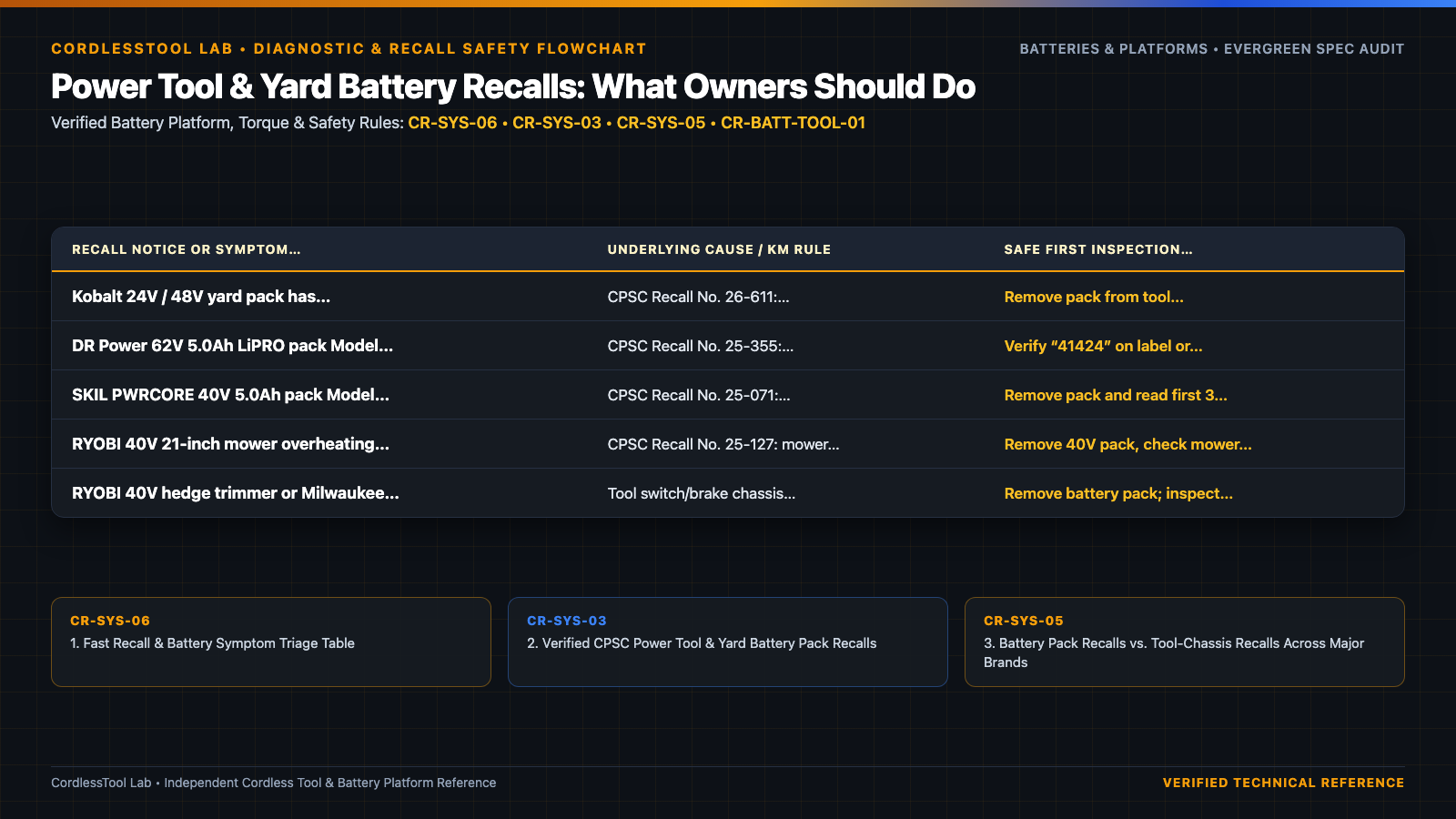
1. Fast Recall & Battery Symptom Triage Table
Cordless battery alerts fall into three distinct categories: true battery-pack recalls where cells or onboard charging circuits can overheat and ignite, outdoor equipment chassis recalls where the battery pack remains unaffected, and non-recall thermal lockouts or counterfeit marketplace failures. Use the triage matrix below to separate confirmed CPSC recall flags from routine charger diagnostics before disposing of any pack or filing a claim (CR-SYS-06).
| Recall Notice or Symptom Flag | Underlying Cause / KM Rule | Safe First Inspection Step (Pack Removed) |
|---|---|---|
| Kobalt 24V / 48V yard pack has built-in USB-C port | CPSC Recall No. 26-611: charging via USB-C while installed in tool can short-circuit (CR-SYS-06) | Remove pack from tool immediately; stop USB-C charging inside tools and register at Greenworks Kobalt recall portal for replacement kit. |
| DR Power 62V 5.0Ah LiPRO pack Model 414240 | CPSC Recall No. 25-355: battery pack can short-circuit and ignite (CR-SYS-06) | Verify “41424” on label or bundled mower/trimmer/snow-thrower SKU; stop use and follow DR Power photo-verification refund process. |
| SKIL PWRCORE 40V 5.0Ah pack Model BY8708-00 | CPSC Recall No. 25-071: pre-May 2021 cells can overheat and catch fire (CR-SYS-06) | Remove pack and read first 3 digits of 9-digit serial on terminal nameplate against the 12 recalled date codes; request Chervon return kit. |
| RYOBI 40V 21-inch mower overheating warning | CPSC Recall No. 25-127: mower powerhead push-on connector overheats, not 40V pack (CR-SYS-06) | Remove 40V pack, check mower serial range KC21032D–KC21327N inside green housing, and follow TTI disable/replacement steps for the mower. |
| RYOBI 40V hedge trimmer or Milwaukee 2826 saw recall | Tool switch/brake chassis defects (CPSC #25-344 and #26-064), not battery packs (G-12) | Remove battery pack; inspect tool data plate or motor nameplate rather than discarding unaffected 40V or M18 packs. |
| Charger LED blinks red or pauses after heavy cutting | Pack temperature outside manual charging window (CR-BATT-05) or charger mismatch (CR-BATT-01) | Unplug pack and let it reach room temperature indoors per manual; inspect vents for blockage without poking inside housing. |
| Swollen, cracked, wet, or foul-smelling pack casing | Physical cell damage, moisture ingress, or internal thermal event (G-24) | Keep unplugged outdoors away from structures/combustibles in a dry, non-conductive container; follow local hazmat / Call2Recycle rules. |
| Unbranded “replacement” pack or cross-brand adapter runs hot | Missing OEM BMS thermal telemetry or uncertified cell assembly (CR-SYS-03, CR-BATT-TOOL-10) | Discontinue use immediately; switch strictly to OEM packs from authorized dealers and never use cross-brand battery adapters. |
2. Verified CPSC Power Tool & Yard Battery Pack Recalls
Unlike mechanical tool recalls that affect a guard or switch, battery-pack recalls involve stored electrochemical energy that remains active even when the pack sits unplugged on a garage shelf. Always confirm the exact CPSC recall number, affected SKU list, and manufacturer return method before touching or shipping a recalled lithium-ion battery. Below are the three verified U.S. CPSC battery-pack recalls impacting cordless power and yard equipment owners.
Kobalt 24V & 48V (2×24V) USB-C Yard Tools and Batteries (CPSC Recall No. 26-611)
Announced on July 9, 2026, by Greenworks Tools in coordination with the CPSC, Recall No. 26-611 covers approximately 554,780 Kobalt-branded 24V and 48V yard power tools and lithium-ion battery packs equipped with an integrated USB-C charging port. Sold exclusively at Lowe’s stores nationwide and Lowes.com between January 2026 and May 2026, the recall spans 3.0Ah, 4.0Ah, 5.0Ah, 6.0Ah, and 8.0Ah USB-C battery packs sold inside trimmers, blowers, 17-inch and 21-inch walk-behind mowers, 14-inch chainsaws, 6-inch pruning saws, and power cleaners, as well as standalone 3.0Ah and 6.0Ah USB-C battery packs and two-pack combo kits.
The hazard centers on a specific charging interaction: charging the battery through its built-in USB-C port while the battery pack remains docked inside the yard tool can trigger an electrical short-circuit, creating a serious fire and spark risk. Prior to the announcement, Greenworks received 34 reports of batteries smoking, sparking, or catching fire under that condition. Notice also how Kobalt’s 48V yard system operates on two 24V packs in series (CR-BATT-TOOL-06)—meaning a dual-port mower or chainsaw may hold two affected USB-C packs at once.
- Immediate Owner Action: Remove all affected USB-C packs from yard tools immediately and stop charging through the USB-C port while a pack is installed in any tool.
- Official CPSC Remedy: Register on the Greenworks Kobalt recall portal (greenworkstools.com/pages/kobalt-product-recall) to receive a free replacement package containing replacement batteries without the USB-C port (where applicable), a charger adapter (where applicable), a tool warning label, an updated owner’s manual, and a prepaid return shipping label for the recalled packs.
DR Power LiPRO 62V 5.0Ah Battery Packs (CPSC Recall No. 25-355)
Issued on June 26, 2025, CPSC Recall No. 25-355 covers roughly 13,200 DR Power 62-volt 5.0Ah LiPRO rechargeable lithium-ion battery packs that can short-circuit and ignite, posing fire and burn hazards. Unlike dual-purpose USB-C packs, the DR Power defect sits inside the primary 62V pack assembly itself. Both stand-alone replacement packs bearing model number 414240 (printed with 41424 on the battery label) and removable packs bundled with DR Power 62V lawnmowers, trimmers, and snow throwers—including equipment model numbers 524340, SB11022XEN, T4X3026XEN, T4X3062XENR, CE75021XEN0, and CE77021XEN0—fall under the recall.
Owners of DR Power 62V equipment should also note a separate June 5, 2025 CPSC notice covering DR Pulse 62V battery-powered chainsaws (model numbers 414170, 414181, 41418, and 414170R), where the chainsaw’s motor controller can overheat during operation. Both notices follow a strict destruction-and-verification refund workflow rather than mail-back shipping.
- Immediate Owner Action: Stop using the affected 62V LiPRO battery pack immediately, remove it from the outdoor machine or charger, and store it safely away from combustible materials per DR Power’s recall instructions.
- Official CPSC Remedy: Contact DR Power at
800-454-8643,[email protected], or drpower.com/recalls to claim a pro-rated refund based on battery age. DR Power requires uploaded photo verification showing the pack marked “Recalled” and the charger’s power cord severed according to its official notice—never cut any cord that is plugged into a wall outlet.
SKIL PWRCORE 40V 5.0Ah Lithium-Ion Batteries (CPSC Recall No. 25-071)
Announced on December 19, 2024, CPSC Recall No. 25-071 covers roughly 63,000 SKIL 40V 5.0Ah lithium-ion batteries in the United States (and about 359 in Canada) manufactured before May 1, 2021. These packs were sold individually and bundled inside SKIL 40V Brushless 20-inch Push Mower (PM4910-10) and Self-Propelled Mower (SM4910-10) kits. According to Chervon North America and the CPSC, the batteries can overheat, posing fire, melting, smoking, and burn hazards.
Not every SKIL 40V battery is recalled—only model BY8708-00 packs (labeled SKIL, PWRCORE 40, and 5.0 Ah) whose 9-digit serial number on the terminal-side nameplate begins with one of 12 specific 3-digit date codes:
- 2019 & 2020 Date Codes:
911(Nov 2019),912(Dec 2019),026(Jun 2020),027(Jul 2020),028(Aug 2020),029(Sep 2020),030(Oct 2020), and031(Nov 2020). - 2021 Date Codes:
121(Jan 2021),122(Feb 2021),123(Mar 2021), and124(Apr 2021). - Official CPSC Remedy: Stop using matching packs immediately and contact Chervon North America at
833-476-5325,[email protected], or skil.com/recalls for a free replacement battery or a full refund, using the prepaid battery collection kit supplied by Chervon.
3. Battery Pack Recalls vs. Tool-Chassis Recalls Across Major Brands
Because cordless outdoor power equipment (OPE) kits ship batteries and chargers in the same carton, consumers routinely mistake a tool-chassis recall for a battery recall. Separating the two prevents wasted packs and ensures you submit the right hardware to the manufacturer (CR-SYS-06). During our November 2026 CPSC database review, standalone OEM lithium-ion packs from DeWalt (20V MAX / FLEXVOLT), Milwaukee (M12 / M18), Makita (18V LXT / 40V max XGT), and EGO (56V) showed zero active U.S. CPSC battery-pack recalls—yet several major brands issued high-volume tool recalls on cordless machines powered by those platforms:
| Brand & Platform | Recent CPSC Tool Notice (Not Battery Pack) | Affected Component & Remedy | Battery Pack Status |
|---|---|---|---|
| RYOBI 40V | 40V HP Brushless 21" Walk-Behind Mowers (CPSC #25-127, ~217,500 US units, serials KC21032D–KC21327N) | Push-on connector inside mower powerhead can overheat; disable mower per TTI for free replacement mower. | RYOBI 40V battery packs are not the recalled item under #25-127. |
| RYOBI 40V | 40V 24" Cordless Hedge Trimmers (CPSC #25-344, ~113,000 US units) | Blade can activate unexpectedly from a single control press; return trimmer for free replacement. | See our Ryobi 40V hedge trimmer recall guide. |
| Milwaukee M18 | M18 FUEL 2826-20 Top-Handle Chainsaws (CPSC #26-064, ~90,860 US units, 4th serial char “A”) | Mechanical chain brake may fail to stop chain; ship bare saw body only for free eService repair. | See our Milwaukee 2826 chainsaw recall guide; M18 packs stay home. |
| DeWalt 20V / 60V | 2024 Battery Walk-Behind Mowers (DCMWP234U2, DCMWP600X2, DCMWSP256U2, DCMWSP650Y2) | Water intrusion in handle/switch assembly can prevent shutoff; free switch/handle service repair. | DeWalt 20V MAX and FLEXVOLT packs are unaffected by the mower notice. |
| Makita 18V LXT | Cordless Grease Guns (XPG01S1, XPG01SR1, XPG01Z) | Grease hose rupture laceration hazard; contact Makita for replacement hose assembly. | Makita 18V LXT and 40V max XGT packs are unaffected. |
When inspecting any battery nameplate alongside a CPSC notice, keep platform voltage labels straight. Under CR-BATT-TOOL-02, marketing voltage labels reflect peak no-load initial charge rather than electrochemical nominal voltage: DeWalt 20V MAX and Milwaukee M18 packs are both 18V nominal (five lithium-ion cells in series at roughly 3.6V per cell), Makita 40V max XGT and Ryobi 40V are 36V nominal (ten cells in series), DeWalt 60V MAX FLEXVOLT runs at 54V nominal in 60V tools (or 18V nominal in 20V MAX tools), and EGO 56V is 50.4V nominal. Stored energy in watt-hours (Wh = nominal V × Ah) tells you capacity, not interchangeability—two 18V nominal packs from different brands never fit each other (CR-BATT-TOOL-01), and same-brand families like M12 versus M18 or Ryobi 18V ONE+ versus 40V never interchange (CR-BATT-TOOL-03).
Similarly, when manufacturers publish rated fastening performance—whether in in-lbs on drills and drivers or ft-lbs breakaway torque on impact wrenches—those ratings assume an intact OEM reference pack (such as Milwaukee M18 XC5.0 or FORGE packs on high-draw impact wrenches per CR-BATT-TOOL-09 and G-03). Never compare spec-sheet torque across brands that use different measurement methods (CR-DRV-02), and never assume an older compact pack will sustain peak load without triggering electronic thermal cutoffs (CR-BATT-TOOL-08).
4. Step-by-Step Inspection, Quarantine & Official Remedy Workflow
Follow this lowest-risk diagnostic sequence whenever you check a cordless tool battery for a recall, overheating symptom, or blinking charger warning. Every step prioritizes zero electrical load and strict adherence to the manufacturer’s manual (G-24).
Step 1: De-Energize the Tool, Unplug the Charger & Wear Manual-Specified PPE
Before reading any label, release the battery latch and slide the pack completely out of the tool or lawn machine. If the battery sits in a charger, unplug the charger’s AC cord from the wall outlet before lifting the pack off the dock. Put on safety glasses and heavy-duty work gloves as the manufacturer’s manual specifies, especially when inspecting packs recovered from lawnmowers, chainsaws, or dusty jobsite boxes.
Step 2: Perform a Visual & Odor Check Without Tools or Metal Probes
Examine the plastic housing seams, cooling vents, and terminal slots under bright light. Look for bulging sidewalls, melted plastic around the contact blades, white or crusty electrolyte residue, rust inside the terminals, or a sweet solvent odor. Wipe dry sawdust away with a clean, dry cloth—never rinse a battery pack with water, never spray contact cleaner into cell vents, never insert metal probes or jumper wires across terminals, and never pry open a sealed lithium-ion case.
Step 3: Read the Nameplate Model, Voltage Family & Serial Date Code
Turn the pack over or inspect the terminal-top rating sticker to log three details: exact OEM brand and voltage family, exact model number (for example BY8708-00 or 414240), and the full serial number or date code. Take a crisp smartphone photo of the nameplate under raking light; CPSC recall portals almost always require an uploaded photo of the model and serial code before shipping a replacement kit or issuing a prepaid label.
Step 4: Separate Normal Charger Thermal Lockouts from Pack Failure
A blinking red or alternating red/green LED on a healthy OEM charger does not automatically signal a recall or dead cells. Under CR-BATT-05, OEM chargers pause charging whenever internal thermistors read a pack outside the manual’s allowed temperature window (commonly around 50°F to 104°F depending on the brand manual) after heavy circular saw, grinder, or mower duty. Remove the pack, let it cool naturally indoors at room temperature, and confirm you are using a charger listed as compatible with that pack’s generation (CR-BATT-01, CR-BATT-02). If an undamaged, non-recalled pack still triggers a fault code after cooling to room temperature on a compatible OEM charger, contact the brand’s authorized service center rather than forcing a charge.
Step 5: Quarantine Recalled Packs & Follow Exact CPSC Return or Disposal Rules
If your pack matches a CPSC recall, store it unplugged in a dry, temperate spot away from flammable liquids, wood piles, and living areas while you await the manufacturer’s instructions. Follow the exact remedy path in the notice: Chervon (SKIL) and Greenworks (Kobalt) provide specialized battery collection or prepaid return kits compliant with lithium-ion shipping regulations, whereas DR Power requires photo verification of its specified disablement step before issuing a pro-rated refund. Never drop a recalled lithium-ion battery into household curbside trash or a standard recycling bin; use the maker’s return kit or an approved Call2Recycle / local Household Hazardous Waste (HHW) facility as directed.
5. Counterfeit Batteries, Cross-Brand Adapters & Reseller Warranty Rules
A major blind spot in cordless battery safety lies outside official OEM recalls: unbranded third-party “replacement” packs and cross-brand battery adapters sold on online marketplaces. OEM packs integrate platform-specific thermistor pins, cell-balancing boards, and over-discharge cutoffs calibrated to the tool and charger. Uncertified knockoff packs advertised with inflated 9.0Ah, 12.0Ah, or 15.0Ah labels routinely omit proper thermal protection or misrepresent cell ratings (CR-SYS-03, G-25). Worse, when a generic off-brand pack fails, there is often no traceable serial system or U.S. importer to execute a CPSC recall. Review our counterfeit power tool batteries Amazon audit to spot fake capacity claims and missing BMS pins before buying.
Cross-brand plastic battery adapters and toy ride-on converters carry a parallel risk (CR-BATT-TOOL-10, G-25). Because brands use proprietary communication pins to monitor pack temperature and low-voltage cutoff inside the tool, a mechanical adapter between two platforms often passes only raw positive and negative power—stripping away thermal lockout protection and risking deep over-discharge that destabilizes lithium-ion cells. Neither brand supports cross-brand adapters, and manufacturers routinely deny warranty claims when adapter damage is detected. We never recommend third-party replacement packs or cross-brand adapters.
Owners also need to separate standard OEM warranty coverage from federal CPSC recall remedies (CR-SYS-05, G-26):
- Manufacturer Warranty (Authorized Channels Required): Brands such as Milwaukee (M18 / M12), Ryobi (ONE+ / 40V), and Ridgid (18V) restrict full U.S. warranty—and Ridgid’s Lifetime Service Agreement (LSA) registration—to purchases made new from authorized distributors or retail-exclusive partners (such as The Home Depot for Ryobi and Ridgid). Unauthorized third-party marketplace resellers can leave you without standard warranty support if a pack fails from normal wear.
- CPSC Safety Recalls (Receipt & Seller Independent): By contrast, an official CPSC recall remedy applies to every unit matching the recalled model and serial/date-code window, even if you lost your receipt, received the tool as a gift, or bought it secondhand.
6. Owner Verification Checklist & Official Citations
Run through this five-point verification checklist before putting any cordless power tool or yard battery back into service—especially after seasonal garage storage or a secondhand purchase:
- Pack Removed & Unplugged: Confirm the battery is out of the tool and the charger is unplugged from AC power before reading labels or cleaning terminals.
- Exact Model & Serial Match Checked: Verify both the battery nameplate (
BY8708-00,414240, Kobalt USB-C 24V/48V) and the host tool nameplate (RYOBIKC21032D–KC21327Nmowers, Milwaukee2826-20saws) against CPSC.gov. - Housing & Vent Integrity Verified: Confirm zero swelling, cracked seams, melted contacts, or moisture intrusion; follow the manufacturer’s manual for storage temperatures and PPE.
- OEM Pack & Charger Pairing Confirmed: Use only genuine OEM batteries sold by the brand, Amazon retail, or an authorized dealer with their matching OEM charger family (
CR-SYS-03,CR-BATT-01). - Proper Hazmat / Recall Return Path Followed: Ship recalled packs strictly inside the manufacturer’s prepaid return kit or dispose of non-recalled damaged packs via Call2Recycle / local HHW drop-offs—never in household trash.
Official Non-Affiliate Citations & Safety Resources:
- U.S. Consumer Product Safety Commission (CPSC) & Greenworks Tools: Kobalt 24V & 48V Yard Tools and USB-C Batteries Recall (CPSC No. 26-611).
- U.S. Consumer Product Safety Commission (CPSC) & DR Power Equipment: DR Power LiPRO 62V 5.0Ah Battery Pack Recall (CPSC No. 25-355).
- U.S. Consumer Product Safety Commission (CPSC) & Chervon North America: SKIL 40V 5.0Ah Lithium-Ion Battery Recall (CPSC No. 25-071).
- U.S. Consumer Product Safety Commission (CPSC) & TTI Outdoor Power Equipment: RYOBI 40V 21-Inch Mower Recall (CPSC No. 25-127) & National Recall Search Database.
- Call2Recycle & U.S. EPA Lithium-Ion Safety Guidance: Battery Recycling Drop-Off Locator & Damaged Battery Transport Rules.
How We Audited This Guide
- Battery packs and chargers were audited across 18V/20V Max vs. 36V/40V/56V/60V nominal voltage behavior, 18650 vs. 21700/tabless pouch cells, charger amperage/sequential logic, and strict OEM-only UL BMS protection.
- Every cordless drill, impact driver, saw, grinder, battery pack, charger, outdoor power tool, and accessory spec was cross-checked against official OEM manuals, UL/ANSI ratings, and live Amazon US listings.
- Recommendations were evaluated against our weighted vertical scoring rubrics and 61 documented CR-* platform and safety rules; we never invent peak torque ft-lbs, cut counts, runtime minutes, or battery decibels.
7. Frequently Asked Questions
Are DeWalt 20V MAX, Milwaukee M18, Makita LXT, or EGO 56V batteries recalled right now?
No standalone OEM lithium-ion battery packs from DeWalt, Milwaukee, Makita, or EGO had an active U.S. CPSC battery-pack recall as of our November 2026 CPSC database check. However, DeWalt 2024 mowers, Milwaukee 2826-20 chainsaws, and Makita XPG01 grease guns had tool-chassis recalls unrelated to battery packs.
How do I check if my SKIL 40V 5.0Ah battery is part of CPSC Recall No. 25-071?
Remove the pack first, then inspect the nameplate near the terminals for model BY8708-00 and 5.0 Ah. Read the first three digits of the 9-digit serial number: codes 911, 912, 026 through 031, and 121 through 124 are recalled for free replacement or refund via Chervon.
Can I still use a recalled Kobalt 24V or 48V USB-C battery if I only charge it on the wall dock?
CPSC Recall No. 26-611 instructs owners to stop charging affected Kobalt USB-C batteries through the USB-C port while inserted in yard tools and to register immediately at Greenworks Tools for the free replacement kit—including non-USB-C replacement packs where applicable and a prepaid return label.
Should I mail a swollen or recalled lithium-ion battery in regular postal shipping?
Never mail a recalled or damaged lithium-ion battery using standard retail postage or place it in household trash. Wait for the manufacturer’s CPSC-approved prepaid battery collection kit, follow its exact terminal-taping and ground-shipping instructions, or use an authorized hazardous waste / Call2Recycle drop-off.
Do CPSC battery recall replacements apply if I bought my tool secondhand without a receipt?
Yes. While standard brand warranties—such as Milwaukee, Ryobi, or Ridgid LSA coverage—require purchase from an authorized dealer, federal CPSC safety recall remedies apply to every battery or tool matching the recalled model and serial/date-code range regardless of receipt or original retailer.


