Disclosure: As an Amazon Associate, CordlessTool Lab earns from qualifying purchases. If you buy through links on this page, we may earn a small commission at no extra cost to you. Retail commission rates (3% in Tools & Home Improvement) never alter our engineering analysis or battery recommendations.
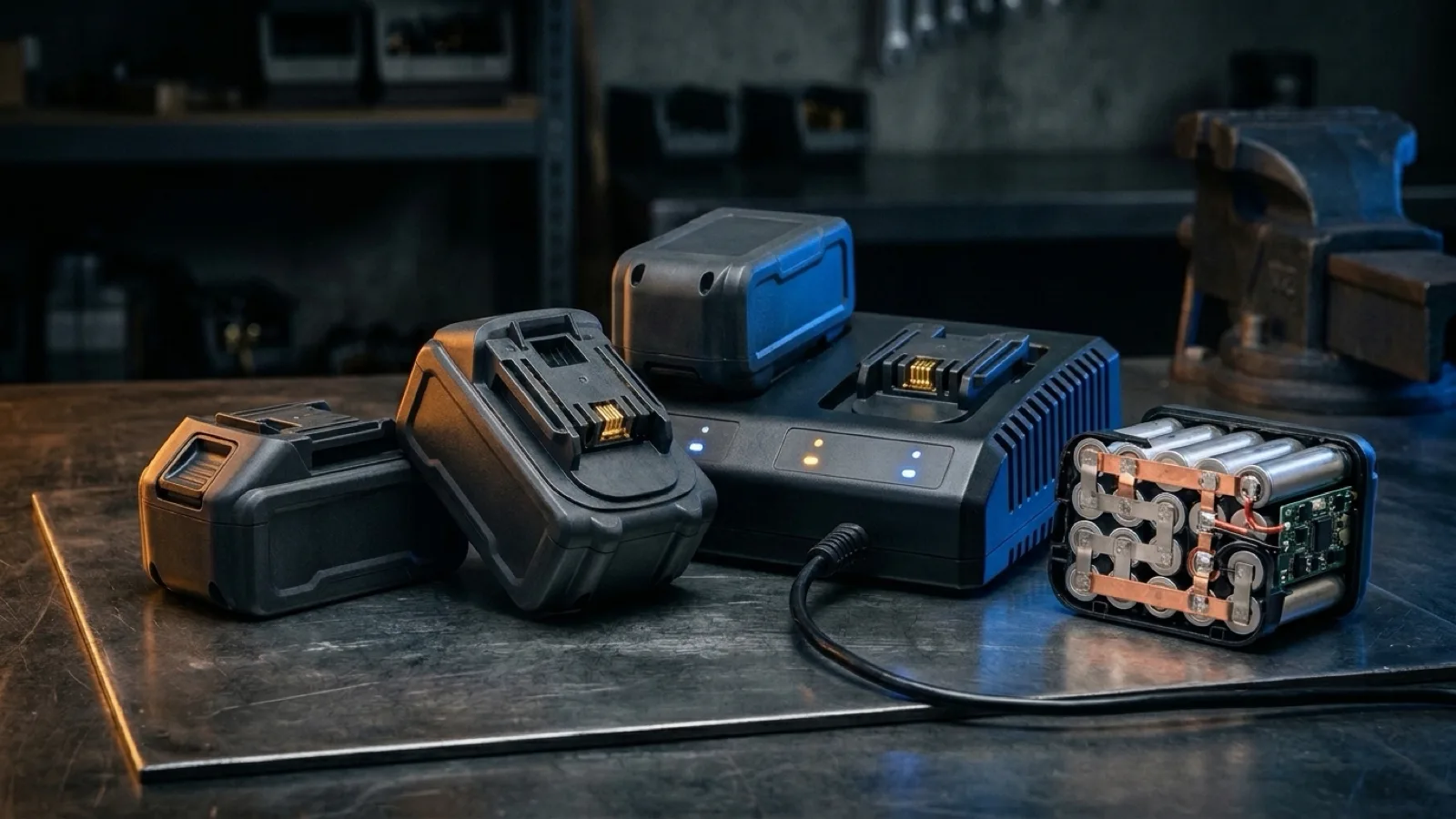
Few topics cause more confusion in the hardware aisle than the 20v max vs 18v battery label split. Shoppers routinely see DeWalt, Craftsman, and Black+Decker stamping “20V MAX” on their cordless drills while Milwaukee, Makita, Bosch, Ryobi, and Ridgid stamp “18V” on competing tools—leading many buyers to assume a 20V MAX battery delivers roughly 11% more power. As part of our cordless tool battery platforms hub and specification audit methodology, we break down the five-cell lithium-ion chemistry, watt-hour math, and rail-lock rules behind both labels.
Quick Answer — Is 20V MAX Stronger Than 18V?
No. Both 20V MAX and 18V cordless tool batteries run five lithium-ion cells wired in series at an identical 18V nominal rating (CR-BATT-TOOL-02). “20V MAX” measures peak initial open-circuit voltage immediately off the charger, whereas “18V” states average working voltage under load. Neither label offers inherent extra power, and competing brands never cross-fit (CR-BATT-TOOL-01).
In This Guide
- 1. Nominal Voltage vs. Maximum Initial Voltage (5S Cell Math)
- 2. Amp-Hours, Watt-Hours & Worked Energy Examples (FAA 100 Wh Rule)
- 3. Master Compatibility & Voltage Comparison Table
- 4. What Actually Drives Power (Cell Impedance, Reference Packs & Torque Methods)
- 5. Same-Brand Voltage Tiers & Dual-Voltage Exceptions
- 6. Five Battery Myths, Third-Party Adapters & Counterfeit Risks
- 7. Charging Safety, CPSC Recalls & Retail Channel Warranties
- 8. Verified OEM Reference Packs & Starter Kits
- 9. Authoritative Non-Affiliate References
- 10. Frequently Asked Questions
1. Nominal Voltage vs. Maximum Initial Voltage (5S Cell Math)
To understand the 20v max vs 18v distinction, you have to look inside the plastic shell at the individual lithium-ion cells. Whether a battery uses cylindrical 18650 cells (18 mm × 65 mm / 0.71 in × 2.56 in), cylindrical 21700 cells (21 mm × 70 mm / 0.83 in × 2.76 in), or flat laminated pouch cells, standard lithium-ion tool chemistry behaves identically across brands:
- Nominal voltage (average operating voltage): A single lithium-ion power-tool cell averages roughly 3.6 volts across its normal discharge curve. Multiplying five cells wired in series (
5S) gives5 × 3.6V = 18.0V—the exact nominal voltage used by Milwaukee M18, Makita 18V LXT, Bosch 18V, Ryobi 18V ONE+, and Ridgid 18V. - Maximum initial voltage (no-load peak): Immediately after a full charge, with zero tool load pulling current, each lithium-ion cell rests near 4.0V to 4.2V (roughly 4.0V × 5 = 20V, up to ~20.5V–21V at peak rest). Brands such as DeWalt (“20V MAX*”), Craftsman (“V20”), and Black+Decker (“20V MAX”) print that unloaded maximum initial voltage on the casing, usually accompanied by an asterisk noting that nominal voltage is 18V.
- Voltage under actual tool load: The instant you squeeze a drill or circular saw trigger, battery voltage drops immediately from its resting ~20V peak into the ~16V–18V working range regardless of which sticker is printed on the side. Under rule
CR-BATT-TOOL-02, DeWalt 20V MAX and Milwaukee M18 operate on the same 18V nominal foundation; the label difference is purely marketing convention, never extra power.
The exact same dual-labeling convention repeats across compact and high-voltage tool classes. Three-cell (3S) compact packs measure 10.8V nominal (3 × 3.6V) and sell as DeWalt 12V MAX, Milwaukee M12, Bosch 12V Max, and Makita 12V max CXT. Ten-cell (10S) packs measure 36V nominal (10 × 3.6V) and sell as Makita 40V max XGT, Ryobi 40V, and Metabo HPT 36V MultiVolt. Stepping higher, 14-cell (14S) EGO 56V packs sit at 50.4V nominal, while 15-cell (15S) DeWalt FLEXVOLT 60V MAX packs operate at 54V nominal. In every tier, nominal cell count—not the marketing integer—tells you the electrical class.
2. Amp-Hours, Watt-Hours & Worked Energy Examples (FAA 100 Wh Rule)
Because “20V MAX” and “18V” describe the same 18V nominal voltage, buyers often get tripped up next by amp-hours (Ah) and watt-hours (Wh). Amp-hours measure stored electrical charge at a given voltage—roughly comparable to the size of a fuel tank—not motor output or speed. To compare stored energy fairly across packs, multiply nominal voltage by amp-hours:
Stored Energy (Wh, nominal) = Nominal Voltage (V) × Capacity (Ah)
- Worked Example 1 — Standard 5.0Ah Pack Parity (20V MAX vs. 18V): Compare a DeWalt
DCB205orDCBP520(labeled 20V MAX, 5.0Ah) against a MilwaukeeXC5.0(labeled M18, 5.0Ah) or MakitaBL1850B(18V LXT, 5.0Ah). Applying nominal voltage across all three yields18V × 5.0Ah = 90 Wh. If you mistakenly multiplied DeWalt’s 20V marketing label by 5.0Ah (100 Wh) and Milwaukee’s 18V nominal label by 5.0Ah (90 Wh), you would invent an 11% energy gap that does not exist inside the cells. All three packs weigh roughly 1.39 lb to 1.6 lb (0.63 kg to 0.73 kg) bare and sit comfortably under the 100 Wh threshold for commercial air travel. - Worked Example 2 — Dual-Voltage FLEXVOLT & Label Basis Disclosure: Dual-voltage DeWalt FLEXVOLT packs wire three parallel 5S banks in 20V MAX mode and switch internally to one 15S series bank in 60V MAX mode. On the
DCB606(rated 6.0Ah at 20V MAX / 2.0Ah at 60V MAX), nominal stored energy is18V × 6.0Ah = 108 Wh, which equals54V × 2.0Ah = 108 Wh(DeWalt prints120 Whon its max-voltage label basis). Similarly, theDCB609(rated 9.0Ah at 20V MAX / 3.0Ah at 60V MAX) holds18V × 9.0Ah = 162 Whnominal, while DeWalt stamps180 Whusing its 20V max-voltage basis. Never add both amp-hour ratings together—reconfiguring wiring from parallel to series triples voltage and divides amp-hours by three while keeping total watt-hours constant. - Worked Example 3 — Why Higher Voltage Does Not Automatically Mean Larger Wh: A compact 40V max XGT 2.5Ah pack holds
36V nominal × 2.5Ah = 90 Wh—the exact same stored energy as an 18V 5.0Ah pack, simply arranged in 10 cells in series (1P) instead of 5 cells in series across 2 parallel strings (2P).
Two critical guardrails govern watt-hour numbers. First, never convert Wh into runtime claims (minutes, fastener counts, or cuts per charge) without an explicit manufacturer rating or controlled benchmark specification (G-01), because brushless motor efficiency, load resistance, blade kerf, and wood density alter actual consumption drastically. Second, lithium-ion batteries exceeding 100 Wh (including most 6.0Ah, 8.0Ah, and 12.0Ah 18V/20V packs as well as 56V OPE packs) face commercial airline carry-on and cargo carrier restrictions—always check the current FAA PackSafe lithium battery rules and carrier guidelines before traveling or shipping.
3. Master Compatibility & Voltage Comparison Table
Matching nominal voltage never means physical compatibility. Under rule CR-BATT-TOOL-01, every cordless tool platform is defined by the combination of brand + voltage family + mechanical rail/terminal interface. The diagram and reference table below map how major 20V MAX and 18V families align chemically while staying mechanically isolated.
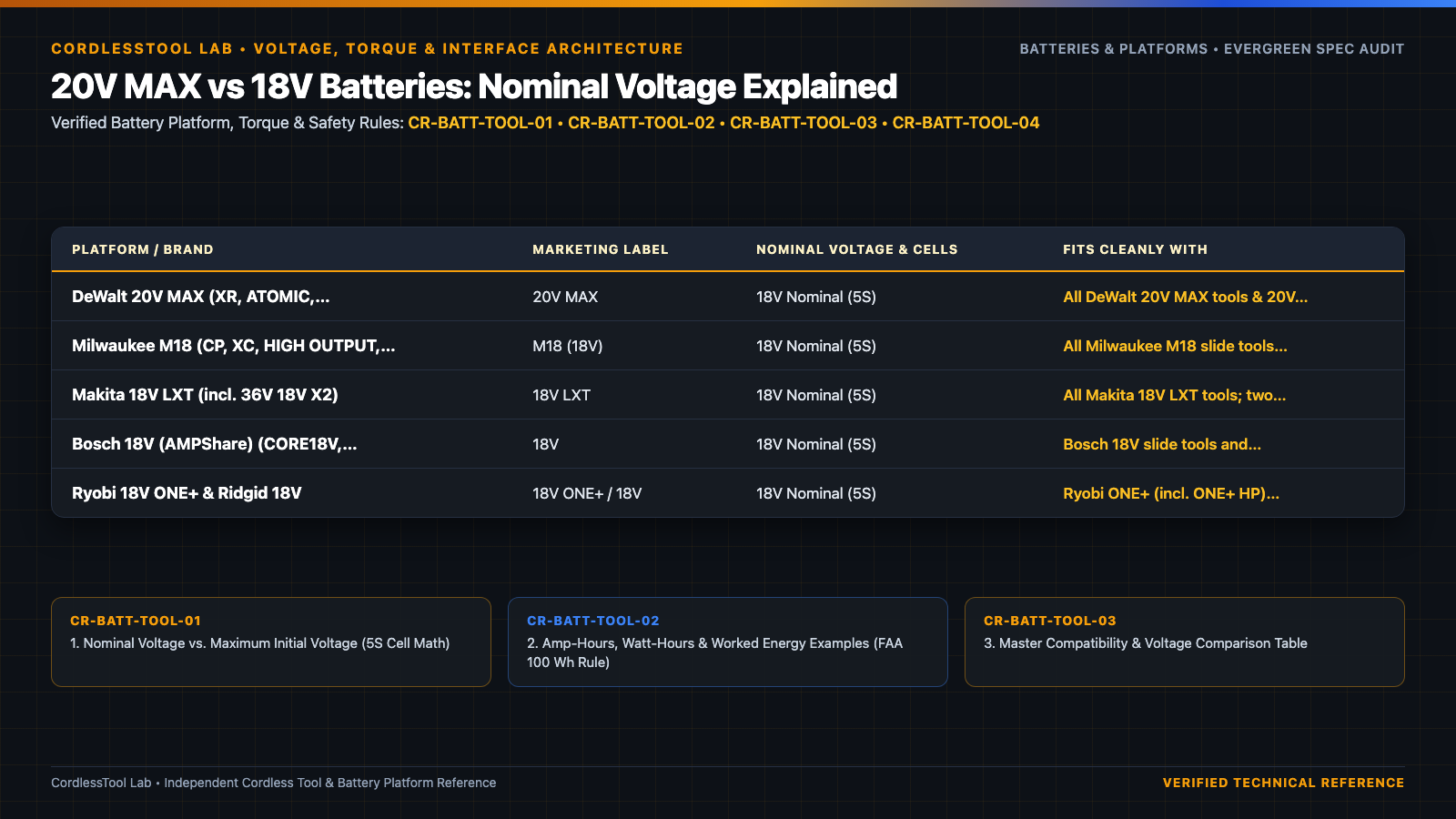
| Platform / Brand | Marketing Label | Nominal Voltage & Cells | Fits Cleanly With | Incompatible or Risky Caveat |
|---|---|---|---|---|
| DeWalt 20V MAX (XR, ATOMIC, POWERSTACK) | 20V MAX | 18V Nominal (5S) | All DeWalt 20V MAX tools & 20V MAX / 12V-20V slide chargers (CR-BATT-TOOL-12) | Does not run DeWalt 60V MAX FLEXVOLT tools (CR-BATT-TOOL-05), DeWalt 12V MAX, Craftsman V20, or Black+Decker 20V. |
| Milwaukee M18 (CP, XC, HIGH OUTPUT, FORGE) | M18 (18V) | 18V Nominal (5S) | All Milwaukee M18 slide tools & M18 chargers per Milwaukee (CR-BATT-TOOL-12) | Incompatible with M12, MX FUEL, and DeWalt 20V MAX (CR-BATT-TOOL-03). Verify authorized dealer on Amazon (CR-SYS-05). |
| Makita 18V LXT (incl. 36V 18V X2) | 18V LXT | 18V Nominal (5S) | All Makita 18V LXT tools; two packs power 36V (18V X2) dual-slot tools (CR-BATT-TOOL-06) | Incompatible with Makita 40V max XGT (36V nom.) and 12V max CXT (CR-BATT-TOOL-03). |
| Bosch 18V (AMPShare) (CORE18V, PROFACTOR) | 18V | 18V Nominal (5S) | Bosch 18V slide tools and partner tools inside the AMPShare 18V alliance | Does not fit Bosch 12V Max tools or legacy Bosch NiCd stems (CR-BATT-TOOL-03). |
| Ryobi 18V ONE+ & Ridgid 18V | 18V ONE+ / 18V | 18V Nominal (5S) | Ryobi ONE+ (incl. ONE+ HP) within ONE+; Ridgid 18V within Ridgid | Ryobi ONE+ does not fit Ryobi 40V. Both brands are Home Depot retail-exclusives in the US; Amazon 3P listings risk warranty/LSA loss (G-26). |
| Craftsman V20 & Black+Decker 20V | V20 / 20V MAX | 18V Nominal (5S) | Tools inside each individual brand family (V20 ↔ V20 only) | Shared parent company (Stanley Black & Decker) does NOT grant fit onto DeWalt 20V MAX rails (CR-BATT-TOOL-01). |
| DeWalt FLEXVOLT 60V MAX | 20V/60V MAX | 18V / 54V Nominal (5S3P ↔ 15S1P) | All DeWalt 60V MAX tools, 120V MAX (2 packs), and 20V MAX tools (CR-BATT-TOOL-04) | Adds noticeable bulk/weight on compact 20V drills; standard 20V MAX packs never power 60V MAX tools. |
| Metabo HPT MultiVolt | 36V / 18V MultiVolt | 18V / 36V Nominal | Metabo HPT 36V MultiVolt tools and 18V slide tools (CR-BATT-TOOL-07) | One-way compatibility: 18V-only packs cannot run 36V MultiVolt tools. |
Notice a critical takeaway in that table: even brands owned by the same parent corporation keep their battery rails physically separate. Stanley Black & Decker owns DeWalt, Craftsman, and Black+Decker—all three market “20V” systems built on 5S 18V-nominal cells, yet none share slide rails. Likewise, TTI produces Milwaukee M18, Ryobi 18V ONE+, and Ridgid 18V, and all three remain incompatible. For a deeper look at rail keying and BMS pinouts, read our explainer on whether power tool batteries are interchangeable between brands.
4. What Actually Drives Power (Cell Impedance, Reference Packs & Torque Methods)
If 20V MAX and 18V packs run at the same 18V nominal voltage, why do certain battery packs noticeably outwork others on a 7-1/4-inch (184 mm) circular saw, angle grinder, SDS-plus rotary hammer, or 1/2-inch high-torque impact wrench? The answer comes down to internal cell resistance (impedance), parallel cell strings, and brushless motor electronics—not the voltage number on the sticker.
- Cell format & parallel strings (
CR-BATT-04,CR-BATT-TOOL-08): Compact 1.5Ah–2.5Ah 18V/20V packs use a single row of five cells (5S1P). Standard 4.0Ah–5.0Ah packs wire two rows in parallel (5S2P), halving internal resistance and allowing higher sustained current without triggering early low-voltage cutoff on saws or grinders. Newer high-output packs push further via larger21700cylindrical cells (e.g., Bosch CORE18V, Milwaukee HIGH OUTPUT), flat laminated pouch cells (e.g., DeWalt XR POWERSTACK, Milwaukee FORGE 6.0), or tabless cylindrical cells (e.g., Milwaukee FORGE XC8.0). Cell format never changes which tools the pack physically fits, but low-impedance high-output packs keep voltage from sagging under heavy load. - Reference-pack torque disclosures (
G-03,CR-BATT-TOOL-09): High-output packs can directly raise a tool’s rated performance. For instance, Milwaukee states two distinct ratings for its2967M18 FUEL 1/2-inch High Torque Impact Wrench depending on the battery attached: 1,100 ft-lbs (1,491 Nm) fastening torque and 1,500 ft-lbs (2,034 Nm) nut-busting torque when paired with anM18 XC5.0pack, increasing to 1,200 ft-lbs (1,627 Nm) fastening and 1,600 ft-lbs (2,169 Nm) nut-busting when paired with anM18 FORGEpack. That jump happens on the exact same 18V nominal platform strictly because lower pack impedance delivers higher peak current. - Why cross-brand spec-sheet torque rankings fail (
CR-DRV-02,G-15,G-16): Manufacturers measure drill and driver torque using different internal methods. Drills are commonly rated inin-lbs(where12 in-lbs = 1 ft-lb) andNm, while impact wrenches useft-lbsandNm. DeWalt also publishesUWO(Unit Watts Out) /MWOpower figures alongside max brake torque on several drills, whereas Milwaukee and Makita publish peakin-lbsunder their own bench procedures. Because methods differ across brands, never rank a 20V MAX tool above an 18V tool—or vice versa—using manufacturer spec sheets alone without an identical third-party benchmark method.
If you are actively weighing the two largest 18V-nominal ecosystems side by side, see our head-to-head Milwaukee M18 vs. DeWalt 20V MAX platform showdown or explore how DeWalt organizes its internal lines in our DeWalt 20V MAX battery platform guide.
5. Same-Brand Voltage Tiers & Dual-Voltage Exceptions
Another frequent pitfall when comparing 20v max vs 18v ecosystems is assuming that buying into one brand lets you share batteries across every voltage badge that brand sells. Under rule CR-BATT-TOOL-03, same-brand voltage families stay locked apart unless the maker engineers a documented cross-voltage system:
- DeWalt FLEXVOLT (20V/60V MAX —
CR-BATT-TOOL-04,CR-BATT-TOOL-05): FLEXVOLT batteries fit both 60V MAX tools and standard 20V MAX tools, automatically stepping down to 18V nominal when slid onto a 20V MAX tool. However, compatibility flows in one direction only: standard 20V MAX packs (including POWERSTACK 5.0Ah) cannot run 60V MAX FLEXVOLT tools. Keep in mind that heavy FLEXVOLT packs add bulk and weight on compact 20V MAX drills (CR-BATT-TOOL-11). - Metabo HPT MultiVolt (36V/18V —
CR-BATT-TOOL-07): MultiVolt packs automatically run both Metabo HPT 36V and 18V slide tools, whereas 18V-only packs cannot power 36V MultiVolt tools. - Makita 36V (18V X2) LXT vs. 40V max XGT (
CR-BATT-TOOL-03,CR-BATT-TOOL-06): Makita’s 36V LXT saws and yard tools require two 18V LXT packs installed simultaneously in dual bays; both slots must hold charged packs to operate. By contrast, Makita’s newer 40V max XGT platform (36V nominal single pack) uses an entirely different slide rail and terminal block—LXT packs never run XGT tools, and XGT chargers accept LXT batteries only through Makita’s optionalADP10charging adapter (CR-BATT-01). - Bare tools vs. starter kits (
CR-SYS-01,CR-SYS-02,CR-SYS-07): When comparing prices online, inspect the exact SKU suffix and “What’s in the box” list for your chosen variation. A bare tool is a tool-only listing: battery and charger sold separately, while combo kits occasionally bundle entry-tier or brushed tools alongside standard packs.
6. Five Battery Myths, Third-Party Adapters & Counterfeit Risks
Myth vs. Engineering Reality — Voltage, Adapters & Marketplace Traps
Before buying batteries or cross-brand accessories online, separate true lithium-ion physics from marketing claims and unapproved marketplace workarounds (CR-BATT-TOOL-10, CR-SYS-03, G-25).
- Myth 1: “20V MAX beats 18V automatically.” Engineering reality: Both use 5S lithium-ion cells at 18V nominal (
CR-BATT-TOOL-02). Tool torque, cut speed, and thermal endurance depend on cell impedance, parallel strings, and motor efficiency—not whether the label prints peak or nominal voltage. - Myth 2: “Higher amp-hours mean higher voltage or raw power.” Engineering reality: Amp-hours measure charge capacity, not voltage. A 5.0Ah pack and a 2.0Ah pack on the same platform both run at 18V nominal; larger packs only deliver more peak current when their parallel cell layout or cell format (such as 21700, pouch, or tabless) lowers internal resistance (
CR-BATT-TOOL-08). - Myth 3: “DeWalt 20V MAX and Craftsman V20 or Black+Decker 20V share batteries.” Engineering reality: Despite shared ownership under Stanley Black & Decker, all three rails are mechanically keyed apart and will not fit one another (
CR-BATT-TOOL-01). - Myth 4: “Third-party cross-brand battery adapters or Power Wheels adapters carry zero risk.” Engineering reality: Neither OEM approves third-party cross-brand adapters (
CR-BATT-TOOL-10). Because brands split low-voltage cutoff and thermal protection differently—for example, placing cutoff logic inside the battery vs. inside the tool—passive adapter sleds drop BMS communication pins, risking over-discharged lithium cells, thermal stress, and refused OEM warranty claims. CordlessTool Lab excludes all cross-brand adapters and ride-on toy adapters from buying recommendations (G-25). - Myth 5: “Generic ‘replacement for’ Amazon batteries match OEM safety and capacity.” Engineering reality: Unbranded third-party packs frequently exaggerate amp-hour ratings, use inconsistent cell binning, omit OEM thermistor telemetry, and lack recognized third-party safety marks (
CR-SYS-03). Stick strictly to genuine OEM packs sold by the brand, Amazon retail, or an authorized dealer (G-25).
7. Charging Safety, CPSC Recalls & Retail Channel Warranties
High-energy lithium-ion packs require manufacturer-instruction-first care across every jobsite and home garage. Follow the OEM instruction manual first for battery charging, storage, saw guards, grinder wheels, blades, chains, and impact wrenches, and wear eye, hearing, and hand PPE as the manual specifies (G-24):
- Charger matching & thermal lockouts (
CR-BATT-01,CR-BATT-02,CR-BATT-05): Charge every battery strictly on an OEM-listed compatible charger—older chargers may not list newer pouch-cell or high-output packs as compatible. If a charger indicator blinks a hot/cold delay, never attempt to bypass thermal protection; move the battery indoors and let it reach room temperature within the manual’s specified charging window before restarting. - Damaged, swollen, or wet packs: Stop using any battery pack that shows housing cracks, swelling, water intrusion, or scorch marks. Never open a pack or attempt wire jump-starting; follow the manufacturer’s instructions and local municipal or retailer lithium-ion recycling drop-off programs.
- Third-party seller & retail-exclusive warranty rules (
CR-SYS-05,G-26): In the US, Ryobi (ONE+ / 40V) and Ridgid (18V) are retail-exclusive brands distributed primarily through Home Depot, meaning third-party Amazon marketplace listings—especially bulk-packaged or unsealed packs—often lack authorized-dealer warranty eligibility and fail Ridgid’s Lifetime Service Agreement (LSA) registration rules. Milwaukee M18 and M12 listings on Amazon US are similarly dominated by third-party resellers; verify authorized distributor status on the brand’s US warranty page and keep your purchase receipt. - CPSC safety recall screening (
CR-SYS-06,G-12): Always verify battery packs and outdoor tools—especially clearance or secondhand units—against the U.S. Consumer Product Safety Commission (CPSC) Recalls database. Documented lithium-ion outdoor recalls include SKIL 40V 5.0Ah lawnmower/outdoor packs, DR Power 62V 5.0Ah LiPRO packs (refund remedy), Kobalt 24V and 48V USB-C yard-tool packs (fire hazard linked to charging via the USB-C port while installed in the tool), and Milwaukee’s 2826-20 M18 FUEL top-handle chainsaw recall. Check unit serial and date codes and follow the official remedy instructions.
8. Verified OEM Reference Packs & Starter Kits
The four verified Amazon US OEM listings below illustrate the core 20v max vs 18v concepts covered in this guide: standard 90 Wh energy parity at 5.0Ah, stacked pouch-cell output upgrades, dual-voltage FLEXVOLT downward compatibility, and starter-kit vs. bare-pack rules (CR-SYS-01, CR-SYS-03). Zero non-OEM packs or cross-brand adapters appear here, and pricing is referenced solely by broad tier bands.
1. DEWALT 20V MAX 5.0Ah Battery and Charger Starter Kit (DCB205C)

Platform Spec: STD-BATT-DEWALT-20V-MAX | 18V Nominal (20V MAX label) | 5.0Ah / 90 Wh Nominal | Starter Kit (1x DCB205 Pack + Charger) | Price Tier: TIER-BATT-VALUE
If you bought a bare DeWalt 20V MAX drill or saw (a tool-only listing: battery and charger sold separately under CR-SYS-01), the DCB205C starter kit gives you DeWalt’s standard 5.0Ah cylindrical reference pack alongside a matching 20V MAX charger in one box. Its 18V × 5.0Ah = 90 Wh nominal energy matches competing 18V 5.0Ah packs exactly and fits every 20V MAX slide tool, though it cannot power 60V MAX FLEXVOLT equipment (CR-BATT-TOOL-05).
2. DEWALT 20V MAX XR POWERSTACK 5.0Ah Battery (DCBP520)

Platform Spec: STD-BATT-DEWALT-20V-MAX | 18V Nominal (20V MAX label) | 5.0Ah / 90 Wh Nominal | Stacked Pouch Cells | Bare Pack Only (Charger Sold Separately) | Price Tier: TIER-BATT-MID
The DCBP520 proves that internal cell construction—not a “20V MAX” vs. “18V” sticker—governs voltage sag under heavy load. Replacing cylindrical cells with flat laminated pouch cells, DeWalt claims 50% more power and 2x charge-cycle lifespan compared directly against its standard DCB205 5.0Ah pack per DeWalt’s official DCBP520 specifications. Note that this is a tool-only/bare-pack listing: battery charger sold separately (CR-SYS-01), and it runs 20V MAX tools only, not 60V MAX FLEXVOLT tools.
3. Milwaukee 48-11-1850R M18 18V 5.0Ah XC Resistant Battery 2-Pack

Platform Spec: STD-BATT-MILWAUKEE-M18 | 18V Nominal (M18) | 2 x 5.0Ah (90 Wh Each / 180 Wh Total) | Chemical-Resistant Housing | Bare 2-Pack (Charger Sold Separately) | Price Tier: TIER-BATT-MID
Milwaukee’s 48-11-1850R M18 5.0Ah 2-pack carries an 18V nominal badge while storing the exact same 90 Wh per battery as a DeWalt 20V MAX 5.0Ah pack, packaged inside an oil-, grease-, and solvent-resistant housing per Milwaukee Tool’s official product specifications. It fits every M18 tool (never M12 or MX FUEL under CR-BATT-TOOL-03). Because this 2-pack excludes a charger (CR-SYS-01) and Milwaukee Amazon listings frequently ship through third-party dealers, confirm authorized seller provenance before checkout to preserve US warranty coverage (CR-SYS-05).
4. DEWALT FLEXVOLT 20V/60V MAX 6.0Ah Lithium-Ion Battery (DCB606)

Platform Spec: STD-BATT-DEWALT-FLEXVOLT-60V | 18V Nominal (20V MAX Mode @ 6.0Ah) / 54V Nominal (60V MAX Mode @ 2.0Ah) | 108 Wh Nominal (120 Wh Label Basis) | Bare Pack Only (Charger Sold Separately) | Price Tier: TIER-BATT-MID
For owners stepping up from standard 18V/20V MAX into higher-voltage saws and outdoor equipment, the DCB606 FLEXVOLT battery auto-switches between 18V nominal (6.0Ah) in 20V MAX tools and true 54V nominal (2.0Ah) in 60V MAX tools—holding 108 Wh nominal in either mode (120 Wh on DeWalt’s max-voltage label basis). Expect added bulk on compact 20V drills (CR-BATT-TOOL-04), note that 108 Wh exceeds the 100 Wh airline carry-on cap, and verify you own a compatible 20V/60V MAX charger because this bare pack ships without one (CR-SYS-01, CR-BATT-01).
9. Authoritative Non-Affiliate References
- DEWALT Official 20V MAX XR POWERSTACK & Nominal Voltage Disclosures — Official 18V nominal / 20V MAX platform explanation and DCBP520 vs. DCB205 comparison basis.
- Milwaukee Tool M18 REDLITHIUM & Authorized Warranty Documentation — 18V nominal M18 compatibility, FORGE vs. XC5.0 torque reference disclosures, and US warranty policy.
- Makita USA 18V LXT 5.0Ah Specifications — 90 Wh rating, Star Protection controls, and 18V LXT vs. 36V (18V X2) / 40V max XGT boundaries.
- FAA PackSafe Lithium-Ion Battery Travel Guidance — Official 100 Wh carry-on threshold and spare-battery packing requirements.
- U.S. CPSC Product Safety Recalls Database — Official recall screening for lithium-ion power tool and outdoor equipment packs.
How We Audited This Guide
- Battery packs and chargers were audited across 18V/20V Max vs. 36V/40V/56V/60V nominal voltage behavior, 18650 vs. 21700/tabless pouch cells, charger amperage/sequential logic, and strict OEM-only UL BMS protection.
- Every cordless drill, impact driver, saw, grinder, battery pack, charger, outdoor power tool, and accessory spec was cross-checked against official OEM manuals, UL/ANSI ratings, and live Amazon US listings.
- Recommendations were evaluated against our weighted vertical scoring rubrics and 61 documented CR-* platform and safety rules; we never invent peak torque ft-lbs, cut counts, runtime minutes, or battery decibels.
10. Frequently Asked Questions
Is a 20V MAX battery actually more powerful than an 18V battery?
No. Both 20V MAX and 18V packs use five series lithium-ion cells at 18V nominal. “20V MAX” reflects unloaded peak voltage off the charger, while “18V” reflects working nominal voltage. Real-world output depends on cell impedance and motor design, not the sticker.
Do 20V MAX and 18V batteries from different brands fit each other?
No. Matching 18V nominal chemistry never grants cross-brand fit. Every manufacturer molds proprietary slide rails, latch locks, and BMS pins—even brands sharing a parent company like DeWalt 20V MAX and Craftsman V20 remain physically incompatible.
How do watt-hours (Wh) compare between 20V MAX 5.0Ah and 18V 5.0Ah packs?
They hold the exact same stored energy. Multiply 18V nominal by 5.0Ah to get 90 Wh for both a DeWalt 20V MAX 5.0Ah pack and a Milwaukee M18 or Makita LXT 5.0Ah pack. Both stay below the 100 Wh FAA airline carry-on cap.
What about DeWalt 60V MAX FLEXVOLT or Makita 40V max XGT—are those marketing labels too?
Yes, both use maximum initial voltage labels over higher series cell counts: DeWalt 60V MAX equals 54V nominal (15 cells), and Makita 40V max XGT equals 36V nominal (10 cells). Those higher-voltage systems carry genuinely double or triple the series cells of 18V/20V packs.
Should I use a third-party adapter to run DeWalt 20V MAX packs on Milwaukee 18V tools?
No. Tool makers do not approve cross-brand adapters, and CordlessTool Lab excludes them. Passive adapters skip brand-specific BMS thermistor and low-voltage cutoff pins, creating cell over-discharge and thermal risks while potentially voiding OEM tool and battery warranties.


