
Disclosure: As an Amazon Associate, CordlessTool Lab earns from qualifying purchases. If you buy through links on this page, we may earn a small commission at no extra cost to you. Commission rates (3% in Tools & Home Improvement) never alter our compatibility audits or migration recommendations.
Switching cordless tool battery platforms is rarely as simple as buying one new drill and donating the old toolbox. Because lithium-ion packs, chargers, and housings lock you into a single electrical socket under rule CR-SYS-04, an unplanned brand jump leaves you juggling half-charged batteries, redundant chargers, and underpowered bare tools. Worse, chasing shortcuts like cross-brand plastic battery adapters or cheap aftermarket packs introduces thermal-protection gaps and warranty refusals.
This cost-aware migration roadmap lays out a practical sequence to audit whether switching actually saves money, price out legacy pack replacement against a modern starter anchor, liquidate old tools without losing usable bits or blades, and transition cleanly onto a new platform—or run an intentional two-platform split. Before committing to a destination rail, compare core starter kits in our best cordless power tool combo kit guide and weigh ecosystem depth in our cordless power tool brand comparison.
Migration Budget & Platform Transition Summary (TIER-STARTER $100–$250 → TIER-DIY $250–$500 → TIER-PROSUMER $500–$900)
Golden Rule (CR-SYS-04 & CR-SYS-01): Never buy bare tools on a new rail until you first lock in at least one OEM battery-and-charger starter kit or combo kit on the destination platform.
Transition Budget Split: Allocate 25–35% first to OEM batteries and a charger on the target platform, 35–40% to brushless core drilling/driving tools, 15–25% to high-draw saws (paired with 5.0Ah or high-output packs per CR-BATT-TOOL-08), and 5–10% to interface-matched accessories.
Strict Exclusion (G-25 & CR-BATT-TOOL-10): Zero cross-brand battery adapters and zero non-OEM “replacement” batteries appear in our migration buy list.
In This Migration Roadmap
- 1. Stay vs. Switch Audit: When Changing Platforms Pays Off
- 2. Migration Anchor Parts List (Starter Kits, Fleet Packs & Clean Splits)
- 3. The 4-Phase Migration Roadmap & CR-* Compatibility Proof
- 4. Safety, PPE, Battery Disposal & CPSC Recall Checklist
- 5. Official Amazon US OEM Migration Hardware (6 Verified Picks)
- 6. Frequently Asked Questions
1. Stay vs. Switch Audit: When Changing Platforms Pays Off
Platform lock-in exists because lithium-ion batteries and chargers routinely cost as much as—or more than—bare tools. Before discarding an existing rail, run three objective checks to verify that switching solves a real hardware or lifecycle bottleneck rather than marketing hype.
- Check 1 — The Dead-Pack Replacement Threshold: If you own three or four older brushed tools and two or more original packs can no longer hold a charge, pricing out two fresh OEM 5.0Ah packs often lands inside the same
TIER-BATT-MID($150–$300) orTIER-DIY($250–$500) range as a brand-new brushless combo kit on a stronger platform. Replacing failing batteries on an obsolete brushed lineup rarely makes financial sense; that is the cleanest moment to exit. - Check 2 — Do Not Switch for “20V vs. 18V” Marketing Labels (
CR-BATT-TOOL-02): Switching from an 18V system such as Milwaukee M18, Makita 18V LXT, or Ryobi 18V ONE+ to a 20V MAX platform such as DeWalt 20V MAX or Craftsman V20 does not give you extra voltage power. Both labels describe five lithium-ion cells wired in series (5 × 3.6V = 18V nominal); “20V MAX” simply measures peak unloaded voltage immediately off the charger. - Check 3 — Do Not Switch Over Incompatible Torque Claims (
CR-DRV-02,G-03,G-15): Manufacturers measure torque differently. DeWalt frequently publishes drill output in UWO (unit watts out), while Milwaukee publishes peak torque inin-lbson drills and separates fastening torque from nut-busting (breakaway) torque inft-lbson impact wrenches. Moreover, high-draw tools tie their rated numbers to specific batteries: for example, Milwaukee rates its M18 FUEL 2967 1/2-inch high-torque impact wrench at 1,100 ft-lbs fastening and 1,500 ft-lbs nut-busting with an XC5.0 pack, versus 1,200 ft-lbs fastening and 1,600 ft-lbs nut-busting with a FORGE pack. Never rank competing brands from spec sheets alone unless an independent benchmark evaluates both under identical conditions and reference packs. - Check 4 — Missing Trade Tools or Retail Channel Friction (
CR-SYS-05,G-26): Switching is justified when your current brand lacks the specific tools your work demands—such as sub-compact automotive ratchets, heavy-duty rotary hammers, track saws, or high-voltage outdoor equipment—or when retail exclusivity creates buying friction. Because Ryobi ONE+ and Ridgid 18V are Home Depot retail-exclusive brands in the US, Amazon US listings for those lines come primarily from third-party resellers where manufacturer warranty or Ridgid Lifetime Service Agreement (LSA) eligibility can be denied.
2. Migration Anchor Parts List (Starter Kits, Fleet Packs & Clean Splits)
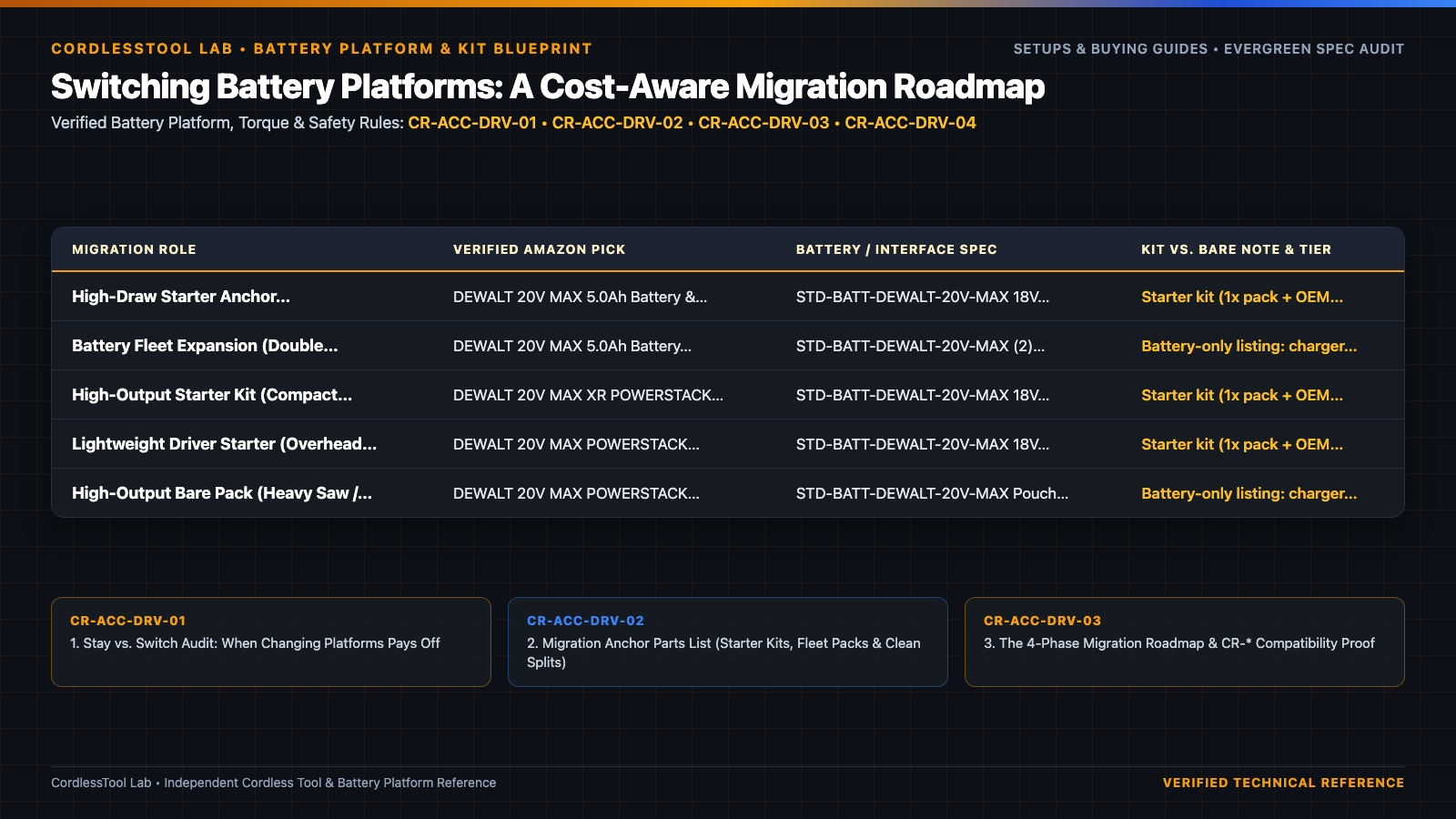
When you pull the trigger on switching cordless tool battery platforms, your first purchases must establish OEM battery energy (Wh) and compatible chargers on the new rail before any bare-tool shopping begins. The table below maps six verified Amazon US OEM anchor options across starter kits, fleet battery packs, and an intentional sub-compact second-platform split.
| Migration Role | Verified Amazon Pick | Battery / Interface Spec | Kit vs. Bare Note & Tier | Amazon Link |
|---|---|---|---|---|
| High-Draw Starter Anchor (Recommended First Buy) | DEWALT 20V MAX 5.0Ah Battery & Charger Kit (DCB205C) | STD-BATT-DEWALT-20V-MAX18V nominal · 5.0Ah (90 Wh) | Starter kit (1x pack + OEM charger)TIER-BATT-VALUE | Check Price on Amazon |
| Battery Fleet Expansion (Double 5.0Ah Pack) | DEWALT 20V MAX 5.0Ah Battery 2-Pack (DCB205-2) | STD-BATT-DEWALT-20V-MAX(2) 5.0Ah · 180 Wh nominal total | Battery-only listing: charger sold separately · TIER-BATT-MID | Check Price on Amazon |
| High-Output Starter Kit (Compact Power Anchor) | DEWALT 20V MAX XR POWERSTACK 3.5Ah Kit (DCBP320C) | STD-BATT-DEWALT-20V-MAX18V nominal · 3.5Ah (63 Wh) | Starter kit (1x pack + OEM charger)TIER-BATT-MID | Check Price on Amazon |
| Lightweight Driver Starter (Overhead Balance) | DEWALT 20V MAX POWERSTACK Compact Kit (DCBP034C) | STD-BATT-DEWALT-20V-MAX18V nominal · 1.7Ah (30.6 Wh) | Starter kit (1x pack + OEM charger)TIER-BATT-VALUE | Check Price on Amazon |
| High-Output Bare Pack (Heavy Saw / Grinder Add-On) | DEWALT 20V MAX POWERSTACK 5.0Ah Battery (DCBP520) | STD-BATT-DEWALT-20V-MAXPouch cell · 5.0Ah (90 Wh) | Battery-only listing: charger sold separately · TIER-BATT-MID | Check Price on Amazon |
| Intentional 12V Split (Compact Auto / MEP Kit) | Milwaukee 2494-25 M12 5-Tool Combo Kit | STD-BATT-MILWAUKEE-M1210.8V nominal · (2) 2.0Ah packs | Complete 5-tool kit (2 packs + charger + bag; verify seller warranty) · TIER-DIY | Check Price on Amazon |
3. The 4-Phase Migration Roadmap & CR-* Compatibility Proof
Executing a transition without stranding half your shop requires following strict electrical and mechanical compatibility gates. Walk through these four phases in order before placing bare-tool orders.
Phase 1: Map Rail Boundaries & Liquidate Legacy Tools Cleanly (CR-BATT-TOOL-01..07)
Before selling or retiring your old system, verify which tools share a battery rail and which ones never interchange. As detailed in our power tool battery interchangeability explainer, physical housings and battery-management terminals—not voltage—govern fit:
- Zero cross-brand compatibility (
CR-BATT-TOOL-01): Milwaukee M18, DeWalt 20V MAX, Makita 18V LXT, Bosch 18V, Ryobi 18V ONE+, Ridgid 18V, and Craftsman V20 never fit one another. Even shared corporate parents offer zero cross-fit—Craftsman V20 and Black+Decker 20V MAX packs do not slide onto DeWalt 20V MAX tools. - Same-brand voltage families are isolated silos (
CR-BATT-TOOL-03): Owning one brand’s logo does not guarantee cross-tool fit. Milwaukee M12, M18, and MX FUEL are three completely separate sockets; Makita 12V max CXT, 18V LXT, and 40V max XGT do not interchange; DeWalt 12V MAX stem packs do not fit 20V MAX tools; and Ryobi USB Lithium, 18V ONE+, and 40V stay strictly separate. - Know the rare one-way exceptions before buying (
CR-BATT-TOOL-04..07): Only two mainstream families allow limited cross-voltage operation. DeWalt FLEXVOLT 20V/60V MAX packs automatically down-shift to power DeWalt 20V MAX tools (with extra bulk and weight perCR-BATT-TOOL-04), yet standard 20V MAX packs can never power 60V MAX tools (CR-BATT-TOOL-05). Similarly, Metabo HPT MultiVolt 36V/18V packs run both 18V and 36V Metabo HPT tools, whereas 18V-only packs cannot run 36V tools (CR-BATT-TOOL-07). Also remember that Makita 36V (18V X2) LXT tools require two charged 18V LXT packs installed simultaneously (CR-BATT-TOOL-06)—not an XGT 40V pack. - Sell working legacy gear in bundled lots: Instead of waiting until your old batteries are completely dead, bundle working legacy tools with their remaining functional batteries and charger on local marketplaces while they still demonstrate charge retention. Keep only low-frequency specialty tools (such as an occasional glue gun or work light) quarantined with a dedicated legacy charger if their replacement cost is high.
Phase 2: Anchor Batteries & Chargers Before Bare Tools (CR-SYS-01, CR-BATT-01..05)
The fastest way to overspend during a platform switch is ordering a discounted “bare” circular saw or hammer drill only to discover it is a tool-only listing: battery and charger sold separately (CR-SYS-01). Buying a single standalone battery plus a standalone charger afterward frequently erases the bare-tool savings.
- Size energy in Watt-Hours (Wh) for the tools you are migrating (
03§3.4 e): Calculate stored energy usingNominal V × Ah = Nominal Wh. On an 18V nominal platform such as DeWalt 20V MAX or Milwaukee M18, a 1.7Ah compact pack holds30.6 Wh, a 3.5Ah pack holds63 Wh, and a 5.0Ah pack holds90 Wh. Stored Wh tells you energy capacity—never runtime minutes—for comparing packs on the same platform. - Match pack class to tool draw (
CR-BATT-TOOL-08,CR-BATT-TOOL-11): Compact packs such as the 1.7AhDCBP034keep compact drills and impact drivers balanced overhead. High-draw tools—7-1/4-inch circular saws, reciprocating saws, angle grinders, and rotary hammers—benefit from 5.0Ah or high-output packs (such as DeWalt POWERSTACK/FLEXVOLT, Milwaukee HIGH OUTPUT/FORGE, or Makita XGT) to avoid voltage sag and early electronic cutoff under load. - Cell format is a design detail, not a fit gate (
CR-BATT-04,CR-BATT-TOOL-12): Whether an OEM pack uses 18650, 21700, or pouch cells (such as DeWalt’sDCBP520POWERSTACK), it still shares the platform’s rail fit. Just verify charger generation compatibility (CR-BATT-01,CR-BATT-02) and recognize that charging large packs on slow entry chargers takes noticeably longer than on rapid fan-cooled chargers (CR-BATT-03).
Phase 3: Sequence Tool Replacements & Audit Accessory Carryover (CR-SYS-04, CR-TOOL-01..02, CR-ACC-*)
You do not have to replace every tool in one weekend. Prioritize replacing the tools you run most often or that demand high current, and verify which consumables carry over from your old shop:
- Keep intentional splits cleanly separated (
CR-SYS-04): Running two battery platforms is smart only in two scenarios: (1) pairing an 18V/20V carpentry/shop platform with a dedicated high-voltage outdoor power platform such as EGO 56V (so lawn mowers and blowers do not cook smaller 18V packs perCR-BATT-OPE-01), or (2) pairing a full-size 18V/20V system with a sub-compact 12V system such as the Milwaukee2494-25M12 5-Tool Combo Kit for tight under-dash auto repair, electrical panels, and cabinetry—provided each system keeps its own dedicated packs and charger. - Watch combo-kit motor tiers and model generations (
CR-TOOL-01,CR-TOOL-02,CR-SYS-07): Entry promo bundles often pair a modern battery with older brushed tools (like the Milwaukee2494-25M12 brushed starter bundle vs. M12 FUEL brushless models) or prior-generation hammers/drivers. Brushless motors run cooler and deliver more work per charge than brushed tools; always check exact model numbers rather than assuming every combo kit ships flagship tools. - Most accessories move across brands—with two key exceptions: Your 1/4-inch hex impact-rated driver bits (
CR-ACC-DRV-01,CR-ACC-DRV-02), 1/2-inch drill bits (CR-ACC-DRV-06), 1/2-inch or 3/8-inch square-drive impact sockets (CR-ACC-DRV-04,CR-ACC-DRV-05), 7-1/4-inch circular saw blades with 5/8-inch arbors (CR-ACC-SAW-01,CR-ACC-SAW-02), T-shank jigsaw blades (CR-ACC-SAW-05), and 5/8-11 angle-grinder wheels matched to the proper guard (CR-ACC-GRD-04) all transfer straight to your new platform. Check two exceptions before tossing consumables: SDS-plus vs. SDS-max masonry bits (CR-ACC-DRV-03) and oscillating multi-tool mounts—STARLOCK Plus/Max tools reject open-back universal blades (CR-ACC-SAW-06).
Phase 4: Reject Cross-Brand Adapters & Verify Amazon Seller Provenance (CR-BATT-TOOL-10, CR-SYS-03, CR-SYS-05)
When switching platforms, plastic adapters promising “DeWalt battery to Milwaukee tool” or “Ryobi to Makita” look tempting on marketplace search pages. Our cross-brand battery adapter risk audit flags three reasons why adapters never belong in a migration plan:
- Unapproved communication and protection gaps (
CR-BATT-TOOL-10,G-25): Battery packs and cordless tools exchange temperature, current-limit, and low-voltage cutoff signals through proprietary data pins. Third-party adapters physically bridge power rails without manufacturer approval, often bypassing tool-side or pack-side over-discharge protection—which can permanently brick expensive packs—and voiding OEM warranty coverage. - No non-OEM “replacement” batteries (
CR-SYS-03): Unbranded replacement packs advertising inflated 9.0Ah or 12.0Ah capacities at bargain prices carry documented counterfeit, cell-imbalance, and certification concerns. Buy genuine OEM packs sold by the tool brand, Amazon retail, or an authorized dealer. - Check Amazon seller authorization & variation contents (
CR-SYS-02,CR-SYS-05,G-26): Always confirm the “What’s in the box” list on your selected Amazon variation before checkout rather than relying on the gallery photo. Just as importantly, check seller provenance: DeWalt sells broadly through Amazon first-party and its official Brand Store (3-year limited warranty), whereas Milwaukee M18/M12 listings on Amazon US are dominated by third-party resellers where buyers must verify authorized-distributor status to protect Milwaukee’s 5-year tool / 2-to-3-year battery warranty. Likewise, Ryobi and Ridgid are Home Depot retail-exclusive brands in the US; Amazon third-party or bulk-split listings can forfeit OEM warranty and Ridgid’s Lifetime Service Agreement (LSA).
4. Safety, PPE, Battery Disposal & CPSC Recall Checklist
Manufacturer-First Safety, Disposal & CPSC Recall Protocol (G-24, G-12, CR-SYS-06)
- Follow tool manuals and wear PPE as the manual specifies: When transitioning onto unfamiliar tools, read each new manufacturer manual before first operation. Wear ANSI-rated eye protection, hearing protection, gloves where specified, and respiratory protection as the manual specifies—especially when running circular saws, angle grinders, or oscillating tools.
- Guards, brakes, wheels & impact wrench limits: Never remove, pin back, or bypass a circular saw lower guard, grinder Type 27 / Type 1 wheel guard, or chainsaw chain brake. Match blade and wheel maximum RPM ratings to or above tool no-load speed, remove the battery pack before every bit/blade change, and remember that an impact wrench is not a calibrated torque wrench (
CR-DRV-03)—verify critical lug or structural fasteners with a calibrated torque wrench. - Charger temperature lockouts & damaged pack retirement (
CR-BATT-05): If a new charger blinks a hot/cold delay light, let the battery reach room temperature as the manual instructs rather than forcing a charge. Never attempt to open, jump-start, or rebuild failing legacy lithium-ion packs; tape over terminals and recycle swollen, cracked, or end-of-life packs through manufacturer take-back or local Call2Recycle retail drop-offs. Note under FAA PackSafe rules that packs exceeding 100 Wh (such as 6.0Ah+ 18V/20V or FLEXVOLT packs) carry strict airline carry-on quantity and approval limits. - Mandatory CPSC recall check before reselling or buying legacy gear (
CR-SYS-06): Check serial numbers and date codes on the U.S. CPSC Recalls database before listing or buying secondhand tools. Notable active/mitigated cordless recalls include the October 2025 recall of Milwaukee M18 FUEL top-handle chainsaws (2826-20,2826-20C,2826-20T,2826-21T,2826-22T—chain brake defect, free repair remedy), the SKIL 40V 5.0Ah outdoor tool battery recall, the June 2025 DR Power 62V 5.0Ah LiPRO battery recall (refund remedy), and the Kobalt 24V/48V USB-C battery recall linked to charging via USB-C while installed in tools.
5. Official Amazon US OEM Migration Hardware (6 Verified Picks)
Every SKU below is a verified OEM listing on Amazon US selected to anchor a clean platform transition without third-party replacement packs or cross-brand adapters. Positioning references whole-dollar CordlessTool Lab tier bands rather than volatile daily retail prices.
1. DEWALT 20V MAX 5.0Ah Lithium-Ion Battery and Charger Starter Kit (DCB205C) — Best First Migration Anchor

Migration Role & Specs: High-Draw Target-Platform Starter Kit (TIER-BATT-VALUE: under $150 starter band) | STD-BATT-DEWALT-20V-MAX (18V nominal, 20V MAX label) | (1) 5.0Ah DCB205 pack (90 Wh nominal) + OEM charger.
If you are moving onto DeWalt 20V MAX via discounted bare saws, rotary hammers, or mid-torque impact wrenches, the DCB205C is the cleanest day-one foundation. One 90 Wh 5.0Ah battery supplies two parallel cell strings capable of feeding high-draw bare circular saws and grinders without tripping early cutoff (CR-BATT-TOOL-08), while the included OEM charger satisfies CR-BATT-01 immediately. Two real trade-offs: it ships with only one battery (so continuous work still calls for a second pack), and the bundled standard charger charges slower than DeWalt’s fan-cooled rapid chargers (CR-BATT-03).
2. DEWALT 20V MAX 5.0Ah Lithium-Ion Battery 2-Pack (DCB205-2) — Fleet Capacity Expansion
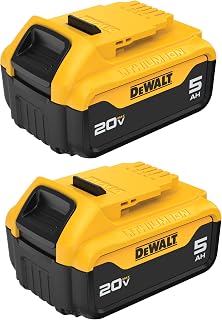
Migration Role & Specs: Multi-Tool Shop Fleet Expansion (TIER-BATT-MID: $80–$180 / $150–$300 band) | STD-BATT-DEWALT-20V-MAX (18V nominal) | (2) 5.0Ah DCB205 packs (180 Wh nominal combined) | Battery-only listing: charger sold separately.
Once your new platform includes both a drill/driver and a saw or grinder, rotating a single battery slows down every project. Adding the DCB205-2 2-pack immediately provides 180 Wh of combined OEM capacity so two tools stay ready while a third pack sits on the charger. Note two caveats under CR-SYS-01 and CR-BATT-TOOL-11: no charger is included in this box (pair it after buying a starter kit or combo kit), and 5.0Ah packs add noticeable weight to compact overhead drills compared with 1.7Ah or 2.0Ah packs.
3. DEWALT 20V MAX XR POWERSTACK 3.5Ah Battery and Charger Kit (DCBP320C) — High-Output Mid-Weight Starter

Migration Role & Specs: Compact High-Output Starter Kit (TIER-BATT-MID) | STD-BATT-DEWALT-20V-MAX (18V nominal) | (1) 3.5Ah XR POWERSTACK pack (63 Wh nominal) + OEM charger.
Buyers switching from a bulky legacy platform often want one pack that handles both daily driving and intermittent high-draw cuts without the footprint of a larger 5.0Ah–8.0Ah pack. The DCBP320C pairs DeWalt’s 3.5Ah XR POWERSTACK battery (63 Wh nominal) with an OEM 20V MAX charger. Under CR-BATT-04, cell format is a design detail rather than a fit variable—it clicks onto standard 20V MAX tools—but keep in mind two limits: stored Wh is 30% lower than a 5.0Ah pack for marathon circular saw ripping, and it cannot run 60V MAX FLEXVOLT tools (CR-BATT-TOOL-05).
4. DEWALT 20V MAX Starter Kit with POWERSTACK Compact Battery and Charger (DCBP034C) — Lightweight Ergonomics Entry
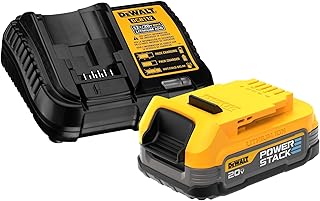
Migration Role & Specs: Low-Weight Drilling & Fastening Anchor (TIER-BATT-VALUE: under $150 starter band) | STD-BATT-DEWALT-20V-MAX (18V nominal) | (1) 1.7Ah DCBP034 compact POWERSTACK pack (30.6 Wh nominal) + OEM charger.
If your first bare-tool replacements on a new platform are compact impact drivers, oscillating multi-tools, or drywall/cabinet drills, the DCBP034C starter kit delivers an authentic 20V MAX charger and a low-profile 1.7Ah pouch-cell battery tailored to overhead ergonomics (CR-BATT-TOOL-11). Two caveats apply: its 30.6 Wh nominal capacity is not built for sustained circular saw or grinder workloads (CR-BATT-TOOL-08), and you still only receive one battery out of the box.
5. DEWALT 20V MAX POWERSTACK 5.0Ah Lithium-Ion Battery (DCBP520) — High-Output Saw & Grinder Upgrade

Migration Role & Specs: High-Draw Bare Battery Expansion (TIER-BATT-MID: $80–$180 single-pack band) | STD-BATT-DEWALT-20V-MAX (18V nominal) | (1) 5.0Ah pouch-cell pack (90 Wh nominal, ~1.4 lb per retailer listing) | Battery-only listing: charger sold separately.
Once you own a 20V MAX charger from a starter kit, the DCBP520 serves as DeWalt’s flagship high-output 5.0Ah pouch-cell pack for heavy-draw 20V MAX bare tools. DeWalt markets the DCBP520 as delivering more power and longer cycle life compared directly against its standard DCB205 5.0Ah pack (CR-BATT-04). Two clear limitations: it is a battery-only listing: charger sold separately (CR-SYS-01), and despite its high-output rating, it remains strictly a 20V MAX pack that cannot power 60V MAX FLEXVOLT tools (CR-BATT-TOOL-05).
6. Milwaukee 2494-25 M12 5-Tool Combo Kit — Intentional Sub-Compact Second-Platform Split

Migration Role & Specs: Intentional Dual-Platform Sub-Compact Split (TIER-DIY: $250–$500) | STD-BATT-MILWAUKEE-M12 (10.8V nominal, M12 label) | Includes M12 Drill, Impact Driver, 3/8″ Ratchet, Inflator, Work Light, (2) 2.0Ah stem batteries, M12 charger, and tool bag.
Sometimes switching cordless tool battery platforms is not about abandoning an 18V/20V shop—it is about offloading tight-clearance automotive, HVAC, and cabinet tasks onto a dedicated 12V stem-pack rail. Because the 2494-25 includes two M12 batteries and its own M12 charger, it satisfies CR-SYS-04 as an independent second platform rather than an orphaned bare tool. Note three important caveats: first, M12 packs never fit M18 tools (CR-BATT-TOOL-03); second, this 2494-25 kit ships entry brushed M12 tools rather than brushless M12 FUEL models (CR-TOOL-01, CR-SYS-07); and third, because Milwaukee listings on Amazon US frequently ship via third-party resellers, confirm authorized-dealer status before purchase to preserve OEM warranty coverage (CR-SYS-05, G-26).
How We Audited This Guide
- Workshop blueprints, upgrade roadmaps, and Amazon marketplace audits enforce single-platform battery lock-in budgets, third-party pack and adapter exclusion rules, Bare Tool trap checks, and PPE/kickback safety.
- Every cordless drill, impact driver, saw, grinder, battery pack, charger, outdoor power tool, and accessory spec was cross-checked against official OEM manuals, UL/ANSI ratings, and live Amazon US listings.
- Recommendations were evaluated against our weighted vertical scoring rubrics and 61 documented CR-* platform and safety rules; we never invent peak torque ft-lbs, cut counts, runtime minutes, or battery decibels.
6. Frequently Asked Questions
Can I use a cross-brand battery adapter when switching cordless tool battery platforms?
No. Under rules CR-BATT-TOOL-10 and G-25, third-party cross-brand adapters are not approved by either tool maker. They can bypass pack-to-tool thermal and over-discharge communication, risk bricking batteries, and jeopardize warranty coverage. Anchor your new platform with an OEM starter kit instead.
Should I buy bare tools or a combo kit first on a new battery platform?
Always buy a combo kit or a battery-and-charger starter kit first (CR-SYS-01). Bare tools are tool-only listings with battery and charger sold separately, and buying standalone batteries plus a standalone charger afterward usually costs more than anchoring with a bundled starter kit.
Is switching from an 18V brand to a 20V MAX brand a power upgrade?
No. Under compatibility rule CR-BATT-TOOL-02, DeWalt 20V MAX, Milwaukee M18, Makita 18V LXT, and Ryobi ONE+ are all 18-volt nominal platforms using five lithium-ion cells in series. “20V MAX” describes peak unloaded voltage off the charger, not extra tool power.
When does running two battery platforms actually make sense?
An intentional two-platform split works best when separating indoor 18V/20V carpentry tools from either a dedicated high-voltage yard system (such as 56V EGO) or a compact 12V system (such as Milwaukee M12), provided each platform keeps its own OEM batteries and charger (CR-SYS-04).
Why should I check Amazon seller provenance before buying Milwaukee, Ryobi, or Ridgid kits?
Under rule CR-SYS-05 and guardrail G-26, Ryobi and Ridgid are Home Depot retail-exclusive brands in the US, and Milwaukee Amazon listings are heavily populated by third-party resellers. Unauthorized reseller or bulk-split purchases can lose OEM warranty and Ridgid Lifetime Service Agreement coverage.
Final Migration Takeaway & Authoritative Sources
A disciplined platform switch replaces guesswork with sequence: audit dead legacy packs first, ignore 20V-vs-18V marketing labels, liquidate working old tools in complete sets before their cells die, anchor your destination rail with an OEM battery-and-charger kit such as the DEWALT DCB205C, and scale into bare saws only once 90 Wh class packs are in your bag. Keep cross-brand adapters out of your shop, verify Amazon seller authorization on every order, and consult the authoritative manufacturer and safety resources below before buying or selling gear:
- DEWALT Official Safety Notices & Product Manuals — OEM battery, charger, and guard compliance instructions.
- Milwaukee Tool US Warranty & Authorized Distributor Policy — Warranty duration and authorized seller requirements for M12/M18 tools and packs.
- U.S. Consumer Product Safety Commission (CPSC) Recalls Database — Official recall verification for chainsaws, yard equipment, and lithium-ion packs.
- OSHA Hand and Power Tools Safety Standards — Guarding, PPE, and workplace power-tool safety guidance.
- FAA PackSafe Lithium Battery Guidance — 100 Wh carry-on watt-hour thresholds for lithium-ion battery transport.


