
On This Page
Disclosure: As an Amazon Associate, CordlessTool Lab earns from qualifying purchases. If you buy verified OEM tools or battery kits through links on this page, we may earn a small commission at no extra cost to you. Commission rates never influence platform recommendations.
Comparing ryobi one+ vs dewalt 20v max comes down to one decisive platform rule before any drill or saw specification matters: choose the battery rail first, because once you own packs and chargers on one system, staying on that platform delivers far better long-term value (CR-SYS-04). Both Ryobi 18V ONE+ and DeWalt 20V MAX run on identical five-cell, 18-volt nominal lithium-ion chemistry—yet their housings, high-output pack tiers, 60V upgrade paths, and US retail warranty rules separate them cleanly between budget-focused homeowner shops and demanding remodeling or jobsite trades.
If you are mapping out your first cordless ecosystem from scratch, start with our pillar overview of cordless tool battery platforms so you understand how voltage families and mechanical rails lock tools together. Below, we audit Ryobi ONE+ and DeWalt 20V MAX across electrical parity, motor generations, charger architecture, bare-tool economics, and Amazon US seller provenance.
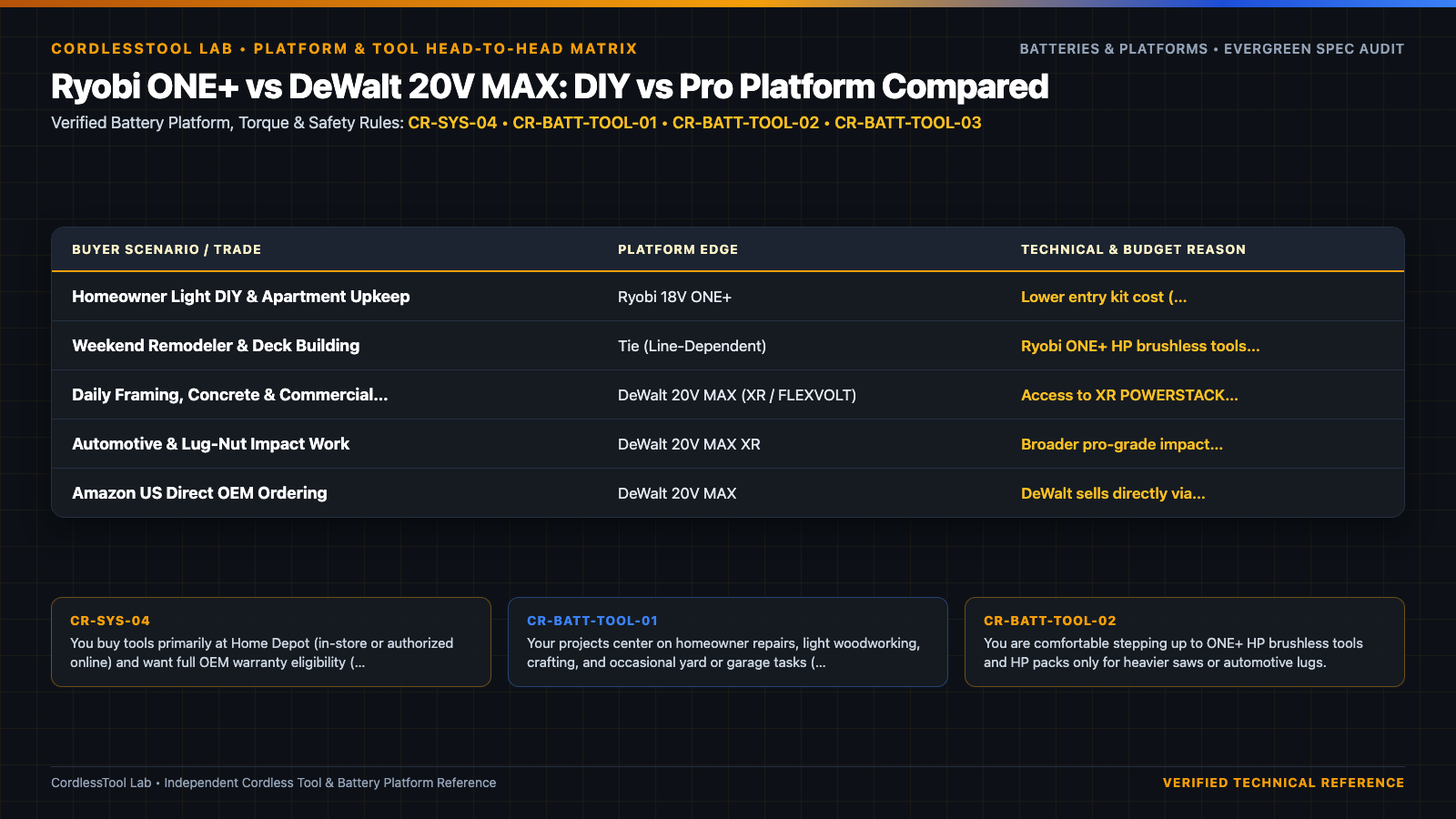
Quick Verdict Matrix: Which Platform Wins by Use Case?
Neither ecosystem wins every trade or household garage. Instead of crowning a single blanket champion, match your primary tasks, budget tier, and preferred retailer to the verified trade-offs in the matrix below.
| Buyer Scenario / Trade | Platform Edge | Technical & Budget Reason |
|---|---|---|
| Homeowner Light DIY & Apartment Upkeep | Ryobi 18V ONE+ | Lower entry kit cost (TIER-ENTRY to TIER-STARTER) and a massive catalog of specialty lifestyle tools, inflators, fans, and light-duty drivers sharing one stem-and-slide rail. |
| Weekend Remodeler & Deck Building | Tie (Line-Dependent) | Ryobi ONE+ HP brushless tools cover TIER-DIY budgets well, while DeWalt ATOMIC and XR brushless kits add tighter ergonomics and faster OEM charger options. |
| Daily Framing, Concrete & Commercial Trades | DeWalt 20V MAX (XR / FLEXVOLT) | Access to XR POWERSTACK pouch-cell packs, ANTI-ROTATION flagship drills, and one-way compatibility with 60V MAX FLEXVOLT high-draw saws and grinders. |
| Automotive & Lug-Nut Impact Work | DeWalt 20V MAX XR | Broader pro-grade impact wrench lineup and higher-current pack pairings; always finish lug nuts with a calibrated torque wrench per vehicle specs (CR-DRV-03). |
| Amazon US Direct OEM Ordering | DeWalt 20V MAX | DeWalt sells directly via Amazon first-party retail and its official Brand Store, whereas Ryobi is Home Depot retail-exclusive in the US with third-party seller warranty risks on marketplaces (CR-SYS-05). |
| Already Own Packs on One Rail | Your Existing Platform | Never split a workshop across incompatible 18V rails unless adding a dedicated higher-voltage yard system with its own packs and charger (CR-SYS-04). |
Side-by-Side Platform & Compatibility Audit
Every specification in the comparison table below reflects official US manufacturer platform documentation. Where an internal cell chemistry or model-specific dimension is unpublished across an entire product line, it is noted honestly as no verified data available yet rather than estimated.
| Platform Attribute | Ryobi 18V ONE+ | DeWalt 20V MAX |
|---|---|---|
| Nominal Voltage (Electrochemical) | 18V nominal (5 series lithium-ion cell groups) | 18V nominal (5 series lithium-ion cell groups) |
| Marketing Voltage Label | 18V ONE+ (working nominal label) | 20V MAX (maximum initial unloaded voltage; CR-BATT-TOOL-02) |
| Battery Housing Interface | Stem-and-slide hybrid pod rail (STD-BATT-RYOBI-ONEPLUS-18V) | Flat slide rail (STD-BATT-DEWALT-20V-MAX) |
| Cross-Brand Interchangeability | None; fits Ryobi 18V ONE+ tools only (CR-BATT-TOOL-01) | None; incompatible with Ryobi, Craftsman V20, and Black+Decker 20V MAX |
| Same-Brand Non-Compatible Lines | Ryobi 40V (36V nominal) and Ryobi 4V USB Lithium (CR-BATT-TOOL-03) | DeWalt 12V MAX (10.8V nominal stem packs) |
| Higher-Voltage Pack Bridge | None; 18V ONE+ and 40V remain strictly separated | One-way downward fit: 60V MAX FLEXVOLT packs run 20V MAX tools (CR-BATT-TOOL-04); 20V packs never run 60V tools (CR-BATT-TOOL-05) |
| High-Output Battery Tier | ONE+ HP packs (e.g., 4Ah HP class, 72 Wh nominal 18V basis) | XR POWERSTACK pouch-cell packs (DCBP034, DCBP320, DCBP520) & FLEXVOLT bricks |
| Tool Motor Generations | Brushed ONE+ entry line + ONE+ HP brushless tier | Brushed entry kits (DCK240C2) + ATOMIC compact brushless + XR brushless |
| Torque Rating Method | Brand-published in-lbs / ft-lbs method (not cross-brand normalized; CR-DRV-02) | Max brake torque + Unit Watts Out (UWO) power rating |
| US Retail & Warranty Channel | Home Depot retail-exclusive; Amazon offers are third-party resellers (CR-SYS-05) | Amazon US first-party retail, official Brand Store & major pro distributors (3-year limited pack warranty on select models) |
| Active CPSC Battery Recall Status | Verify serial numbers on CPSC.gov; zero open core ONE+ lithium pack recalls in current audit | Verify serial numbers on CPSC.gov; zero open core 20V MAX pack recalls in current audit |
Battleground 1: Voltage Parity, Cell Architecture & High-Output Packs
The single most common misconception in the ryobi one+ vs dewalt 20v max debate is assuming that “20V MAX” delivers 11% more electrical muscle than “18V ONE+.” Under CR-BATT-TOOL-02, both platforms arrange five ~3.6-volt lithium-ion cell groups in series (5S). Fresh off the charger with zero load, a five-cell pack reads roughly 20 to 21 volts on a multimeter—which DeWalt markets as 20V MAX—before immediately settling to its 18-volt nominal operating plateau once a drill trigger is pulled. Ryobi simply prints the 18V nominal figure on the badge. Neither sticker implies higher power on its own.
Stored Energy (Wh) vs. High-Output Current Delivery
To compare stored battery energy accurately across either brand, multiply the 18V nominal voltage by the pack’s amp-hour (Ah) rating to get nominal watt-hours (Wh). A Ryobi ONE+ HP 4.0Ah pack holds 72 Wh (18V × 4.0Ah), whereas DeWalt’s reference 5.0Ah pack (DCB205) and 5.0Ah POWERSTACK pack (DCBP520) each store 90 Wh (18V × 5.0Ah). Stored watt-hours measure fuel tank size, never guaranteed minutes of runtime or screw counts, because motor efficiency and material resistance vary per job (G-01).
Where modern packs diverge is sustained current delivery under heavy load (CR-BATT-TOOL-08). Standard cylindrical 18650 packs handle everyday driving and assembly without trouble, yet heavy-draw circular saws, angle grinders, and high-torque impact wrenches can trigger early thermal or low-voltage cutoffs on small compact packs:
- Ryobi ONE+ HP Architecture: Ryobi pairs its brushless ONE+ HP tools with High Performance batteries featuring upgraded cell output and multi-pin communication contacts designed to supply higher sustained current to demanding HP saws and grinders. Exact internal cylindrical cell suppliers vary by pack SKU and production run (no verified data available yet across every capacity).
- DeWalt XR POWERSTACK & FLEXVOLT Architecture: DeWalt offers flat laminated pouch-cell packs (such as the
DCBP5205.0Ah and compactDCBP034) alongside cylindricalDCB205XR packs and dual-voltage FLEXVOLT bricks. Per DeWalt’s official DCBP520 specifications, its 5.0Ah POWERSTACK pack delivers 50% more power and twice the lifespan compared specifically against DeWalt’s cylindricalDCB205pack. UnderCR-BATT-04, cell format affects current resistance and footprint—never which tools a pack fits.
For travel or parcel shipping, keep an eye on pack energy: single 18V packs up to 5.0Ah (90 Wh nominal) sit below the 100 Wh threshold referenced in FAA PackSafe lithium battery guidance, while 6.0Ah (108 Wh nominal) and 9.0Ah FLEXVOLT packs (162 Wh nominal / 180 Wh DeWalt label basis) exceed 100 Wh and carry airline and carrier restrictions.
Battleground 2: Rail Lock-In, Backward Compatibility & 60V Upgrade Paths
Mechanical rail design is where Ryobi and DeWalt feel completely different in the hand—and where long-term upgrade flexibility separates them.
Stem-and-Slide Pod vs. Flat Slide Rail
Ryobi’s signature 18V ONE+ stem-and-slide pod extends upward into the tool handle, preserving mechanical backward compatibility with decades of Ryobi ONE+ cordless tools per Ryobi’s official ONE+ platform page (legacy NiCd/NiMH packs excluded; CR-BATT-TOOL-12). The trade-off is handle circumference: compact ONE+ tools still require a grip wide enough to swallow the central battery stem, and compact ONE+ packs remain slightly taller beneath the grip than flat slide designs.
DeWalt transitioned years ago to a flat slide rail across its entire DeWalt 20V MAX battery platform, covering entry brushed kits, compact ATOMIC tools, pro-grade XR tools, and POWERSTACK packs. Removing the internal stem lets DeWalt sculpt narrower handles and fit compact 1.7Ah pouch packs cleanly into tight cabinetry or electrical enclosures. Remember that shared parent ownership never equals battery fit: DeWalt 20V MAX packs do not fit Craftsman V20 or Black+Decker 20V MAX tools despite Stanley Black & Decker owning all three brands (CR-BATT-TOOL-01).
Same-Brand Voltage Walls & The FLEXVOLT Bridge
Same brand is never enough across voltage families (CR-BATT-TOOL-03). On Ryobi, 18V ONE+ packs never fit Ryobi 40V (36V nominal) outdoor equipment or Ryobi 4V USB Lithium gadgets. On DeWalt, 20V MAX packs never fit DeWalt 12V MAX (10.8V nominal) stem tools.
DeWalt holds one unique architectural advantage for heavy saws, rotary hammers, and yard tools: FLEXVOLT 20V/60V MAX dual-voltage batteries (DCB606, DCB609, DCB612). These packs automatically switch internal cell wiring between parallel 18V nominal (20V MAX) and series 54V nominal (60V MAX):
- Downward Fit (
CR-BATT-TOOL-04, SOFT caveat): A FLEXVOLT pack slides onto and runs DeWalt 20V MAX tools in 20V MAX mode. However, it adds substantial weight and bulk—making a compact 20V drill or impact driver tail-heavy for overhead ladder work (CR-BATT-TOOL-11). - Upward Lockout (
CR-BATT-TOOL-05, HARD stop): Standard 20V MAX packs (includingDCB205andDCBP520) physically cannot power 60V MAX FLEXVOLT saws, grinders, or outdoor tools. Never add a FLEXVOLT pack’s 20V Ah rating and 60V Ah rating together—the 6.0AhDCB606stores the exact same 108 Wh nominal energy in both modes (6.0Ah at 18V nominal equals 2.0Ah at 54V nominal).
Battleground 3: Brushed vs. Brushless Tiers & Torque Spec Pitfalls
Both Ryobi and DeWalt sell entry-level brushed tools alongside flagship brushless hardware—and both rely on combo-kit naming that can confuse first-time buyers (CR-TOOL-01, CR-SYS-07). Under CR-TOOL-01, brushless motors run cooler and convert battery energy more efficiently into sustained work per charge than brushed motors, though brushed drills remain entirely serviceable for light furniture assembly and occasional homeowner repairs.
Always check the exact model number inside a combo kit rather than assuming flagship performance from a brand badge:
- Ryobi Tier Split: Basic green ONE+ combo kits frequently bundle brushed drills and circular saws to hit
TIER-ENTRYandTIER-STARTERpricing, while ONE+ HP kits upgrade to brushless motors and higher-draw electronics for framing, masonry, and automotive fasteners. - DeWalt Tier Split: Entry kits such as the
DCK240C2pair brushed 20V MAX tools with compact batteries insideTIER-STARTER($100–$250 broad kit bracket). Stepping up to ATOMIC brings compact brushless housings, while XR delivers full-size brushless durability and safety features such as electronicANTI-ROTATIONkickback control on the flagshipDCD1007hammer drill (CR-DRV-04).
Critical Torque Comparison Warning (CR-DRV-02, G-15): Do not rank Ryobi ONE+ drills or impact wrenches against DeWalt 20V MAX tools purely by comparing printed spec-sheet torque numbers. DeWalt measures max brake torque and publishes Unit Watts Out (UWO) power ratings, whereas Ryobi states in-lbs and ft-lbs using its own internal fixture method. Furthermore, manufacturers often tie rated peak output to a specific high-output reference pack (CR-BATT-TOOL-09, G-03)—dropping a compact 1.5Ah or 2.0Ah battery onto a high-draw impact wrench or circular saw will not replicate figures achieved on an HP, POWERSTACK, or FLEXVOLT pack. Without identical third-party measurement conditions across both contenders, cross-brand spec-sheet torque rankings are invalid.
Battleground 4: Chargers, Thermal Lockout & Battery Safety
Chargers dictate how smoothly a two-battery shop stays running (CR-BATT-01 through CR-BATT-05). Entry kits in both ecosystems frequently include slow wall-wart or low-amperage standard chargers that stretch recharge times past two hours on 4.0Ah or 5.0Ah packs (CR-BATT-03):
- DeWalt Multi-Family Charging: Many DeWalt benchtop chargers—including standard units like the
DCB115and the fan-cooled rapidDCB118—charge DeWalt 12V MAX, 20V MAX, and FLEXVOLT packs on one unit (verify supported pack families on each charger’s datasheet;CR-BATT-01,CR-BATT-02). - Ryobi Dedicated ONE+ Charging: Ryobi ONE+ chargers (such as the
P118dual-chemistry charger and current ONE+ rapid or multi-port superchargers) charge 18V ONE+ and ONE+ HP packs only—never Ryobi 40V or USB Lithium batteries.
On both platforms, blinking temperature indicator lights signal that the charger’s thermal protection circuit has paused charging because the pack is too hot from heavy cutting or too cold from an unheated truck or shed (CR-BATT-05). Let the battery reach the room-temperature charging window specified in the manufacturer’s manual before re-docking it. Follow the manual’s exact storage guidance, never use a pack that is swollen, cracked, wet, or overheated, and dispose of damaged lithium-ion batteries through brand take-back programs or local household hazardous-waste recycling drop-offs as the manual directs (G-24). Before buying used or clearance packs, verify model serial numbers on the U.S. CPSC Recalls database (CR-SYS-06).
Battleground 5: Starter Economics, Retail Exclusivity & Warranty Caveats
Budget planning differs sharply depending on where you shop and how many bare tools you plan to add over five years (CR-SYS-01, G-08). Ryobi 18V ONE+ dominates TIER-ENTRY (under $100) and TIER-STARTER ($100–$250) kit economics inside Home Depot seasonal promos, making it far cheaper to pick up niche bare tools like cordless caulk guns, glue guns, inflators, and compact fans. DeWalt 20V MAX starts slightly higher in TIER-STARTER to TIER-DIY ($250–$500) for brushless ATOMIC or XR kits, while offering clear pro-grade durability and resale demand across TIER-PROSUMER ($500–$900) and TIER-PRO ($900–$1,800) setups.
Crucial US Channel & Warranty Warning (G-26, CR-SYS-05): Ryobi is a Home Depot retail-exclusive brand in the United States. While Ryobi tools and ONE+ battery kits appear on Amazon US, those listings come from third-party resellers—often split out of retail combo bundles—rather than Ryobi or Amazon first-party retail. Manufacturer warranty coverage can be denied when tools are not purchased from an authorized US retailer. Read our full Ryobi & Ridgid on Amazon seller and warranty audit before clicking checkout on any marketplace Ryobi listing.
Excluded Market Traps: Clone Packs & Plastic Adapters (G-25, CR-BATT-TOOL-10)
When comparing platform costs, ignore two tempting marketplace shortcuts—both are explicitly excluded from our recommended buy lists:
- Non-OEM “Replacement For” Clone Batteries (
CR-SYS-03): Generic Amazon packs claiming 9.0Ah or 12.0Ah capacity for Ryobi ONE+ or DeWalt 20V MAX frequently inflate ratings, skip UL/ETL safety certification, and omit OEM thermal communication pins. Buy only genuine OEM packs sold by the brand, Amazon retail, or an authorized dealer. - Ryobi-to-DeWalt / DeWalt-to-Ryobi Plastic Adapters (
CR-BATT-TOOL-10): Cross-brand plastic sleds bridge only positive and negative terminals while cutting off brand-specific BMS temperature and low-voltage shutoff lines. Neither Ryobi nor DeWalt approves adapters, using them can permanently over-discharge cells, and warranty coverage may be refused.
Final Platform Decision: Choose Ryobi ONE+ vs. Choose DeWalt 20V MAX
Choose Ryobi 18V ONE+ If…
- You buy tools primarily at Home Depot (in-store or authorized online) and want full OEM warranty eligibility (
CR-SYS-05). - Your projects center on homeowner repairs, light woodworking, crafting, and occasional yard or garage tasks (
TIER-ENTRYtoTIER-DIY). - You value hundreds of affordable specialty bare tools—lights, fans, rotary tools, inflators—sharing one backward-compatible ONE+ battery rail.
- You are comfortable stepping up to ONE+ HP brushless tools and HP packs only for heavier saws or automotive lugs.
Choose DeWalt 20V MAX If…
- You prefer buying verified OEM tools and batteries directly from Amazon US first-party retail, the DEWALT Brand Store, or pro supply houses.
- You tackle daily remodeling, deck framing, concrete anchoring, or fabrication requiring XR brushless durability and slim slide-rail ergonomics.
- You want high-output XR POWERSTACK stacked pouch packs (
DCBP520) that curb voltage sag without adding bulky dual-voltage bricks. - You want a future upgrade path into 60V MAX FLEXVOLT miter saws, grinders, or yard equipment whose packs also run 20V MAX tools.
Verified Amazon US OEM Starter Kits & Battery Options
Because Ryobi 18V ONE+ is Home Depot retail-exclusive in the US (G-26), shoppers who want guaranteed OEM warranty provenance directly through Amazon US should focus on verified first-party DEWALT 20V MAX starter kits and upgrade packs below. Always verify the selected Amazon variation’s “What’s in the box” list before ordering (CR-SYS-02).
1. DEWALT 20V MAX 5.0Ah Battery & Charger Starter Kit (DCB205C) — Best First-Time 20V MAX Entry

Key Specs: 18V Nominal (20V MAX label) | 5.0Ah / 90 Wh (nominal 18V basis) | Includes 1x DCB205 Battery + Charger | Flat Slide Rail | Budget Band: TIER-BATT-VALUE
If you are leaving Ryobi or building a new DeWalt 20V MAX setup around bare tools, the DCB205C starter kit solves the CR-SYS-01 charger barrier immediately. It bundles DeWalt’s benchmark 5.0Ah DCB205 pack with a matching charger, unlocking lower bare-tool pricing on ATOMIC and XR tools right away.
Pros
- Includes both an OEM 90 Wh battery and a DeWalt charger in one
TIER-BATT-VALUEkit. - Fits all 20V MAX tools and sits under the 100 Wh air-travel limit.
Cons
- Includes only a single pack—heavy continuous jobs still pause during recharge without a second battery.
- Standard cylindrical DCB205 cells trail POWERSTACK pouch packs on peak sustained high-draw output.
2. DEWALT 20V MAX XR POWERSTACK 5.0Ah Battery (DCBP520) — Best High-Output 20V Upgrade

Key Specs: 18V Nominal (20V MAX label) | 5.0Ah / 90 Wh (nominal 18V basis) | Stacked Pouch Cells | Tool-Only Listing: battery and charger sold separately (bare pack; CR-SYS-01) | Budget Band: TIER-BATT-MID
Designed for remodeling saws, grinders, and heavy hammer drilling (CR-BATT-TOOL-08), the DCBP520 replaces cylindrical cans with low-resistance stacked pouch cells. DeWalt rates it for 50% more power and twice the lifespan compared against its own DCB205 pack while remaining compatible with every 20V MAX tool and charger (CR-BATT-TOOL-12).
Pros
- Stacked pouch architecture lowers internal impedance on high-draw 20V MAX circular saws and grinders.
- Rubberized impact-resistant base and clear LED fuel gauge built for daily jobsite use.
Cons
- Bare battery (tool-only listing: battery and charger sold separately)—requires an existing 20V MAX charger.
- Cannot step up to 54V/60V nominal output for DeWalt 60V MAX FLEXVOLT tools (
CR-BATT-TOOL-05).
3. DEWALT 20V MAX POWERSTACK Compact Starter Kit (DCBP034C) — Best Lightweight & Overhead Kit
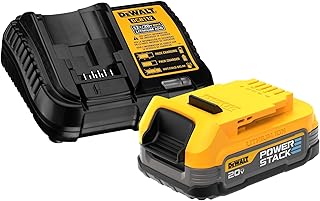
Key Specs: 18V Nominal (20V MAX label) | 1.7Ah / 30.6 Wh (nominal 18V basis) | Stacked Pouch Cells | Includes 1x DCBP034 Battery + Charger | Budget Band: TIER-BATT-VALUE
Homeowners upgrading from bulky stem-style drills appreciate how compact the DCBP034C starter kit feels on ATOMIC drills, impact drivers, and oscillating multi-tools. Keeping stored capacity compact minimizes wrist fatigue during overhead drywall, shelving, and cabinetry work (CR-BATT-TOOL-11) while still supplying punchy pouch-cell current.
Pros
- Ultra-compact footprint balances cleanly on one-handed drills and tight overhead fasteners.
- Ships complete with an OEM DeWalt charger in the
TIER-BATT-VALUEstarter bracket.
Cons
- 30.6 Wh nominal capacity drains quickly on circular saws, grinders, or long decking runs (
CR-BATT-TOOL-08). - Includes only one compact battery rather than a two-pack rotation.
4. DEWALT FLEXVOLT 20V/60V MAX 6.0Ah Battery (DCB606) — Best Dual-Voltage Upgrade Path

Key Specs: 18V / 54V Nominal (20V/60V MAX dual-voltage) | 6.0Ah at 20V MAX / 108 Wh nominal | Tool-Only Listing: battery and charger sold separately (bare pack; CR-SYS-01) | Budget Band: TIER-BATT-MID
The DCB606 highlights the one ecosystem capability Ryobi ONE+ lacks: automatic voltage switching between DeWalt 20V MAX tools and heavy-duty 60V MAX FLEXVOLT saws, grinders, and outdoor equipment (CR-BATT-TOOL-04, CR-BATT-TOOL-05). Slide it onto a 20V MAX saw for extended 108 Wh work, then move it straight onto a 60V MAX chainsaw or miter saw later.
Pros
- Bridges DeWalt 20V MAX and 60V MAX FLEXVOLT tools with zero separate battery inventory.
- 108 Wh nominal energy supports demanding 60V saws and outdoor equipment.
Cons
- Noticeably heavier and bulkier on compact 20V MAX drills or impact drivers (
CR-BATT-TOOL-04). - Bare pack (tool-only listing: battery and charger sold separately) and exceeds the 100 Wh airline carry-on limit.
How We Audited This Guide
- Battery packs and chargers were audited across 18V/20V Max vs. 36V/40V/56V/60V nominal voltage behavior, 18650 vs. 21700/tabless pouch cells, charger amperage/sequential logic, and strict OEM-only UL BMS protection.
- Every cordless drill, impact driver, saw, grinder, battery pack, charger, outdoor power tool, and accessory spec was cross-checked against official OEM manuals, UL/ANSI ratings, and live Amazon US listings.
- Recommendations were evaluated against our weighted vertical scoring rubrics and 61 documented CR-* platform and safety rules; we never invent peak torque ft-lbs, cut counts, runtime minutes, or battery decibels.
Frequently Asked Questions: Ryobi ONE+ vs. DeWalt 20V MAX
Are DeWalt 20V MAX batteries more powerful than Ryobi 18V ONE+ batteries?
No. Both DeWalt 20V MAX and Ryobi 18V ONE+ use five-cell lithium-ion packs at 18 volts nominal under working load. DeWalt markets peak open-circuit voltage (20V MAX), while Ryobi states nominal voltage (18V). Real-world output depends on cell impedance, high-output tier, and motor design—not the voltage sticker.
Can Ryobi 18V ONE+ batteries fit DeWalt 20V MAX tools with an adapter?
Neither Ryobi nor DeWalt approves third-party cross-brand battery adapters, and we do not recommend them. Plastic sled adapters interrupt OEM thermal monitoring and low-voltage cutoff signals between pack and tool, which risks over-discharging lithium cells and can void manufacturer warranty claims.
Do older Ryobi ONE+ tools work with newer ONE+ HP batteries?
Yes, Ryobi states that 18V ONE+ and ONE+ HP lithium-ion batteries fit across its 18V ONE+ tool lineup, keeping the stem-and-slide pod rail intact. However, Ryobi 18V ONE+ batteries never fit Ryobi 40V outdoor tools or 4V USB Lithium products, which are separate platforms.
Is it safe to buy Ryobi ONE+ tools on Amazon instead of Home Depot?
In the United States, Ryobi is a Home Depot retail-exclusive brand. Listings on Amazon US come from third-party resellers rather than Ryobi directly, which can compromise OEM 3-year warranty eligibility if the seller is unauthorized. Always verify authorized-retailer status before buying Ryobi online.
Can standard DeWalt 20V MAX packs run 60V MAX FLEXVOLT tools?
No. DeWalt FLEXVOLT compatibility works in one direction only: 20V/60V MAX FLEXVOLT packs step down to run DeWalt 20V MAX tools, whereas standard 20V MAX packs such as the DCB205 or POWERSTACK DCBP520 cannot power 60V MAX FLEXVOLT saws, grinders, or outdoor equipment.


