
Disclosure: As an Amazon Associate, CordlessTool Lab earns from qualifying purchases. If you buy through links on this page, we may earn a small commission at no extra cost to you. Commission rates (3% in Tools & Home Improvement) never alter our compatibility rules or hardware evaluations.
If you already own DeWalt cordless gear or are shopping for higher-capacity packs, one practical question comes up constantly: can you use flexvolt battery in 20v tool housings without damaging your motor or electronics? Yes—every DeWalt FLEXVOLT 20V/60V MAX battery physically fits and safely powers DeWalt 20V MAX tools by automatically switching its internal cell banks to 18V nominal mode (CR-BATT-TOOL-04). Understanding how that one-way voltage switch works—and where our cordless tool battery platforms hub draws hard compatibility boundaries—prevents costly starter-kit mistakes.
Quick Answer — Can You Use a FLEXVOLT Battery in a 20V MAX Tool?
Yes. DeWalt FLEXVOLT 20V/60V MAX batteries are engineered for downward compatibility with DeWalt 20V MAX tools, switching automatically from 54V nominal to 18V nominal when latched onto a 20V MAX rail (CR-BATT-TOOL-04). However, compatibility runs strictly one way: standard 20V MAX packs never fit or run 60V MAX FLEXVOLT tools (CR-BATT-TOOL-05).
In This Guide
- 1. How FLEXVOLT Auto-Switching Works Inside a 20V MAX Tool
- 2. Nominal Voltage Parity & Worked Watt-Hour (Wh) Examples
- 3. DeWalt Battery & Tool Compatibility Matrix
- 4. Weight, Balance & High-Draw Tool Performance Caveats
- 5. Charger Compatibility, Charge Speeds & Thermal Lockouts
- 6. Five Common FLEXVOLT Myths, Adapters & Clone Pack Warnings
- 7. Transport Rules, Manual-First Safety, Recalls & Seller Warranties
- 8. Verified OEM DeWalt FLEXVOLT, 20V MAX & Charger Options
- 9. Frequently Asked Questions
1. How FLEXVOLT Auto-Switching Works Inside a 20V MAX Tool
To see why a FLEXVOLT pack runs smoothly on a standard 20V MAX drill or circular saw without over-volting the electronics, look inside the battery housing rather than at the marketing sticker. A standard DeWalt 20V MAX pack wires five lithium-ion cells in series (5S), or two parallel strings of five cells (5S2P) on 4.0Ah and 5.0Ah packs such as the DCB205. By contrast, a DeWalt FLEXVOLT battery arranges 15 lithium-ion cells split into three separate 5-cell banks (3 × 5S), linked to a spring-loaded mechanical selector switch built right into the top slide rail.
The tool receptacle—not an electronic software toggle—physically actuates that internal bus switch the moment you slide the pack home:
- When latched onto a DeWalt 20V MAX tool (Parallel Mode —
CR-BATT-TOOL-04): The 20V MAX tool housing leaves the FLEXVOLT series-switching pins untouched. All three 5-cell banks remain wired in parallel, delivering 18V nominal (marketed as 20V MAX) while summing the amp-hour capacity of all three banks together. - When latched onto a DeWalt 60V MAX tool (Series Mode —
CR-BATT-TOOL-05): Dedicated mechanical ribs and extra terminal blades on the 60V MAX tool depress the pack’s internal bus switch, connecting the three 5-cell banks end-to-end in series (15S). That triples operating voltage to 54V nominal (marketed as 60V MAX) while dividing amp-hour capacity by three. - When latched into a DeWalt 120V MAX dual-battery tool (
CR-BATT-TOOL-06): Stationary miter saws and specialty 120V MAX tools carry two 60V MAX bays wired in series (2 × 54V nominal = 108V nominal, marketed as 120V MAX). Both battery slots must hold charged FLEXVOLT packs at the same time (unless the specific model also supports DeWalt’s corded AC power adapter per its manual).
Because the voltage state lives inside a physical mechanical switch on the FLEXVOLT rail, a standard 20V MAX tool never sees 54V nominal—it receives the exact same 18V nominal supply it was designed for. For a side-by-side look at tool catalogs and pricing tiers across both systems, read our DeWalt FLEXVOLT vs. 20V MAX comparison.
2. Nominal Voltage Parity & Worked Watt-Hour (Wh) Examples
Battery labels often confuse buyers comparing 18V, 20V MAX, and 60V MAX specifications. Under compatibility rule CR-BATT-TOOL-02, standard lithium-ion cells average roughly 3.6 volts nominal under working load and peak around 4.0 to 4.2 volts immediately after charging with zero load connected. Multiplying five cells in series (5 × 3.6V) yields 18V nominal, while DeWalt’s 20V MAX label states the peak initial no-load voltage. Similarly, 15 cells in series (15 × 3.6V) equal 54V nominal, marketed by DeWalt as 60V MAX. That means a DeWalt 20V MAX pack and a Milwaukee M18 or Makita 18V LXT pack share the same 18V nominal cell chemistry—the label difference is marketing convention, not extra power.
To compare stored energy accurately across batteries—or verify airline carry-on thresholds—never look at amp-hours (Ah) without multiplying by voltage:
Energy (Wh, nominal) = Nominal Voltage (V) × Capacity (Ah)
Notice that DeWalt prints watt-hours on FLEXVOLT housings using its maximum open-circuit voltage basis (20V × Ah or 60V × Ah), whereas engineering comparisons use the electrochemical nominal basis (18V × Ah or 54V × Ah). Always state which basis you are quoting, and never add the 20V MAX and 60V MAX amp-hour numbers together—the internal cells hold the exact same stored energy in either mode:
- Worked Example 1 — DeWalt DCB606 FLEXVOLT (6.0Ah / 2.0Ah): When mounted on a 20V MAX tool, the DCB606 operates at 18V nominal and 6.0Ah:
18V × 6.0Ah = 108 Wh (nominal). When moved to a 60V MAX saw, it switches to 54V nominal and 2.0Ah:54V × 2.0Ah = 108 Wh (nominal). DeWalt stamps 120 Wh on the label using its 20V/60V MAX basis (20V × 6.0Ah = 120 Wh). - Worked Example 2 — DeWalt DCB609 FLEXVOLT (9.0Ah / 3.0Ah): In 20V MAX parallel mode,
18V × 9.0Ah = 162 Wh (nominal). In 60V MAX series mode,54V × 3.0Ah = 162 Wh (nominal). DeWalt prints 180 Wh on the DCB609 casing on its max-voltage basis (20V × 9.0Ah = 180 Wh). Compare that against a standard 5.0Ah 20V MAX pack such as theDCB205orDCBP520POWERSTACK:18V × 5.0Ah = 90 Wh (nominal)(100 Wh on a 20V MAX basis). Thus, a DCB609 stores 1.8× the nominal energy of a 5.0Ah 20V MAX battery (162 Wh / 90 Wh = 1.8).
Keep one critical guardrail in mind (G-01): watt-hours measure stored electrical energy, never guaranteed runtime minutes, screw counts, or linear feet cut. Real-world runtime depends on motor efficiency, blade kerf, material density, and thermal resistance, and no runtime figure should ever be assumed without a manufacturer rating or a verified benchmark under stated conditions. For a full deep dive on the 9.0Ah pack, see our DeWalt DCB609 FLEXVOLT 9Ah audit.
3. DeWalt Battery & Tool Compatibility Matrix
The compatibility map and reference table below summarize every rule governing DeWalt FLEXVOLT batteries, 20V MAX tools, 12V MAX tools, chargers, and rival brand platforms.
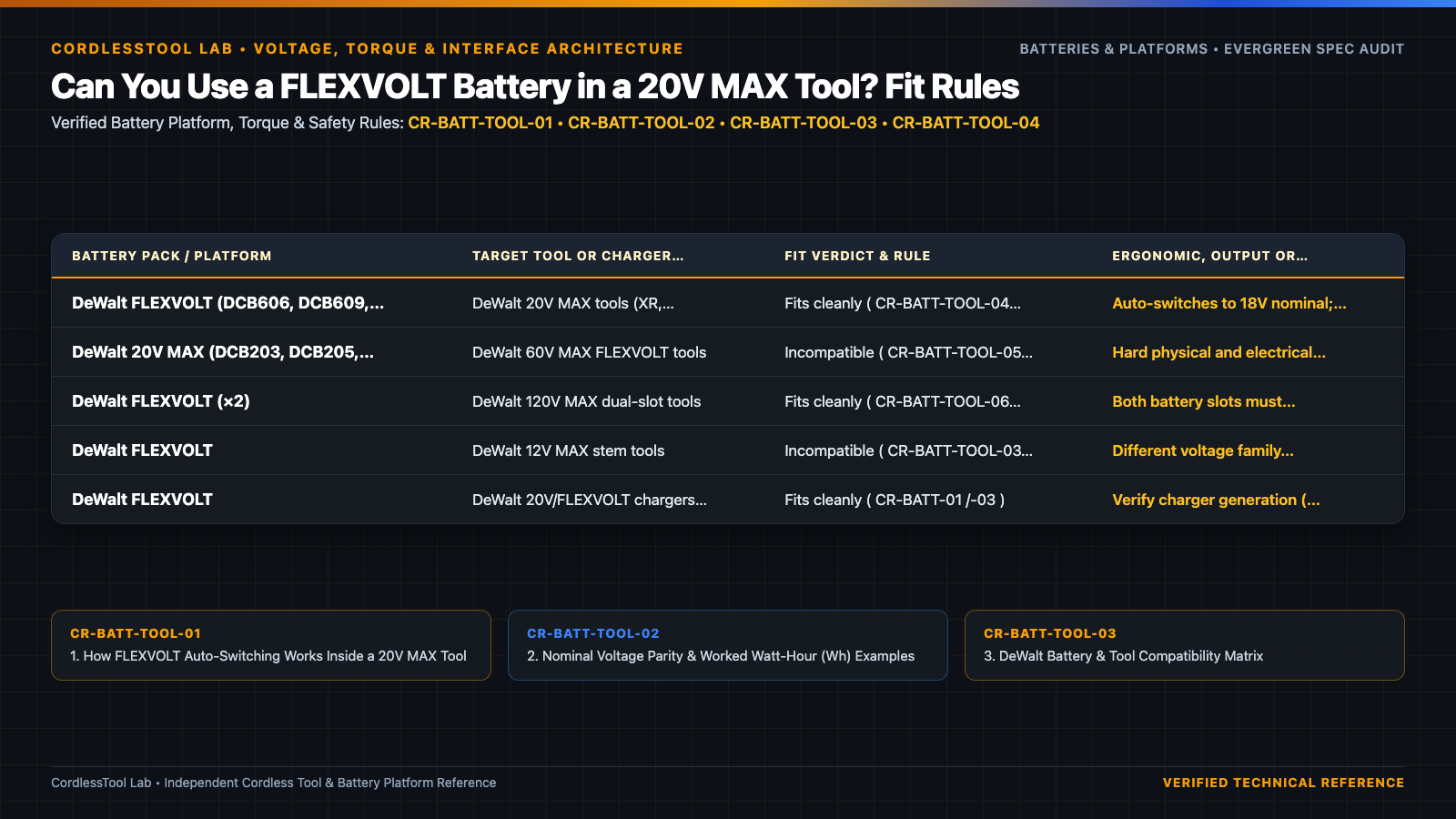
| Battery Pack / Platform | Target Tool or Charger Class | Fit Verdict & Rule | Ergonomic, Output or Safety Caveat |
|---|---|---|---|
| DeWalt FLEXVOLT (DCB606, DCB609, DCB612) | DeWalt 20V MAX tools (XR, ATOMIC, brushed) | Fits cleanly ( CR-BATT-TOOL-04 SOFT) | Auto-switches to 18V nominal; adds weight and rear bulk on compact drills/drivers (CR-BATT-TOOL-11). |
| DeWalt 20V MAX (DCB203, DCB205, DCBP520) | DeWalt 60V MAX FLEXVOLT tools | Incompatible ( CR-BATT-TOOL-05 HARD) | Hard physical and electrical stop; 20V MAX packs lack 54V series switching and never run 60V tools. |
| DeWalt FLEXVOLT (×2) | DeWalt 120V MAX dual-slot tools | Fits cleanly ( CR-BATT-TOOL-06 HARD) | Both battery slots must contain charged FLEXVOLT packs; single pack will not run the tool. |
| DeWalt FLEXVOLT | DeWalt 12V MAX stem tools | Incompatible ( CR-BATT-TOOL-03 HARD) | Different voltage family (10.8V nominal) and stem socket; zero physical tool interchange. |
| DeWalt FLEXVOLT | DeWalt 20V/FLEXVOLT chargers (DCB115, DCB118, DCB1112, DCB1404) | Fits cleanly ( CR-BATT-01 / -03) | Verify charger generation (CR-BATT-02); 8A DCB118 or 12A DCB1112 cuts long recharge waits vs. 2A–4A units. |
| DeWalt FLEXVOLT / 20V MAX | Craftsman V20, Black+Decker 20V, Milwaukee M18, Makita LXT, Ryobi ONE+ | Incompatible ( CR-BATT-TOOL-01 HARD) | Shared parent ownership (Stanley Black & Decker) or matching 18V nominal voltage never grants rail fit. |
| Any Pack + 3P Adapter | Cross-brand or toy adapters | Excluded ( CR-BATT-TOOL-10 / G-25) | Not manufacturer-approved; risks lost BMS thermal/cutoff telemetry and voided warranty. |
4. Weight, Balance & High-Draw Tool Performance Caveats
Just because a FLEXVOLT battery latches cleanly onto a 20V MAX tool does not mean it is the smartest daily pairing for every job. Under rules CR-BATT-TOOL-04, CR-BATT-TOOL-08, and CR-BATT-TOOL-11, tool balance and current draw decide whether a FLEXVOLT pack helps or hinders your workflow:
- Compact drills, 1/4-inch impact drivers, and overhead work (
CR-BATT-TOOL-11): A standard 5.0Ah 20V MAX pack such as theDCB205orDCBP520POWERSTACK weighs roughly 1.4 lb to 1.5 lb (0.63 kg to 0.68 kg) bare. By contrast, aDCB6066.0Ah FLEXVOLT weighs around 2.55 lb (1.16 kg), and aDCB6099.0Ah FLEXVOLT weighs roughly 3.2 lb to 3.45 lb (1.45 kg to 1.56 kg) bare. Hanging more than 3 lb under the grip of a compact ATOMIC drill or drywall screwgun makes the tool tail-heavy, strains your wrist on ladders, and blocks tight cabinet clearances. Keep compact 1.7Ah–5.0Ah 20V MAX packs on light fastening tools. - High-draw 20V MAX tools (
CR-BATT-TOOL-08): Heavy-load 20V MAX tools—such as 7-1/4-inch (184 mm) circular saws, reciprocating saws, 4-1/2-inch to 5-inch (115 mm to 125 mm) angle grinders, SDS-plus rotary hammers, and high-torque impact wrenches—draw high sustained current. Compact single-row packs (1.5Ah–2.0Ah) experience voltage sag and can trip thermal or over-current protection early under heavy cuts. Larger FLEXVOLT packs (with three parallel 5S banks in 20V mode) or DeWalt POWERSTACK pouch-cell packs provide lower internal impedance and hold up better under sustained load. - “FLEXVOLT ADVANTAGE” 20V MAX tools & torque-method parity (
G-03,CR-BATT-TOOL-09,CR-DRV-02,G-15): DeWalt markets specific 20V MAX tools under its FLEXVOLT ADVANTAGE designation that are designed to deliver higher output when paired with a FLEXVOLT pack than with a standard 20V MAX reference pack (verify claims on the specific tool’s US spec sheet). Whenever evaluating tool power or fastening ratings—whetherin-lbsfor drills/drivers,ft-lbs(12 in-lbs = 1 ft-lb) for impact wrenches, or DeWalt’s proprietaryUWO(Unit Watts Out) metric—always read the maker’s torque measurement method and stated reference battery. Because Milwaukee, Makita, and DeWalt calculate torque under different laboratory methods, never rank rival brands solely by spec-sheet numbers.
If you own zero 60V MAX tools and only want lighter high-output packs for 20V MAX saws, drills, and impact wrenches, explore our DeWalt 20V MAX battery platform guide covering XR, ATOMIC, and POWERSTACK options.
5. Charger Compatibility, Charge Speeds & Thermal Lockouts
Powering a 20V MAX tool with a FLEXVOLT pack also raises a practical benchtop question: do you need a special 60V charger? Under rule CR-BATT-01, standard DeWalt 20V MAX slide-pack chargers—including multi-family docks that accept 12V MAX, 20V MAX, and FLEXVOLT packs—charge FLEXVOLT batteries safely because the charger engages the battery in its 18V nominal parallel configuration (or via its multi-pin balancing terminals). Still, three rules determine how fast and reliably your packs recover:
- Verify charger generation support (
CR-BATT-02): Always confirm on DeWalt’s compatibility chart or charger nameplate that an older 20V MAX charger explicitly lists FLEXVOLT 20V/60V MAX packs as supported before leaving high-capacity packs on the dock. - Amperage decides turnaround time (
CR-BATT-03): Basic 1.25A–4A kit chargers (such as older DCB107/DCB112/DCB115 units) work, but refilling a 108 Wh DCB606 or 162 Wh DCB609 takes noticeably longer—often two hours or more on low-amp docks. Stepping up to DeWalt’s 8-amp fan-cooledDCB118or 12-ampDCB1112rapid charger draws cooling air across the cells and slashes jobsite downtime. - Respect hot/cold charge pauses (
CR-BATT-05): If your charger LED blinks a hot/cold delay code, never force charging or tamper with contacts. Following the manufacturer’s manual, remove the pack from direct sunlight or freezing conditions and allow it to return to room temperature inside the manual’s specified charging window before restarting the cycle.
6. Five Common FLEXVOLT Myths, Adapters & Clone Pack Warnings
Myth vs. Engineering Reality — What Buyers Get Wrong About FLEXVOLT & 20V MAX
Clearing up these five misconceptions saves you from incompatible tool purchases, unrealistic power expectations, and unsafe aftermarket hardware.
- Myth 1: “Putting a FLEXVOLT battery on a standard 20V MAX drill turns it into a 60V drill.” Reality: False. A standard 20V MAX tool cannot trip the series-mode switch inside a FLEXVOLT pack. The battery stays in 18V nominal parallel mode (
CR-BATT-TOOL-04), supplying 20V MAX voltage—not 60V MAX voltage. - Myth 2: “A 20V MAX 5.0Ah or POWERSTACK pack can run a 60V MAX saw for light cuts.” Reality: False. Under hard rule
CR-BATT-TOOL-05, standard 20V MAX batteries lack both the mechanical keying slots and the 15-cell 54V nominal series bus. They will not latch or power any 60V MAX tool. - Myth 3: “A DCB609 gives you 9.0Ah plus 3.0Ah—12Ah of total capacity.” Reality: False. Both ratings describe the exact same 162 Wh nominal cell bank (180 Wh label) measured at two different output voltages:
18V × 9.0Ah = 162 Whand54V × 3.0Ah = 162 Wh. - Myth 4: “DeWalt 20V MAX, Craftsman V20, and Black+Decker 20V MAX share batteries because Stanley Black & Decker owns all three.” Reality: False. Each brand molds distinct rail geometry and BMS pinouts. Cross-brand battery sharing never occurs natively (
CR-BATT-TOOL-01), as detailed in our guide on whether power tool batteries are interchangeable between brands. - Myth 5: “Third-party battery adapters and cheap ‘replacement for DeWalt’ packs are harmless budget shortcuts.” Reality: False. Under
CR-BATT-TOOL-10,CR-SYS-03, andG-25, third-party cross-brand adapters, Power Wheels ride-on toy adapters, and unbranded non-OEM clone packs are excluded from CordlessTool Lab recommendations. Passive adapters bypass OEM BMS thermistor and low-voltage cutoff communication, creating thermal and over-discharge risks while voiding manufacturer warranties. Unbranded replacement packs often carry unverified safety markings and inflated amp-hour claims.
7. Transport Rules, Manual-First Safety, Recalls & Seller Warranties
High-energy lithium-ion packs require careful adherence to manufacturer instructions and US transport rules (G-24, G-12, G-26):
- Manufacturer-instruction-first safety & PPE (
G-24): Follow the tool, battery, and charger instruction manuals first for blade guards, grinding wheels, chainsaw chain brakes, impact wrench torque-wrench verification (CR-DRV-03), and charging temperature windows. Always wear eye, hearing, and hand protection as the manual specifies. Never modify battery housings, disable thermal cutoffs, or attempt DIY pack repair; stop using any swollen, cracked, wet, or overheated pack and follow the maker’s guidance and local battery-recycling rules. - FAA 100 Wh air travel limits & red transport cap: Under FAA PackSafe lithium battery regulations, spare lithium-ion packs rated at or below 100 Wh (like the 5.0Ah DCB205 or DCBP520) are generally permitted in carry-on luggage. Packs between 101 Wh and 160 Wh—such as the
DCB606(108 Wh nominal / 120 Wh DeWalt label)—require airline approval and are capped at two spare batteries in carry-on only. Packs above 160 Wh—including theDCB609(162 Wh nominal / 180 Wh label)—are prohibited on passenger aircraft. For ground transit or toolbox storage, snap DeWalt’s included red transport cap over the FLEXVOLT terminals to lock the internal cells in a disconnected state per the manual. - CPSC safety recall screening (
CR-SYS-06,G-12): As of2026-11-26, a check of the U.S. Consumer Product Safety Commission (CPSC) Recalls database and DeWalt’s official Safety Notices & Recalls page shows no open US CPSC recalls for the DCB606 or DCB609 FLEXVOLT packs. Across the wider market, verified lithium-ion tool and outdoor-equipment recalls include SKIL 40V 5.0Ah packs, DR Power 62V 5.0Ah LiPRO packs, Kobalt 24V/48V USB-C yard-tool packs (fire hazard when charging via USB-C while installed in the tool), and Milwaukee’s 2826-20 M18 FUEL top-handle chainsaw recall—always verify model numbers and date codes on CPSC.gov before buying clearance or secondhand gear. - Authorized seller & retail-exclusive warranty caveats (
CR-SYS-05,G-26): Genuine DeWalt batteries purchased from DeWalt, Amazon retail, or an authorized US dealer carry DeWalt’s 3-year limited warranty per DeWalt US Support—always inspect the “Sold by” line at checkout. Keep the same vigilance if shopping rival brands on Amazon US: Milwaukee M18 and M12 listings on Amazon are heavily third-party reseller-driven, while Ryobi (ONE+ / 40V) and Ridgid (18V) are Home Depot retail-exclusive brands whose third-party or bulk Amazon listings typically forfeit OEM warranty and Ridgid’s Lifetime Service Agreement (LSA) eligibility.
8. Verified OEM DeWalt FLEXVOLT, 20V MAX & Charger Options
The four verified Amazon US OEM listings below satisfy every CR-SYS-03 authenticity check and cover the main scenarios for running FLEXVOLT packs alongside 20V MAX tools—without any third-party clone batteries or cross-brand adapters. Check each listing’s exact box-contents variation before ordering (CR-SYS-02).
1. DEWALT FLEXVOLT 20V/60V MAX 6.0Ah Battery (DCB606) — Balanced Dual-Voltage Pick

Platform & Listing Notice: STD-BATT-DEWALT-FLEXVOLT-60V (auto-fits STD-BATT-DEWALT-20V-MAX) | 18V Nominal 6.0Ah / 54V Nominal 2.0Ah | 108 Wh Nominal (120 Wh DeWalt Label) | ~2.55 lb | Tool-only / bare pack listing: charger sold separately (CR-SYS-01) | Tier: TIER-BATT-MID
If you want dual-voltage flexibility across 60V MAX tools and high-draw 20V MAX saws without strapping a 3.3+ lb brick onto your drill, the DCB606 is the lightest mainstream FLEXVOLT option. It gives 20V MAX tools 108 Wh of nominal stored energy while preserving full 54V nominal compatibility for 60V MAX grinders, string trimmers, and reciprocating saws. Note that this bare-pack listing omits a charger, so first-time DeWalt buyers should start with a charger kit.
2. DEWALT 20V/60V MAX FLEXVOLT 9.0Ah Battery & Charger Starter Kit — High-Draw Bundle

Platform & Listing Notice: STD-BATT-DEWALT-FLEXVOLT-60V + STD-BATT-DEWALT-20V-MAX | 18V Nominal 9.0Ah / 54V Nominal 3.0Ah | 162 Wh Nominal (180 Wh DeWalt Label) | Includes Charger (verify exact charger model in selected variation per CR-SYS-02) | Tier: TIER-BATT-MID / TIER-BATT-PREMIUM edge
Designed for framers, concrete contractors, and remodelers running heavy-draw 60V MAX saws or 20V MAX FLEXVOLT ADVANTAGE tools, this 9.0Ah starter kit bundles the battery and charger together to satisfy CR-SYS-01 and CR-BATT-01 in one checkout. Expect roughly 3.2 to 3.45 lb of battery weight—ideal for balancing a 7-1/4-inch circular saw, though tail-heavy on compact drills (CR-BATT-TOOL-11).
3. DEWALT 20V MAX XR POWERSTACK 5.0Ah Battery (DCBP520) — Compact 20V-Only Alternative

Platform & Listing Notice: STD-BATT-DEWALT-20V-MAX only (does not run 60V MAX tools per CR-BATT-TOOL-05) | 18V Nominal 5.0Ah | 90 Wh Nominal | Stacked Pouch Cells | ~1.4–1.5 lb | Tool-only / bare pack listing: charger sold separately (CR-SYS-01) | Tier: TIER-BATT-MID
If you own zero 60V MAX tools, buying a FLEXVOLT pack solely for 20V MAX work adds unnecessary bulk. Per DEWALT’s DCBP520 documentation, this stacked pouch-cell battery claims 50% more power and twice the lifespan versus the cylindrical DCB205 while keeping weight near 1.5 lb and staying under the 100 Wh air-travel ceiling.
4. DEWALT 20V MAX & FLEXVOLT 8-Amp Fan-Cooled Rapid Charger (DCB118)

Platform & Listing Notice: Supports STD-BATT-DEWALT-20V-MAX & STD-BATT-DEWALT-FLEXVOLT-60V | 8.0A Fan-Cooled Output | Charger-only listing: battery sold separately (CR-SYS-01) | Tier: TIER-BATT-VALUE
Upgrading from a slow 2A–4A kit charger to the fan-cooled 8-amp DCB118 cuts recharge delays on 6.0Ah and 9.0Ah FLEXVOLT packs substantially (CR-BATT-03). Its internal fan pulls ambient air across the pack housing during charge cycles to help manage heat, while diagnostic LEDs clearly flag hot/cold pack delays per DeWalt’s manual (CR-BATT-05).
Authoritative Non-Affiliate References
- DEWALT Official US Specifications — DCB609 20V/60V MAX* FLEXVOLT 9.0Ah Battery — Dual-voltage auto-switching, 180 Wh label basis, and 20V MAX tool compatibility.
- DEWALT Official US Specifications — DCBP520 20V MAX XR POWERSTACK 5.0Ah Battery — Pouch-cell architecture and 20V MAX comparison basis against DCB205.
- DEWALT US Support & Warranty Portal — 3-year limited battery warranty, 1-year free service, and authorized seller terms.
- DEWALT Official Safety Notices & Product Recalls & U.S. CPSC Recalls Database — Official safety recall verification for cordless tools and lithium-ion packs.
- FAA PackSafe Lithium Battery Guidance — Federal 100 Wh and 160 Wh passenger aircraft carry-on and shipping thresholds.
How We Audited This Guide
- Battery packs and chargers were audited across 18V/20V Max vs. 36V/40V/56V/60V nominal voltage behavior, 18650 vs. 21700/tabless pouch cells, charger amperage/sequential logic, and strict OEM-only UL BMS protection.
- Every cordless drill, impact driver, saw, grinder, battery pack, charger, outdoor power tool, and accessory spec was cross-checked against official OEM manuals, UL/ANSI ratings, and live Amazon US listings.
- Recommendations were evaluated against our weighted vertical scoring rubrics and 61 documented CR-* platform and safety rules; we never invent peak torque ft-lbs, cut counts, runtime minutes, or battery decibels.
9. Frequently Asked Questions
Can you use a FLEXVOLT battery in a 20V MAX tool safely?
Yes. Every DeWalt FLEXVOLT 20V/60V MAX battery physically fits DeWalt 20V MAX tools and automatically reconfigures its internal cell banks in parallel to supply 18V nominal (20V MAX) power safely without over-volting the tool motor or electronics (CR-BATT-TOOL-04).
Can a standard DeWalt 20V MAX battery run a 60V MAX FLEXVOLT tool?
No. Compatibility is strictly one-way under rule CR-BATT-TOOL-05. Standard 20V MAX packs—including XR 5.0Ah and POWERSTACK batteries—lack the 15-cell series switching bus and mechanical keying ribs required to latch into and power 60V MAX tools.
Does a FLEXVOLT battery make a 20V MAX tool more powerful?
Voltage remains 18V nominal on any 20V MAX tool, so FLEXVOLT never turns a 20V drill into a 60V tool. However, on high-draw 20V MAX tools—especially models labeled FLEXVOLT ADVANTAGE—lower internal resistance reduces voltage sag compared to compact 1.5Ah–2.0Ah packs.
Will my regular DeWalt 20V MAX charger charge a FLEXVOLT battery?
Yes, DeWalt 20V MAX and FLEXVOLT slide chargers accept FLEXVOLT packs (CR-BATT-01), though you should always confirm support on older charger charts (CR-BATT-02). Basic 2A–4A chargers charge slowly, whereas 8A (DCB118) or 12A (DCB1112) fan-cooled chargers cut wait times.
Can a DeWalt FLEXVOLT battery fit Craftsman V20, Milwaukee M18, or Makita 18V tools?
No. Even though DeWalt, Craftsman V20, and Black+Decker share parent company Stanley Black & Decker—and Milwaukee M18 and Makita LXT share 18V nominal chemistry—proprietary slide rails and BMS telemetry block cross-brand fit (CR-BATT-TOOL-01). Never use unapproved third-party adapters.


