
Disclosure: As an Amazon Associate, CordlessTool Lab earns from qualifying purchases. If you buy through links on this page, we may earn a small commission at no extra cost to you. Standard retail commission rates (3% in Tools & Home Improvement) never influence our compatibility rules or hardware evaluations.
Shoppers already invested in one cordless ecosystem frequently spot a bare tool on sale from a rival brand and immediately search Amazon for power tool battery adapters. On paper, sliding a 20V MAX pack onto an 18V rival impact driver looks like a cheap shortcut around buying another starter kit. In practice, our Amazon cordless power tool buying audit shows that third-party plastic adapter shoes introduce silent battery-management failures, void manufacturer warranties, and frequently pair with uncertified knockoff battery listings.
Under CordlessTool Lab compatibility rules CR-BATT-TOOL-01, CR-BATT-TOOL-10, and CR-SYS-03, cross-brand adapters are never approved by either tool manufacturer and never belong in a reliable tool setup. Below is a technical and marketplace audit of why passive adapters fail on Amazon US, how to decode seller and suffix traps before checkout, and which verified OEM battery starter kits provide a trap-free path forward.
Urgent Buyer Alert — Four Pre-Checkout Checks Before Ordering Battery Adapters
- Seller & Authorized Warranty: Neither DeWalt, Milwaukee, Makita, Bosch, Ryobi, nor Ridgid approves cross-brand adapters; warranty claims tied to adapter use or unauthorized third-party packs may be refused (
CR-BATT-TOOL-10,CR-SYS-05). - BMS Pin Drop & Over-Discharge Risk: Most Amazon adapters connect only positive (
+) and negative (-) power blades while severing thermistor and low-voltage cutoff signals—risking permanent cell damage on tools that monitor cutoff inside the tool body. - Bare-Tool vs. Kit Suffix Trap: Many shoppers buy adapters after accidentally ordering a bare tool (DeWalt
B, Milwaukee-20, MakitaZ) where battery and charger are sold separately (CR-SYS-01). - OEM Rail vs. Knockoff & Toy Converters: Skip 18V/20V-to-12V Power Wheels shoes and third-party “9.0Ah–15.0Ah replacement” batteries sold beside adapters; use verified OEM packs and starter kits only (
CR-SYS-03).
In This Marketplace Audit
- 1. Amazon Listing Inspection Matrix
- 2. Why Cross-Brand Adapters Tempt Buyers—And Why OEM Rails Stay Locked
- 3. Inside Passive Adapters: BMS Cutoff Splits, Thermistors & Torque Parity
- 4. Buy-Box Seller Checks, Model Suffixes & Retail-Exclusive Traps
- 5. Rejected & Excluded Amazon Listing Types (Technical Reasons)
- 6. Manual-First Battery Safety & US CPSC Recall Screening
- 7. 60-Second Pre-Checkout Audit Checklist
- 8. Verified Trap-Free OEM Battery & Starter Kit Alternatives
- 9. Frequently Asked Questions
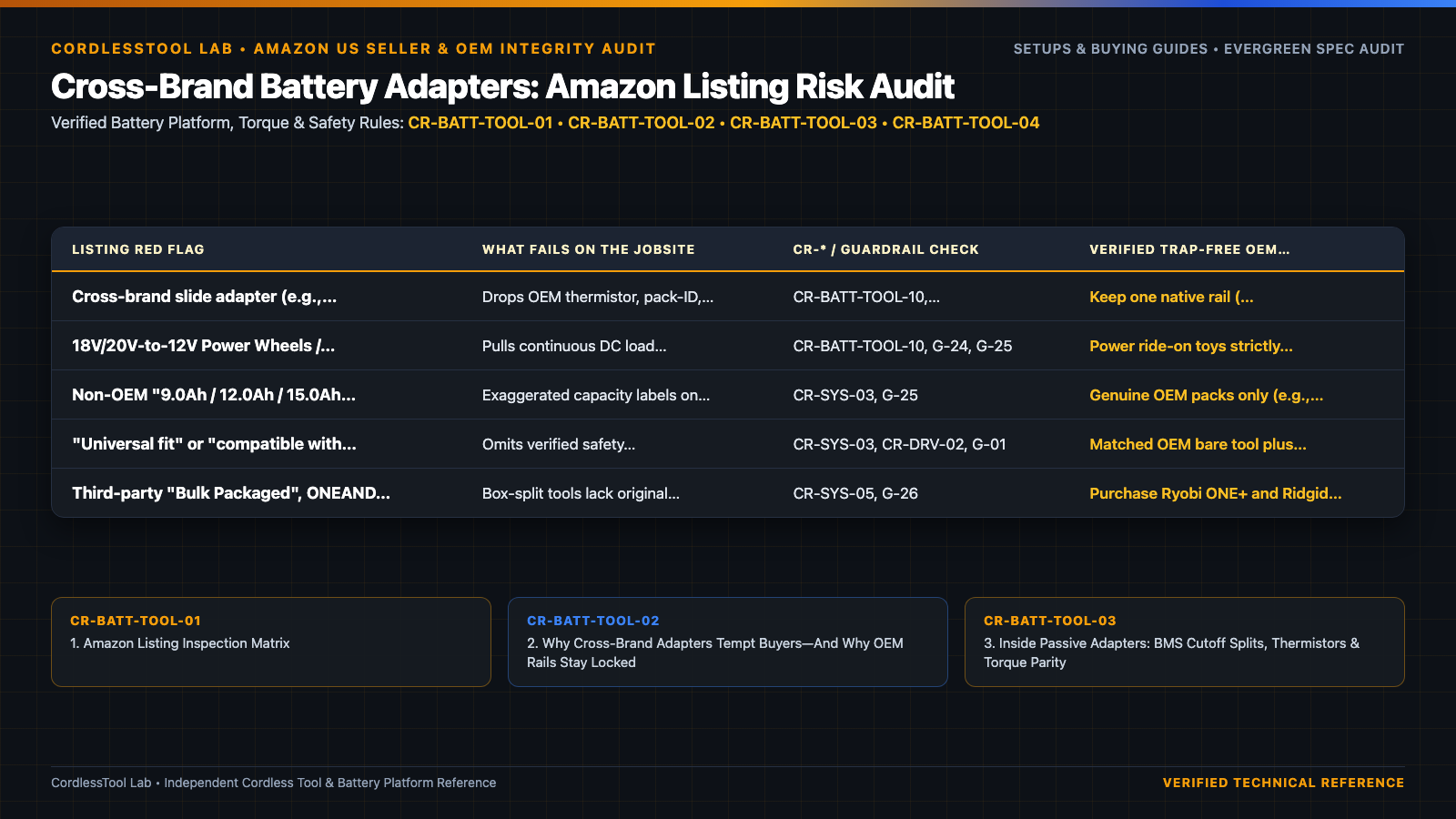
1. Amazon Listing Inspection Matrix
Amazon search pages for cordless batteries and cross-brand converters mix genuine OEM hardware with third-party plastic bridges, step-down ride-on toy shoes, and uncertified clone packs. Use the matrix below to match every common listing red flag to its exact failure mode and trap-free OEM alternative.
| Listing Red Flag | What Fails on the Jobsite | CR-* / Guardrail Check | Verified Trap-Free OEM Choice |
|---|---|---|---|
| Cross-brand slide adapter (e.g., DeWalt 20V MAX pack to Milwaukee M18 or Makita LXT tool) | Drops OEM thermistor, pack-ID, and low-voltage cutoff communication; tall stacked lever arm loosens latch hooks and strains terminals on saws or grinders | CR-BATT-TOOL-10, CR-BATT-TOOL-01, G-25 | Keep one native rail (CR-SYS-04) or add a verified OEM starter kit such as DeWalt DCB205C or an M18 pack |
| 18V/20V-to-12V Power Wheels / ride-on toy adapter shoe | Pulls continuous DC load without OEM battery-to-tool thermal feedback; unverified inline fuse ratings and missing low-voltage cutoff can permanently drain cells | CR-BATT-TOOL-10, G-24, G-25 | Power ride-on toys strictly with the toy manufacturer’s approved battery and charger as the manual specifies |
| Non-OEM “9.0Ah / 12.0Ah / 15.0Ah replacement” battery bundled alongside adapters | Exaggerated capacity labels on standard-size shells, inconsistent cell balancing, and missing recognized safety certification marks | CR-SYS-03, G-25 | Genuine OEM packs only (e.g., DeWalt DCB205-2, DCBP520, or Milwaukee 48-11-1865) |
| “Universal fit” or “compatible with 20V tools” unbranded cordless tools & chargers | Omits verified safety listings, charger temperature windows, and verified torque standards; claims inflated Nm figures without a benchmark basis | CR-SYS-03, CR-DRV-02, G-01 | Matched OEM bare tool plus verified OEM battery and listed charger |
Third-party “Bulk Packaged”, ONEAND typo, or Amazon Renewed retail-exclusive tools (Ryobi / Ridgid) | Box-split tools lack original retail packaging and proof of authorized purchase; Ridgid Lifetime Service Agreement (LSA) is denied outside authorized channels | CR-SYS-05, G-26 | Purchase Ryobi ONE+ and Ridgid 18V at authorized US retailers (Home Depot / Direct Tools Factory Outlet) |
Bare tool (-20, B, Z) mistaken for a complete kit from the hero photo | Tool arrives with zero battery or charger, tempting buyers into ordering a quick adapter instead of an OEM starter pack | CR-SYS-01, CR-SYS-02 | Verify “What’s in the box” on the selected variation and pair bare tools with a native starter kit |
2. Why Cross-Brand Adapters Tempt Buyers—And Why OEM Rails Stay Locked
The appeal of third-party power tool battery adapters starts with a real engineering fact: nearly every 18V-class cordless tool battery uses five lithium-ion cell groups wired in series (5S), producing roughly 18 volts nominal under load. As detailed in our guide asking are power tool batteries interchangeable between brands, two widespread myths convince shoppers that a simple plastic spacer should bridge any brand:
- The 20V MAX vs. 18V marketing confusion (
CR-BATT-TOOL-02): DeWalt’s “20V MAX” and Craftsman’s “V20” state peak no-load voltage (~4.0V per cell × 5 = 20V) right off the charger, whereas Milwaukee M18, Makita 18V LXT, Bosch 18V, Ryobi 18V ONE+, and Ridgid 18V state 18V nominal voltage (~3.6V per cell × 5 = 18V). Under real drilling or cutting loads, both label styles deliver the exact same 18V nominal chemistry. Neither label implies extra power, and matching chemistry never grants physical fit across brands. - Shared parent corporations: Stanley Black & Decker owns DeWalt, Craftsman, and Black+Decker, while Techtronic Industries (TTI) owns Milwaukee, Ryobi, and Ridgid. Despite corporate kinship, each brand maintains distinct slide rails, stem towers, retention latches, and pin spacing so batteries never cross-fit between pro, prosumer, and homeowner tool lines (
CR-BATT-TOOL-01). - Same-brand voltage boundaries (
CR-BATT-TOOL-03): Even staying inside a single logo does not guarantee interchangeability. Milwaukee M12, M18, and MX FUEL remain mechanically isolated; Makita 12V max CXT, 18V LXT, and 40V max XGT never swap; and Ryobi USB Lithium, 18V ONE+, and 40V stay locked apart.
Only a narrow set of manufacturer-engineered exceptions cross voltage tiers safely without third-party hardware: DeWalt FLEXVOLT 20V/60V MAX packs auto-switch downward to run DeWalt 20V MAX tools (CR-BATT-TOOL-04, though standard 20V MAX packs never power 60V MAX tools per CR-BATT-TOOL-05); Metabo HPT MultiVolt 36V/18V packs step down to run Metabo HPT 18V tools (CR-BATT-TOOL-07); Makita 36V (18V X2) tools run on two matched 18V LXT packs inserted simultaneously (CR-BATT-TOOL-06); and Bosch’s 18V AMPShare alliance shares its official interface strictly among licensed partner brands. Outside those documented OEM systems, every cross-brand bridge on Amazon is an unapproved third-party adapter.
3. Inside Passive Adapters: BMS Cutoff Splits, Thermistors & Torque Parity
Most cross-brand battery adapters sold on Amazon are hollow injection-molded shells with two stamped brass or copper power blades linking the battery’s main + and - slots to the tool’s main + and - tabs. Because competing manufacturers put different safety electronics inside the tool versus inside the battery pack, breaking those auxiliary communication pins creates four distinct engineering failures:
3.1 Low-Voltage Cutoff Architecture Mismatch
Lithium-ion cells degrade rapidly—and can enter unsafe chemical states if recharged afterward—when discharged below safe per-cell voltage thresholds. Cordless tool brands split responsibility for low-voltage cutoff across two opposite designs:
- Pack-resident protection: DeWalt and Ryobi ONE+ place primary low-voltage monitoring inside the battery pack’s internal circuit board (though communication pins still exchange thermal and state signals with OEM tools and chargers).
- Tool-resident protection: Milwaukee (REDLINK Intelligence) and Makita (Star Protection Computer Controls) rely on active electronic handshakes between the tool’s motor controller and the pack’s battery management system (BMS) to shut the tool down before cells over-discharge or overheat.
When a passive adapter mounts a Milwaukee M18 or Makita 18V LXT battery onto a rival tool whose controller expects pack-side cutoff—or mounts an older pack without onboard cutoff onto a tool expecting an active handshake—neither side reliably enforces the cutoff threshold. Leaving an adapter clicked onto a pack overnight can also allow tiny parasitic draws in converter electronics or tool LEDs to drain cells below recovery voltage.
3.2 Missing Thermistor & High-Draw Contact Stress
Under rule CR-BATT-TOOL-08, high-draw tools—including 7-1/4-inch circular saws, angle grinders, SDS-plus rotary hammers, and high-torque impact wrenches—pull heavy continuous current that heats both lithium cells and terminal blades. OEM battery interfaces monitor negative-temperature-coefficient (NTC) thermistors so the tool reduces output or pauses before cell temperatures climb out of bounds. Passive adapters either leave the tool’s thermal pin open or bridge it with a fixed dummy resistor that reports a permanent room-temperature reading regardless of actual pack heat. Combined with loose molded rail tolerances and extra contact resistance across an extra pair of unplated blades, high-draw tools can overheat terminals, melt plastic housings, or trip unpredictably mid-cut.
3.3 Power Wheels & 12V Step-Down Converter Risks
A fast-growing subset of Amazon adapter listings markets 18V/20V-to-12V buck-converter shoes and bare-wire pigtails for kids’ ride-on toys (“Power Wheels adapters”) or DIY DC projects. These listings routinely omit UL safety certification, rely on undersized inline automotive blade fuses, and lack automatic low-voltage cutoff calibrated to the donor lithium pack. Over-discharging a 5S lithium battery in a toy drive train—or subjecting toy motors and wiring harnesses to higher voltage and current spikes than designed—poses both cell-destruction and thermal hazards. Power ride-on toys strictly with the ride-on manufacturer’s approved battery and charger as the manual specifies.
3.4 Torque Spec Parity & Reference Battery Rules
Some shoppers buy adapters expecting a rival brand’s high-capacity pack to boost an impact driver’s in-lbs or an impact wrench’s ft-lbs output. That assumption fails under two KM rules: first, under CR-BATT-TOOL-09 and guardrail G-03, manufacturer-rated torque and cut figures assume a specific native reference battery—for example, Milwaukee rates its 2967 M18 FUEL 1/2-inch high-torque impact wrench at 1,100 ft-lbs fastening and 1,500 ft-lbs nut-busting torque using an M18 XC5.0 pack, and 1,200 ft-lbs fastening / 1,600 ft-lbs nut-busting with an M18 FORGE pack per Milwaukee’s published specifications. Second, under CR-DRV-02 and G-15, brands measure torque using incompatible methods (such as DeWalt’s max brake torque and UWO/MWO power ratings versus Milwaukee and Makita’s own in-lbs procedures), so cross-brand paper numbers never translate through an adapter. Adding an unapproved adapter introduces voltage drop across extra contacts rather than matching a native high-output pack.
4. Buy-Box Seller Checks, Model Suffixes & Retail-Exclusive Traps
Before buying an adapter—or choosing a replacement battery or bare tool on Amazon US—run three marketplace checks that protect both your wallet and your warranty coverage.
4.1 How to Audit the Byline and Buy-Box Seller (CR-SYS-05 & G-26)
On any Amazon US product page, look immediately beneath the title for the brand link (Visit the DEWALT Store vs. generic text like Brand: Generic) and inspect the right-hand buy box for both Ships from and Sold by. Two major channel rules govern power tools on Amazon US:
- DeWalt, Makita, Bosch, Craftsman, and EGO: These brands maintain official Amazon brand stores with widespread first-party
Amazon.comor brand-authorized fulfillment on core batteries and starter kits. - Milwaukee, Ryobi, and Ridgid reseller caveats (
G-26): Milwaukee does not sell first-party directly through Amazon retail; Amazon US Milwaukee M18 and M12 listings are dominated by third-party merchants. Always verify whether a seller is an authorized distributor under Milwaukee’s US warranty terms, and retain your invoice because unauthorized reseller purchases may fall back to manufacturing serial date-code limits or warranty denial. Meanwhile, Ryobi (ONE+ / 40V) and Ridgid (18V) are Home Depot retail-exclusives in the US. Amazon listings for Ryobi and Ridgid come from unauthorized third-party resellers—often split out of combo kits asBulk Packagedbare tools, mislabeled withONEANDtypos, or sold asAmazon Renewed. Buying Ridgid tools through unauthorized Amazon resellers voids eligibility for Ridgid’s Lifetime Service Agreement (LSA).
4.2 Decoding Bare-Tool vs. Kit Suffixes (CR-SYS-01 & CR-SYS-02)
Many adapter purchases happen after a buyer misunderstands a model suffix and receives an empty box without batteries. Always confirm the selected variation’s “What’s in the box” text against standard OEM suffix codes rather than trusting the main product photo:
- DeWalt: Trailing
Bdenotes a bare tool (tool-only listing: battery and charger sold separately), whereasC,D1,P2, orM1suffixes indicate a kit with specific battery capacities and counts. - Milwaukee: Trailing
-20indicates a bare tool (tool-only listing: battery and charger sold separately),-21indicates a 1-battery kit, and-22indicates a 2-battery kit. - Makita: Trailing
Zdenotes a bare tool (tool-only listing: battery and charger sold separately), while multi-letter codes such asRMEorSYXindicate bundled packs and chargers.
4.3 Avoiding Non-OEM Replacement Packs Sold Beside Adapters (CR-SYS-03)
Amazon’s recommendation carousels on adapter pages frequently promote off-brand replacement batteries claiming 9.0Ah, 12.0Ah, or 15.0Ah capacities in compact housings at steep discounts below OEM TIER-BATT-VALUE packs. Those listings routinely overstate real watt-hour capacity, omit documented UL safety certification, and lack reliable thermal cutoffs. Review our dedicated counterfeit power tool batteries Amazon audit for packaging, label, and weight-discrepancy red flags before purchasing any lithium pack.
5. Rejected & Excluded Amazon Listing Types (Technical Reasons)
Under CordlessTool Lab guardrails G-22 and G-25, we strictly exclude the following four Amazon listing categories from every buyer recommendation list:
- Cross-Brand Passive Battery Adapters (e.g., DeWalt-to-Milwaukee, Makita-to-DeWalt, Ryobi-to-DeWalt): Excluded under
CR-BATT-TOOL-10andG-25because they drop proprietary BMS thermistor and low-voltage cutoff communication pins, create mechanical leverage stress on tool rails, and void OEM warranties. - 18V/20V-to-12V Ride-On Toy & Power Wheels Converter Shoes: Excluded under
G-24andG-25because uncertified buck converters and bare-wire adapters can over-discharge donor tool cells below safe recovery voltage and deliver unmonitored current to non-tool DC loads. - Third-Party “Replacement For” Battery Packs & Knockoff Chargers: Excluded under
CR-SYS-03andG-25because off-brand packs claiming exaggerated 9Ah–15Ah capacities lack OEM BMS handshakes, manufacturer warranty backing, and verifiable US safety certification. - Unauthorized 3P “Bulk Packaged” & Renewed Home Depot Exclusives (Ryobi / Ridgid): Excluded under
CR-SYS-05andG-26because box-split reseller stock lacks retail warranty provenance and disqualifies Ridgid buyers from Lifetime Service Agreement (LSA) coverage.
6. Manual-First Battery Safety & US CPSC Recall Screening
Safe cordless operation always begins with the manufacturer’s printed manual rather than marketplace workarounds (G-24). Follow these non-negotiable precautions across batteries, chargers, and powered tools:
- Charger compatibility & temperature windows (
CR-BATT-01,CR-BATT-02,CR-BATT-05): Charge batteries exclusively on OEM chargers listed for that pack’s platform and generation. If a charger’s status LED indicates a hot or cold pause, let the battery reach room temperature indoors as the manual instructs rather than forcing a charge or swapping onto an uncertified multi-brand dock. - Tool guards, PPE & damaged packs (
G-24): Never defeat or disable battery thermal-cutoff circuits, blade guards, riving knives, chain brakes, or grinder guards. Always wear eye, hearing, and hand protection as the manual specifies for the tool in use. If any lithium-ion pack becomes swollen, cracked, water-damaged, or unusually hot, stop using it immediately and dispose of it through the manufacturer’s guidance or local battery-recycling drop-off programs. - Open & recent US CPSC recall screening (
CR-SYS-06,G-12): Always check serial numbers and date codes against the U.S. CPSC Recalls database before using secondhand or discounted marketplace battery gear. Notable official lithium tool and yard-equipment notices include the Greenworks-made Kobalt 24V and 48V yard tools with USB-C batteries recall (fire hazard linked to charging via the USB-C port while the pack remains installed in the tool), the DR Power 62V 5.0Ah LiPRO battery pack recall (short-circuit and ignition hazard), the SKIL 40V 5.0Ah lithium-ion battery recall for outdoor tools, and the Milwaukee 2826-20 M18 FUEL top-handle chainsaw recall (remedy per Milwaukee’s official recall notice).
7. 60-Second Pre-Checkout Audit Checklist
If you are tempted to bridge two tool systems—or you are building out a workshop from scratch—walk through this five-step check before clicking Add to Cart:
- Decide if you actually need a second platform (
CR-SYS-04): Buying one native OEM starter pack (battery + charger) and pairing it with bare tools inside that ecosystem eliminates adapter risks permanently. If you plan to leave an older brand behind, follow our cost-aware battery platform migration roadmap rather than patching rails together. - Verify platform and voltage family exactness: Confirm that the pack’s nominal voltage family matches the tool socket (for example, DeWalt 20V MAX vs. 12V MAX, or Makita 18V LXT vs. 40V max XGT).
- Match pack output class to tool draw (
CR-BATT-TOOL-08): Reserve compact 1.5Ah–2.0Ah packs for drills and impact drivers, and pair circular saws, grinders, and high-torque wrenches with standard 5.0Ah or high-output packs (POWERSTACK,HIGH OUTPUT,FORGE). - Decode the SKU suffix & check variation box contents (
CR-SYS-01,CR-SYS-02): Confirm whether you are buying a bare battery pack (charger sold separately) or a complete starter kit with a listed charger. - Audit the Buy Box seller & warranty rules (
CR-SYS-05): FavorShips from and sold by Amazon.comor verified brand-authorized dealers—especially on Milwaukee M18 hardware, where unauthorized third-party listings can complicate warranty claims.
8. Verified Trap-Free OEM Battery & Starter Kit Alternatives
Instead of risking cell damage or voided coverage with unapproved cross-brand adapters, the clean, reliable fix for running a second brand’s bare tool is buying a genuine OEM starter kit or matched factory battery pack. Every pick below is a verified OEM listing from DeWalt or Milwaukee on Amazon US—zero third-party clones, zero adapters, and zero renewed bulk splits.
1. DEWALT 20V MAX 5.0Ah Battery & Charger Starter Kit (DCB205C)

Audit Spec: STD-BATT-DEWALT-20V-MAX | 18V Nominal (20V MAX Label) | 5.0Ah (90 Wh Nominal) | Complete Starter Kit (1 Pack + Charger) | Tier: TIER-BATT-VALUE
If you spotted a bare DeWalt 20V MAX tool on sale while owning another brand’s batteries, the DCB205C starter kit is the cleanest way onto the DeWalt rail without an adapter. You get a genuine 90 Wh 5.0Ah pack with onboard pack-side low-voltage protection plus a factory DeWalt charger, keeping every thermistor and retention latch 100% OEM. Note that this pack runs DeWalt 20V MAX tools only—it will not power 60V MAX FLEXVOLT tools (CR-BATT-TOOL-05) or Craftsman V20 tools (CR-BATT-TOOL-01).
2. DEWALT 20V MAX 5.0Ah Lithium-Ion Battery 2-Pack (DCB205-2)
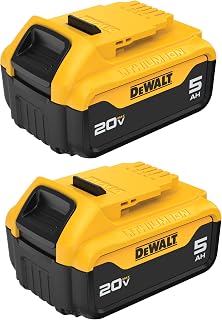
Audit Spec: STD-BATT-DEWALT-20V-MAX | 18V Nominal (20V MAX Label) | 2 × 5.0Ah (90 Wh Each / 180 Wh Total) | Bare 2-Pack (Charger Sold Separately) | Tier: TIER-BATT-MID
For DeWalt owners tempted by cheap off-brand multi-packs or cross-brand adapters just to keep a second tool running, the DCB205-2 twin-pack delivers two genuine 90 Wh OEM packs—the exact reference battery DeWalt uses across its 20V MAX comparisons. Each pack sits just under the 100 Wh FAA carry-on threshold per pack and includes an onboard LED fuel gauge. Because this is a bare battery listing (charger sold separately, CR-SYS-01), pair it with an existing compatible DeWalt 12V/20V/FLEXVOLT charger (CR-BATT-01).
3. DEWALT 20V MAX XR POWERSTACK 5.0Ah Battery (DCBP520)

Audit Spec: STD-BATT-DEWALT-20V-MAX | 18V Nominal (20V MAX Label) | 5.0Ah (90 Wh Nominal) | Stacked Pouch Cells | Bare Pack (Charger Sold Separately) | Tier: TIER-BATT-MID
Running high-draw circular saws, grinders, or hammer drills through an adapter causes extra voltage drop across unplated contacts. DeWalt’s OEM DCBP520 POWERSTACK 5.0Ah pack uses stacked pouch cells (CR-BATT-04) and is marketed by DeWalt as delivering higher output and longer cycle life compared to its standard DCB205 pack while remaining compatible with 20V MAX tools and listed chargers. Note that this is a bare pack (charger sold separately, CR-SYS-01), and it will not power 60V MAX FLEXVOLT tools (CR-BATT-TOOL-05).
4. Milwaukee 48-11-1865 M18 REDLITHIUM HIGH OUTPUT XC 6.0Ah Battery
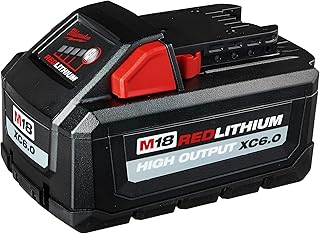
Audit Spec: STD-BATT-MILWAUKEE-M18 | 18V Nominal (M18) | 6.0Ah (108 Wh Nominal) | High-Output Class | Bare Pack (Charger Sold Separately) | Tier: TIER-BATT-MID
Because Milwaukee relies on REDLINK tool-to-battery electronic communication for thermal and over-discharge protection, running an M18 FUEL saw, grinder, or high-torque impact wrench on a foreign pack through an adapter undermines the tool’s core protection loop. The genuine Milwaukee 48-11-1865 M18 HIGH OUTPUT XC 6.0Ah pack preserves full REDLINK telemetry across every M18 tool and M18 charger (CR-BATT-TOOL-08, CR-BATT-TOOL-12). Two caveats apply: first, this is a bare battery pack (charger sold separately, CR-SYS-01, and note its 108 Wh rating exceeds the 100 Wh carry-on airline threshold); second, because Amazon US Milwaukee listings are sold primarily by third-party merchants, verify authorized-dealer status in the Buy Box to protect US warranty coverage (CR-SYS-05, G-26).
Authoritative Non-Affiliate References
- DEWALT Official 20V MAX & POWERSTACK Battery Specifications — Official 18V nominal / 20V MAX compatibility scope, charger guidance, and DCBP520 comparison basis.
- Milwaukee Tool US Warranty & Authorized Distributor Policy — Authorized seller requirements, REDLITHIUM M18 compatibility, and serial date-code policy.
- Makita USA 18V LXT Star Protection Documentation — Tool-to-battery thermal and over-discharge protection architecture and LXT / XGT separation.
- U.S. Consumer Product Safety Commission (CPSC) Recalls Database — Official recall lookup for lithium-ion power tool batteries, outdoor equipment packs, and chainsaw notices.
- FAA PackSafe Lithium Battery Guidance — Official carry-on and watt-hour (100 Wh) transport thresholds for spare lithium-ion packs.
9. Frequently Asked Questions
Are cross-brand power tool battery adapters safe to use?
No manufacturer approves third-party cross-brand adapters. Passive adapter shoes bridge only positive and negative power blades while dropping thermistor, ID, and low-voltage cutoff signals, which can over-discharge lithium cells, overheat contacts under high-draw loads, and void OEM warranty coverage.
Can a DeWalt 20V MAX battery damage a Milwaukee M18 or Makita LXT tool through an adapter?
Yes, mismatching BMS designs creates real electrical risks. Although both platforms run 18V nominal chemistry, Milwaukee REDLINK and Makita Star Protection expect active thermal and cutoff handshakes from their own packs; without those pins, neither tool nor pack coordinates heat or discharge limits properly.
Do power tool battery adapters void the manufacturer warranty?
Tool and battery manufacturers explicitly exclude damage caused by non-OEM batteries, unauthorized modifications, or unapproved third-party adapters. If a tool controller or battery BMS fails after adapter use, warranty service can be refused, leaving the owner responsible for replacement costs.
Are 20V MAX-to-12V Power Wheels battery adapters safe for kids’ ride-on toys?
We exclude ride-on toy battery adapters under our safety guardrails. Many step-down converter shoes lack UL certification, reliable low-voltage cutoff, or proper fusing, risking deep cell damage and overheating; always use the ride-on manufacturer’s approved battery and charger.
What is the safest alternative to buying a battery adapter for a bare tool?
Check the bare-tool suffix before checkout and buy a genuine OEM battery-and-charger starter kit for that exact platform, or stay on your existing battery rail using factory bare tools. If switching brands completely, migrate systematically rather than bridging incompatible rails.


