
Disclosure: As an Amazon Associate, CordlessTool Lab earns from qualifying purchases. If you buy through links on this page, we may earn a small commission at no extra cost to you. Retail commission rates (3% in Tools & Home Improvement) never influence our engineering analysis or platform recommendations.
The dewalt 20v max battery platform is one of the broadest 18V-nominal cordless ecosystems in North America, spanning more than 300 tools across compact homeowner kits, jobsite framing saws, and outdoor yard equipment. Before buying your first drill or adding a bare circular saw, understanding how DeWalt separates marketing tiers (Standard, ATOMIC, XR, POWERSTACK) from true electrical battery rails (20V MAX, FLEXVOLT 60V MAX, and 12V MAX) prevents costly incompatibility mistakes. Grounded in our pillar guide to cordless tool battery platforms and CordlessTool Lab review standards, this guide maps every verified rule governing fit, voltage, energy math, chargers, and OEM warranty protection.
Quick Answer — How Does the DeWalt 20V MAX Battery Platform Work?
Every DeWalt 20V MAX, ATOMIC, and XR tool shares a single 18V-nominal slide battery socket. Standard cylindrical XR and stacked pouch-cell POWERSTACK packs fit all 20V MAX tools, while dual-voltage FLEXVOLT batteries step down automatically to power 20V MAX tools—but 20V MAX packs never run 60V MAX FLEXVOLT or 12V MAX tools.
In This Guide
- 1. What Defines the DeWalt 20V MAX Socket (and 18V Nominal Voltage)
- 2. Tool Lines Decoded: Standard 20V MAX vs. ATOMIC vs. XR vs. FLEXVOLT
- 3. Battery Architecture, POWERSTACK Pouch Cells & Worked Wh Examples
- 4. Master DeWalt Compatibility Matrix & Hard Exclusions
- 5. Chargers, Speed Tiers & Temperature Lockout Behavior
- 6. Five Platform Myths, Third-Party Adapters & Counterfeit Risks
- 7. Safety Instructions, CPSC Recall History & US Warranty Rules
- 8. Verified OEM DeWalt 20V MAX Packs & Starter Kits
- 9. Frequently Asked Questions
1. What Defines the DeWalt 20V MAX Socket (and 18V Nominal Voltage)
To navigate the dewalt 20v max battery platform without confusion, separate the physical battery platform (the slide rail, latching clip, and electronic terminal block) from the marketing tier printed on the tool housing. Under rule CR-BATT-TOOL-01, compatibility is determined strictly by brand, voltage family, and mechanical interface—never by voltage stickers alone.
Why “20V MAX” Equals 18V Nominal (CR-BATT-TOOL-02)
DeWalt’s 20V MAX packs connect five lithium-ion cell groups in series (a 5S configuration). Each lithium-ion cell averages roughly 3.6 volts under nominal load (5 × 3.6V = 18.0V nominal) and peaks near 4.0 to 4.2 volts per cell immediately off the charger with no load attached (5 × 4.0V = 20V MAX). As DeWalt prints directly on its US specification sheets, maximum initial battery voltage measured without a workload is 20 volts, while nominal voltage is 18 volts.
Under compatibility rule CR-BATT-TOOL-02, DeWalt 20V MAX, Milwaukee M18, Makita 18V LXT, Bosch 18V, and Ryobi 18V ONE+ are all 18-volt nominal systems. A “20V MAX” label represents an unloaded marketing convention rather than extra power over an “18V” tool. For a complete cell-level comparison across competing ecosystems, see our 20V MAX vs. 18V nominal voltage breakdown.
Pack-Side BMS Protection & Physical Rail Boundaries
Every genuine DeWalt 20V MAX pack houses its own battery management system (BMS) electronics—including low-voltage cutoff and thermal monitoring circuits—rather than relying exclusively on the tool trigger to protect the cells. That internal architecture is one reason DeWalt’s slide rails and pin slots differ physically from every other brand:
- No cross-brand interchange (
CR-BATT-TOOL-01): Stanley Black & Decker owns DeWalt, Craftsman, and Black+Decker, yet DeWalt 20V MAX, Craftsman V20, and Black+Decker 20V MAX packs do not physically fit each other’s rails. - No 12V MAX cross-fit (
CR-BATT-TOOL-03): Same brand is not enough. DeWalt 12V MAX tools use an inserted 3S stem-pod battery (10.8V nominal) that never mates with 20V MAX slide rails, even though multi-voltage chargers such as theDCB115andDCB1404can charge both families. - Legacy 18V NiCd stem tools and the DCA1820 caveat: Prior to launching 20V MAX slide packs, DeWalt sold 18V NiCd tools with a tall tower-style stem socket. While DeWalt produced the
DCA182018V-to-20V adapter for select legacy tools, DeWalt’s documentation excludes 60V FLEXVOLT packs and larger-housing packs from the adapter, prohibits premium 20V packs on compact drillsDC970andD759, and warns that leaving a 20V battery stored inside the adapter creates parasitic drain that can over-discharge the pack.
2. Tool Lines Decoded: Standard 20V MAX vs. ATOMIC vs. XR vs. FLEXVOLT
Shoppers often assume DeWalt XR tools require XR batteries or that ATOMIC tools use a distinct compact rail. In reality, Standard 20V MAX, ATOMIC Compact Series, and XR are tool-performance and motor tiers—all sharing the exact same 20V MAX slide-pack socket under CR-BATT-TOOL-12.
- Standard 20V MAX (Entry / Brushed & Value Brushless): Entry-level combo kits (such as brushed
DCK240C2-class kits) lower upfront cost for light household repairs. Under ruleCR-TOOL-01, brushed motors carry replaceable brushes and generally deliver less work per charge than brushless motors, making them reasonable for occasional DIY fastening while lagging heavy daily framing. - ATOMIC Compact Series (Compact Brushless 20V MAX): ATOMIC pairs brushless motors with shortened head lengths and reduced bare weight for overhead cabinetry, tight stud bays, and electrical/plumbing rough-ins. Every ATOMIC tool accepts every 20V MAX slide pack and down-shifted FLEXVOLT battery, though a heavy pack defeats the compact ergonomics (
CR-BATT-TOOL-11). - XR (“Extreme Runtime” Flagship Brushless): XR designates DeWalt’s heavy-duty 20V MAX brushless tools—such as the
DCD1007hammer drill (succeeding earlierDCD998/DCD999generations perCR-TOOL-02)—alongside high-capacity cylindrical packs and POWERSTACK pouch packs. Explore how these two 20V lines split by head length, clutch features, and kit value in our DeWalt ATOMIC vs. XR comparison. - FLEXVOLT 60V MAX & 120V MAX (Dual-Voltage Heavy Equipment): FLEXVOLT tools run at 54V nominal (60V MAX) or 2 × 54V nominal (120V MAX dual-slot tools such as select large miter saws, requiring both battery bays filled per
CR-BATT-TOOL-06). UnderCR-BATT-TOOL-05, 60V MAX tools strictly require FLEXVOLT batteries; standard 20V MAX packs—including POWERSTACK 5.0Ah—will not power a 60V MAX saw or grinder. Conversely, FLEXVOLT packs fit downward onto 20V MAX tools (CR-BATT-TOOL-04), with select “FLEXVOLT ADVANTAGE” 20V MAX models rated by DeWalt for higher output when paired with a FLEXVOLT pack. See the full breakdown in DeWalt FLEXVOLT vs. 20V MAX.
Torque & Power Spec Parity Note (CR-DRV-02, G-03, G-15, G-16): When comparing DeWalt drills and impact wrenches against rival brands, pay close attention to measurement standards. DeWalt frequently publishes drill power in UWO (Unit Watts Out) alongside max brake torque in in-lbs (12 in-lbs = 1 ft-lb), and states impact wrench fastening and breakaway torque in ft-lbs (and Nm) tied to a specific reference battery (CR-BATT-TOOL-09). Because competing manufacturers use different internal fixtures and reference packs, never rank brands by spec-sheet torque figures alone without identical measurement conditions.
3. Battery Architecture, POWERSTACK Pouch Cells & Worked Wh Examples
Once you are inside the DeWalt 20V MAX rail, battery selection splits by cell format, stored energy in watt-hours (Wh), and peak current capability. Under rule CR-BATT-04, cell format (18650, 21700, or stacked laminated pouch cells) is an internal engineering detail that never changes which 20V MAX tools a pack fits. Where cell architecture matters is sustained current under heavy load (CR-BATT-TOOL-08) and tool balance (CR-BATT-TOOL-11).
Cylindrical XR Packs vs. Stacked Pouch POWERSTACK Packs
- Compact cylindrical packs (1.5Ah–2.0Ah, e.g., DCB203): Single parallel cell string (
1P × 5S). Ideal for lightweight drills, impact drivers, and overhead fasteners, though high-draw 7-1/4-inch (184 mm) circular saws and angle grinders can experience voltage sag or premature cutoff under heavy ripping. - Standard/Extended cylindrical XR packs (5.0Ah, e.g., DCB205): Two parallel strings (
2P × 5S) with a 3-LED state-of-charge gauge. TheDCB205serves as DeWalt’s baseline 5.0Ah reference pack across countless combo kits and manufacturer performance comparisons. - XR POWERSTACK pouch-cell packs (DCBP034 1.7Ah, DCBP320 3.5Ah, DCBP520 5.0Ah): Instead of cylindrical metal cans, POWERSTACK stacks flat laminated pouch cells to lower internal electrical resistance and shed heat faster. Per DeWalt’s official
DCBP520documentation, the 5.0Ah POWERSTACK pack claims 50% more power, 50% more work per charge, and 2x charge-cycle lifespan compared against the cylindricalDCB205, while retaining a rubber overmolded impact base and 3-LED fuel gauge. Remember: POWERSTACK packs run 20V MAX tools only—never 60V MAX FLEXVOLT tools (CR-BATT-TOOL-05).
Worked Watt-Hour (Wh) Energy Examples & FAA Travel Thresholds
Amp-hours (Ah) measure charge volume at a given voltage, not power. To compare total stored energy consistently across DeWalt 20V MAX and FLEXVOLT packs, apply the nominal energy formula:
Energy (Wh, nominal) = Nominal Voltage (V) × Capacity (Ah)
- Worked Example 1 — Standard 20V MAX 5.0Ah (DCB205 & DCBP520): Operating at 18V nominal,
18V × 5.0Ah = 90 Wh. Both the cylindricalDCB205and pouch-cellDCBP520store 90 Wh of nominal energy (labeled 100 Wh on a 20V max-voltage basis) and fall within typical ~1.4 lb to ~1.5 lb (0.64 kg to 0.68 kg) bare-pack weights. Because 90 Wh nominal stays below the 100 Wh Federal Aviation Administration (FAA) carry-on threshold, standard 5.0Ah packs qualify for standard passenger carry-on rules—always verify current airline restrictions on the FAA PackSafe lithium battery guidance page before flying. - Worked Example 2 — Dual-Voltage FLEXVOLT (DCB606 6.0Ah & DCB609 9.0Ah): A FLEXVOLT pack switches internal cell banks between parallel 18V nominal mode and series 54V nominal mode. On the
DCB609,18V × 9.0Ah = 162 Whin 20V MAX mode and54V × 3.0Ah = 162 Whin 60V MAX mode—the stored energy stays identical, and you never add 9.0Ah and 3.0Ah together. Similarly, theDCB606delivers18V × 6.0Ah = 108 Whnominal (54V × 2.0Ah = 108 Wh). DeWalt prints180 Whon theDCB609and120 Whon theDCB606using its 20V max-voltage label basis; always state which basis you cite. Because both exceed 100 Wh, shipping and air travel carry strict carrier rules.
Keep in mind that watt-hours quantify stored energy, not runtime minutes or cut counts (G-01). Runtime varies sharply by blade kerf, lumber moisture, fastener size, and motor efficiency; avoid unverified runtime estimates unless grounded in an official DeWalt specification or controlled benchmark condition.
4. Master DeWalt Compatibility Matrix & Hard Exclusions
The platform architecture chart and matrix table below summarize every verified DeWalt battery, tool, and charger pairing, distinguishing true physical/electrical stops (HARD) from weight or charging-speed trade-offs (SOFT).
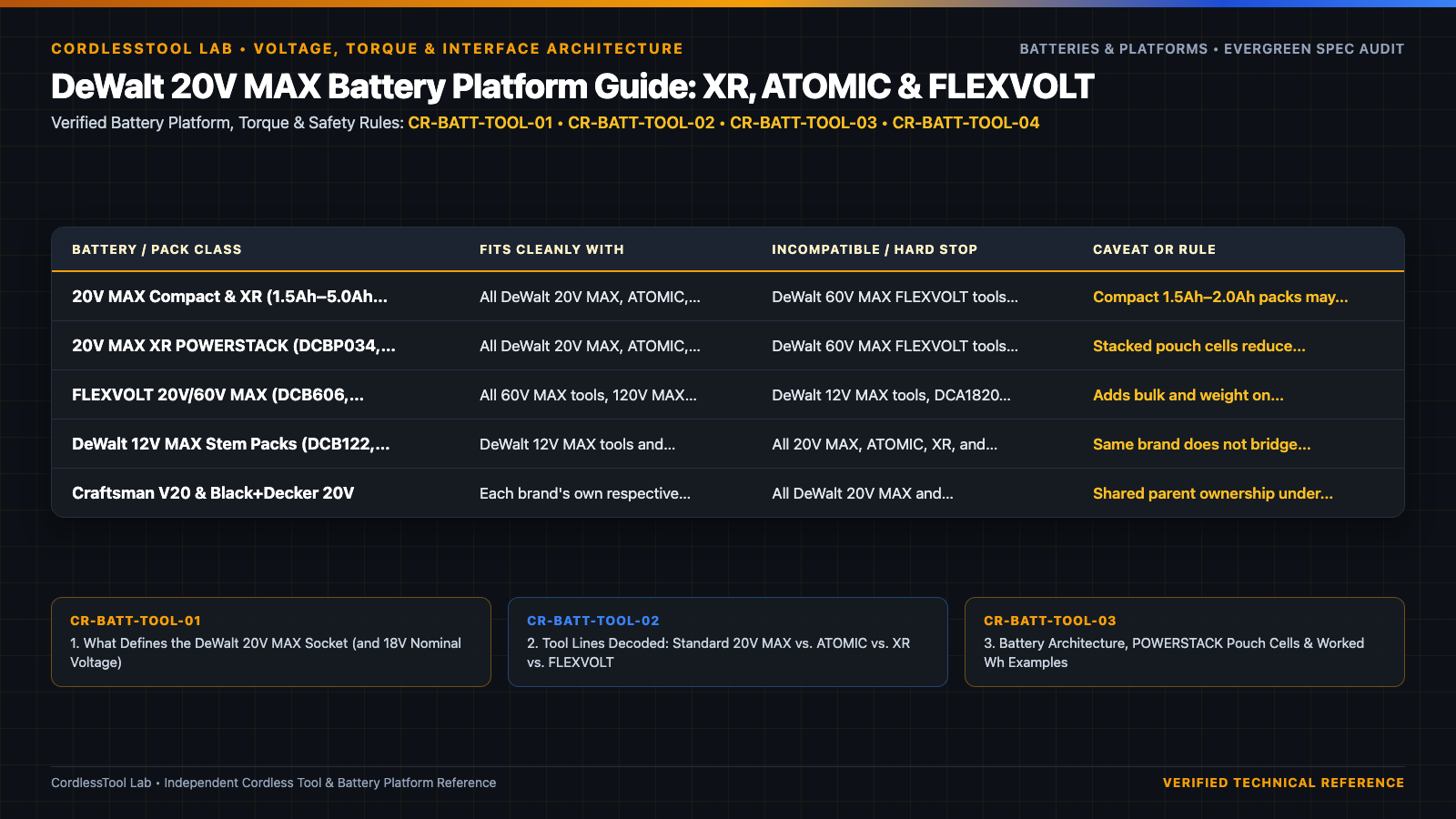
| Battery / Pack Class | Fits Cleanly With | Incompatible / Hard Stop | Caveat or Rule |
|---|---|---|---|
| 20V MAX Compact & XR (1.5Ah–5.0Ah Cylindrical, e.g., DCB203, DCB205) | All DeWalt 20V MAX, ATOMIC, and XR tools; DCB115, DCB118, DCB1112, DCB1404 chargers | DeWalt 60V MAX FLEXVOLT tools (CR-BATT-TOOL-05), 120V MAX tools, 12V MAX tools, Craftsman V20, Black+Decker 20V | Compact 1.5Ah–2.0Ah packs may drop output or trigger early cutoff on high-draw circular saws and grinders (CR-BATT-TOOL-08). |
| 20V MAX XR POWERSTACK (DCBP034, DCBP320, DCBP520) | All DeWalt 20V MAX, ATOMIC, and XR tools; DeWalt 20V MAX chargers | DeWalt 60V MAX FLEXVOLT tools (CR-BATT-TOOL-05), 12V MAX tools, competing brands | Stacked pouch cells reduce impedance on high-draw 20V MAX tools without adding 60V cell count (CR-BATT-04). |
| FLEXVOLT 20V/60V MAX (DCB606, DCB609, DCB612) | All 60V MAX tools, 120V MAX dual-slot tools (2 packs required), all 20V MAX / ATOMIC / XR tools, 20V/60V chargers | DeWalt 12V MAX tools, DCA1820 18V NiCd adapter, competing brands | Adds bulk and weight on compact 20V drills and overhead drivers (CR-BATT-TOOL-04, CR-BATT-TOOL-11); packs >100 Wh carry airline limits. |
| DeWalt 12V MAX Stem Packs (DCB122, DCB124) | DeWalt 12V MAX tools and multi-voltage chargers (DCB115, DCB1404) | All 20V MAX, ATOMIC, XR, and 60V MAX tools (CR-BATT-TOOL-03); DCB118/DCB1112 chargers | Same brand does not bridge voltage families; physically separate 10.8V nominal stem pod. |
| Craftsman V20 & Black+Decker 20V | Each brand’s own respective tool rail only | All DeWalt 20V MAX and FLEXVOLT tools and chargers (CR-BATT-TOOL-01) | Shared parent ownership under Stanley Black & Decker does not make rails or BMS pins compatible. |
If you are deciding which DeWalt packs belong in a home workshop or pro bag, explore our curated roundup of the best DeWalt 20V MAX batteries or follow our homeowner starter setup blueprint on DeWalt 20V MAX to avoid under-batteried kits.
5. Chargers, Speed Tiers & Temperature Lockout Behavior
Buying a bare pack or bare tool requires matching your charger to both battery family (CR-BATT-01) and pack size (CR-BATT-03). DeWalt’s current US charger lineup spans four distinct capability tiers:
- DCB115 (4.0A Standard Multi-Voltage Charger): Passively cooled single-bay charger accepting 12V MAX, 20V MAX, and FLEXVOLT batteries (charging FLEXVOLT packs via their 20V rail). Adequate for 1.7Ah–5.0Ah packs, though large 9.0Ah–12.0Ah FLEXVOLT packs charge noticeably slower than on fan-cooled units (
CR-BATT-03). - DCB118 (8.0A Fan-Cooled Fast Charger): Active internal fan draws cool air across the battery pack to shorten thermal cool-down delays after heavy cuts and speed up charge cycles on 20V MAX and FLEXVOLT packs. Note: the
DCB118does not accept 12V MAX stem batteries (CR-BATT-01). - DCB1112 (12.0A Dual-Fan Fast Charger): High-output 12-amp dock built for high-capacity 8.0Ah–15.0Ah packs and heavy jobsite rotation across 20V MAX and FLEXVOLT rails (also excludes 12V MAX packs).
- DCB1404 (4-Port Simultaneous Multi-Family Charger): Charges up to four batteries simultaneously at 4 amps per port across 12V MAX, 20V MAX, and FLEXVOLT packs—eliminating manual swapping for mixed-voltage crews.
Temperature Lockout (CR-BATT-05): DeWalt chargers include diagnostic LED blink patterns for hot/cold pack delay. If a freshly worked battery or winter-stored pack triggers a hot/cold pause, do not attempt to force charging or bypass protection—unplug or remove the pack and let it reach room temperature inside the charging window specified in your DeWalt manual.
6. Five Platform Myths, Third-Party Adapters & Counterfeit Risks
Engineering Reality Check — Marketplace Traps to Avoid (CR-BATT-TOOL-10 & CR-SYS-03)
High-volume marketplace listings frequently blur voltage labels, tool tiers, and OEM authenticity. Review these five facts before buying replacement packs or cross-brand accessories.
- Myth 1: “DeWalt 20V MAX automatically outpowers Milwaukee or Makita 18V tools.” Reality: Both run 5S 18V-nominal lithium-ion packs (
CR-BATT-TOOL-02). Real work output stems from motor design, pack impedance, and tool electronics—not the sticker number. - Myth 2: “ATOMIC tools need special compact batteries, and XR tools require XR batteries.” Reality: ATOMIC and XR define motor size and feature tier, not battery rails. Every 20V MAX slide battery—standard, XR, POWERSTACK, and FLEXVOLT—fits both ATOMIC and XR tools (
CR-BATT-TOOL-12). - Myth 3: “Craftsman V20 or Black+Decker 20V packs work in DeWalt 20V MAX tools.” Reality: Despite shared corporate parentage under Stanley Black & Decker, mechanical rail keys and BMS contacts block cross-fit (
CR-BATT-TOOL-01). - Myth 4: “Cross-brand plastic adapters or ride-on toy adapters are harmless shortcuts.” Reality: Under
CR-BATT-TOOL-10andG-25, third-party cross-brand adapters and Power Wheels wire harnesses are never approved by tool manufacturers. Because DeWalt places low-voltage cutoff and thermal cutoff protection inside the pack (while brands like Milwaukee coordinate telemetry between tool and pack), passive two-wire adapters risk deep cell over-discharge, thermal stress, and refused warranty claims. CordlessTool Lab excludes all battery adapters from buy lists. - Myth 5: “Unbranded ‘replacement for DeWalt 20V MAX’ 9.0Ah–12.0Ah packs equal OEM batteries.” Reality: Under
CR-SYS-03andG-25, non-OEM clone listings routinely inflate amp-hour claims, omit OEM BMS thermal protection and UL/ETL certification, and void OEM tool warranties. Always purchase genuine DEWALT packs sold by DEWALT, Amazon retail, or an authorized distributor.
7. Safety Instructions, CPSC Recall History & US Warranty Rules
Cordless tools and lithium-ion packs require strict adherence to manufacturer safety protocols (G-24). Follow the DeWalt instruction manual first when installing saw blades, grinding wheel guards (Type 27 vs. Type 1), impact wrench sockets (using calibrated torque wrenches for final lug-nut torque per CR-DRV-03), or operating chargers—and always wear eye, hearing, and hand PPE as the manual specifies. Never modify or bypass blade guards, electric brakes, or battery thermal lockouts. If any lithium-ion pack becomes cracked, swollen, water-soaked, or overheated, discontinue use immediately and dispose of it through DeWalt-approved or local municipal battery recycling programs.
CPSC Recall Screening (CR-SYS-06, G-12): Checking the U.S. CPSC Recalls database and DeWalt’s official safety notices portal shows no open US recalls on current DeWalt 20V MAX lithium-ion or FLEXVOLT battery packs as of our verification date. However, legacy 1996 and 2000 CPSC recalls affected older DeWalt NiCd-era chargers (models DW9104, DW9106, DW9107, DW9108, and DW9116 within specific date-code ranges) due to housing separation, overcharging, or internal clip shock hazards—anyone acquiring vintage corded NiCd chargers secondhand should verify date codes against CPSC records and stop using un-repaired units. Separately, outdoor tool buyers cross-shopping other brands should screen active 2025–2026 CPSC lithium recalls (including SKIL 40V 5.0Ah, DR Power 62V 5.0Ah LiPRO, Kobalt 24V/48V USB-C packs, and Milwaukee 2826-20 top-handle chainsaws).
Bare-Tool Listings & US Warranty Provenance (CR-SYS-01, CR-SYS-02, CR-SYS-05, G-26): Always inspect the exact selected variation on Amazon US before checkout. Any bare DeWalt listing (typically ending in B) is a tool-only listing: battery and charger sold separately, while kit suffixes (such as C, D2, P2) specify pack counts and charger inclusions. Most DeWalt 20V MAX XR and FLEXVOLT tools and batteries carry a 3-year limited warranty, 1-year free service, and 90-day money-back guarantee per DeWalt’s US warranty terms when purchased from authorized channels. By contrast, buyers comparing ecosystems on Amazon US should note that Milwaukee M18/M12 listings rely heavily on third-party resellers where unauthorized dealer status can jeopardize warranty start dates, while Ryobi and Ridgid are Home Depot retail-exclusives in the US—meaning Amazon third-party listings for Ryobi or Ridgid can void OEM coverage and Ridgid’s Lifetime Service Agreement (LSA).
8. Verified OEM DeWalt 20V MAX Packs & Starter Kits
If you are entering the dewalt 20v max battery platform alongside a bare tool or upgrading an existing kit for high-draw saws, the four verified Amazon US OEM listings below cover each core capacity and voltage role. No non-OEM replacement batteries or adapters appear here, and broad market tiers follow CordlessTool Lab pricing bands rather than fluctuating decimal retail prices.
1. DEWALT 20V MAX 5.0Ah Battery & Charger Starter Kit (DCB205C)

Platform Spec: STD-BATT-DEWALT-20V-MAX | 18V Nominal (20V MAX) | 5.0Ah / 90 Wh Nominal | Starter Kit (1x DCB205 Pack + Charger) | Tier: TIER-BATT-VALUE
The DCB205C starter kit solves the bare-tool dilemma under CR-SYS-01 by bundling DeWalt’s proven 5.0Ah cylindrical reference battery (90 Wh nominal, 3-LED fuel gauge) with an OEM 20V MAX charger in one box. It powers every DeWalt 20V MAX, ATOMIC, and XR tool cleanly while remaining FAA carry-on eligible under 100 Wh—just remember it stays locked at 18V nominal and cannot run 60V MAX FLEXVOLT saws (CR-BATT-TOOL-05).
2. DEWALT 20V MAX POWERSTACK Compact Starter Kit (DCBP034C)
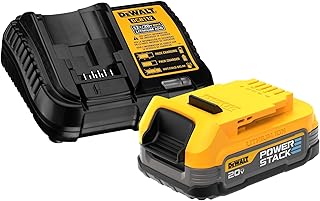
Platform Spec: STD-BATT-DEWALT-20V-MAX | 18V Nominal (20V MAX) | 1.7Ah / 30.6 Wh Nominal | Pouch Cells | Starter Kit (1x DCBP034 Pack + Charger) | Tier: TIER-BATT-VALUE
For compact ATOMIC drills, cabinetry drivers, and overhead installation work, the DCBP034C pairs DeWalt’s lightweight 1.7Ah stacked pouch-cell battery with a matching OEM charger. Compared against bulky 5.0Ah or FLEXVOLT bricks, the compact footprint keeps wrist balance centered (CR-BATT-TOOL-11), though heavy circular saws or angle grinders should step up to a 5.0Ah pack for sustained runtime and current delivery (CR-BATT-TOOL-08).
3. DEWALT 20V MAX XR POWERSTACK 5.0Ah Battery (DCBP520)

Platform Spec: STD-BATT-DEWALT-20V-MAX | 18V Nominal (20V MAX) | 5.0Ah / 90 Wh Nominal | Stacked Pouch Cells | Bare Pack Only (Charger Sold Separately) | Tier: TIER-BATT-MID
Designed as DeWalt’s flagship 20V MAX output upgrade, the DCBP520 POWERSTACK 5.0Ah pack uses laminated pouch cells to deliver a claimed 50% more power and double the lifespan of the cylindrical DCB205 while protecting against impacts with a rubberized overmold. This is a pack-only (tool-only style) listing with charger sold separately (CR-SYS-01), and it remains 20V MAX-only—it will not power 60V MAX FLEXVOLT tools.
4. DEWALT FLEXVOLT 20V/60V MAX 6.0Ah Battery (DCB606)

Platform Spec: STD-BATT-DEWALT-FLEXVOLT-60V | 18V / 54V Nominal (20V/60V MAX) | 6.0Ah (20V) / 2.0Ah (60V) | 108 Wh Nominal (120 Wh Label) | Bare Pack Only (Charger Sold Separately) | Tier: TIER-BATT-MID
If your workshop includes both 20V MAX hand tools and a 60V MAX FLEXVOLT circular saw, grinder, or blower, the DCB606 acts as a one-pack bridge—automatically running 60V MAX tools at 54V nominal and stepping down to 18V nominal on 20V MAX tools (CR-BATT-TOOL-04). Because it is a bare pack without a charger (CR-SYS-01), pair it with a compatible DeWalt 20V/60V charger such as the DCB115 or fan-cooled DCB118, and note both its heavier ergonomics on compact drills and its 108 Wh nominal rating above the 100 Wh airline threshold.
Authoritative Non-Affiliate References
- DEWALT Official DCBP520 20V MAX XR POWERSTACK 5.0Ah Specifications — Official 18V nominal / 20V MAX voltage disclaimer, pouch-cell specs, and DCB205 comparison basis.
- DEWALT Official FLEXVOLT 20V/60V MAX Battery Documentation — Auto-switching 20V/60V MAX operation, dual Ah ratings, and 20V MAX backward compatibility.
- DEWALT US Limited Warranty, Free Service & Money-Back Guarantee Terms — Official 3-year limited warranty, 1-year free service, and 90-day money-back terms.
- DEWALT Safety Notices & Recalls Portal & U.S. CPSC Recalls Database — Recall verification confirming current 20V MAX pack status alongside legacy 1996/2000 NiCd charger notices.
- FAA PackSafe Lithium Battery Travel Guidance — Official US carry-on limits around the 100 Wh and 160 Wh thresholds.
How We Audited This Guide
- Battery packs and chargers were audited across 18V/20V Max vs. 36V/40V/56V/60V nominal voltage behavior, 18650 vs. 21700/tabless pouch cells, charger amperage/sequential logic, and strict OEM-only UL BMS protection.
- Every cordless drill, impact driver, saw, grinder, battery pack, charger, outdoor power tool, and accessory spec was cross-checked against official OEM manuals, UL/ANSI ratings, and live Amazon US listings.
- Recommendations were evaluated against our weighted vertical scoring rubrics and 61 documented CR-* platform and safety rules; we never invent peak torque ft-lbs, cut counts, runtime minutes, or battery decibels.
9. Frequently Asked Questions
Do all DeWalt 20V MAX, ATOMIC, and XR tools use the same batteries?
Yes. Standard 20V MAX, ATOMIC Compact, and XR denote tool performance and motor lines rather than separate sockets. Every DeWalt 20V MAX cylindrical pack, POWERSTACK pouch pack, and FLEXVOLT battery slides onto and powers all DeWalt 20V MAX, ATOMIC, and XR tools.
Can a standard DeWalt 20V MAX battery run a 60V MAX FLEXVOLT tool?
No. Compatibility flows in one direction only. While FLEXVOLT batteries automatically switch down to 18V nominal to run 20V MAX tools, 60V MAX FLEXVOLT saws and grinders require 54V nominal series switching that standard 20V MAX and POWERSTACK packs cannot supply.
Are DeWalt 20V MAX batteries compatible with Craftsman V20 or Black+Decker 20V tools?
No. Although Stanley Black & Decker owns all three brands, DeWalt 20V MAX, Craftsman V20, and Black+Decker 20V MAX use physically different slide rails and terminal keying. Packs from those sibling brands never lock onto or run DeWalt 20V MAX tools.
Is there a performance advantage to DeWalt 20V MAX over 18V platforms?
No. Both DeWalt 20V MAX and 18V platforms such as Milwaukee M18 and Makita 18V LXT wire five lithium-ion cells in series at 18V nominal. “20V MAX” describes peak unloaded voltage, whereas real tool output depends on motor efficiency and pack current capability.
Will any DeWalt charger charge POWERSTACK and FLEXVOLT batteries?
Yes, across DeWalt’s 20V MAX slide charger lineup—including the 4A DCB115, 8A fan-cooled DCB118, 12A DCB1112, and 4-port DCB1404. Note that the DCB118 and DCB1112 do not accept 12V MAX stem packs, and large FLEXVOLT packs charge faster on fan-cooled docks.


