
Disclosure: As an Amazon Associate, CordlessTool Lab earns from qualifying purchases. If you buy through verified product links on this page, we may earn a small commission at no extra cost to you. Commission rates never influence platform recommendations or editorial verdicts.
Comparing dewalt 20v max vs makita 18v lxt begins with one non-negotiable hardware rule: battery platforms are mechanical sockets, and the better system is usually the one whose packs and chargers you already own (CR-SYS-04, CR-BATT-TOOL-01). Even though both ecosystems run on identical five-cell 18-volt nominal lithium-ion chemistry, a DeWalt slide pack will never latch onto a Makita tool, and a Makita slide pack will never power a DeWalt tool.
If you are buying into your first cordless ecosystem from scratch, your decision comes down to how each brand scales high-output cells, high-voltage saws, rapid charging, and US retail availability—topics we map across all major brands in our cordless tool battery platforms pillar guide. Below, we audit verified OEM specifications, bare-tool versus starter-kit economics, and compatibility limits across both 18-volt nominal giants without crowning a single all-trade champion.
In This Platform Comparison
- Quick Verdict Matrix by Trade & Use Case
- Side-by-Side Verified Platform & Battery Specifications
- 1. Nominal Voltage Reality (20V MAX vs. 18V) & Rail Lock-In
- 2. High-Voltage Scaling: FLEXVOLT 60V vs. Makita 36V (18V X2) & XGT
- 3. Cell Tech, High-Draw Pairing & Torque Method Parity
- 4. Charger Speeds, Thermal Lockout & Bare-vs-Kit Economics
- 5. Counterfeits, Adapters, US Warranties & CPSC Recall Screening
- Choose DeWalt 20V MAX vs. Choose Makita 18V LXT
- Verified OEM Battery Packs & Starter Kits on Amazon US
- Frequently Asked Questions
Quick Verdict Matrix: Which Platform Wins by Trade & Use Case?
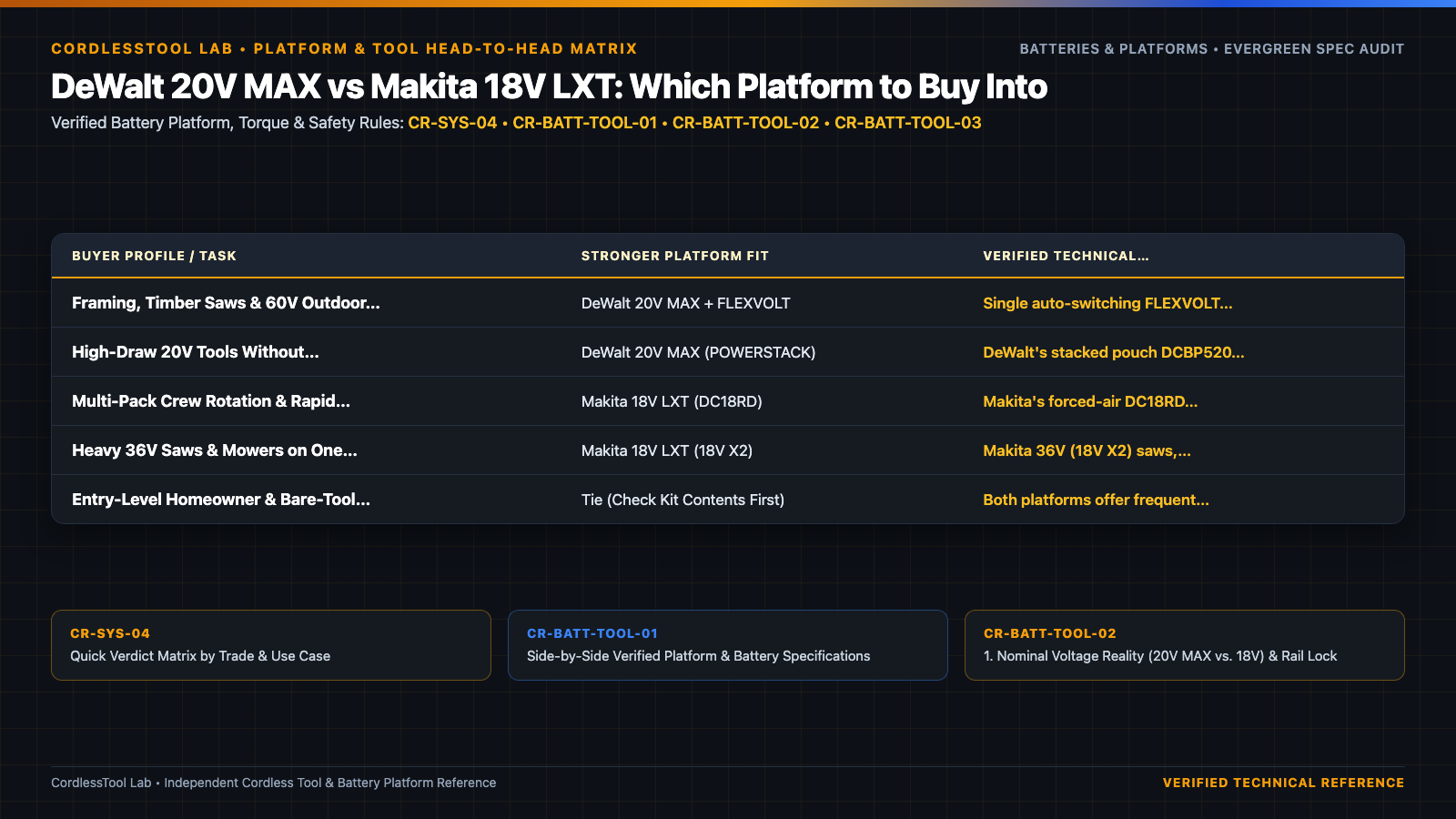
Neither DeWalt 20V MAX nor Makita 18V LXT sweeps every jobsite category. DeWalt holds clear structural advantages in stacked pouch-cell upgrades and single-battery 60V MAX scaling, whereas Makita leads in sub-50-minute forced-air dual-port charging and keeping heavy 36V tools inside the same 18V battery pool.
| Buyer Profile / Task | Stronger Platform Fit | Verified Technical Rationale |
|---|---|---|
| Framing, Timber Saws & 60V Outdoor Expansion | DeWalt 20V MAX + FLEXVOLT | Single auto-switching FLEXVOLT packs run 60V MAX saws and outdoor equipment while remaining downward-compatible with 20V MAX tools (CR-BATT-TOOL-04). |
| High-Draw 20V Tools Without Brick-Sized Packs | DeWalt 20V MAX (POWERSTACK) | DeWalt’s stacked pouch DCBP520 (5.0Ah, 90 Wh) maintains ~1.5 lb handling while DeWalt states 50% more power and 2x lifespan versus the cylindrical DCB205. |
| Multi-Pack Crew Rotation & Rapid Turnaround | Makita 18V LXT (DC18RD) | Makita’s forced-air DC18RD Two-Port Rapid Optimum Charger refills two BL1850B 5.0Ah packs simultaneously in ~45 minutes. |
| Heavy 36V Saws & Mowers on One Battery Type | Makita 18V LXT (18V X2) | Makita 36V (18V X2) saws, rotary hammers, and mowers draw power from two standard 18V LXT batteries (CR-BATT-TOOL-06), avoiding a separate heavy high-voltage pack line. |
| Entry-Level Homeowner & Bare-Tool Expansion | Tie (Check Kit Contents First) | Both platforms offer frequent US starter bundles in TIER-BATT-VALUE to TIER-BATT-MID; always check bare vs. kit suffixes (CR-SYS-01, CR-SYS-02). |
| Woodworking Shops & Ergonomic Finish Carpentry | Makita 18V LXT (Slight Edge) | Makita’s compact ~1.4 lb 5.0Ah BL1850B footprint, 325+ product lineup, and track/miter saw ecosystem suit precision finish shops—though DeWalt’s XR routers and sanders compete closely. |
Side-by-Side Verified Platform & Battery Specifications
The table below compares verified manufacturer specifications on identical engineering bases (18V nominal voltage, watt-hour energy, imperial pack weights, and US warranty terms). Independent cross-brand lab torque or runtime curves are intentionally excluded because neither maker uses identical measurement fixtures across its catalog—where standardized third-party measurements are absent, we mark cross-brand output rankings as no verified data available yet under a unified method (CR-DRV-02, G-09).
| Specification / Platform Gate | DeWalt 20V MAX | Makita 18V LXT |
|---|---|---|
| Nominal Voltage (Electrochemical) | 18V nominal (5 cells in series × 3.6V) | 18V nominal (5 cells in series × 3.6V) |
| Marketing Voltage Label | “20V MAX” (maximum initial no-load voltage) | “18V LXT” (nominal voltage label) |
| Maker-Stated Catalog Breadth | 300+ cordless products (per DeWalt US) | 325+ cordless products (per Makita USA) |
| Reference 5.0Ah Pack & Energy | DCB205 XR / DCBP520 POWERSTACK (5.0Ah / 90 Wh nominal) | BL1850B LXT (5.0Ah / 90 Wh nominal) |
| 5.0Ah Pack Weight (Maker Spec) | ~1.4 lb (DCB205) / ~1.5 lb (DCBP520) | ~1.4 lb (BL1850B) |
| Cell Format Options on Rail | Cylindrical (XR) + Stacked Pouch (POWERSTACK) | Cylindrical Li-Ion w/ Star Protection BMS |
| High-Voltage Scaling Path | Single dual-voltage FLEXVOLT 20V/60V MAX pack (plus 120V MAX dual-FLEXVOLT tools) | Dual-slot 36V (18V X2) LXT tools (takes two 18V LXT packs); separate 40V max XGT line |
| Same-Brand Non-Interchange Families | DeWalt 12V MAX stem packs (and sister brands Craftsman V20 / Black+Decker 20V) | Makita 12V max CXT & Makita 40V max XGT (zero tool cross-fit) |
| 5.0Ah Rapid Charge Time (OEM) | ~75 min on 4A DCB115/DCB1104; ~50–60 min on 8A fan-cooled DCB118 | ~45 min on fan-cooled DC18RC (single) or DC18RD (two packs simultaneously) |
| Unified Cross-Brand Lab Ranking | No verified data available yet under identical fixture across all SKUs | No verified data available yet under identical fixture across all SKUs |
| US OEM Warranty Coverage | 3-Year Limited Warranty, 1-Year Free Service, 90-Day Money-Back Guarantee | 3-Year Limited Warranty on qualifying LXT tools, batteries, and chargers |
| Amazon US Seller Channel | Amazon first-party retail + official DeWalt Store + authorized dealers | Amazon first-party retail + official Makita Store + authorized dealers |
1. Nominal Voltage Reality (20V MAX vs. 18V) & Hard Rail Lock-In
The most persistent myth in the dewalt 20v max vs makita 18v lxt debate is that DeWalt packs deliver 11% more power because the housing says “20V” instead of “18V.” That assumption fails basic electrochemistry (CR-BATT-TOOL-02). Both DeWalt 20V MAX and Makita 18V LXT packs wire five lithium-ion cell groups in series (5S). Multiplied by 3.6 volts nominal per cell group, both deliver an identical 18 volts nominal under working tool load. DeWalt markets the peak open-circuit voltage measured fresh off the charger without a load (20V MAX), while Makita prints the 18V nominal figure.
Because both systems store 90 watt-hours (Wh) in a 5.0Ah pack (18V × 5.0Ah = 90 Wh), stored energy capacity at identical amp-hour ratings is a mathematical tie. What differs is mechanical and electronic lock-in (CR-BATT-TOOL-01):
- Zero Cross-Brand Mechanical Fit: DeWalt 20V MAX slide rails, terminal blades, and latch geometry fit only DeWalt 20V MAX tools (and FLEXVOLT downward compatibility). Makita 18V LXT rails fit only Makita 18V LXT tools.
- Shared Corporate Parents Still Do Not Interchange: Even though Stanley Black & Decker owns DeWalt, Craftsman, and Black+Decker, Craftsman V20 and Black+Decker 20V MAX packs have distinct rail keys and never fit DeWalt 20V MAX tools (
CR-BATT-TOOL-01). - Same-Brand Voltage Walls Apply to Both (
CR-BATT-TOOL-03): Within DeWalt, 12V MAX stem batteries do not fit 20V MAX slide tools. Within Makita, 12V max CXT and 40V max XGT batteries have completely different rails and never fit 18V LXT tools. For a side-by-side look at Makita’s two primary pro rails, see our Makita 18V LXT vs. 40V max XGT breakdown. - Backward Compatibility Inside Each 18V/20V Family (
CR-BATT-TOOL-12): Current DeWalt 20V MAX slide packs (XR and POWERSTACK) fit legacy 20V MAX slide tools (excluding older 18V NiCd post-style tools), and current MakitaBL1850Bpacks fit 18V LXT tools—though older pre-Star LXT tools without the Star symbol or yellow receiver plate should be verified against Makita’s Star Protection chart before pairing.
2. High-Voltage Scaling: FLEXVOLT 60V vs. Makita 36V (18V X2) & XGT
When you move past drills and impact drivers into framing circular saws, SDS-plus rotary hammers, plunge track saws, and outdoor yard equipment, voltage architecture becomes the sharpest dividing line between DeWalt and Makita.
DeWalt’s One-Way FLEXVOLT Bridge (CR-BATT-TOOL-04 & CR-BATT-TOOL-05)
DeWalt solves high-voltage scaling through dual-voltage 20V/60V MAX FLEXVOLT packs (such as the DCB609). Internal mechanical switches reconfigure the cell banks automatically depending on the tool socket: in a 60V MAX saw or grinder, the cells run in series at 54V nominal (60V MAX); in a 20V MAX tool, the cells parallel down to 18V nominal (20V MAX). Remember two strict rules outlined in our DeWalt 20V MAX battery platform guide:
- Downward Compatibility Has a Weight Caveat (
CR-BATT-TOOL-04): A FLEXVOLT battery powers 300+ DeWalt 20V MAX tools—and select “FLEXVOLT ADVANTAGE” 20V MAX tools gain rated output per DeWalt—but the larger pack adds noticeable weight and bulk to compact drills and impact drivers (CR-BATT-TOOL-11). - Upward Compatibility Is Impossible (
CR-BATT-TOOL-05): Standard 20V MAX packs like theDCB205orDCBP520will never latch onto or power a 60V MAX FLEXVOLT tool. Also note that FLEXVOLT Ah ratings are printed at 20V MAX (for example, 9.0Ah at 20V MAX equals 3.0Ah at 60V MAX; DeWalt labels theDCB609at 180 Wh on its max-voltage basis versus 162 Wh at 18V nominal—never add both Ah figures together).
Makita’s 36V (18V X2) Dual-Slot Approach vs. 40V max XGT (CR-BATT-TOOL-06)
Makita keeps its high-power LXT tools on the exact same 18V LXT batteries by wiring two 18V battery bays in series on 36V (18V X2) LXT saws, rotary hammers, blowers, and mowers. Under CR-BATT-TOOL-06, both battery slots must hold charged 18V LXT packs before the tool turns on—installing a single pack leaves the tool dead. The upside is zero special dual-voltage pack inventory: the same pair of 5.0Ah BL1850B packs that run your framing saw can split onto a drill and impact driver afterward.
Where Makita complicates the picture is its newer 40V max XGT platform (36V nominal). Unlike DeWalt FLEXVOLT, XGT packs do not fit 18V LXT tools, and 18V LXT packs do not fit 40V max XGT tools (CR-BATT-TOOL-03). If your future roadmap includes heavy concrete demolition or single-battery 36V commercial outdoor tools, compare both ecosystems in our Milwaukee M18 vs. Makita 18V LXT comparison before committing.
3. Cell Architecture, High-Draw Tool Pairing & Torque Method Parity
Internal cell geometry does not change tool fit (CR-BATT-04), yet it strongly shapes how each platform handles high-draw circular saws, angle grinders, and high-torque impact wrenches (CR-BATT-TOOL-08).
DeWalt’s Stacked Pouch Advantage: Alongside cylindrical XR packs (like the DCB205 5.0Ah), DeWalt offers XR POWERSTACK packs built with flat laminated pouch cells (DCBP034 1.7Ah, DCBP320 3.5Ah, and DCBP520 5.0Ah). Per DeWalt’s official comparison against its own cylindrical DCB205 reference pack, the DCBP520 delivers 50% more power and up to 2x charge-cycle lifespan in a ~1.5 lb footprint. That gives DeWalt 20V MAX owners a compact, low-impedance upgrade path without carrying a heavy FLEXVOLT battery.
Makita’s Cylindrical Reliability & Star Protection: Makita 18V LXT packs such as the BL1850B (5.0Ah, 90 Wh) and BL1860B (6.0Ah, 108 Wh) stick with cylindrical lithium-ion cells paired with Star Protection Computer Controls—a BMS telemetry handshake between battery and tool that monitors overload, over-discharge, and overheating. Makita has reserved its tabless and newer high-output cell updates largely for its separate 40V max XGT platform rather than releasing pouch packs on 18V LXT.
Torque Rating Discipline (CR-DRV-02, CR-BATT-TOOL-09, G-03, G-15): When comparing drills (in-lbs) or impact wrenches (ft-lbs) across DeWalt and Makita, never rank one brand over the other solely from printed brochure torque numbers. DeWalt frequently publishes UWO/MWO power ratings alongside brake-torque figures tied to specific high-output or FLEXVOLT packs, whereas Makita rates its drills and impact wrenches in in-lbs or ft-lbs using its own internal fixture methods. Always check which reference battery pack the manufacturer specifies for a rated figure (CR-BATT-TOOL-09), and reserve cross-brand strength claims for controlled benchmarks run on identical fasteners and packs.
4. Charger Turnarounds, Thermal Lockout & Bare-vs-Kit Economics
Charging speed and starter-kit value are where Makita 18V LXT punches well above its age—while DeWalt counters with multi-voltage charger flexibility and lower entry starter-kit pricing.
- Makita Rapid Optimum Charging (
CR-BATT-01,CR-BATT-03): Makita’s fan-cooledDC18RC(single-port) andDC18RD(two-port simultaneous) chargers push active cooling air through internal channels in theBL1850B, reaching a full charge in approximately 45 minutes per 5.0Ah pack—even when filling two 5.0Ah batteries side-by-side on theDC18RDfor 36V X2 tools. Note that Makita’sDC40RAXGT charger cannot charge 18V LXT packs unless paired with Makita’s optionalADP10charging adapter. - DeWalt Multi-Voltage Chargers: DeWalt entry starter kits often include 4.0A chargers like the
DCB115orDCB1104(roughly 75 to 90 minutes for a 5.0AhDCB205orDCBP520), while stepping up to the fan-cooled 8.0ADCB118FLEXVOLT Fast Charger trims 5.0Ah charge time to roughly 50–60 minutes. Most modern DeWalt slide chargers support 12V MAX, 20V MAX, and FLEXVOLT packs on one unit—verify exact pack-generation support on the charger’s compatibility label (CR-BATT-02). - Thermal Pause Rules (
CR-BATT-05): Both DeWalt and Makita chargers monitor internal thermistor resistance. If a charger indicator blinks after pulling a pack off a sun-baked roof or out of a cold truck bed, the charger is pausing safely until cells return to the operating window specified in the owner’s manual. - Bare-Tool vs. Kit Math (
CR-SYS-01,CR-SYS-02,CR-SYS-07): When browsing Amazon US, remember DeWalt bare tools usually end inBand Makita bare tools usually end inZ. Any bare listing is a tool-only listing: battery and charger sold separately—budget for a starter pack unless you already own that platform. Also inspect combo-kit model numbers carefully: entry combo bundles inTIER-ENTRYorTIER-STARTERsometimes bundle brushed or compact models rather than flagship XR or LXT brushless tools (CR-SYS-07), and kit contents vary across listing variations (CR-SYS-02).
5. Counterfeits, Adapters, US Warranties & CPSC Recall Screening
Before clicking buy on any battery or kit on Amazon US, apply four marketplace and safety screens:
- Zero Non-OEM Replacement Batteries (
G-25,CR-SYS-03): Unbranded third-party packs claiming “9.0Ah” or “12.0Ah” compatibility for DeWalt 20V MAX or Makita 18V LXT are strictly excluded from our recommendations. Counterfeit and aftermarket packs often omit brand-specific thermistor telemetry, use inconsistent cells, and lack verified safety certification—buy genuine OEM packs sold by the brand store, Amazon retail, or an authorized dealer. - Zero Cross-Brand Battery Adapters (
G-25,CR-BATT-TOOL-10): Neither DeWalt nor Makita approves third-party plastic sleds that adapt one brand’s battery onto another brand’s tool (or onto ride-on toys). Because brands split low-voltage cutoff and thermal monitoring differently between the tool and the battery BMS, passive adapters bypass critical protection handshakes and risk warranty refusal. - US Seller Provenance & Warranty Rules (
CR-SYS-05,G-26): Both DeWalt and Makita maintain strong first-party Amazon retail and official Brand Store channels (covering DeWalt’s 3-year limited warranty / 1-year free service and Makita’s 3-year limited warranty). By contrast, if you cross-shop Milwaukee M18/M12, Ryobi ONE+/40V, or Ridgid 18V on Amazon US, remember that Ryobi and Ridgid are US retail-exclusive brands and Milwaukee relies heavily on authorized distributors—third-party marketplace resellers on those brands can jeopardize OEM warranty or Ridgid Lifetime Service Agreement (LSA) eligibility. - CPSC Recall Status & Manual-First Safety (
CR-SYS-06,G-12,G-24): As of our 2026-11-26 check of the U.S. CPSC Product Safety Recalls database, zero open recalls affect core DeWalt 20V MAX or Makita 18V LXT lithium-ion battery packs. However, owners should verify serial numbers on peripheral platform equipment—such as DeWalt’s August 2024 recall on select 20V MAX push mowers (DCMWP234U2andDCMWP600X2) for handle-switch water intrusion, and Makita’s late-2025 recall onXPG01cordless grease gun flexible hoses. Always follow the manufacturer’s manual first for charging temperatures, blade guards, wheel RPM ratings, torque-wrench final fastening on lug nuts, and PPE as the manual specifies; stop using swollen, cracked, or wet packs immediately and dispose of them via authorized recycling programs.
Final Platform Decision: Choose DeWalt 20V MAX vs. Choose Makita 18V LXT
Choose DeWalt 20V MAX If…
- You want high-output stacked pouch-cell batteries (
POWERSTACK DCBP520) that fit standard 20V MAX tools without extra brick weight. - You plan to add 60V MAX FLEXVOLT timber saws, grinders, or outdoor gear and want dual-voltage packs that also power your 20V MAX tools (
CR-BATT-TOOL-04). - You prefer lower entry starter-kit pricing (
DCB205CinTIER-BATT-VALUE) with wide Amazon US first-party stock and a 3-year limited warranty + 1-year free service.
Choose Makita 18V LXT If…
- You want 45-minute forced-air charging on 5.0Ah packs—especially with the dual-port
DC18RDcharger refilling two batteries at once. - You prefer running heavy 36V saws, rotary hammers, and mowers off two identical 18V LXT packs (
18V X2,CR-BATT-TOOL-06) instead of buying a separate high-voltage battery tier. - You value a 325+ tool lineup with balanced ~1.4 lb 5.0Ah pack ergonomics for woodworking, cabinetry, and finish trades.
Verified OEM Battery Packs & Starter Kits to Enter Each Platform
If you are starting fresh—or adding OEM batteries to match a bare-tool purchase—the four verified Amazon US listings below provide clean entry and high-output expansion paths on both rails without third-party counterfeits or unsupported adapters.
1. DEWALT 20V MAX 5.0Ah Battery & Charger Starter Kit (DCB205C) — Best Entry Starter Kit

Key Specs: 18V Nominal (20V MAX marketing label) | 5.0Ah / 90 Wh (nominal 18V basis) | Cylindrical XR Cells | Includes 1x DCB205 Battery + 1x DEWALT 20V MAX Charger | 3-Year Limited Warranty | Price Tier: Value Starter Tier (TIER-BATT-VALUE)
The DCB205C is the most direct entry ramp into DeWalt’s 300+ tool 20V MAX catalog when buying a bare tool (tool-only listing: battery and charger sold separately). Pairing the ~1.4 lb DCB205 5.0Ah battery with an OEM charger gets a drill, impact driver, or compact saw running immediately while staying comfortably below the 100 Wh airline carry-on threshold.
Buyer Verification Alert: Kit includes one 5.0Ah pack and one charger (verify exact charger model in the selected Amazon variation per CR-SYS-02). Standard 20V MAX packs never power 60V MAX FLEXVOLT tools (CR-BATT-TOOL-05).
Pros
- Includes both a full 5.0Ah (90 Wh) OEM battery and charger in
TIER-BATT-VALUEstarter pricing. - Balanced ~1.4 lb pack weight suits everyday drilling, driving, and multi-tool cuts across 300+ 20V MAX tools.
- Backed by DeWalt’s 3-year limited warranty, 1-year free service, and 90-day money-back guarantee.
Cons
- Single-battery bundle pauses continuous saw or grinder work while charging.
- Standard cylindrical cells trail POWERSTACK
DCBP520under heavy sustained loads and cannot run 60V MAX tools.
2. DEWALT 20V MAX XR POWERSTACK 5.0Ah Battery (DCBP520) — Best High-Output Upgrade

Key Specs: 18V Nominal (20V MAX marketing label) | 5.0Ah / 90 Wh (nominal 18V basis) | Stacked Pouch Cells | ~1.5 lb | Pack-Only Listing (Charger Sold Separately) | 3-Year Limited Warranty | Price Tier: Mid-Range Pack Tier (TIER-BATT-MID)
For builders running high-draw DeWalt 20V MAX circular saws, grinders, and hammer drills, the DCBP520 replaces cylindrical cells with stacked pouch layers. DeWalt states 50% more power and 2x charge-cycle lifespan compared to the cylindrical DCB205 reference pack while holding total weight near 1.5 lb and staying under 100 Wh.
Buyer Verification Alert: Pack-only listing: charger and tools sold separately (CR-SYS-01). Fits all DeWalt 20V MAX tools and compatible 20V MAX chargers (DCB115, DCB1104, DCB118), but will not run 60V MAX FLEXVOLT tools (CR-BATT-TOOL-05).
Pros
- Stacked pouch cells lower internal impedance; DeWalt cites 50% more power and 2x lifespan vs. the
DCB205. - Impact-resistant rubberized base and 3-LED fuel gauge protect finished surfaces and pack status checks.
- Maintains ~1.5 lb balance and 90 Wh energy without stepping up to heavier FLEXVOLT bricks.
Cons
- Pack-only SKU includes no charger (
CR-SYS-01) and sits inTIER-BATT-MIDfor a single battery. - Does not auto-switch to 54V/60V MAX for FLEXVOLT-only saws and grinders (
CR-BATT-TOOL-05).
3. Makita BL1850B2DC2 18V LXT 5.0Ah Dual-Port Starter Pack — Best LXT & 36V X2 Kit

Key Specs: 18V Nominal (36V in 18V X2 dual-slot tools) | 2x 5.0Ah / 90 Wh each (180 Wh total nominal) | Star Protection BMS | Includes 2x BL1850B Batteries + DC18RD Dual Port Rapid Optimum Charger | 3-Year Limited Warranty | Price Tier: Mid-to-Pro Starter Tier (TIER-BATT-MID)
The BL1850B2DC2 starter pack highlights Makita’s strongest operational advantage: two 5.0Ah packs plus the dual-port forced-air DC18RD Rapid Optimum Charger, which recharges both batteries simultaneously in ~45 minutes. That dual-pack configuration powers standard 18V LXT tools all shift and satisfies Makita’s 36V (18V X2) two-battery requirement right out of the box (CR-BATT-TOOL-06).
Buyer Verification Alert: Compatible with Makita 18V LXT and 36V (18V X2) tools only—will not fit Makita 40V max XGT or 12V max CXT tools (CR-BATT-TOOL-03). Verify Star Protection compatibility on legacy pre-Star LXT tools.
Pros
- Simultaneous 45-minute forced-air dual-port charging on the included
DC18RDminimizes jobsite downtime. - Matched pair of 5.0Ah packs (180 Wh combined) immediately runs 36V (18V X2) saws, blowers, and rotary hammers (
CR-BATT-TOOL-06). - Each ~1.4 lb pack stays below 100 Wh and includes Star Protection Computer Controls plus an integrated LED charge indicator.
Cons
- Higher upfront starter outlay than single-battery entry bundles like DeWalt’s
DCB205C. - Locked strictly to 18V LXT; does not power 40V max XGT tools and uses cylindrical cells without a pouch-cell LXT tier.
4. Makita BL1850B-2 18V LXT 5.0Ah Battery 2-Pack — Best LXT Expansion Pack

Key Specs: 18V Nominal (36V in 18V X2 dual-slot tools) | 2x 5.0Ah / 90 Wh each (180 Wh total nominal) | Star Protection BMS | ~1.4 lb per pack | 2-Pack Only (Charger Sold Separately) | 3-Year Limited Warranty | Price Tier: Mid-Range 2-Pack Tier (TIER-BATT-MID)
If you already own a Makita DC18RC or DC18RD charger and want matched capacity for bare-tool (Z-suffix) LXT purchases or dual-battery 36V X2 saws, the BL1850B-2 two-pack keeps per-pack handling light at roughly 1.4 lb while providing 180 Wh of combined nominal energy.
Buyer Verification Alert: Pack-only 2-pack: charger sold separately (CR-SYS-01). Requires an 18V LXT charger such as the DC18RC or DC18RD (charging on an XGT DC40RA requires Makita’s optional ADP10 adapter per CR-BATT-01).
Pros
- Matched pair powers 36V (18V X2) tools immediately while splitting cleanly across two handheld 18V tools.
- Recharges in ~45 minutes on Makita Rapid Optimum Chargers with Star Protection thermal and overload telemetry.
- Trim ~1.4 lb per-pack weight preserves drill and impact driver balance on ladders and cabinets.
Cons
- Includes no charger (
CR-SYS-01); slower non-fan LXT chargers extend wait times noticeably (CR-BATT-03). - No stacked-pouch or tabless cell upgrade option on LXT, and zero compatibility with 40V max XGT tools (
CR-BATT-TOOL-03).
How We Weighted This Platform Comparison
Consistent with CordlessTool Lab’s battery platform rubric (Evaluation Methodology), we evaluate competing ecosystems across six weighted engineering and ownership factors:
| Evaluation Criterion | Weight | DeWalt 20V MAX vs. Makita 18V LXT Finding |
|---|---|---|
| Platform Fit & Ecosystem | 25% | Makita leads slightly in 18V catalog count (325+ vs. 300+); DeWalt counters with one-way FLEXVOLT 60V compatibility while Makita separates LXT from XGT. |
| Output Class & Tool Pairings | 20% | DeWalt holds an edge on 18V-class high-draw tools via stacked-pouch POWERSTACK packs; Makita relies on dual-pack 36V (18V X2) tools for heavy draw. |
| Energy Density & Ergonomics | 15% | Both hit 90 Wh at ~1.4–1.5 lb in 5.0Ah packs; POWERSTACK trims bulk under load while BL1850B balances compact handhelds cleanly. |
| Charging Speed & Chargers | 15% | Makita’s forced-air DC18RC/DC18RD (~45 min 5.0Ah turnaround, dual simultaneous) outpaces DeWalt’s standard 4A and 8A single-bay chargers. |
| Value & Bare-vs-Kit Math | 15% | DeWalt entry starter kits (DCB205C) land lower in TIER-BATT-VALUE; Makita rewards multi-pack buyers running 36V X2 tools on one battery type. |
| US Warranty & Channel Trust | 10% | Both offer 3-year US limited warranties (plus DeWalt 1-year free service) with strong first-party Amazon US OEM availability and zero core battery recalls. |
Official Manufacturer & Safety Citations
- DEWALT US — 20V MAX XR 5.0Ah Battery (DCB205) Specifications & Warranty
- DEWALT US — 20V MAX XR POWERSTACK 5.0Ah Battery (DCBP520) Specifications
- Makita USA — 18V LXT 5.0Ah Battery (BL1850B) & Rapid Optimum Charging
- U.S. Consumer Product Safety Commission (CPSC) — Official Recalls Database
How We Audited This Guide
- Battery packs and chargers were audited across 18V/20V Max vs. 36V/40V/56V/60V nominal voltage behavior, 18650 vs. 21700/tabless pouch cells, charger amperage/sequential logic, and strict OEM-only UL BMS protection.
- Every cordless drill, impact driver, saw, grinder, battery pack, charger, outdoor power tool, and accessory spec was cross-checked against official OEM manuals, UL/ANSI ratings, and live Amazon US listings.
- Recommendations were evaluated against our weighted vertical scoring rubrics and 61 documented CR-* platform and safety rules; we never invent peak torque ft-lbs, cut counts, runtime minutes, or battery decibels.
Frequently Asked Questions: DeWalt 20V MAX vs. Makita 18V LXT
Is DeWalt 20V MAX actually stronger than Makita 18V LXT?
No—both systems use five lithium-ion cell groups in series for an identical 18V nominal voltage under working load. DeWalt prints maximum initial no-load voltage (20V MAX), while Makita prints nominal voltage (18V). Real-world output depends on motor design and high-output pack selection, not the voltage sticker.
Can I use a battery adapter to put DeWalt batteries on Makita tools?
Neither DeWalt nor Makita approves cross-brand battery adapters, and we do not recommend them. Passive sleds interrupt proprietary BMS thermal and low-voltage protection telemetry between the battery and tool, risking cell over-discharge and voided warranty coverage. Commit to one OEM platform or keep separate chargers.
How do DeWalt FLEXVOLT and Makita 36V (18V X2) handle heavy saws differently?
DeWalt 60V MAX tools require a single auto-switching FLEXVOLT battery, which also runs 20V MAX tools with added weight (standard 20V MAX packs never run 60V tools). Makita 36V (18V X2) tools run on two standard 18V LXT packs installed simultaneously, keeping everything on one battery family.
Do Makita 18V LXT batteries fit Makita 40V max XGT tools?
No. Makita 18V LXT and 40V max XGT use completely different slide rails and terminal layouts, so batteries never interchange between tools. Makita’s optional ADP10 adapter only allows charging 18V LXT batteries on an XGT DC40RA charger—it does not convert packs to run XGT tools.
Which platform charges 5.0Ah batteries faster on standard kits?
Makita holds the edge with its fan-cooled Rapid Optimum Chargers: both the single-port DC18RC and two-port DC18RD recharge 5.0Ah BL1850B batteries in roughly 45 minutes. DeWalt’s 4A kit chargers (DCB115/DCB1104) take roughly 75–90 minutes, though the optional 8A fan-cooled DCB118 cuts that to 50–60 minutes.


