
Disclosure: As an Amazon Associate, CordlessTool Lab earns from qualifying purchases. If you buy through links on this page, we may earn a small commission at no extra cost to you. Retail commission rates (3% in Tools & Home Improvement) never alter our compatibility rules, cost math, or hardware recommendations.
Understanding the tool only vs kit price split is the fastest way to avoid overpaying when starting or expanding a cordless workshop. A bare tool listing looks dramatically cheaper on a product grid, yet lithium-ion battery packs and chargers routinely represent 30% to 45% of a starter setup’s real cost. Inside our cordless power tool combo kit buying hub and specification audit framework, we break down how box contents, SKU suffixes, watt-hour energy math, and hidden combo-kit trade-offs dictate whether a bare tool or a bundled kit saves you money.
Quick Answer — Should You Buy Tool-Only or a Kit?
Buy a kit (starter or combo kit) if you are entering a battery platform from scratch or need spare packs and a charger, because buying a bare tool plus separate batteries usually costs more (CR-SYS-01, CR-SYS-04). Buy tool-only (bare tool) only once you already own two healthy OEM packs and a compatible charger on that exact platform.
In This Guide
- 1. What “Tool-Only” (Bare Tool) vs. “Kit” Actually Means (CR-SYS-01 & CR-SYS-02)
- 2. Real Starting Cost, 18V Nominal Parity & Worked Watt-Hour Examples
- 3. Tool-Only vs. Kit Decision Matrix & Visual Framework
- 4. Hidden Kit Traps: Brushed Filler Tools, Compact Packs & Dual-Battery Tools
- 5. Five Buying Myths, Third-Party Adapters & Reseller Warranty Risks
- 6. Battery & Tool Safety Rules, PPE & CPSC Recall Screening
- 7. Verified OEM Reference Listings: Starter Kits, Bare Tools & Combo Bundles
- 8. Authoritative Non-Affiliate References
- 9. Frequently Asked Questions
1. What “Tool-Only” (Bare Tool) vs. “Kit” Actually Means (CR-SYS-01 & CR-SYS-02)
When comparing tool only vs kit listings online, manufacturers divide cordless hardware into three distinct packaging formats. Knowing the exact scope of each box prevents the most common first-time buyer mistake: unboxing a new circular saw or impact wrench only to realize you cannot spin the motor without spending another tier band on power hardware.
- Tool-only (bare tool / naked tool): Under rule
CR-SYS-01, a bare SKU is a tool-only listing: battery and charger sold separately. The carton typically holds the tool body, a belt clip or side handle if specified, an operator manual, and occasionally a single starter bit or blade—never a lithium-ion battery pack, charger, or hard case unless explicitly stated in the selected variation. - Single-tool starter kit: Bundles one primary power tool with one or two OEM battery packs, a matching charger, and a soft contractor bag or molded case. Starter kits are designed to establish a working battery foundation alongside a core tool such as a hammer drill, circular saw, or leaf blower.
- Multi-tool combo kit: Groups two to ten tools on one shared battery rail alongside one or two packs, a charger, and storage bags. For entry setups—such as our roundup of drill and impact driver combo kits under $200—a 2-tool bundle frequently delivers a lower combined price than purchasing one bare tool plus a separate OEM battery starter kit.
To spot bare listings quickly before reading full product descriptions, learn each major brand’s SKU suffix conventions (and consult our full breakdown of power tool model suffixes decoded):
- Milwaukee (M12 / M18): A
-20suffix (such as2904-20) indicates a bare tool only. A-21suffix denotes a 1-battery kit, while-22denotes a 2-battery kit with charger and case or bag. - DeWalt (20V MAX / 60V MAX): A trailing
B(such asDCF891BorDCS334B) marks a bare tool;BLRmarks a lanyard-ready bare tool. Kit suffixes encode battery class and count—for example,Cfor a compact or single-pack starter kit (DCB205C),D2for two 2.0Ah packs (DCK1021D2), andP2for two 5.0Ah packs. - Makita (18V LXT / 40V max XGT): A trailing
Zmarks a bare tool only, whereas letters such asT,M1, orRindicate battery capacities and counts. - Bosch, Ryobi & EGO: Bosch commonly uses trailing
NorBcodes for bare tools and numbered suffixes (-01,-25) for kits; Ryobi pairsB(bare) againstK1/K2(kit); EGO 56V outdoor equipment omits trailing kit letters on bare units and appendsTorEon battery-plus-charger kits.
Crucial Amazon variation rule (CR-SYS-02): Never assume a product listing’s hero thumbnail matches the option selected in the drop-down variation picker. Many Amazon tool pages group “Tool Only” and “Kit with 2 Batteries” on a single parent page while retaining a kit photograph as the default image. Always inspect the exact variation title, SKU suffix, and “What’s in the box” specification line before clicking checkout.
2. Real Starting Cost, 18V Nominal Parity & Worked Watt-Hour Examples
Because batteries are the recurring engine of any cordless platform, rule CR-SYS-04 establishes the single most important purchasing principle: choose the battery platform first, then the tools. Two rules govern real starting cost when comparing kits across brands: electrochemical voltage parity and stored watt-hour math.
First, under rule CR-BATT-TOOL-02, DeWalt’s “20V MAX”, Craftsman’s “V20”, and Black+Decker’s “20V MAX” packs operate on the exact same five-cell series lithium-ion chemistry (5S × 3.6V = 18.0V) as Milwaukee’s “M18”, Makita’s “18V LXT”, Bosch’s “18V”, Ryobi’s “18V ONE+”, and Ridgid’s “18V”. “20V MAX” simply measures unloaded resting voltage right off the charger (~4.0V per cell), whereas “18V” states average working nominal voltage under load. Never pay extra for a kit solely because the label says “20V MAX” instead of “18V”.
Second, to evaluate how much battery energy a kit actually delivers—and whether buying a bare tool plus a separate starter pack makes financial sense—convert amp-hours (Ah) into nominal watt-hours (Wh):
Stored Energy (Wh, nominal) = Nominal Voltage (V) × Capacity (Ah)
- Worked Example 1 — First-Time Buyer Starting Cost (
TIER-STARTERvs. Bare +TIER-BATT): Suppose you own zero cordless tools and want a brushless drill/driver or impact wrench. Buying a mid-tier bare brushless tool alone places you inTIER-DRV-MID($70–$120 for drills/impact drivers; $150–$220 for mid-torque impact wrenches), but because it is a bare unit, you must immediately add an OEM battery-and-charger starter kit—typicallyTIER-BATT-VALUE(under $150 for a single 5.0Ah pack and charger) orTIER-BATT-MID($150–$300 for a 2-pack starter kit). Combined, a bare drill plus a starter pack frequently lands inside or above theTIER-STARTER($100–$250) band of a complete 2-tool drill-and-impact combo kit that includes two packs, a charger, and a bag. For first-time buyers, a combo kit almost always lowers cost per tool and per watt-hour. - Worked Example 2 — Why Two 2.0Ah Kit Packs Hold Less Energy Than One 5.0Ah Starter Pack: Many multi-tool kits (such as DeWalt’s
D2suffix bundles) ship with two compact 2.0Ah packs rated at 18V nominal. Computing nominal stored energy gives18V × 2.0Ah = 36 Whper pack, or 72 Wh total across both packs. By contrast, a single 5.0Ah starter pack (such as DeWaltDCB205C, MilwaukeeXC5.0, or MakitaBL1850B) holds18V × 5.0Ah = 90 Wh—25% more total energy in a single roughly 1.4 lb to 1.6 lb (0.64 kg to 0.73 kg) housing. Note also that under Federal Aviation Administration rules, packs above 100 Wh (such as 6.0Ah FLEXVOLT packs at18V × 6.0Ah = 108 Whnominal, labeled 120 Wh by DeWalt on its max-voltage basis) face commercial airline carry-on and shipping restrictions—check the FAA PackSafe lithium battery guidance before flying with large kits. - Worked Example 3 — Reference-Pack Torque & High-Draw Output (
CR-BATT-TOOL-08,CR-BATT-TOOL-09): Stored watt-hours alone never translate into guaranteed minutes or cut counts without an official manufacturer rating or controlled benchmark specification (G-01). However, pack output class directly affects heavy-load performance on high-draw tools. Milwaukee, for example, publishes two torque tiers for its2967M18 FUEL 1/2-inch (12.7 mm) High Torque Impact Wrench depending on the battery attached: 1,100 ft-lbs (1,491 Nm) fastening and 1,500 ft-lbs (2,034 Nm) nut-busting with a standardM18 XC5.0pack, climbing to 1,200 ft-lbs (1,627 Nm) fastening and 1,600 ft-lbs (2,169 Nm) nut-busting with anM18 FORGEpack. Similarly, when comparing drill specs across brands, remember12 in-lbs = 1 ft-lband never rank competing brands purely off spec-sheet torque (CR-DRV-02,G-15): DeWalt pairs max brake torque with Unit Watts Out (UWO/MWO) figures while Milwaukee and Makita publish peakin-lbsusing different internal bench procedures.
3. Tool-Only vs. Kit Decision Matrix & Visual Framework
Before selecting a bare SKU or a multi-piece bundle, run your existing gear through our four-step platform audit below. The diagram and table summarize how current battery inventory, tool draw class, and SKU suffix verification determine the lowest real cost path.
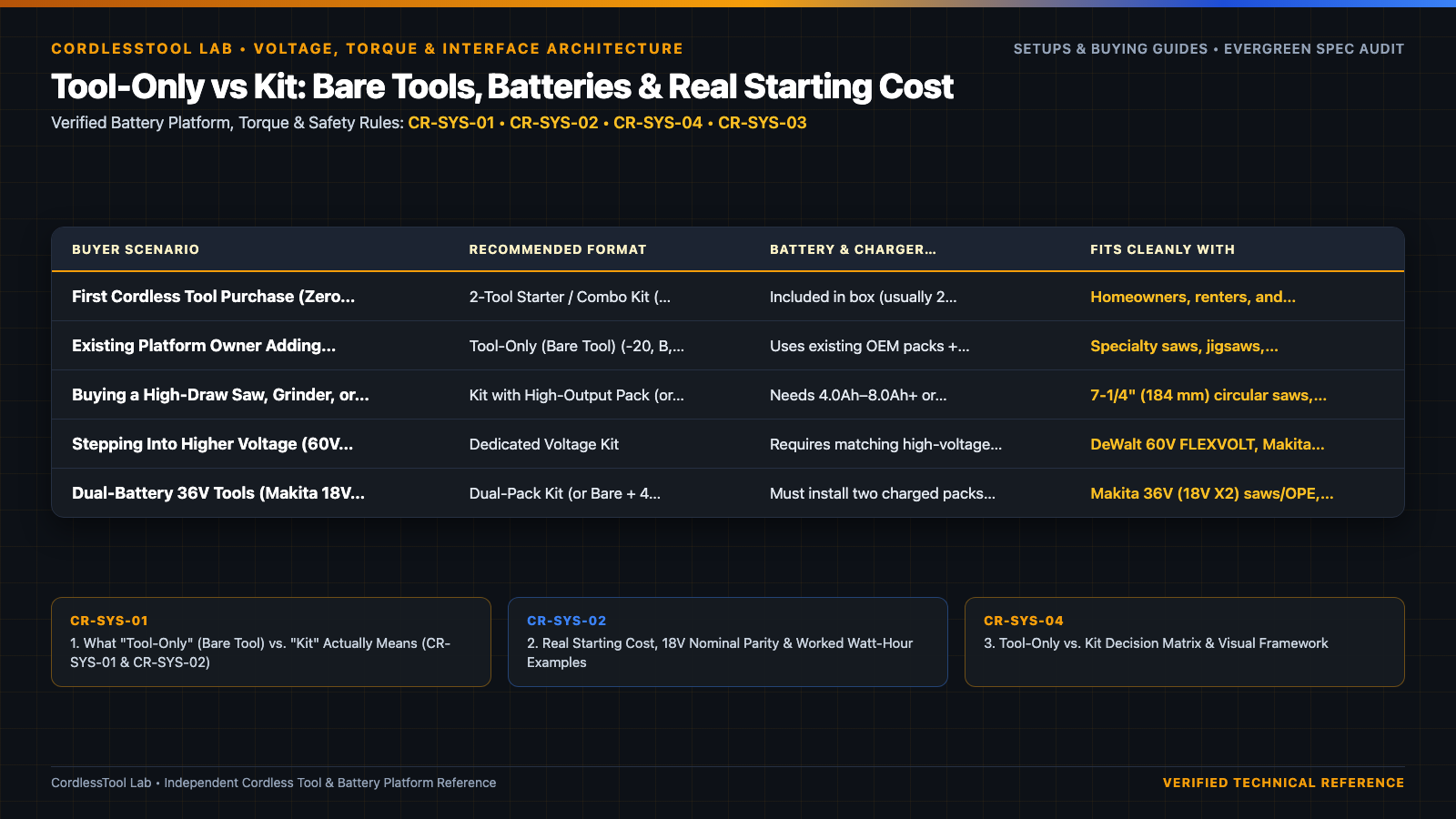
| Buyer Scenario | Recommended Format | Battery & Charger Requirement | Fits Cleanly With | Watch-Out / Compatibility Rule |
|---|---|---|---|---|
| First Cordless Tool Purchase (Zero existing packs) | 2-Tool Starter / Combo Kit (TIER-STARTER or TIER-DIY) | Included in box (usually 2 compact/standard packs + charger) | Homeowners, renters, and DIYers starting on one 18V/20V or 12V rail | Verify both tools are brushless if planning heavy framing/decking (CR-SYS-07, CR-TOOL-01). |
| Existing Platform Owner Adding 2nd–5th Tool | Tool-Only (Bare Tool) (-20, B, Z, N) | Uses existing OEM packs + charger on the same rail | Specialty saws, jigsaws, impact wrenches, routers, and sanders | Confirm existing packs match the new tool’s draw class (CR-BATT-TOOL-08). |
| Buying a High-Draw Saw, Grinder, or Rotary Hammer | Kit with High-Output Pack (or Bare + TIER-BATT-MID Starter) | Needs 4.0Ah–8.0Ah+ or high-output (FORGE / POWERSTACK / FLEXVOLT) pack | 7-1/4″ (184 mm) circular saws, grinders, SDS-plus rotary hammers | Avoid running heavy saws on 1.5Ah–2.0Ah kit packs, which can cut out early (CR-BATT-TOOL-08). |
| Stepping Into Higher Voltage (60V MAX / 40V XGT / 56V OPE) | Dedicated Voltage Kit | Requires matching high-voltage pack + compatible charger | DeWalt 60V FLEXVOLT, Makita 40V XGT, Ryobi 40V, EGO 56V OPE | Standard 18V/20V packs never power 60V FLEXVOLT or 40V XGT tools (CR-BATT-TOOL-03, CR-BATT-TOOL-05). |
| Dual-Battery 36V Tools (Makita 18V X2 / 120V MAX) | Dual-Pack Kit (or Bare + 4 existing packs) | Must install two charged packs simultaneously (CR-BATT-TOOL-06) | Makita 36V (18V X2) saws/OPE, DeWalt 120V MAX miter saws | A single-battery starter kit will not run a dual-slot tool; verify pack count in box (CR-SYS-02). |
4. Hidden Kit Traps: Brushed Filler Tools, Compact Packs & Dual-Battery Tools
Even when a multi-tool kit looks like an unbeatable bargain per piece, four recurring engineering caveats can erase the apparent savings once you put the tools to work:
- Trap 1 — Mixed motor tiers inside large combo kits (
CR-SYS-07,CR-TOOL-01): Five-tool to ten-tool combo kits routinely pair one headline brushless drill or impact driver with older brushed circular saws, reciprocating saws, or work lights—or bundle compact sub-lines rather than flagship XR/FUEL models. Brushless motors generally run cooler and extract more work per charge than brushed motors, while brushed tools remain suited primarily to light, occasional jobs at a lower tier band. Always check every individual tool model number inside a bundle before assuming flagship performance. - Trap 2 — Undersized batteries for high-draw tools (
CR-BATT-TOOL-08): Many entry and multi-tool kits ship with two 1.5Ah or 2.0Ah single-row (5S1P) compact packs. Those packs balance cleanly on drills and impact drivers, but on a 6-1/2-inch (165 mm) or 7-1/4-inch (184 mm) circular saw, angle grinder, or rotary hammer, higher internal resistance causes faster voltage sag and premature thermal or low-voltage cutoff. Conversely, sliding a massive 9.0Ah or 12.0Ah pack onto a compact drill makes the grip tail-heavy for overhead ladder work (CR-BATT-TOOL-11). - Trap 3 — Same-brand voltage lock-outs & one-way exceptions (
CR-BATT-TOOL-03..07): Owning one brand’s starter kit never guarantees cross-voltage fit. Milwaukee M12, M18, and MX FUEL packs never interchange; Makita 12V max CXT, 18V LXT, and 40V max XGT never interchange on tools; Ryobi USB Lithium, 18V ONE+, and 40V never interchange. Only two documented exceptions cross voltage families, and both run one way only: DeWalt FLEXVOLT (20V/60V MAX) packs step down to run 20V MAX tools with added bulk (CR-BATT-TOOL-04), and Metabo HPT MultiVolt (36V/18V) packs run 18V slide tools (CR-BATT-TOOL-07)—neither brand’s standard 18V/20V pack can power a 60V or 36V tool. - Trap 4 — Slow kit chargers & legacy charger lockouts (
CR-BATT-01,CR-BATT-02,CR-BATT-03): Entry kits typically ship with basic low-amperage chargers (for example, 1.25A–2A outputs) rather than rapid or simultaneous dual-bay chargers. While safe for compact 2.0Ah packs, charging an 8.0Ah or 12.0Ah upgrade pack on a slow kit charger takes noticeably longer. In addition, always verify that an older existing charger is explicitly listed on the manufacturer’s compatibility chart for newer pouch-cell or high-output packs before buying a bare battery expansion.
5. Five Buying Myths, Third-Party Adapters & Reseller Warranty Risks
Myth vs. Engineering Reality — Why Shortcuts Backfire
Buying a bare tool and trying to bridge the battery gap with generic packs, cross-brand adapters, or unverified third-party split-kit listings introduces electrical, thermal, and warranty hazards (CR-BATT-TOOL-10, CR-SYS-03, CR-SYS-05, G-25, G-26).
- Myth 1: “A bare tool plus a generic third-party replacement battery beats an OEM kit.” Engineering reality: Unbranded “replacement for” packs sold online frequently overstate amp-hour ratings, use inconsistent cell binning, omit factory thermistor safety telemetry, and lack verified safety certifications (
CR-SYS-03). CordlessTool Lab excludes all non-OEM replacement batteries from buying recommendations (G-25). - Myth 2: “A cross-brand battery adapter lets me buy bare tools from any brand.” Engineering reality: Neither manufacturer approves third-party cross-brand plastic adapters or ride-on toy (Power Wheels) adapters (
CR-BATT-TOOL-10). Because manufacturers split low-voltage cutoff and over-temperature signaling differently between tool and pack electronics, passive adapters drop critical BMS protection pins—risking irreversible cell over-discharge, thermal stress, and refused OEM warranty repairs. Adapters never belong in a buying strategy (G-25). - Myth 3: “Brands under the same parent company share kits and batteries.” Engineering reality: Stanley Black & Decker owns DeWalt, Craftsman, and Black+Decker, while TTI manufactures Milwaukee, Ryobi, and Ridgid—yet every brand’s battery rail is mechanically keyed apart (
CR-BATT-TOOL-01). - Myth 4: “Bulk-packed or split-kit Amazon listings carry the exact same factory warranty.” Engineering reality: Some sellers buy multi-tool combo kits, break them apart, and resell individual tools as “bulk-packed” bare items without retail cartons or clear purchase documentation. Even for sealed retail boxes, seller authorization matters (
CR-SYS-05,G-26): Milwaukee M18 and M12 listings on Amazon US rely heavily on third-party resellers where unauthorized dealer purchases can forfeit invoice-based warranty start dates, while Ryobi and Ridgid are Home Depot retail-exclusives in the US—meaning third-party Amazon purchases risk losing OEM coverage and Ridgid’s Lifetime Service Agreement (LSA) registration eligibility. - Myth 5: “Cell format inside a kit battery decides tool compatibility.” Engineering reality: Whether an OEM pack uses 18650, 21700, stacked pouch, or tabless cells is strictly an internal performance and thermal design detail (
CR-BATT-04); it never changes rail fit within the brand’s matching platform.
6. Battery & Tool Safety Rules, PPE & CPSC Recall Screening
Whether you unbox a bare specialty tool or a multi-piece kit, follow manufacturer-instruction-first safety protocols across batteries, chargers, blades, wheels, and high-torque fasteners, and wear eye, hearing, respiratory, and hand PPE as the manual specifies (G-24):
- Battery charging & thermal lockouts (
CR-BATT-05): Charge packs strictly on an OEM-listed compatible charger inside the manual’s specified ambient temperature window. If a charger LED signals a hot or cold delay, let the battery return to room temperature naturally—never bypass thermal protection or attempt improvised wire jump-starting. Stop using any swollen, cracked, wet, or overheated battery immediately and follow manufacturer and local recycling instructions. - Guards, blades, wheels & impact wrenches (
CR-ACC-SAW-01..03,CR-ACC-GRD-01..04,CR-DRV-03): Before operating any bare tool, verify you have the proper factory guard and rated accessories (matched arbor size, blade/wheel maximum RPM ≥ tool no-load RPM, Type 27 grinding vs. Type 1 cut-off guard, and impact-rated Cr-Mo sockets rather than chrome hand sockets on impact wrenches). Never modify or remove guards, and never use an impact wrench as a torque-measuring instrument—final-tighten vehicle lug nuts and specified fasteners with a calibrated torque wrench to the vehicle or fastener maker’s specification (CR-DRV-03). - CPSC safety recall screening (
CR-SYS-06,G-12): When buying clearance kits, closeout bare tools, or secondhand bundles, check model numbers and serial/date codes against the U.S. CPSC Product Safety Recalls database. Documented recalls include Milwaukee’s2826-20M18 FUEL 12-inch and 14-inch top-handle chainsaws (including2826-20C,2826-20T,2826-21T, and2826-22Tkits with fourth serial character"A", recalled for a chain-brake hazard while bundled M18 batteries and chargers remain unaffected), SKIL 40V 5.0Ah lawnmower/outdoor batteries, DR Power 62V 5.0Ah LiPRO packs (refund remedy), and Kobalt 24V/48V USB-C outdoor tool packs (fire hazard linked to USB-C charging while installed in the tool). Follow official recall remedies immediately before use.
7. Verified OEM Reference Listings: Starter Kits, Bare Tools & Combo Bundles
The four verified Amazon US OEM listings below illustrate every decision point in the tool only vs kit framework on one unified 18V nominal platform (DeWalt 20V MAX): an essential battery-and-charger starter kit, two high-value bare tools (B suffix) for existing platform owners, and a 10-tool combo kit demonstrating bulk bundle economics and compact battery caveats. Zero non-OEM batteries, cross-brand adapters, or bulk-packed split listings appear here.
1. DEWALT 20V MAX 5.0Ah Battery and Charger Starter Kit (DCB205C)

Format & Platform: Battery + Charger Starter Kit | STD-BATT-DEWALT-20V-MAX (18V Nominal) | 1x 5.0Ah Pack (90 Wh Nominal) + OEM Charger | Price Tier: TIER-BATT-VALUE
If your first purchase is a specialty bare tool that does not commonly ship in a starter bundle, the DCB205C starter kit supplies the exact foundation required under CR-SYS-01: one standard 5.0Ah (90 Wh nominal) pack with a 3-LED state-of-charge gauge and a matching charger per DeWalt’s US product and warranty framework. Unlike compact 2.0Ah kit batteries, 5.0Ah capacity pairs cleanly with high-draw saws and impact wrenches while staying under the 100 Wh FAA carry-on limit. Note that it powers 20V MAX tools only—never 60V MAX FLEXVOLT tools (CR-BATT-TOOL-05).
2. DEWALT 20V MAX XR Brushless Jig Saw, Bare Tool Only (DCS334B)

Format & Platform: Bare Tool Only (B Suffix) | STD-BATT-DEWALT-20V-MAX (18V Nominal) | Brushless Motor | T-Shank Keyless Clamp | Price Tier: TIER-SAW-MID
The DCS334B is a textbook example of when buying tool-only beats buying another kit. Marked clearly with the B suffix, this is a tool-only listing: battery and charger sold separately (CR-SYS-01). For woodworkers and remodelers who already own two 20V MAX packs and a charger from a drill/impact kit, picking up the brushless 3,200 SPM variable-speed top-handle jigsaw bare avoids paying for a duplicate charger. Remember to use T-shank jigsaw blades matched to the material TPI (CR-ACC-SAW-04, CR-ACC-SAW-05) and wear eye protection as the manual specifies (G-24).
3. DEWALT 20V MAX XR 1/2-Inch Impact Wrench, Bare Tool Only (DCF891B)

Format & Platform: Bare Tool Only (B Suffix) | STD-BATT-DEWALT-20V-MAX (18V Nominal) | 1/2-Inch Hog Ring Anvil | Rated 600 ft-lbs (813 Nm) Fastening / 800 ft-lbs (1,085 Nm) Breakaway | Price Tier: TIER-DRV-MID
Specialty automotive tools like the DCF891B mid-torque impact wrench are most often purchased bare—a tool-only listing: battery and charger sold separately (CR-SYS-01). However, high-draw impact wrenches highlight rule CR-BATT-TOOL-08: if your only existing batteries are 1.5Ah or 2.0Ah compact packs from an entry drill kit, stepping up to a 5.0Ah pack (like the DCB205C above) or high-output POWERSTACK pack helps prevent early voltage sag under stubborn suspension bolts. Pair it strictly with 1/2-inch drive impact-rated sockets (CR-ACC-DRV-04, CR-ACC-DRV-05), and always final-tighten wheel lug nuts using a calibrated torque wrench to the vehicle maker’s specification (CR-DRV-03).
4. DEWALT 20V MAX 10-Tool Cordless Combo Kit with 2 Batteries & Charger (DCK1021D2)

Format & Platform: 10-Tool Combo Kit (D2 Suffix) | STD-BATT-DEWALT-20V-MAX (18V Nominal) | 2x 2.0Ah Packs (72 Wh Nominal Total) + Charger + 2 Bags | Price Tier: TIER-PROSUMER
DeWalt’s DCK1021D2 illustrates both the appeal and the key audit checks of large multi-tool bundles. Starting an empty workshop by buying ten individual bare tools plus a charger would push cost far higher than this single bundle. At the same time, the D2 suffix signals two critical rules: first, verify every bundled tool’s individual model number and motor type (CR-SYS-02, CR-SYS-07) before assuming flagship XR output across all ten pieces; second, recognize that two 2.0Ah packs (72 Wh combined) work cleanly for drilling, driving, and light work, whereas sustained circular saw or grinder cuts will benefit from adding a higher-capacity 5.0Ah pack later (CR-BATT-TOOL-08).
8. Authoritative Non-Affiliate References
- DEWALT US Limited Warranty & Authorized Purchase Terms — Official 3-year tool/battery limited warranty structure and 20V MAX (18V nominal) disclosures.
- DEWALT Official Safety Notices & Recall Portal — Manufacturer safety alerts and legacy charger date-code screening.
- Milwaukee Tool US Registration & Warranty Policy — Authorized distributor requirement, 5-year tool / 2-to-3-year battery terms, and serial date-code policy.
- Makita USA 3-Year Limited Warranty Documentation — Coverage across 18V LXT bare (“Z”) tools, batteries, and chargers, plus genuine OEM battery requirements.
- U.S. CPSC Recalls Database & FAA PackSafe Lithium Battery Guidance — Active power-tool recall checks and the 100 Wh passenger carry-on threshold.
How We Audited This Guide
- Workshop blueprints, upgrade roadmaps, and Amazon marketplace audits enforce single-platform battery lock-in budgets, third-party pack and adapter exclusion rules, Bare Tool trap checks, and PPE/kickback safety.
- Every cordless drill, impact driver, saw, grinder, battery pack, charger, outdoor power tool, and accessory spec was cross-checked against official OEM manuals, UL/ANSI ratings, and live Amazon US listings.
- Recommendations were evaluated against our weighted vertical scoring rubrics and 61 documented CR-* platform and safety rules; we never invent peak torque ft-lbs, cut counts, runtime minutes, or battery decibels.
9. Frequently Asked Questions
Does a “tool-only” or “bare tool” listing include a battery or charger?
No. Under rule CR-SYS-01, a tool-only (bare tool) listing includes the power tool body only—battery and charger are sold separately. Look for trailing SKU markers such as -20 (Milwaukee), B (DeWalt/Ryobi), Z (Makita), or N (Bosch), and verify the selected variation’s box contents before buying.
Is it cheaper to buy a bare tool and add a battery separately, or buy a kit?
If you own zero batteries on that platform, buying a kit almost always costs less overall. Separate OEM battery-and-charger starter kits typically sit in TIER-BATT-VALUE or TIER-BATT-MID, often pushing a bare tool plus starter pack above a complete 2-tool combo kit.
How many batteries should I own before switching to tool-only purchases?
Two healthy OEM packs and one compatible charger on the same platform are the practical minimum. Having two batteries prevents work stoppages while one pack cools or charges, especially when running higher-draw circular saws, grinders, or impact wrenches.
Are the tools inside multi-tool combo kits identical to standalone bare tools?
Not always. Under rule CR-SYS-07, large combo kits frequently mix one brushless flagship drill with brushed saws or entry compact models alongside smaller 1.5Ah–2.0Ah packs. Always check each individual tool’s model number rather than assuming every item matches top-tier standalone specs.
Can I buy a bare tool from another brand and use a third-party battery adapter?
No. Tool makers do not approve cross-brand battery adapters, and CordlessTool Lab excludes them (CR-BATT-TOOL-10, G-25). Passive adapters drop brand-specific thermal and low-voltage cutoff pins, risking lithium cell over-discharge and voided warranty coverage. Choose one primary battery platform first.


