
Disclosure: As an Amazon Associate, CordlessTool Lab earns from qualifying purchases. If you buy through links on this page, we may earn a small commission at no extra cost to you. Commission rates (3% in Tools & Home Improvement) never alter our engineering analysis, compatibility rules, or hardware recommendations.
Understanding the mechanical boundary between sds plus vs sds max saves contractors and remodelers from buying incompatible concrete bits, stalling undersized tools, or damaging expensive rotary hammer chucks. Both systems use slotted shanks that slide axially inside a piston-driven tool holder, yet their shaft diameters, groove counts, insertion depths, and Joule impact classes sit in completely separate tiers. As part of our power tool accessory compatibility hub and specification verification standards, this guide maps the exact engineering dimensions, battery draw demands, adapter limits, and safety rules governing both standards.
Quick Answer — SDS-Plus vs. SDS-Max at a Glance
SDS-Plus uses a 10 mm (0.39 in) shank with four grooves (two open, two closed) built for concrete anchoring up to ~1 to 1-1/8 inches and light chipping (~1.9–3.65 J). SDS-Max steps up to an 18 mm (0.71 in) shank with five grooves for heavy structural coring and demolition (~6+ J). They never cross-fit natively (CR-ACC-DRV-03).
In This Guide
- 1. Shank Geometry & Mechanical Standards (10 mm vs. 18 mm)
- 2. Impact Energy, Joule Ratings & Worked Battery Math
- 3. Master Compatibility & Decision Matrix
- 4. Representative Cordless SDS-Plus & SDS-Max Reference Models
- 5. SDS-Max-to-SDS-Plus Adapters: Strict Conditional Limits
- 6. Myth vs. Engineering Reality in Masonry Drilling
- 7. Jobsite Safety, OSHA Silica Rules, Warranties & CPSC Recalls
- 8. Verified OEM Bits & Cordless SDS Rotary Hammers
- 9. Authoritative Non-Affiliate References
- 10. Frequently Asked Questions
1. Shank Geometry & Mechanical Standards (10 mm vs. 18 mm)
Developed originally by Bosch (Steck-Dreh-Sitz, or “insert-twist-lock” / “Special Direct System”), slotted rotary hammer shanks solve two fatal weaknesses of a standard 3-jaw drill chuck in cured concrete. First, positive mechanical splines transmit rotational torque without relying on jaw friction, so carbide masonry bits never spin and chew up inside the chuck when hitting steel rebar or dense aggregate. Second, closed ball-locking grooves allow the bit to float axially roughly 3/8 inch to 1/2 inch inside the tool holder so an internal air-cushioned striker piston can hammer the rear of the shank directly without shattering gearbox bearings.
Despite sharing that slotted operating principle, SDS-Plus (STD-SHANK-SDS-PLUS) and SDS-Max (STD-SHANK-SDS-MAX) are engineered around different physical dimensions and energy loads:
- SDS-Plus Shank Geometry (10 mm / 0.39 in): Every genuine SDS-Plus bit, chisel, or core arbor terminates in a uniform 10 mm (0.39 in) cylindrical shaft regardless of whether the carbide tip cuts a 3/16-inch (4.8 mm) Tapcon pilot hole or a 1-inch (25.4 mm) anchor bore. The shank carries four total grooves—two open-ended driving flutes that transfer rotation from internal chuck ribs and two closed-ended locking slots engaged by steel retaining balls. Standard insertion depth into the chuck measures approximately 40 mm (1.57 in), balancing compact tool length with light-to-medium piston blows.
- SDS-Max Shank Geometry (18 mm / 0.71 in): Designed to replace legacy spline-drive shanks on heavy rotary and demolition hammers, SDS-Max widens the shaft to 18 mm (0.71 in)—offering roughly 3.24 times the cross-sectional steel area of SDS-Plus to resist bending and shear fatigue under severe impact blows. The shank features five total grooves—three open driving flutes for higher torque transfer and two closed locking slots—with a much deeper insertion length of roughly 90 mm (3.54 in) inside the collar.
- Hard Interface Lock (
CR-ACC-DRV-03): Because shaft diameters, groove spacing, and locking-ball positions differ completely, SDS-Plus bits drop loosely out of an SDS-Max chuck, and an 18 mm SDS-Max shank cannot enter a 10 mm SDS-Plus sleeve. Furthermore, clamping an SDS-Plus bit inside a standard 1/2-inch 3-jaw hammer drill chuck (STD-CHUCK-3JAW-1-2) is never an acceptable substitute for an SDS rotary hammer: the three jaws cannot grip symmetrically across open flutes, inducing bit wobble and chuck wear without piston impact energy.
If you are deciding whether your concrete project even justifies a dedicated piston tool over a standard percussion drill, walk through our hammer drill vs. rotary hammer breakdown before selecting a shank class.
2. Impact Energy, Joule Ratings & Worked Battery Math
While drills and impact drivers are rated by rotational torque in in-lbs or ft-lbs (where 12 in-lbs = 1 ft-lb), rotary hammers are evaluated primarily by single-blow impact energy stated in Joules (J)—or occasionally in impact ft-lbs (1 ft-lb ≈ 1.356 Joules). Blows per minute (BPM) tell only half the story; single-blow Joule energy determines whether a carbide bit fractures cured aggregate or stalls in hard concrete.
Under rule CR-DRV-01, masonry work follows a clear four-step escalation ladder: a standard drill/driver belongs in wood and metal; a 1/2-inch hammer drill handles occasional small holes in brick, block, or mortar; an SDS-Plus rotary hammer (~1.9 J to 3.65 J in typical 18V/20V cordless models) covers frequent 3/16-inch to 1-1/8-inch concrete anchoring and light chipping; and an SDS-Max rotary hammer (~6.1 J to 6.9+ J in cordless models, climbing higher on corded or heavy equipment lines) owns sustained structural anchors, deep coring, and heavy concrete demolition.
Two critical battery and rating rules apply when sizing cordless SDS tools:
- Worked Battery Energy Math & Voltage Parity (
CR-BATT-TOOL-02,03§3.4e): Never let “20V MAX” vs. “18V” labels fool you when shopping for an SDS-Plus rotary hammer. Both DeWalt 20V MAX and Milwaukee M18 run five lithium-ion cell groups in series (5S × 3.6V = 18V nominal); “20V MAX” simply reflects unloaded initial peak voltage off the charger. Compute true stored energy using nominal voltage:Energy (Wh, nominal) = Nominal Voltage (V) × Capacity (Ah). Pairing a standard 5.0Ah pack yields18V × 5.0Ah = 90 Whon either Milwaukee M18XC5.0or DeWalt 20V MAXDCB205. By contrast, stepping up to a cordless SDS-Max hammer such as DeWalt’s 60V MAX FLEXVOLTDCH481Bmoves to a 15-cell54V nominalpack: aDCB609(rated 9.0Ah at 20V MAX / 3.0Ah at 60V MAX) stores54V × 3.0Ah = 162 Whnominal (labeled180 Whon DeWalt’s max-voltage basis), delivering 80% more stored energy while reducing current draw at triple the voltage. - High-Draw Battery Pairing & Rating Methods (
CR-BATT-TOOL-08,CR-BATT-TOOL-09,CR-DRV-02): Both SDS-Plus and SDS-Max hammers sit in the high-draw tool class. While older or compact OEM packs on the same slide rail snap in cleanly (CR-BATT-TOOL-12), compact single-row packs can experience voltage sag or cut out early during continuous concrete boring—use high-output packs (such as Milwaukee HIGH OUTPUT / FORGE, DeWalt XR POWERSTACK / FLEXVOLT, or Bosch CORE18V) for sustained holes. Additionally, note that brands publish impact-energy and torque metrics using different internal procedures (CR-DRV-02,G-03,G-15): Bosch quotes EPTA 05/2016 Joules, Milwaukee frequently states both ft-lbs and Joules, and some manufacturers tie peak ratings to specific high-output packs. Never rank competing brands by paper spec sheets alone without identical third-party measurement conditions, and never convert Wh into unverified holes-per-charge estimates (G-01).
3. Master Compatibility & Decision Matrix
The diagram and compatibility table below map every concrete drilling shank and chuck interface against its permitted tool classes, capacity envelopes, and hard exclusions under CR-ACC-DRV-03 and CR-DRV-01.
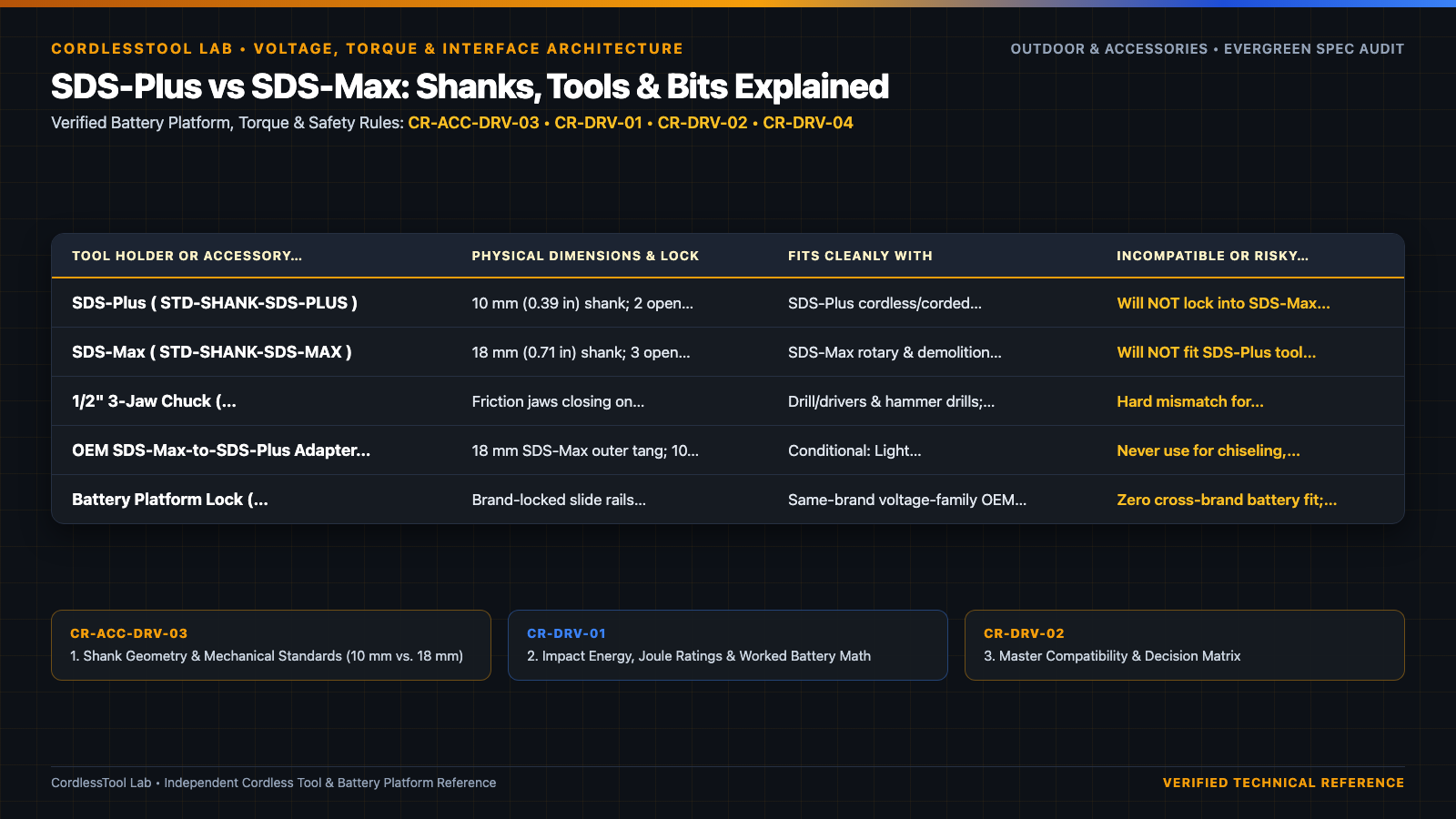
| Tool Holder or Accessory Standard | Physical Dimensions & Lock | Fits Cleanly With | Incompatible or Risky Caveat |
|---|---|---|---|
| SDS-Plus ( STD-SHANK-SDS-PLUS) | 10 mm (0.39 in) shank; 2 open + 2 closed grooves; ~40 mm (1.57 in) insertion | SDS-Plus cordless/corded rotary hammers; solid carbide bits ~3/16″ to 1-1/8″ max; thin-wall cores; light chiseling | Will NOT lock into SDS-Max chucks natively; never clamp in a 3-jaw chuck for hammering (CR-ACC-DRV-03). |
| SDS-Max ( STD-SHANK-SDS-MAX) | 18 mm (0.71 in) shank; 3 open + 2 closed grooves; ~90 mm (3.54 in) insertion | SDS-Max rotary & demolition hammers; heavy bits ~1/2″ to 2″; large core bits; structural demolition chisels | Will NOT fit SDS-Plus tool holders; heavy ~11.9–12.2 lb bare weight makes overhead anchor runs fatiguing. |
| 1/2″ 3-Jaw Chuck ( STD-CHUCK-3JAW-1-2) | Friction jaws closing on shanks ≤ 1/2 in (12.7 mm) | Drill/drivers & hammer drills; round, 3-flat, or 1/4″ hex shanks for wood, steel, and occasional light masonry | Hard mismatch for SDS-Plus/SDS-Max shanks; cam percussion stalls quickly in cured structural concrete (CR-DRV-01). |
| OEM SDS-Max-to-SDS-Plus Adapter (e.g., Bosch HA1030, DeWalt DW5891) | 18 mm SDS-Max outer tang; 10 mm SDS-Plus inner quick-lock collet | Conditional: Light rotary-hammer drilling with small SDS-Plus bits on reduced impact/speed settings | Never use for chiseling, scaling, or hammer-only demolition; full SDS-Max Joule blows can snap 10 mm shanks. |
| Battery Platform Lock ( CR-BATT-TOOL-01, CR-BATT-TOOL-08) | Brand-locked slide rails (18V/20V MAX, 54V FLEXVOLT, M18, LXT) | Same-brand voltage-family OEM high-output packs (FORGE, HIGH OUTPUT, POWERSTACK, CORE18V, FLEXVOLT) | Zero cross-brand battery fit; exclude 3P cross-brand battery adapters and generic non-OEM packs (G-25). |
4. Representative Cordless SDS-Plus & SDS-Max Reference Models
Comparing verified OEM specifications across active cordless models shows exactly how tool weight, Joule output, RPM, and solid-bit capacity jump between sds plus vs sds max platforms. Note that all bare-tool listings below require compatible batteries and chargers sold separately (CR-SYS-01).
| Model & Platform | Shank Standard | Maker-Rated Impact Energy | No-Load RPM / BPM | Rated Solid Concrete Capacity | Bare Weight & Safety Tech |
|---|---|---|---|---|---|
Bosch GBH18V-22(Bosch 18V, 18V nominal) | STD-SHANK-SDS-PLUS(10 mm) | 1.9 J (EPTA 05/2016) | 0–1,050 rpm 0–4,675 bpm | Up to 3/4 in (22 mm); 4–12 mm optimal | 5.1 lb (2.3 kg) bare; KickBack Control & anti-vibration |
DeWalt DCH273B(20V MAX XR, 18V nominal) | STD-SHANK-SDS-PLUS(10 mm) | 2.1 J (~1.55 ft-lbs) | 0–1,100 rpm 0–4,600 bpm | Up to 1 in (25.4 mm); 3/16″–1/2″ optimal | 6.8 lb (3.1 kg) bare (var. specs); SHOCKS vibration control & clutch |
Milwaukee 2912-20(M18 FUEL, 18V nominal) | STD-SHANK-SDS-PLUS(10 mm) | 2.7 J (2.0 ft-lbs rated) | 0–1,330 rpm 0–4,800 bpm | Up to 1 in (25.4 mm); 2-1/2″ thin-wall core | 6.8 lb (3.1 kg) bare/rated; AUTOSTOP kickback control & AVS |
DeWalt DCH293B(20V MAX XR, 18V nominal) | STD-SHANK-SDS-PLUS(10 mm) | 3.5 J (~2.58 ft-lbs) | 0–1,000 rpm 0–4,480 bpm | Up to 1-1/8 in (28.6 mm); 5/8″–7/8″ optimal | 8.2 lb (3.7 kg) bare; SHOCKS active vibration control & clutch |
DeWalt DCH481B(60V MAX FLEXVOLT, 54V nominal) | STD-SHANK-SDS-MAX(18 mm) | 6.1 J (~4.5 ft-lbs) | 0–540 rpm 0–3,150 bpm | Up to 1-9/16 in (40 mm); 1/2″–1-1/8″ optimal | 11.9 lb (5.4 kg) bare; E-Clutch anti-rotation & electronic speed |
Milwaukee 2717-20(M18 FUEL, 18V nominal) | STD-SHANK-SDS-MAX(18 mm) | ~6.9 J (5.1 ft-lbs rated) | 0–450 rpm 0–3,000 bpm | Up to 1-9/16 in (40 mm) solid / heavy cores | 12.15 lb (5.5 kg) bare; mechanical clutch & AVS damping |
Notice the clear sweet spot revealed in that table. Most electrical, plumbing, HVAC, and deck-anchoring work falls between 1/4-inch and 5/8-inch wedge or sleeve anchors—squarely inside the 5.1 lb to 6.8 lb SDS-Plus envelope. Step up to an 11.9 lb+ SDS-Max machine only when your regular workflow requires 3/4-inch to 1-9/16-inch+ through-holes, thick rebar-reinforced coring, or extended concrete breaking. Explore full platform options in our best cordless SDS-Plus rotary hammer guide.
5. SDS-Max-to-SDS-Plus Adapters: Strict Conditional Limits
Because SDS-Max tools sit at the top of the masonry ladder, crews sometimes ask whether a single SDS-Max hammer can cover smaller 1/4-inch or 3/8-inch anchor holes using an adapter. Under rule CR-ACC-DRV-03, genuine OEM steel adapters—such as the Bosch HA1030 or DeWalt DW5891 SDS-Max-to-SDS-Plus adapters—convert the native hard mismatch into a conditional pass, provided you obey three strict engineering limits:
- Light Rotary-Hammer Drilling Only — Never Chiseling: OEM SDS-Max-to-SDS-Plus adapters are intended strictly for drilling occasional smaller-diameter concrete holes (typically 3/16 inch to 1/2 inch). Never run hammer-only / chiseling mode or SDS-Plus scaling chisels through an adapter; full 6+ Joule SDS-Max blows can shatter, bend, or permanently seize a 10 mm chisel shank inside the adapter collet.
- Dial Down Variable Speed / Impact Controls: If your SDS-Max hammer includes an electronic speed or impact-energy dial, lower the setting when driving small SDS-Plus carbide tips. Full-throttle SDS-Max blows vibrate slim masonry bits violently, overheating brazing joints and causing premature shank fatigue right where the 10 mm shaft exits the adapter sleeve.
- Expect Added Length, Weight & Chuck Play: An adapter adds several inches of dead length and extra mass ahead of the SDS-Max collar, increasing runout wobble and trapping heat in the nose seals. For any job requiring dozens of small anchors or overhead work, carrying a dedicated 18V/20V SDS-Plus hammer remains faster, cleaner, and far less fatiguing.
6. Myth vs. Engineering Reality in Masonry Drilling
Myth vs. Engineering Reality — Masonry Shanks, Chuck Hacks & Battery Adapters
Before ordering rotary hammer bits or accessories online, separate true DIN/OEM shank standards from jobsite folklore and unapproved marketplace claims (CR-ACC-DRV-03, CR-BATT-TOOL-10, CR-SYS-03, G-25).
- Myth 1: “SDS-Plus and SDS-Max refer to the cutting bit diameter, not the shank.” Engineering reality: Bit diameter and shank standard are independent. A 1-inch SDS-Plus carbide bit still has a 10 mm shank, while a 1/2-inch SDS-Max bit still has an 18 mm shank. Always verify the shank name (
STD-SHANK-SDS-PLUSvs.STD-SHANK-SDS-MAX) before adding bits to your cart. - Myth 2: “You can clamp an SDS-Plus bit in a 1/2-inch 3-jaw hammer drill chuck for concrete work.” Engineering reality: Under
CR-ACC-DRV-03, this is a hard mismatch. Three-jaw friction chucks cannot align properly on slotted SDS flutes, causing slip, severe runout, and chewed chuck jaws—while the drill’s cam discs deliver zero pneumatic piston stroke. - Myth 3: “An SDS-Max-to-SDS-Plus adapter lets a demo hammer replace an SDS-Plus rotary hammer for everything.” Engineering reality: OEM adapters like
HA1030andDW5891are conditional light-drilling workarounds only. Heavy hammering or chiseling with an SDS-Plus chisel inside an SDS-Max hammer risks snapping the 10 mm shank or jamming the adapter. - Myth 4: “A 20V MAX SDS rotary hammer hits harder than an 18V rotary hammer.” Engineering reality: Under
CR-BATT-TOOL-02, DeWalt 20V MAX and Milwaukee M18 are both 18V nominal five-cell systems. Real-world concrete speed depends on Joule piston energy, high-output pack current delivery, and 4-cutter carbide tip geometry—not the voltage integer on the label. - Myth 5: “Third-party cross-brand battery adapters or generic replacement packs work fine on rotary hammers.” Engineering reality: High-draw rotary hammers push sustained current spikes that expose unapproved adapters and counterfeit packs quickly. Passive cross-brand battery adapters strip OEM thermal and over-discharge BMS pins (
CR-BATT-TOOL-10), voiding factory warranties, while non-OEM replacement batteries carry inflated capacity claims and missing safety certifications (CR-SYS-03). CordlessTool Lab excludes all non-OEM batteries and cross-brand adapters from our hardware picks (G-25).
7. Jobsite Safety, OSHA Silica Rules, Warranties & CPSC Recalls
Concrete drilling and demolition expose operators to sudden rebar bind-up torque, intense hand-arm vibration, flying masonry chips, and respirable crystalline silica. Follow the tool and accessory manufacturer’s instruction manual first for every operation, and never bypass guards, clutches, or battery protection circuits (G-24):
- Auxiliary Side Handles, Anti-Rotation & PPE (
CR-DRV-04,G-24): Always install, tighten, and grip the auxiliary side handle for rotary-hammer boring as the tool manual specifies—especially when drilling near rebar where a bit can snag abruptly. Keep manufacturer anti-rotation or clutch systems enabled (such as MilwaukeeAUTOSTOP, DeWaltE-Clutch, or BoschKickBack Control), inspect shanks for mushrooming or hairline cracks, lubricate SDS shanks lightly with rotary hammer grease per the manual, and wear ANSI-rated eye protection, hearing protection, work gloves, and respiratory PPE as the manual specifies. - OSHA 29 CFR 1926.1153 Table 1 Silica Extraction: Dry concrete drilling creates hazardous crystalline silica dust. Under OSHA’s Respirable Crystalline Silica Standard (Table 1, entry vii) for handheld rotary and hammer drills, jobsites must pair the drill with a commercially available shroud or cowling connected to a dust collector delivering the tool maker’s recommended CFM (or greater), equipped with a 99%+ efficiency filter and a filter-cleaning mechanism—plus a HEPA-filtered vacuum when clearing drilled anchor holes.
- Amazon US Channel & Warranty Caveats (
CR-SYS-05,G-26): Before clicking checkout on Amazon US, verify the seller name. DeWalt operates an official Amazon Brand Store alongside Amazon first-party retail listings, protecting its 3-year limited warranty. By contrast, Milwaukee M18 and M12 listings on Amazon US are dominated by third-party resellers—Milwaukee’s 5-year US tool warranty applies only when purchased from an authorized distributor, so confirm dealer authorization on Milwaukee’s official site and keep your invoice. Similarly, Ryobi (ONE+ / 40V) and Ridgid (18V) are Home Depot retail-exclusives in the US; third-party Amazon marketplace listings for those brands typically forfeit factory coverage and Ridgid’s Lifetime Service Agreement (LSA) eligibility. - CPSC Safety Recall Verification (
CR-SYS-06,G-12): At our verification sweep, none of the active flagship cordless models highlighted in this guide (DCH273B,DCH293B,DCH481B,2912-20,2717-20, orGBH18V-22) carried an open CPSC recall. However, historical CPSC recalls have hit older masonry tools—including an October 2000 recall of specific Makita rotary hammers (HR2410,HR2420) for sticking Eaton switches and a November 2018 recall of specific Porter-Cable and Bostitch hammer-drill side handles—alongside recent cordless tool recalls such as Milwaukee’s 20252826-20top-handle chainsaw chain-brake notice. Always screen serial and date codes in the U.S. CPSC Recalls database before placing older or secondary-market tools into service.
8. Verified OEM Bits & Cordless SDS Rotary Hammers
The four verified Amazon US OEM listings below bridge the exact hardware standards explained above: one multi-size SDS-Plus bit kit, one heavy-duty SDS-Max 4-cutter rebar bit, and two flagship 18V-nominal cordless SDS-Plus rotary hammers. If you need a wider roundup of bit packs, see our best SDS-Plus drill bit set buyer guide. Pricing is classified strictly by broad TIER-* budget bands without retail decimal pricing (G-08).
1. BOSCH HCK001 7-Piece SDS-Plus Bulldog Rotary Hammer Bit Set

Interface Spec: STD-SHANK-SDS-PLUS (10 mm Shank) | 7 Pieces (3/16″ to 1/2″) | Carbide-Tipped Masonry Bits | Price Tier: TIER-ACC-MID
Bosch’s HCK001 kit covers the core anchor diameters used on everyday electrical, plumbing, and framing slabs: (1) 3/16″ × 4″, (1) 1/4″ × 4″, (2) 1/4″ × 6″, (1) 5/16″ × 6″, (1) 3/8″ × 6″, and (1) 1/2″ × 6″ bits inside a Brute Tough hard case. Every bit carries a true 10 mm 4-groove SDS-Plus shank—fitting Bosch, DeWalt, Milwaukee, and Makita SDS-Plus rotary hammers across brands, while remaining incompatible with SDS-Max chucks or 3-jaw drills (CR-ACC-DRV-03).
2. Diablo Rebar Demon SDS-Max 4-Cutter Carbide Hammer Drill Bit

Interface Spec: STD-SHANK-SDS-MAX (18 mm Shank) | 4-Cutter Full Carbide Head | Reinforced Concrete & Rebar Rated | Price Tier: TIER-ACC-MID
Built on an 18 mm 5-groove SDS-Max shaft, Diablo’s Rebar Demon 4-cutter carbide line pairs Dura-Carbide tips and Tri-Metal Fusion Welding to take smaller, lower-vibration bites when striking embedded rebar in structural slabs per Diablo Tools specifications. Under rule CR-SYS-02, double-check the exact diameter and overall length variation selected on the Amazon listing before checkout, as SDS-Max Rebar Demon bits span 3/8-inch to 2-inch sizes and never fit 10 mm SDS-Plus hammers.
3. DEWALT 20V MAX XR 1-Inch SDS-Plus Brushless Rotary Hammer (DCH273B)

Platform & Holder Spec: STD-BATT-DEWALT-20V-MAX (18V Nominal) | STD-SHANK-SDS-PLUS | 2.1 J | 0–1,100 RPM / 0–4,600 BPM | 6.8 lb Bare | Price Tier: TIER-DRV-PREMIUM
A benchmark L-shape SDS-Plus machine for overhead and wall anchoring, the DCH273B delivers 2.1 Joules of piston energy across three modes (drill, hammer-drill, chip) with SHOCKS active vibration control and OSHA Table 1 shroud compatibility per DeWalt’s official product specifications. Remember that DCH273B is a tool-only listing: battery and charger sold separately (CR-SYS-01); pair it with high-output 20V MAX XR, POWERSTACK, or FLEXVOLT packs for heavy concrete work (CR-BATT-TOOL-08).
4. Milwaukee M18 FUEL 1-Inch SDS-Plus Brushless Rotary Hammer (2912-20)

Platform & Holder Spec: STD-BATT-MILWAUKEE-M18 (18V Nominal) | STD-SHANK-SDS-PLUS | 2.7 J (2 ft-lbs) | 0–1,330 RPM / 0–4,800 BPM | 6.8 lb Bare | Price Tier: TIER-DRV-PREMIUM
Milwaukee’s 2912-20 steps up to 2.7 Joules (rated 2 ft-lbs) with AUTOSTOP electronic kickback control, AVS anti-vibration damping, and 3-mode operation up to 1-inch solid carbide bits and 2-1/2-inch thin-wall cores per Milwaukee Tool specifications. This is a tool-only listing: battery and charger sold separately (CR-SYS-01)—we advise pairing it with M18 HIGH OUTPUT or FORGE packs for sustained drilling, and confirming authorized-distributor seller status on Amazon US to protect its 5-year warranty (CR-SYS-05).
9. Authoritative Non-Affiliate References
- Bosch Power Tools USA — Bulldog SDS-Plus & SDS-Max System Specifications — Official 10 mm SDS-Plus (
HCK001,GBH18V-22) and 18 mm SDS-Max /HA1030adapter engineering documentation. - DEWALT Official US Rotary Hammer & FLEXVOLT Specifications — Verified
DCH273B(2.1 J, 20V MAX / 18V nominal),DCH481B(6.1 J, 60V MAX FLEXVOLT), andDW5891adapter disclosures. - Milwaukee Tool USA — M18 FUEL Rotary Hammer & Warranty Policy — Official
2912-20(2.7 J / 2 ft-lbs, AUTOSTOP) and2717-20(5.1 ft-lbs) specifications plus authorized-distributor warranty terms. - OSHA 29 CFR 1926.1153 Table 1 — Respirable Crystalline Silica Standard — Mandatory dust shroud, CFM, and 99%+ filtration rules for handheld rotary hammers in concrete.
- U.S. Consumer Product Safety Commission (CPSC) Recalls Database — Official US safety recall verification portal for cordless power tools, rotary hammers, and lithium-ion packs.
How We Audited This Guide
- Outdoor power equipment and tool accessories were verified across battery Ah runtime fit, string trimmer bump-feed vs. blower CFM ratings, carbide tooth geometry, Impact Rated vs. chrome socket steel, and ANSI blade guard safety.
- Every cordless drill, impact driver, saw, grinder, battery pack, charger, outdoor power tool, and accessory spec was cross-checked against official OEM manuals, UL/ANSI ratings, and live Amazon US listings.
- Recommendations were evaluated against our weighted vertical scoring rubrics and 61 documented CR-* platform and safety rules; we never invent peak torque ft-lbs, cut counts, runtime minutes, or battery decibels.
10. Frequently Asked Questions
What is the main difference between SDS-Plus and SDS-Max?
SDS-Plus uses a 10 mm (0.39 in) shank with four grooves built for light-to-medium concrete anchoring (~1.9–3.65 J), while SDS-Max uses an 18 mm (0.71 in) shank with five grooves engineered for large structural bores, heavy coring, and demolition (~6+ J).
Can I use SDS-Plus bits in an SDS-Max rotary hammer?
Not directly, because the 10 mm shank will not lock into an 18 mm chuck. You can use an OEM SDS-Max-to-SDS-Plus adapter (such as Bosch HA1030 or DeWalt DW5891) strictly for light rotary-hammer drilling at reduced speed—never for chiseling or hammer-only work.
Do SDS-Plus and SDS-Max bits cross brands like Milwaukee, DeWalt, and Bosch?
Yes. Unlike cordless batteries, SDS-Plus and SDS-Max are open mechanical shank standards. Any genuine Bosch, Diablo, Milwaukee, or DeWalt SDS-Plus bit fits any brand’s SDS-Plus rotary hammer, and any SDS-Max bit fits any SDS-Max tool holder.
Can I put an SDS-Plus bit inside a standard 1/2-inch hammer drill chuck?
No. A 3-jaw chuck cannot grip uniformly across slotted SDS grooves, causing severe bit wobble and chuck wear, while cam-action hammer drills lack the electro-pneumatic piston stroke needed to drive floating SDS shanks effectively in concrete.
Which battery class should I use on a cordless SDS rotary hammer?
SDS rotary hammers are high-draw tools. Although any same-platform OEM pack snaps on, pair SDS-Plus hammers with high-output packs (such as FORGE, HIGH OUTPUT, POWERSTACK, or CORE18V) and run SDS-Max hammers on high-voltage or high-capacity packs to curb voltage sag.


