
On This Page
Disclosure: As an Amazon Associate, I earn from qualifying purchases. If you buy through links on this page, we may earn a small commission at no extra cost to you. Tools & Home Improvement commission rates never alter our technical evaluations or platform verdicts.
Deciding between a hammer drill vs rotary hammer comes down to concrete hole frequency, anchor diameter, and whether you need a single multi-material driver or a dedicated masonry tool. A cordless hammer drill pairs a 1/2-inch 3-jaw chuck with serrated cam discs to handle wood, metal, fasteners, and occasional small holes in brick, block, or mortar—while an SDS-plus rotary hammer uses an electro-pneumatic piston and slotted 10 mm shank to drive frequent anchors into cured concrete without stalling (CR-DRV-01, CR-ACC-DRV-03).
Before comparing individual models, apply the battery-platform rule first (CR-SYS-04): adding a second tool on an 18V/20V slide rail you already own is almost always more cost-effective than starting an unrelated battery ecosystem. If you are still choosing your core drilling setup, start at our best cordless drill hub before committing to a masonry tool.
Quick Verdict Matrix: Hammer Drill vs. SDS-Plus Rotary Hammer by Job
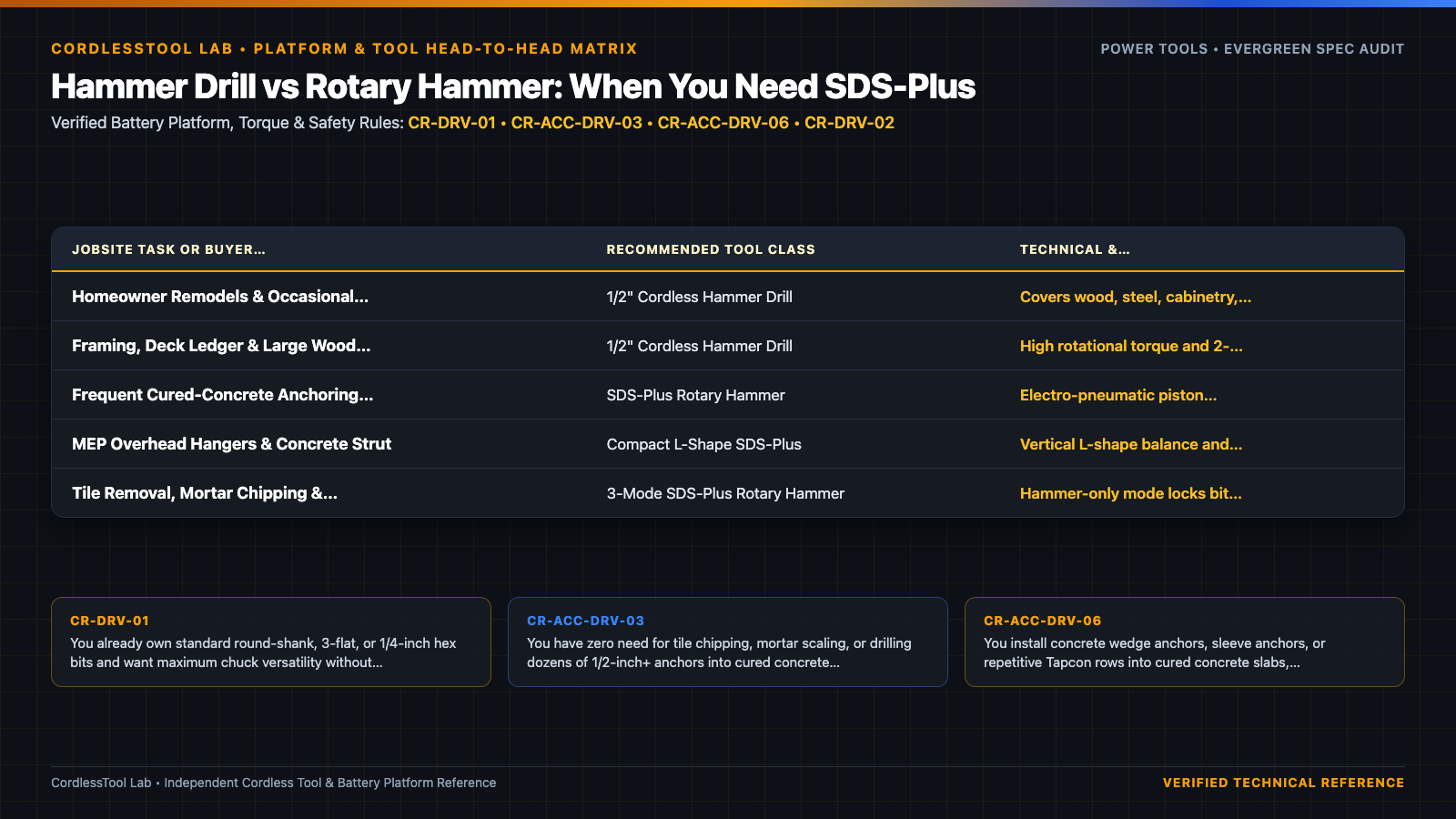
Neither tool replaces the other across every trade task. A flagship 1/2-inch hammer drill excels at mixing fasteners, wood augers, and rare masonry anchors, whereas an SDS-plus rotary hammer takes over the moment concrete anchoring becomes repetitive or diameter climbs past 3/8 inch.
| Jobsite Task or Buyer Scenario | Recommended Tool Class | Technical & Compatibility Rationale |
|---|---|---|
| Homeowner Remodels & Occasional Tapcon Screws | 1/2″ Cordless Hammer Drill | Covers wood, steel, cabinetry, and a handful of 3/16-inch to 3/8-inch holes in brick, cinder block, or mortar without buying a specialty concrete machine. |
| Framing, Deck Ledger & Large Wood Bores | 1/2″ Cordless Hammer Drill | High rotational torque and 2- to 3-speed gearboxes drive hole saws and self-feed bits cleanly; rotary hammers lack clutch-controlled screwdriving. |
| Frequent Cured-Concrete Anchoring (3/8″–3/4″+) | SDS-Plus Rotary Hammer | Electro-pneumatic piston energy (2.1–3.5 Joules) fractures aggregate rapidly with light feed pressure instead of burning up carbide tips (CR-DRV-01). |
| MEP Overhead Hangers & Concrete Strut | Compact L-Shape SDS-Plus | Vertical L-shape balance and active vibration control (SHOCKS / AVS) reduce wrist strain across dozens of 1/4-inch to 1/2-inch overhead concrete holes. |
| Tile Removal, Mortar Chipping & Light Demo | 3-Mode SDS-Plus Rotary Hammer | Hammer-only mode locks bit rotation for SDS-plus flat and scaling chisels; standard hammer drills cannot turn off rotation. |
| Structural Coring (>1-1/8″ Solid) & Heavy Slab Demo | SDS-Max Rotary Hammer | Exceeds SDS-plus capacity; step up to an 18 mm SDS-max rotary hammer on high-voltage packs. |
Side-by-Side Verified Spec & Interface Comparison
The table below contrasts both tool classes using verified manufacturer specifications in US imperial units across active flagship cordless models—the DeWalt DCD1007B and Milwaukee 2904-20 (Gen 4) 1/2-inch hammer drills against the DeWalt DCH273B, DeWalt DCH293B, and Milwaukee 2912-20 SDS-plus rotary hammers.
| Attribute | 1/2″ Cordless Hammer Drill | SDS-Plus Rotary Hammer |
|---|---|---|
| Hammering Mechanism | Two serrated mechanical cam discs vibrating axially at high RPM | Electro-pneumatic air-cushion cylinder driving a free-floating piston & striker |
| Primary Output Rating | Rotational torque (in-lbs) + blows per minute (BPM) | Single-blow impact energy (Joules) + BPM |
Tool Holder Standard (STD) | STD-CHUCK-3JAW-1-2 (1/2″ keyless 3-jaw chuck; friction grip) | STD-SHANK-SDS-PLUS (10 mm slotted quick-lock; axial float) |
| Bit Shank Compatibility | Round, 1/4″ hex, and 3-flat shanks ≤ 1/2″ (CR-ACC-DRV-06) | SDS-plus shanks only; incompatible with SDS-max or 3-jaw hammer use (CR-ACC-DRV-03) |
| Operating Modes | Drill, Clutch Screwdriving, Hammer-Drill (no hammer-only mode) | Rotary-Only, Rotary Hammer, Hammer-Only / Chisel (on 3-mode units) |
| Verified Reference Models | DeWalt DCD1007B (2,100 in-lbs max brake torque / 1,530 MWO; up to 38,250 bpm); Milwaukee 2904-20 Gen 4 (1,400 in-lbs rated; 0–33,000 bpm) | DeWalt DCH273B (2.1 J; 0–4,600 bpm); DeWalt DCH293B (3.5 J; 0–4,480 bpm); Milwaukee 2912-20 (2.7 J / 2 ft-lbs; 0–4,800 bpm) |
| Bare Tool Dimensions & Weight | 6.95–7.6 in length; 3.3 lb (2904-20) to 4.1 lb (DCD1007B) bare | 11.5–13.0 in length; 6.8 lb (DCH273B / 2912-20) to 8.2 lb (DCH293B) bare |
| Battery Pairing Guidance | Compact packs fine for fasteners; high-output packs advised for large augers (CR-BATT-TOOL-08) | High-draw masonry load strongly favors high-output packs (FORGE, HIGH OUTPUT, POWERSTACK, FLEXVOLT) |
| Kickback & Vibration Control | Electronic anti-rotation (ANTI-ROTATION / AUTOSTOP) + auxiliary side handle | Mechanical slip clutch or AUTOSTOP + active vibration damping (SHOCKS / AVS) + side handle |
| Bare-Tool Price Tier (US) | TIER-DRV-MID to TIER-DRV-PREMIUM (battery and charger extra) | TIER-DRV-PREMIUM (battery and charger extra) |
1. Internal Mechanics: Why 4,600 BPM Hits Harder Than 38,250 BPM
Looking only at blows per minute (BPM) on a spec sheet misleads thousands of concrete buyers every year. A modern brushless hammer drill like the DeWalt DCD1007B produces up to 38,250 bpm (and the Milwaukee 2904-20 reaches 33,000 bpm), whereas an SDS-plus rotary hammer like the DeWalt DCH273B cycles at 0–4,600 bpm and the Milwaukee 2912-20 peaks at 0–4,800 bpm. Yet the slower-cycling rotary hammer fractures cured concrete effortlessly while the hammer drill stalls or overheats carbide tips.
The difference lives inside the gearbox:
- Cam-Action Percussion (Hammer Drill): When you twist the collar to the hammer symbol, two hardened, serrated discs engage behind the 3-jaw chuck. As the spindle spins at up to 2,000–2,100 rpm, the teeth ride up and drop over each other thousands of times per minute. Each vertical drop moves the entire chuck and bit only a fraction of a millimeter, relying heavily on the operator pushing hard into the wall to transfer force into the masonry.
- Electro-Pneumatic Piston & Striker (SDS-Plus Rotary Hammer): Inside a rotary hammer, a crank or wobble-plate drives a primary piston inside a sealed cylinder. Compressing a pocket of air launches a separate flying striker mass forward to slam the rear end of the bit inside the chuck. Because that compressed air cushion absorbs rebound and eliminates the need for heavy body weight, each blow delivers substantial single-impact energy—
2.1 Jouleson theDCH273B,2.7 Joules(2 ft-lbs) on the2912-20, and3.5 Jouleson theDCH293B—while the bit turns at a controlled1,000–1,330 rpmto clear dust flutes without glazing carbide.
This mechanical split also explains why torque ratings cannot bridge the two categories—or even rank competing hammer-drill brands cleanly (CR-DRV-02). Milwaukee rates its Gen 4 2904-20 hammer drill at 1,400 in-lbs, while DeWalt rates the DCD1007B at 2,100 in-lbs max brake torque and 1,530 MWO (Unit/Max Watts Out). Because each brand uses a proprietary measurement method, a higher paper number does not prove superior field output without identical third-party measurement conditions, and neither rotational torque figure predicts concrete-chipping power measured in Joules.
2. Chuck Standards, Bit Compatibility & The Masonry Escalation Ladder
Your bit collection locks to the tool holder, not the brand badge (02f, CR-ACC-DRV-03, CR-ACC-DRV-06). A 1/2-inch cordless hammer drill relies on a keyless 3-jaw ratcheting chuck (STD-CHUCK-3JAW-1-2) that clamps round, 3-flat, or 1/4-inch hex shanks up to 1/2 inch in diameter. That friction grip makes the tool remarkably versatile for twist drills, spade bits, hole saws, and driver bits, though smooth round-shank masonry bits can slip inside the jaws when encountering hard aggregate.
By contrast, an SDS-plus rotary hammer uses a 10 mm slotted tool holder (STD-SHANK-SDS-PLUS) engineered with two open drive grooves and two closed locking grooves. Steel balls inside the collar snap into the closed slots so the bit cannot pull out, while permitting roughly 3/8 inch of axial piston travel inside the chuck. That floating stroke allows the internal striker to hammer directly against the bit shank without shaking the gearbox bearings apart.
Two hard compatibility boundaries govern bit selection:
- Never Clamp SDS-Plus Bits in a 3-Jaw Chuck for Hammering (
CR-ACC-DRV-03): The slotted SDS-plus grooves prevent uniform three-jaw contact, causing extreme bit wobble and rapid chuck damage, and a cam-action drill cannot drive the floating shank as designed. - SDS-Plus and SDS-Max Never Interchange Natively (
CR-ACC-DRV-03): SDS-plus shanks measure 10 mm, whereas heavy-duty SDS-max shanks measure 18 mm. Only step up to SDS-max when boring large structural anchors or heavy demolition—compare both systems in our SDS-plus vs. SDS-max shank guide.
Follow the four-step masonry escalation ladder under CR-DRV-01: a standard drill/driver belongs strictly in wood, metal, and fasteners; a 1/2-inch hammer drill handles occasional 3/16-inch to 3/8-inch holes in brick, block, stucco, and light mortar (browse top multi-purpose contenders in our best cordless hammer drill guide); an SDS-plus rotary hammer owns frequent cured-concrete anchoring from 3/16 inch up to 1 inch or 1-1/8 inches plus light chiseling (see our best cordless SDS-plus rotary hammer roundup); and SDS-max covers sustained core bits and heavy demolition.
3. Battery Platforms, 20V MAX Parity, Bare Tools & Channel Warranty Rules
Cordless power comparison often gets derailed by voltage marketing. Under CR-BATT-TOOL-02, DeWalt’s 20V MAX label and Milwaukee’s M18 label both describe five lithium-ion cell groups wired in series (5S) delivering 18 volts nominal under working load. “20V MAX” simply measures unloaded peak voltage straight off the charger; it does not give a 20V MAX hammer drill an automatic power edge over an 18V nominal M18 tool. Mechanical slide rails never cross brand lines (CR-BATT-TOOL-01), and even within a single brand, compact stem lines like Milwaukee M12 or DeWalt 12V MAX do not interchange with 18V/20V slide tools (CR-BATT-TOOL-03). DeWalt’s one-way FLEXVOLT exception lets 20V/60V MAX packs power 20V MAX tools with added weight (CR-BATT-TOOL-04), though standard 20V MAX packs never run 60V MAX tools (CR-BATT-TOOL-05).
Because an electro-pneumatic rotary hammer and a flagship hammer drill pulling large augers sit in the high-draw tool class (CR-BATT-TOOL-08), pack selection matters. While any current OEM battery on the same slide rail snaps in (CR-BATT-TOOL-12), compact single-row packs can experience voltage sag or trigger early thermal shutdowns during sustained concrete drilling. Pair SDS-plus tools and heavy hammer drills with high-output packs—such as DeWalt XR POWERSTACK, POWERPACK, or FLEXVOLT packs, or Milwaukee REDLITHIUM HIGH OUTPUT or FORGE packs. Avoid third-party “replacement” batteries with inflated capacity labels and passive cross-brand plastic battery adapters (CR-SYS-03, CR-BATT-TOOL-10): neither toolmaker approves adapters, passive bridges bypass brand thermal and low-voltage BMS communication, and warranty coverage may be refused.
Finally, watch two Amazon US purchasing details before ordering:
- Bare Tools vs. Starter Kits & Tool Generations (
CR-SYS-01,CR-SYS-02,CR-TOOL-02): Listings ending inB(DeWalt) or-20(Milwaukee) are bare tools—batteries and chargers are sold separately, so first-time platform buyers must budget for a starter kit in theTIER-BATT-VALUEtoTIER-BATT-MIDrange and verify box contents per listing variation. Also confirm model numbers closely: Milwaukee’s Gen 42904-20superseded the Gen 32804-20, yet older generations remain active in third-party catalogs. - Authorized-Dealer Warranty & Retail Exclusives (
CR-SYS-05): DeWalt operates an official Amazon Brand Store alongside Amazon first-party retail listings, preserving its 3-year limited warranty and 1-year free service contract. By contrast, Milwaukee’s official US warranty (5 years on M18 tools) applies strictly to purchases from authorized Milwaukee distributors—and Amazon third-party resellers typically do not qualify. Similarly, Home Depot retail-exclusive lines such as Ryobi ONE+ and Ridgid 18V appear on Amazon mainly through unauthorized third-party sellers, where factory coverage and Ridgid’s Lifetime Service Agreement (LSA) registration rules may be denied.
4. YMYL Safety: Anti-Rotation Controls, OSHA Silica Compliance & Recall Checks
Drilling high-torque wood bores or rebar-adjacent concrete introduces serious bind-up hazards and respirable crystalline silica exposure. Follow manufacturer instructions first across every setup (CR-DRV-04):
- Side Handles & Electronic Anti-Rotation (
CR-DRV-04): Always install and hold the auxiliary side handle for large-diameter bits, hole saws, and rotary hammer drilling as the tool manual specifies. Flagship hammer drills like DeWalt’sDCD1007B(ANTI-ROTATIONsystem) and Milwaukee’s2904-20(AUTOSTOPcontrol) plus the2912-20SDS-plus rotary hammer integrate electronic sensors to shut off motor rotation during sudden bind-ups, while mechanical clutches on theDCH273BandDCH293Blimit peak wrist twist. Never bypass or disable these protection systems, and always wear ANSI-rated eye protection, hearing protection, gloves, and respiratory PPE as the manual specifies. - OSHA 29 CFR 1926.1153 Table 1 Dust Extraction: Under OSHA’s Respirable Crystalline Silica Standard (Table 1, entry vii) for handheld rotary and hammer drills, jobsites must use a commercially available shroud or cowling connected to a dust collector providing the tool maker’s recommended CFM (or greater), equipped with a 99%+ efficiency filter and a filter-cleaning mechanism—plus a HEPA-filtered vacuum when cleaning out drilled anchor holes.
- CPSC Safety Recall Verification (
CR-SYS-06): At our verification sweep, none of the active flagship models compared here (DCH273B,DCH293B,DCD1007B, or2904-20) carried an open standalone CPSC recall. However, historical switch recalls affected earlier cordless and corded drills—including DeWalt’s December 2007 recall of specific 14.4VDC935andDC936cordless hammerdrills for switch overheating—so buyers acquiring older or secondary-market tools should always screen model and serial codes in the U.S. CPSC Recalls database.
Final Verdict: Choose a Hammer Drill vs. Choose an SDS-Plus Rotary Hammer
Choose a 1/2″ Hammer Drill If…
- You need one compact 3.3–4.1 lb drill for wood boring, metal drilling, clutch-controlled screws, and only occasional 3/16-inch to 3/8-inch brick or block anchors.
- You already own standard round-shank, 3-flat, or 1/4-inch hex bits and want maximum chuck versatility without switching tools.
- You have zero need for tile chipping, mortar scaling, or drilling dozens of 1/2-inch+ anchors into cured concrete slabs.
Choose an SDS-Plus Rotary Hammer If…
- You install concrete wedge anchors, sleeve anchors, or repetitive Tapcon rows into cured concrete slabs, footings, or foundation walls.
- You want electro-pneumatic Joules impact energy (2.1–3.5 J) and active vibration damping (
SHOCKS/AVS) that cut drill time and wrist fatigue. - You need hammer-only chisel mode for removing floor tile, knocking down mortar high spots, or light masonry demolition.
Verified OEM Cordless Contenders on Amazon US
Every SKU below is a verified OEM bare tool on Amazon US—never a third-party battery clone or cross-brand adapter—and should be paired with genuine OEM high-output batteries and chargers matching its slide rail.
1. DEWALT 20V MAX XR 1-Inch SDS-Plus Rotary Hammer (DCH273B)

Key Specs: 18V Nominal (20V MAX) | 2.1 Joules | 0–1,100 rpm / 0–4,600 bpm | STD-SHANK-SDS-PLUS | 6.8 lb bare | Configuration: tool-only listing: battery and charger sold separately (CR-SYS-01) | Price Tier: TIER-DRV-PREMIUM
Per DeWalt’s DCH273B specifications, this 3-mode L-shape brushless rotary hammer balances 2.1 Joules of impact energy with SHOCKS Active Vibration Control and a factory-set mechanical clutch, targeting 3/16-inch to 1/2-inch optimal concrete holes (1-inch maximum) plus light chipping. Cons: (1) Bare tool excludes batteries, charger, and dust-shroud attachments (CR-SYS-01); (2) At 6.8 lb bare, it is dedicated to masonry and lacks clutch-controlled wood or fastener driving.
2. DEWALT 20V MAX XR 1-1/8-Inch L-Shape SDS-Plus Rotary Hammer (DCH293B)

Key Specs: 18V Nominal (20V MAX) | 3.5 Joules | 0–1,000 rpm / 0–4,480 bpm | STD-SHANK-SDS-PLUS | ~8.2 lb bare | Configuration: tool-only listing: battery and charger sold separately (CR-SYS-01) | Price Tier: TIER-DRV-PREMIUM
When regular anchor diameters climb into the 5/8-inch to 7/8-inch range, the DCH293B steps up to 3.5 Joules of impact energy and a 1-1/8-inch maximum concrete rating while retaining DeWalt 20V MAX / FLEXVOLT battery compatibility and SHOCKS vibration damping. Cons: (1) Noticeably heavier at ~8.2 lb bare than 1-inch class L-shape hammers, making sustained overhead drilling tiring; (2) Ships tool-only without packs or charger and demands high-output 20V MAX or FLEXVOLT packs for peak sustained output (CR-BATT-TOOL-08).
3. DEWALT 20V MAX XR 1/2-Inch 3-Speed Hammer Drill (DCD1007B)

Key Specs: 18V Nominal (20V MAX) | 2,100 in-lbs max brake torque / 1,530 MWO | 0–450 / 0–1,200 / 0–2,000 rpm | up to 38,250 bpm | STD-CHUCK-3JAW-1-2 | 4.1 lb bare | Configuration: tool-only listing: battery and charger sold separately (CR-SYS-01) | Price Tier: TIER-DRV-PREMIUM
Per DeWalt’s DCD1007B specifications, this flagship 3-speed hammer drill pairs a nitro-carburized 1/2-inch metal ratcheting chuck with DeWalt’s electronic ANTI-ROTATION bind-up shutoff, making it an authoritative wood-boring and occasional brick/block drill. Cons: (1) Bare listing supplies no battery or charger (CR-SYS-01), and its 4.1 lb bare weight feels front-heavy in tight cabinetry; (2) Cam-action hammering cannot match a piston rotary hammer in frequent cured-concrete anchoring.
4. Milwaukee M18 FUEL 1/2-Inch Hammer Drill/Driver (2904-20, Gen 4)

Key Specs: 18V Nominal (M18) | Gen 4 | 1,400 in-lbs rated torque (Milwaukee method) | 0–500 / 0–2,100 rpm | 0–33,000 bpm | STD-CHUCK-3JAW-1-2 | 6.95 in / 3.3 lb bare | Configuration: tool-only listing: battery and charger sold separately (CR-SYS-01) | Price Tier: TIER-DRV-PREMIUM
Milwaukee’s Gen 4 2904-20 trims head length to 6.95 inches and bare weight to 3.3 lb while integrating AUTOSTOP kickback control, 16 clutch settings, and an all-metal 1/2-inch ratcheting chuck for general construction and intermittent light masonry work. Cons: (1) Bare-tool listing ships without M18 battery or charger (CR-SYS-01), and Milwaukee’s 5-year US warranty requires purchase from an authorized distributor rather than unauthorized Amazon 3P resellers (CR-SYS-05); (2) Cam percussion trails dedicated SDS-plus rotary hammers like the 2912-20 in cured concrete.
How We Audited This Guide
- Cordless drills, saws, and grinders were audited across brushless motor efficiency, max chuck/blade/arbor sizing, electronic kickback protection, Bare Tool vs. Kit value, and manufacturer US warranty terms.
- Every cordless drill, impact driver, saw, grinder, battery pack, charger, outdoor power tool, and accessory spec was cross-checked against official OEM manuals, UL/ANSI ratings, and live Amazon US listings.
- Recommendations were evaluated against our weighted vertical scoring rubrics and 61 documented CR-* platform and safety rules; we never invent peak torque ft-lbs, cut counts, runtime minutes, or battery decibels.
Frequently Asked Questions: Hammer Drill vs. Rotary Hammer
Can a cordless hammer drill drill into cured concrete?
Yes, for occasional small holes (typically 3/16 inch to 3/8 inch) in brick, block, or light concrete anchors. However, cam-action percussion relies on heavy user pressure and heats bits quickly, so frequent or larger cured-concrete holes call for an SDS-plus rotary hammer.
Can you put SDS-plus bits in a regular 3-jaw hammer drill chuck?
No. SDS-plus bits use a 10 mm slotted shank designed to float axially inside an SDS-plus tool holder. Clamping slotted SDS shanks inside a 3-jaw chuck prevents uniform grip, causes severe bit wobble, and damages chuck jaws without delivering pneumatic piston impacts.
Can an SDS-plus rotary hammer drill wood and metal or drive screws?
Only in rotary-only mode with a separate 3-jaw chuck adapter, and poorly compared to a real drill/driver. Rotary hammers spin slowly (around 1,000–1,330 rpm), lack mechanical torque-limiting clutches for screws, and weigh 6.8 to 8.2 lb bare.
Why do rotary hammers rate impact energy in Joules instead of in-lbs?
Joules measure single-blow axial kinetic energy launched by the internal pneumatic piston and striker, which determines how effectively a bit fractures concrete aggregate. Inch-pounds measure rotational twisting torque on a drill chuck, making direct cross-metric comparisons meaningless.
When do you need to skip SDS-plus and buy an SDS-max rotary hammer?
Step up from SDS-plus to an 18 mm SDS-max rotary hammer when routinely drilling solid concrete holes beyond 1-1/8 inches, running deep structural epoxy anchors, or performing continuous heavy slab chipping and demolition work.


