
When a cordless grinder shuts off under load, the tool is almost always triggering an intentional electronic safeguard rather than suffering a sudden mechanical failure. Unlike a compact drill/driver or oscillating multi-tool, a 4-1/2-inch, 5-inch, or 6-inch cordless angle grinder places one of the steepest continuous current demands on an 18V, 20V MAX, or 60V battery platform. Because modern brushless grinders pair high-draw motors with real-time battery management systems (BMS) and bind-up sensors, an undersized battery pack, elevated MOSFET temperature, or pinched abrasive disc will cut motor power instantaneously. Before assuming the motor is damaged or shopping for replacements in our cordless angle grinder hub, work through this ordered diagnostic sequence from lowest-risk battery checks to mechanical guard and wheel verification.
Every major cordless platform—including Milwaukee REDLINK PLUS, DEWALT E-CLUTCH and Kickback Brake, and Makita Star Protection Computer Controls—monitors pack voltage, cell temperature, and sudden amperage spikes simultaneously. That shared high-draw protection architecture is why the underlying electrical behavior mirrors what happens when a cordless circular saw stops under load during wet lumber rips. The difference on an angle grinder is the added mechanical hazard of high-RPM abrasive wheels, making strict battery removal and guard discipline mandatory before touching anything near the spindle.
Urgent Safety & Battery-Removal Rule (G-24):
Follow the manufacturer’s manual before performing any inspection. Always slide out and remove the battery pack completely before touching the abrasive wheel, spindle lock, flange nut, guard, cooling intake vents, or terminal contacts. Wear safety glasses, a full face shield, hearing protection, and work gloves as the manual specifies. Never defeat electronic overload cutoffs, pin a paddle switch, remove a guard to fit an oversized disc, or charge a swollen, cracked, or wet lithium-ion pack.
In This Diagnostic & Safety Guide
- 1. Fast Symptom-to-Cause Diagnostic Triage Table
- 2. Step 1: Battery Removal, PPE & CPSC Recall Verification
- 3. Step 2: Check Pack Class, State of Charge & Voltage Sag
- 4. Step 3: Diagnose Thermal Lockout & Charging Temperature Limits
- 5. Step 4: Electronic Kickback Clutch, Wheel Binding & Guard Rules
- 6. Step 5: Inspect Terminal Contacts, Cooling Vents & Switch Reset
- 7. Non-OEM Packs, Cross-Brand Adapters & Authorized Warranty Rules
- 8. Post-Inspection Checklist & Authoritative Citations
- 9. Frequently Asked Questions
1. Fast Symptom-to-Cause Diagnostic Triage Table
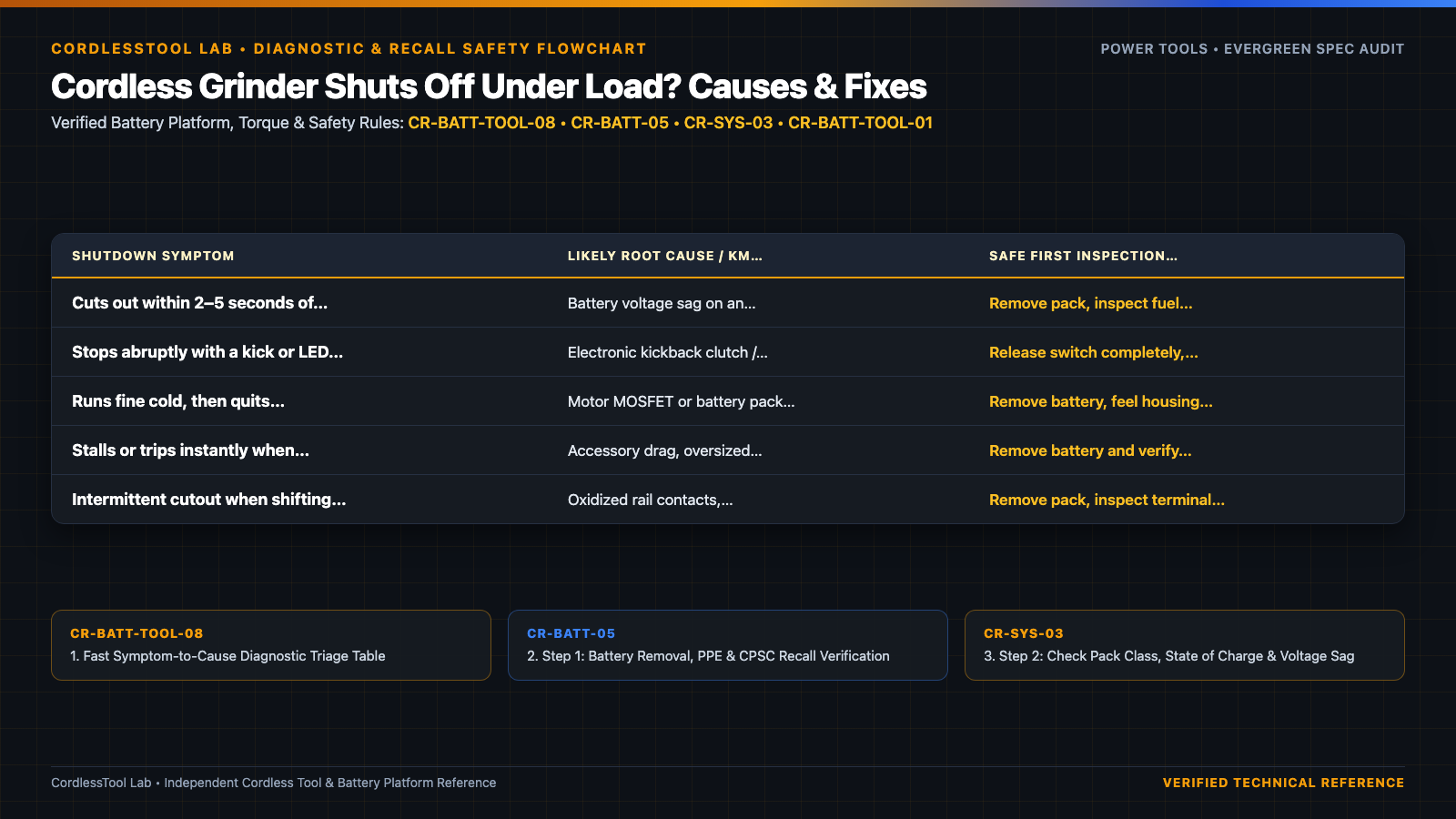
Because a cordless grinder protects both its brushless controller and lithium-ion cells through rapid shutdowns, the exact moment and pattern of the cutoff tells you where to look first. Compare what your tool did just before stopping against the diagnostic matrix below, keeping the battery pack removed until you finish your visual checks.
| Shutdown Symptom | Likely Root Cause / KM Rule | Safe First Inspection Step (Battery Removed) |
|---|---|---|
| Cuts out within 2–5 seconds of touching steel | Battery voltage sag on an undersized or nearly depleted compact pack (CR-BATT-TOOL-08) | Remove pack, inspect fuel gauge, and swap to an OEM high-output pack (5.0Ah+ HIGH OUTPUT, FORGE, POWERSTACK, or FLEXVOLT). |
| Stops abruptly with a kick or LED flash during deep cuts | Electronic kickback clutch / E-Clutch activated by wheel pinch or twist (CR-GRD-01) | Release switch completely, remove battery, check workpiece clamping and wheel kerf alignment, and ease downward feed pressure. |
| Runs fine cold, then quits repeatedly after heavy grinding | Motor MOSFET or battery pack thermal cutoff triggered (CR-BATT-05) | Remove battery, feel housing vents and pack casing, allow indoor room-temperature cooldown, and brush metal grit from intake screens. |
| Stalls or trips instantly when fitting a large cup or wire wheel | Accessory drag, oversized wheel, or tool-class overload (CR-ACC-GRD-01, CR-SYS-08) | Remove battery and verify wheel diameter, RPM rating, and guard type against the nameplate; avoid forcing a 3-inch cut-off tool into heavy fabrication. |
| Intermittent cutout when shifting grip or tapping battery | Oxidized rail contacts, dust-packed terminals, or loose 3P battery/adapter fit (CR-SYS-03, CR-BATT-TOOL-10) | Remove pack, inspect terminal blades for arc pitting or grit, wipe dry with a clean cloth, and discard third-party adapters or non-OEM packs. |
| Pack goes straight from tool cutoff to blinking charger LED | Pack temperature outside the manual’s safe charging window (CR-BATT-05) | Pull pack off the charger and let it normalize indoors between 40°F and 104°F (4.5°C–40°C per typical DEWALT/Milwaukee manuals). |
2. Step 1: Battery Removal, PPE & CPSC Recall Verification
Every physical inspection starts with zero stored electrical energy on the grinder chassis. Press the battery release latches, slide the pack completely out of the rear dock, and set it on a clean, dry workbench away from metal filings or sparks. Even on models equipped with anti-restart electronics, leaving a pack installed while checking flange nuts, guards, or dust screens risks unintended activation if a slide switch is bumped or a paddle lock-off linkage is fouled with grinding grit.
Before assuming your shutdown is normal overload behavior, run a model check against active safety notices (CR-SYS-06, G-12). As of our verification check on 2026-11-26, a review of the U.S. Consumer Product Safety Commission (CPSC) recalls database shows no active recalls targeting mainstream cordless battery-powered angle grinders from Milwaukee, DEWALT, Makita, Bosch, or Ryobi. Historical CPSC grinder notices instead involved specific corded and pneumatic tools—such as Bosch 1380 Slim corded grinders for melting brush covers, Metabo corded/rat-tail grinders for sticking switches, Makita corded guard-sizing notices, and Direct Distributors pneumatic air grinders. Still, always verify your exact catalog number on the CPSC Recalls Database because manufacturer safety notices update continuously.
3. Step 2: Check Pack Class, State of Charge & Voltage Sag
The single most common reason a cordless grinder shuts off under load—especially on a tool that spins freely at full no-load RPM in the air—is battery voltage sag under high-amperage demand (CR-BATT-TOOL-08). When an abrasive wheel presses against steel, current draw spikes sharply. If the battery pack cannot sustain that current without its cell voltage collapsing below the BMS low-voltage threshold, the pack or tool electronics cut power immediately to protect the lithium-ion cells from permanent over-discharge damage.
Why Compact Packs Fail on High-Draw Grinders
On an 18V-nominal platform, a compact 1.5Ah, 2.0Ah, or 2.5Ah pack typically wires five lithium-ion cells in a single series string (5S1P). All current demanded by the grinder must pass through one cell per voltage stage. By contrast, a 4.0Ah, 5.0Ah, 6.0Ah, 8.0Ah, or 12.0Ah pack splits that current across two or three parallel cell strings—or uses lower-impedance 21700, pouch, or tabless cell topologies—dramatically reducing internal resistance and voltage drop under load. That is why Milwaukee’s M18 grinder documentation pairs sustained heavy-grinding output with HIGH OUTPUT or FORGE packs rather than compact CP packs, and why DEWALT pairs high-draw 20V MAX XR grinders with POWERSTACK or FLEXVOLT packs (CR-BATT-TOOL-08).
Do not confuse marketing voltage labels with sustained current capacity (CR-BATT-TOOL-02). DEWALT 20V MAX, Craftsman V20, Milwaukee M18, Makita 18V LXT, Bosch 18V, and Ryobi 18V ONE+ are all 18-volt nominal platforms built from 5S lithium-ion cell groups; a “20V MAX” label reflects unloaded peak cell voltage rather than extra grinding power over an 18V pack. What stops voltage-sag cutoffs is cell discharge capability and parallel string capacity, not the voltage sticker on the side of the pack. Note also that platform interfaces remain strictly locked by brand and voltage family (CR-BATT-TOOL-01, CR-BATT-TOOL-03): Makita 18V LXT packs never fit 40V max XGT grinders, Milwaukee M12 packs never fit M18 grinders, and a 60V MAX grinder such as DEWALT’s DCG418 requires a FLEXVOLT battery because standard 20V MAX packs will not power it (CR-BATT-TOOL-05).
How to Perform a Safe Battery-Swap Load Check
- Check State of Charge First: Press the pack’s LED fuel gauge. A battery showing one or two bars may spin a grinder at full speed with no load, yet dip past the BMS cutoff threshold the instant a Type 27 wheel contacts weld bead.
- Step Up to a High-Output OEM Pack: Swap your compact or aged pack for a freshly charged OEM high-output battery (for example, Milwaukee M18 HIGH OUTPUT XC6.0/XC8.0 or FORGE XC8.0, DEWALT DCBP520 POWERSTACK or FLEXVOLT DCB609 on 20V MAX grinders, or a high-capacity Makita LXT 5.0Ah / XGT 4.0Ah pack on its matching platform).
- Remember Bare-Tool Budgeting Rules: Many pro grinders ship as bare tools (
tool-only listing: battery and charger sold separately,CR-SYS-01). If you bought a bare grinder to save upfront cost and paired it with an older 2.0Ah drill pack you already owned, upgrading to a dedicated high-output pack solves the cutoff without replacing the grinder. - Verify Dual-Voltage & Reference Pack Ratings: Remember that maker performance figures assume a specific reference pack (
CR-BATT-TOOL-09)—smaller packs rarely sustain the same cut rate—and while DEWALT FLEXVOLT packs run 20V MAX tools safely (CR-BATT-TOOL-04), they add noticeable weight and tail-heaviness during overhead grinding.
4. Step 3: Diagnose Thermal Lockout & Charging Temperature Limits
If your grinder completes several cuts normally before shutting off and refusing to restart for several minutes, you are likely encountering thermal protection inside either the battery pack or the grinder’s brushless motor controller. Continuous grinding generates heat at two points simultaneously: internal I²R heating inside the lithium-ion cells and switching heat inside the tool’s electronic speed/torque control board.
When internal cell or board temperatures exceed the manufacturer’s safety ceiling, systems like Makita Star Protection, Milwaukee REDLINK PLUS, and DEWALT’s overload circuit lock out the motor—often accompanied by blinking tool or battery indicator lights—until temperatures drop back into the safe operating window. Forcing the issue by repeatedly pulling the trigger will only keep the lockout timer active or shorten cell lifespan.
Safe Cooldown & Charger Temperature Window (CR-BATT-05)
A common secondary trap occurs right after a thermal shutoff: the user pulls the hot battery off the grinder, drops it directly onto a rapid charger, and sees an error or delay blink pattern. Per both DEWALT and Milwaukee operator manuals, standard lithium-ion charging is permitted only within an ambient temperature window of roughly 40°F to 104°F (4.5°C to 40°C). If internal pack temperature is above that ceiling after heavy metal fabrication, or below freezing in an unheated winter garage, the charger pauses charging automatically to protect the cells (CR-BATT-05).
If your charger enters a hot/cold delay or flashes an error code after a grinder cutoff, do not force repeated re-insertions. Review our dedicated cordless tool charger blinking red guide to distinguish normal thermal pause patterns from permanent pack or charger faults, and allow the battery to rest indoors at room temperature away from direct sunlight or heaters before charging. Never place a hot battery in a freezer or submerge it to speed cooling—condensation inside the BMS circuit creates short-circuit and corrosion hazards.
5. Step 4: Electronic Kickback Clutch, Wheel Binding & Guard Rules
When a grinder shuts off instantaneously mid-cut without feeling hot—especially when cutting thick plate, angle iron, or rebar—the culprit is often an active electronic clutch or kickback brake reacting to a sudden wheel bind. Features such as DEWALT E-CLUTCH / Kickback Brake, Milwaukee Electronic Clutch, and Bosch KickBack Control monitor rapid current spikes or rotational deceleration. Note that safety electronics vary by SKU and generation (CR-GRD-01): never assume a grinder includes an electronic brake or kickback clutch simply because it belongs to a pro line; verify your exact model’s manual and nameplate.
Five Mechanical & Technique Issues That Trigger Bind-Up Cutoffs
- Excessive Downward Feed Pressure: Cordless angle grinders rely on peripheral wheel speed (typically 8,500–9,000+ RPM on 4-1/2″/5″ units, verified per model manual) rather than body weight. Leaning heavily onto a grinding wheel or flap disc bogs RPM, spikes amperage, and triggers electronic overload shutoff in seconds. Let the abrasive grit cut under light, controlled two-handed pressure.
- Unclamped Workpiece Pinching the Kerf: When cutting steel tube, strut, or rebar supported at both ends, the metal sags inward as the cut nears completion, pinching the thin cut-off wheel and spiking motor load instantly. Support workpieces properly and clamp them securely as the owner’s manual directs so the kerf opens away from the disc.
- Wrong Guard or Wheel Type Pairing (
CR-ACC-GRD-04): Flat Type 1 cut-off wheels require a closed-back Type 1 cut-off guard, whereas depressed-center Type 27 grinding wheels and flap discs require a Type 27 grinding guard. Many bare-tool listings ship with only one guard type in the box (CR-SYS-02). Using the wrong disc geometry or letting a worn disc snag against an improperly positioned guard creates severe drag and violates OSHA portable grinder guarding standards (29 CFR 1926.303). - Oversized Wheels or RPM / Spindle Mismatches (
CR-ACC-GRD-01,CR-ACC-GRD-02,CR-ACC-GRD-03): Never remove or loosen a guard to squeeze a 5-inch or 6-inch wheel onto a 4-1/2-inch chassis—larger diameters multiply lever-arm torque against the motor and cause instant overload stalls alongside severe wheel-burst risk. Confirm the wheel’s stamped maximum RPM meets or exceeds the grinder’s no-load RPM, and confirm your mount matches your spindle (US5/8-11UNC with proper flange/nut orientation versus BoschX-LOCKor grey-marketM14imports). - Grinder Class Below Job Demand (
CR-SYS-08,CR-TOOL-01): Compact 3-inch cut-off tools (such as 12V or compact 20V MAX units) excel on thin sheet metal, muffler clamps, and small bolts, while sustained structural steel weld grinding calls for a full-size 4-1/2-inch, 5-inch, or 6-inch brushless grinder. Likewise, older brushed grinders run hotter and shed efficiency sooner under continuous heavy load than brushless models.
6. Step 5: Inspect Terminal Contacts, Cooling Vents & Switch Reset
Metal fabrication creates conductive ferrous dust and abrasive grit that slowly migrate into battery slide rails, cooling intake screens, and switch housings. With the battery pack removed and PPE in place, run these clean-and-reset checks before concluding an internal board has failed.
1. Clean Battery Terminal Blades & Tool Receivers
Look closely into the grinder’s battery terminal block and the slotted female contacts on your battery pack. High-current arcing from loose packs, oxidized blades, or trapped metallic grinding dust increases contact resistance. Under heavy load, high contact resistance creates localized voltage drop across the terminals themselves, fooling the grinder’s controller into reading a dead or disconnected battery. Wipe the plastic rails and exposed tool spade contacts with a clean, dry microfiber cloth or soft nylon brush—avoid conductive liquid cleaners or spraying compressed air straight into sealed PCB cavities where grit can lodge deeper.
2. Clear Dust Screens & Check for Spindle Drag
Most pro cordless grinders (including Milwaukee M18 FUEL and DEWALT XR models) incorporate removable mesh debris screens over the rear air intakes. Unclip and clean these screens per the owner’s manual so cooling air flows freely across the brushless stator and control electronics. While the battery is out, rotate the abrasive wheel by hand (wearing heavy work gloves as the manual specifies): it should turn smoothly with normal gear resistance and zero scraping against the guard, flange washer, or jammed gearhead bearings. Binding gear teeth or a seized bearing will trip over-current protection within a fraction of a second.
3. Understand Switch Reset & Anti-Restart Behavior
If your grinder uses a lock-on slide switch or a paddle switch and shuts off via E-Clutch or anti-restart protection, simply swapping batteries while leaving a slide switch in the “ON” position will keep the motor disabled on models equipped with no-volt/anti-restart protection. Return the switch fully to the “OFF” / released position, wait 2–3 seconds for the controller to reset, and re-engage smoothly. If a paddle switch feels gritty, sticks mechanically, or drops power whenever you lightly flex the handle, stop using the tool—switch assemblies and internal MOSFET boards are non-user-serviceable safety components that require authorized service center repair (G-24).
7. Non-OEM Packs, Cross-Brand Adapters & Authorized Warranty Rules
Two marketplace workarounds are disproportionately responsible for erratic grinder shutdowns under load—and both carry serious safety and warranty consequences that we strictly warn readers against:
- Counterfeit & Non-OEM “Replacement” Batteries (
CR-SYS-03,G-25): Generic marketplace packs advertised as “replacement for DeWalt 20V / Milwaukee M18 / Makita 18V” routinely use low-discharge cells paired with inflated 9.0Ah or 12.0Ah stickers and simplified protection boards that lack genuine brand thermal/current handshakes (such as Makita Star Protection or Milwaukee REDLINK communication). Under a grinder’s steep amperage draw, these packs either sag immediately, trigger communication faults, or overheat without reliable thermal cutoffs. Stick exclusively to authentic OEM packs sold by the brand, Amazon retail, or an authorized dealer. - Cross-Brand Plastic Battery Adapters (
CR-BATT-TOOL-10,G-25): Third-party slide adapters let one brand’s battery latch onto another brand’s grinder, but neither tool maker approves them. Adapters frequently omit thermistor and data-pin passthrough—meaning the grinder cannot monitor pack temperature or throttle output safely—while introducing extra terminal contact resistance that worsens mid-cut voltage sag and can void warranty support. - Authorized Reseller Warranty Caveats (
CR-SYS-05,G-26): If your OEM grinder or battery continues shutting off under light load on a verified high-output pack, check your purchase provenance before filing a warranty claim. Milwaukee M18/M12 standard limited warranties require purchase new from an authorized distributor, and retail-exclusive platforms such as Ryobi ONE+ and Ridgid 18V (primarily sold through The Home Depot in the US) frequently carry unauthorized third-party marketplace listings whose bulk or resold tools fail factory warranty or Ridgid Lifetime Service Agreement (LSA) registration eligibility. Retain your dated receipt and verify seller authorization on the brand’s US support portal.
8. Post-Inspection Verification Checklist & Authoritative Citations
After completing your battery, thermal, guard, and contact inspections—with the battery pack still removed until the final step—verify each item below before returning the grinder to metalwork service:
- [ ] CPSC Recall Screening Cleared: Checked your exact model number on CPSC Recalls and confirmed zero open safety notices (
CR-SYS-06). - [ ] OEM High-Output Pack Paired: Confirmed a charged, room-temperature OEM pack matched to high-draw grinding (no compact single-row packs, no adapters, no non-OEM clones;
CR-BATT-TOOL-08,CR-SYS-03). - [ ] Guard, Spindle & Wheel Verified: Confirmed Type 1 cut-off or Type 27 grinding guard matches the installed disc, wheel diameter does not exceed rated max, wheel max RPM meets or exceeds grinder RPM, and flange nut is seated per manual (
CR-ACC-GRD-01..04). - [ ] Vents, Contacts & Free Spin Checked: Brushed intake screens clean, wiped terminals dry, verified smooth hand rotation with gloves on, and attached the side handle firmly.
- [ ] Brief Unloaded Spin-Up & Light-Pressure Load Check: With full PPE on and the workpiece clamped, re-insert the pack, run an unloaded spin-up check away from bystanders, and apply light feed pressure so wheel RPM performs the cut.
Authoritative Non-Affiliate References
- U.S. Consumer Product Safety Commission (CPSC) — Official Product Recalls & Safety Warnings Database
- U.S. Occupational Safety and Health Administration (OSHA) — 29 CFR 1926.303 Abrasive Wheels and Portable Grinder Guarding Standards
- Milwaukee Tool US — Official M18 FUEL Grinder Operator’s Manuals, REDLINK PLUS & Authorized Service Support
- DEWALT US — Official 20V MAX / FLEXVOLT Grinder Manuals, E-CLUTCH Specifications & ServiceNet Portal
- Makita USA — Star Protection Computer Controls, LXT/XGT Battery Manuals & Warranty Support
How We Audited This Guide
- Cordless drills, saws, and grinders were audited across brushless motor efficiency, max chuck/blade/arbor sizing, electronic kickback protection, Bare Tool vs. Kit value, and manufacturer US warranty terms.
- Every cordless drill, impact driver, saw, grinder, battery pack, charger, outdoor power tool, and accessory spec was cross-checked against official OEM manuals, UL/ANSI ratings, and live Amazon US listings.
- Recommendations were evaluated against our weighted vertical scoring rubrics and 61 documented CR-* platform and safety rules; we never invent peak torque ft-lbs, cut counts, runtime minutes, or battery decibels.
9. Frequently Asked Questions
Why does my cordless grinder shut off after 3 seconds under light pressure?
Short 2–5 second cutoffs almost always indicate battery voltage sag. Compact 1.5Ah–3.0Ah packs or partially discharged batteries drop below the BMS cutoff threshold when a grinder draws peak current, even if the disc spins fine unloaded. Swap to a charged OEM high-output pack.
How do I reset my grinder after E-Clutch or kickback control trips?
Release the paddle switch or slide the lock-on switch completely back to the OFF position, wait two to three seconds, and verify the wheel is not pinched in the kerf. Remove the battery before inspecting a bound disc, then restart using lighter feed pressure.
Can a 20V MAX grinder shut off less than an 18V grinder?
No. DEWALT 20V MAX and Milwaukee M18 or Makita 18V LXT are all 18-volt nominal five-cell systems; “20V MAX” reflects unloaded peak voltage, not extra power. Sustained output and resistance to load cutoffs depend on high-output cell design and parallel capacity, not the label.
Why does my charger blink red right after the grinder cuts off?
Heavy grinding heats lithium-ion cells above the charger’s safe ambient charging window (typically 40°F–104°F per DEWALT and Milwaukee manuals), triggering a hot/cold delay blink. Remove the pack from the charger and let it reach room temperature indoors before charging.
Are there any active CPSC recalls on cordless angle grinders?
As of our verification check, the U.S. CPSC recalls database shows no active recalls on mainstream cordless battery-powered angle grinders from Milwaukee, DEWALT, Makita, Bosch, or Ryobi, though past notices covered specific corded and air models. Always verify your exact model at CPSC.gov.


