
When a cordless circular saw stops under load halfway through a 2×10 rafter, damp pressure-treated decking, or a sheet of subfloor plywood, the tool is almost never broken beyond repair. In modern brushless 6-1/2-inch and 7-1/4-inch circular saws, abrupt mid-cut shutdowns come from two distinct sources: protective electronic cutoffs (battery management system voltage-sag limits, cell temperature lockouts, or tool-side overload circuits) and avoidable mechanical drag (kerf pinching, resin-glazed blades, wrong tooth geometry, or a slipping arbor flange). Before replacing your saw or blaming a battery platform, follow a disciplined lowest-risk inspection order—and if you are comparing replacement platforms or high-output saw designs, start with our best cordless circular saw buyer’s guide.
Safety First — Remove the Battery Pack Before Inspection (G-24):
Always slide the battery pack completely out of the saw before touching the blade, arbor bolt, clamping flanges, lower blade guard, depth lever, or battery terminals. Follow the manufacturer’s owner’s manual for every adjustment, wear ANSI-rated eye protection, hearing protection, and personal protective equipment (PPE) as the manual specifies, and never pin or wedge the lower guard open or attempt to defeat thermal and overcurrent battery cutoffs.
In This Troubleshooting Playbook
- 1. Fast Symptom-to-Cause Diagnostic Table
- 2. Ordered 7-Step Diagnostic Workflow (Lowest Risk First)
- 3. Battery Pack Sizing, Voltage Parity & Platform Rules
- 4. Non-OEM Packs, Reseller Warranty Caveats & CPSC Recall Check
- 5. Pre-Cut Verification Checklist & Official Citations
- 6. Frequently Asked Questions
1. Fast Symptom-to-Cause Diagnostic Table
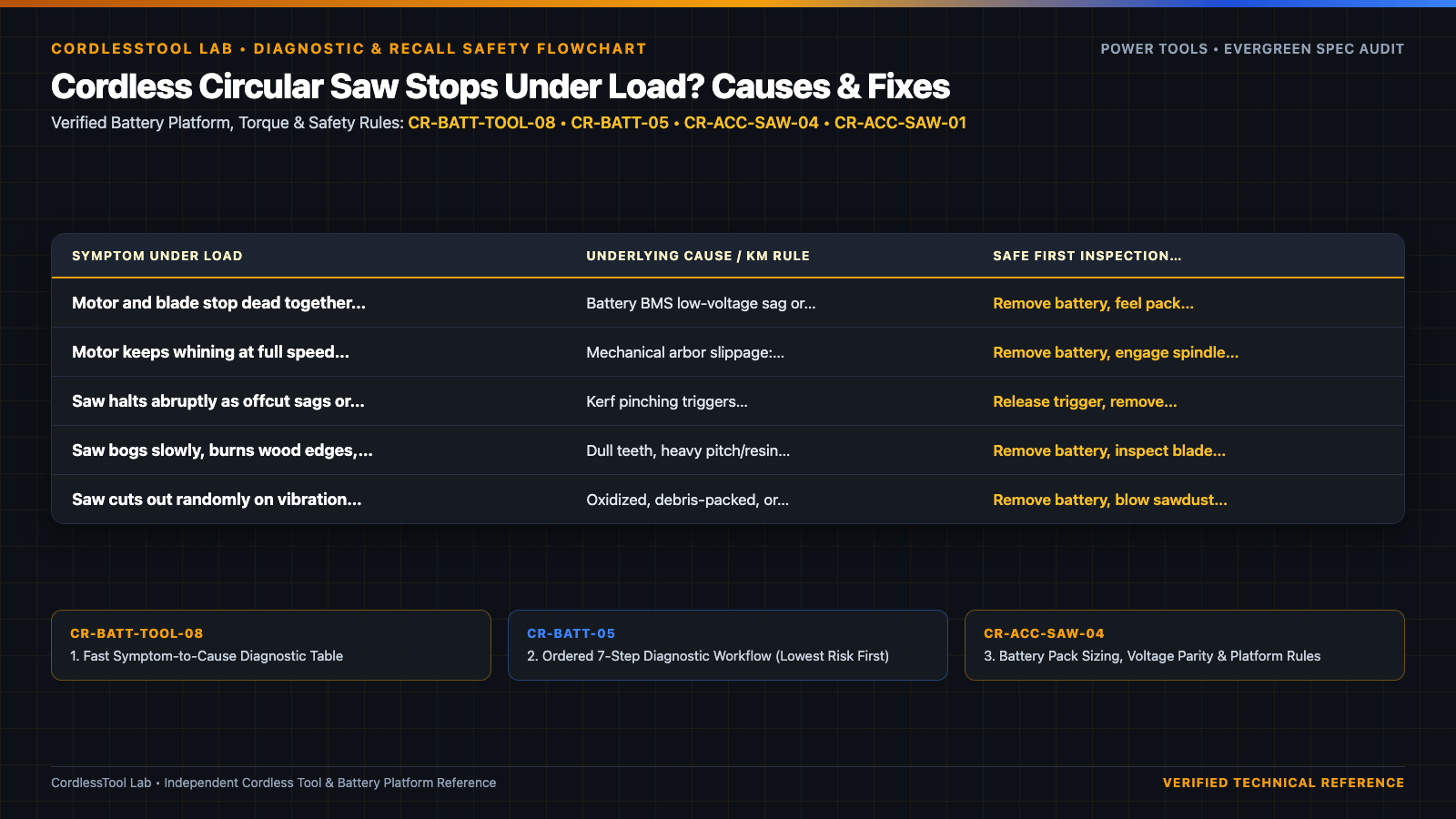
Not every mid-cut stoppage looks or sounds the same. Listening to whether the motor stops simultaneously with the blade—or keeps spinning freely while the blade halts inside the kerf—immediately splits electrical cutoffs from arbor slippage. Use the triage matrix below to pinpoint the most likely rule or hardware bottleneck before tearing down the saw.
| Symptom Under Load | Underlying Cause / KM Rule | Safe First Inspection Step (Battery Removed) |
|---|---|---|
| Motor and blade stop dead together in thick 2× stock; saw restarts after 10–30 seconds | Battery BMS low-voltage sag or high-draw thermal/overcurrent cutoff on compact pack (CR-BATT-TOOL-08) | Remove battery, feel pack casing for excessive warmth, verify fuel-gauge bars, and switch to a cool, fully charged OEM high-output pack. |
| Motor keeps whining at full speed while blade stops inside the wood | Mechanical arbor slippage: loose arbor bolt, pitch/oil between flanges, or missing washer (CR-ACC-SAW-02) | Remove battery, engage spindle lock per manual, verify blade seats cleanly on the arbor step, clean both flanges, and retighten arbor bolt. |
| Saw halts abruptly as offcut sags or when steering back onto cut line | Kerf pinching triggers electronic overload or kickback-brake cutoff (CR-SAW-02) | Release trigger, remove battery before backing blade out, support both sides of workpiece evenly, and align cut straight without twisting shoe. |
| Saw bogs slowly, burns wood edges, and trips overload mid-rip | Dull teeth, heavy pitch/resin glaze, or high-tooth-count finish blade in framing stock (CR-ACC-SAW-04) | Remove battery, inspect blade teeth for rounding or baked sap, and swap to a sharp thin-kerf framing blade (24T class for 7-1/4" wood ripping). |
| Saw cuts out randomly on vibration even in thin plywood; pack feels loose | Oxidized, debris-packed, or spread battery-dock terminal spades causing voltage drop | Remove battery, blow sawdust out of rail channels, and inspect saw spades and pack female slots for soot, bent tabs, or melted housing plastic. |
| Pack stops saw and then triggers blinking red/amber LED on charger | Cell thermistor outside safe charging temperature window, typically ~50°F–104°F (CR-BATT-05) | Unplug pack from charger, let it cool indoors at room temperature until thermal pause clears; never charge swollen or damaged cells. |
| Lower blade guard snags on board edge and stalls entry cut or snaps sluggishly | Bent guard/shoe, resin buildup in pivot, or broken return spring (CR-SYS-06, G-24) | Remove battery immediately, check guard pivot per owner’s manual, verify CPSC recalls for your model, and replace damaged guard parts via OEM service. |
2. Ordered 7-Step Diagnostic Workflow (Lowest Risk First)
Work through these seven checks in sequence. Starting with mechanical safety, arbor grip, and blade geometry solves the majority of mid-cut shutdowns without spending money on new hardware, and prevents you from misdiagnosing a dull blade or pinched kerf as a failed brushless motor.
Step 1: Remove the Battery Pack & Audit Lower Guard Movement (G-24)
Every diagnostic sequence begins with zero power on the tool. Press the battery release latches, pull the pack out of the rear dock, and set it on a clean bench away from metal shavings. Put on eye protection and cut-resistant work gloves as the manufacturer’s manual specifies.
Cycle the lower blade guard manually using its retraction lever. It should glide open smoothly through its entire arc and snap shut crisply against its rubber bumper stop the moment you release it. If sawdust and pitch have packed the upper guard cavity or pivot ring, a sluggish lower guard can catch on the leading edge of a 2×4 and stall the saw right at entry—or worse, leave teeth exposed after a cut. Clean the guard track only as the owner’s manual instructs, check the aluminum or magnesium base shoe for bends from a drop, and never wedge, tie, or remove the lower guard.
Step 2: Separate Motor Stall from Arbor Flange Slippage (CR-ACC-SAW-02)
Think carefully about what happened during the last shutdown. If the brushless motor kept spinning at high RPM while the blade stopped rotating inside the wood, you do not have a battery or electronics fault—you have arbor flange slippage. Circular saws rely on clamping friction between the inner flange washer, the blade body, and the outer flange washer (plus the arbor bolt). Any film of factory anti-rust oil, wet sap, or fine wood dust trapped between those surfaces cuts clamping friction dramatically.
With the battery removed, engage the arbor spindle lock button and loosen the arbor bolt using the factory wrench. Note carefully whether your saw uses a right-hand or left-hand thread—blade-left and blade-right circular saws frequently use opposite thread directions so blade rotation tightens rather than loosens the bolt. Check the arrow embossed on the outer flange or confirm the direction in your owner’s manual before applying force.
- Check Arbor Match (
CR-ACC-SAW-02): Most US 6-1/2-inch and 7-1/4-inch cordless circular saws use a 5/8-inch round arbor (STD-ARBOR-5-8) or accept a diamond-knockout flange (STD-ARBOR-DIAMOND-KO), while many 6-1/2-inch plunge track saws use a 20 mm metric arbor (STD-ARBOR-20MM). Verify that the blade center hole sits flat on the machined arbor shoulder rather than riding on top of the step—especially if a diamond knockout was partially punched or an unapproved reducer bushing shifted out of center. Use reducer bushings only where the saw’s manual explicitly permits them. - Clean Both Flanges Dry: Wipe the inner flange, outer flange, and the clamping ring of the blade with a clean rag and isopropyl alcohol or mild resin cleaner, then let every surface dry completely before reassembly.
- Inspect Flange Wear: If an arbor flange looks dished, scored, or bottomed out against the inner shoulder so it no longer pinches the blade plate firmly, replace the OEM outer and inner flanges before running the saw again.
Step 3: Audit Blade Diameter, Kerf, Tooth Count & Sharpness (CR-ACC-SAW-01, CR-ACC-SAW-04)
Cordless circular saws operate within tighter continuous-power margins than 15-amp corded worm-drive saws, which means blade friction shows up as an electronic overload trip far sooner. Three blade variables drive amp draw under load:
- Tooth Count & Material Pairing (
CR-ACC-SAW-04): Using a 40-tooth or 60-tooth plywood finish blade to rip wet 2× framing lumber packs too many teeth into the cut simultaneously, clogging gullets with sawdust and spiking motor current until the controller trips. Switch to a sharp low-tooth-count framing blade (typically 24 teeth on 7-1/4-inch wood blades) for framing and rip cuts, and save high-tooth-count blades for sheet goods and trim. - Thin-Kerf Geometry & Pitch Glaze: Most cordless circular saws ship with thin-kerf carbide blades designed to remove less wood per pass. Thick standard-kerf blades built for heavy stationary saws or resin-caked teeth generate heavy lateral drag. Clean pitch off carbide tips with an approved blade cleaner, or replace any blade with chipped, missing, or rounded carbide teeth.
- Diameter, Max RPM & Approved Blade Type (
CR-ACC-SAW-01,CR-ACC-SAW-03,CR-ACC-SAW-07): Match the exact rated diameter (never install a 7-1/4-inch blade on a 6-1/2-inch saw or exceed guard clearance), verify the blade’s maximum RPM rating meets or exceeds the saw’s no-load RPM on the nameplate, and never mount abrasive masonry or metal cut-off wheels on a wood circular saw unless the manufacturer’s manual explicitly authorizes them.
Step 4: Eliminate Kerf Pinching, Depth Errors & Excessive Feed Pressure (CR-SAW-02)
Even a sharp 24T thin-kerf blade on a flagship brushless saw will halt instantaneously if the lumber closes onto the blade body mid-cut. Internal tension in wet pressure-treated 2× stock, sagging unsupported offcuts, or twisting the saw shoe while trying to steer back onto a pencil line forces the sides of the blade plate against the kerf walls. Modern electronic saws read that sudden torque spike as a kickback or locked-rotor event and shut off power in milliseconds.
Correct three technique and setup variables with the battery removed before starting your next cut:
- Set Proper Blade Depth: Following your owner’s manual, adjust the depth lever so the carbide teeth extend just past the underside of the lumber (commonly about one-quarter inch or one full tooth gullet below the stock). Dropping a 7-1/4-inch blade to full 2-1/2-inch depth when cutting 3/4-inch plywood puts unnecessary blade arc inside the kerf and increases binding sensitivity.
- Support Both Sides of the Cut: Never bridge a long board across two sawhorses and cut in the middle—as the kerf deepens, both halves sag inward and clamp the blade tight. Support the main piece securely and let a short offcut fall free unobstructed, or lay full sheet goods flat across sacrificial rigid foam insulation board.
- Match Feed Speed to Motor Sound: Let the blade RPM carry the cut rather than shoving the rear handle forward. If pitch changes or RPM drops noticeably in dense LVL or hardwood, ease feed pressure slightly and check whether your stock thickness exceeds the saw’s rated cut capacity at 90° or 45° bevel (
CR-SAW-02).
Step 5: Evaluate Battery Pack Output Class, State of Charge & Thermal Pause (CR-BATT-TOOL-08, CR-BATT-05)
Once blade drag and kerf binding are ruled out, the #1 cause of a cordless circular saw cutting out under heavy ripping is battery voltage sag on an undersized or low-charge pack. A 7-1/4-inch brushless circular saw is one of the highest-draw tools on an 18V nominal platform. Under rule CR-BATT-TOOL-08, compact 1.5Ah to 2.5Ah single-row packs slide into the saw and spin it fine with no load, yet suffer steep internal voltage drop the moment the teeth bite thick timber.
When cell voltage drops below the pack’s low-voltage cutoff threshold—or when high-resistance cells heat rapidly during sustained ripping—the Battery Management System (BMS) opens the circuit to protect the lithium-ion cells from permanent damage. After resting 10 to 30 seconds, surface voltage recovers slightly and the saw runs again for a few inches before tripping out once more. Similarly, if the pack trips a thermal cutoff and you move it straight to the charger, the charger may pause with flashing warning lights under rule CR-BATT-05 because internal cell temperatures sit above the safe charging window (commonly around 50°F to 104°F depending on the brand’s manual). Let the pack cool indoors to room temperature before charging—and if warning lights persist at room temperature, consult our cordless tool charger blinking red diagnostic guide.
Step 6: Inspect Battery Dock Rails & Terminal Contacts for Heat or Vibration Wear
Circular saws generate sustained high-frequency vibration right beneath the rear battery dock. Over months of framing or dusty remodeling work, fine sawdust, drywall powder, or microscopic fretting oxidation can accumulate inside the female battery slots or on the male brass/copper spades inside the tool housing. Extra contact resistance under high amperage creates localized heating and voltage drop at the connector block—tricking the tool controller into thinking the battery is depleted or overheated.
With the battery completely detached, inspect both the tool’s dock spades and the pack’s recessed slots under bright light. Blow loose debris out with low-pressure dry compressed air or brush gently with a dry nylon brush. Look closely for black arc pitting, green corrosion, bent male tabs, or warped/melted plastic around the positive and negative terminals. Never insert metal screwdrivers or conductive probes into live battery slots, and never bend spring terminals forcefully—any melted housing or damaged terminal block requires OEM service replacement.
Step 7: Know When to Stop & Send the Saw to Authorized Service (Never Bypass Cutoffs)
If your saw continues shutting down during shallow, straight cuts in dry pine with a cool, fully charged OEM high-output pack, a sharp 24T blade, and clean arbor flanges, the fault lies inside the tool’s sealed electronics—typically a failing variable-speed trigger switch, thermal thermistor wire, Hall-effect rotor sensor, or potted motor controller board. High-draw brushless tools share these exact electronic protection behaviors; you can compare similar controller cutoff patterns in our cordless grinder shutting off under load playbook.
Stop using the saw immediately and contact the manufacturer’s authorized service center if you observe any of these warning signs:
- Immediate Shutdown on Free-Spin or Feather-Light Load: Indicates an internal stator phase fault, damaged Hall sensor, or failed trigger module.
- Acrid Electrical Odor, Smoke, or Hot Handle/Switch Housing: Never pull the trigger repeatedly to “clear” a thermal cutoff once burning smells appear.
- Swollen, Cracked, Wet, or Overheated Battery Housing (
G-24): Remove the pack from service immediately and follow the manufacturer’s manual and local hazardous-battery recycling rules—never attempt to open a lithium-ion pack or jump cells with external wires.
3. Battery Pack Sizing, Voltage Parity & Platform Rules
Choosing the right pack class inside your existing battery ecosystem prevents almost every power-related cutoff. Because manufacturers tie published cuts-per-charge ratings directly to specific reference packs (CR-BATT-TOOL-09), dropping down to an entry kit’s compact battery changes real-world cutting headroom even when the voltage badge on the side of the tool looks identical.
| Battery Platform Family | Nominal vs. Marketing Voltage | Pack Class for Light / Trim Cuts | Recommended Class for Heavy 7-1/4" Ripping (CR-BATT-TOOL-08) | Hard Platform Boundaries |
|---|---|---|---|---|
| Milwaukee M18 | 18V nominal (“M18”) | M18 CP2.0 / XC5.0 (acceptable for light sheet cuts) | M18 REDLITHIUM HIGH OUTPUT XC6.0 / XC8.0 / HD12.0 or M18 FORGE | Does not interchange with M12 (10.8V nominal) or MX FUEL (CR-BATT-TOOL-03). |
| DeWalt 20V MAX / FLEXVOLT | 18V nominal (“20V MAX”) / 54V nominal (“60V MAX”) | DCB203 (2.0Ah) / DCB205 (5.0Ah) for light 6-1/2" cuts | 20V MAX POWERSTACK 5.0Ah (DCBP520), POWERPACK 8Ah, or FLEXVOLT 6Ah/9Ah (DCB606/DCB609) | 60V MAX saws (DCS578) strictly require FLEXVOLT packs; 20V MAX packs will not run 60V tools (CR-BATT-TOOL-05). |
| Makita 18V LXT / 40V max XGT | 18V nominal (“18V LXT”) / 36V nominal (“40V max XGT”) | BL1830B / BL1850B (5.0Ah) for 6-1/2" single-pack saws | Dual 5.0Ah+ LXT packs for 36V (18V X2) saws (XSH06), or XGT 4.0Ah+ packs for XGT saws (GSH01) | LXT ↔ XGT do not interchange (CR-BATT-TOOL-03); X2 36V saws require two charged LXT packs simultaneously (CR-BATT-TOOL-06). |
| Ryobi 18V ONE+ / ONE+ HP | 18V nominal (“18V ONE+”) | 2.0Ah–4.0Ah standard ONE+ packs (light trim work) | ONE+ HP High Performance 4.0Ah / 6.0Ah+ packs on ONE+ HP brushless saws (PBLCS300) | Does not interchange with Ryobi 40V OPE or USB Lithium (CR-BATT-TOOL-03). |
| Craftsman V20 / Bosch 18V / Metabo HPT | 18V nominal (“V20”, “18V”) / 36V MultiVolt | 2.0Ah–4.0Ah packs for light 6-1/2" cuts | Bosch CORE18V 8.0Ah, Craftsman high-capacity V20, or Metabo HPT 36V MultiVolt packs | Craftsman V20 is not compatible with DeWalt 20V MAX (CR-BATT-TOOL-01); 36V MultiVolt saws need MultiVolt packs (CR-BATT-TOOL-07). |
Two common platform misconceptions create unnecessary troubleshooting confusion on mixed jobsites:
- “20V MAX” Equals 18V Nominal (
CR-BATT-TOOL-02): DeWalt 20V MAX and Craftsman V20 packs contain five lithium-ion cells in series—the exact same 18V nominal stack used inside Milwaukee M18, Makita 18V LXT, Bosch 18V, and Ryobi ONE+ packs. “20V MAX” reflects unloaded peak voltage immediately off the charger, not extra cutting horsepower. Similarly, Makita “40V max XGT” is 36V nominal (10 cells in series), and DeWalt “60V MAX FLEXVOLT” runs at 54V nominal in 60V mode. - Pack Format & Stored Energy vs. Current Delivery (
CR-BATT-04): Cell geometry inside a pack (18650 cylindrical, 21700 cylindrical, pouch cells such as DeWalt POWERSTACK, or tabless designs) never changes which tools the pack physically fits, and stored energy in watt-hours (18V nominal × Ah) only measures capacity—not sustained output power. On high-draw circular saws, stepping into the manufacturer’s designated high-output tier (such as M18 HIGH OUTPUT / FORGE, DeWalt POWERSTACK / FLEXVOLT, or Ryobi HP) reduces voltage sag under load, whereas older compact packs remain completely compatible for light work (CR-BATT-TOOL-12).
4. Non-OEM Packs, Reseller Warranty Caveats & CPSC Recall Check
Before buying a replacement battery pack or sending a stalling circular saw in for service, verify three marketplace and safety rules that directly determine whether your saw cuts reliably and stays covered under factory warranty:
- Avoid Non-OEM “Replacement” Packs (
G-25,CR-SYS-03): Unbranded third-party look-alike packs sold online with inflated 9.0Ah or 12.0Ah claims frequently use mismatched lower-grade cells and omit genuine thermistor and overcurrent handshake circuits. Under the high current spikes of a 7-1/4-inch circular saw, non-OEM packs are prone to premature shutdowns, thermal runaway risks, and refused tool warranty claims. Use only genuine OEM packs made by your tool brand and sold through the brand or authorized dealers. - Never Run Cross-Brand Battery Adapters (
CR-BATT-TOOL-10,G-25): Plastic slide adapters that allow one brand’s battery to latch onto another brand’s circular saw bypass platform-specific digital communication pins between the battery BMS and the saw’s controller. Without that thermal and low-voltage handshake, a high-draw saw can over-discharge cells or fail to throttle safely, and neither brand honors warranty coverage when an adapter is used. - Authorized Seller & Retail-Exclusive Warranty Rules (
CR-SYS-05,G-26): If your troubleshooting points to a defective tool or battery under warranty, keep your proof of purchase and check authorized-dealer requirements. Milwaukee Tool requires purchase new from an authorized Milwaukee distributor for full M18/M12 tool and battery warranty coverage—unauthorized third-party marketplace resellers can void warranty eligibility. Likewise, retail-exclusive US brands Ryobi and Ridgid (distributed primarily through The Home Depot) exclude unauthorized third-party marketplace purchases from standard warranty support and from Ridgid’s Lifetime Service Agreement (LSA), which also requires timely product registration. - Verify Official CPSC Safety Recalls (
CR-SYS-06,G-12): As of our verification date (2026-11-26), a review of the U.S. Consumer Product Safety Commission (CPSC) recalls database shows no active 2025–2026 safety recalls targeting current brushless 18V/20V/60V cordless circular saws from DeWalt, Milwaukee, Makita, Ryobi, or Craftsman. However, historical CPSC actions—such as DeWalt’s 2006 DC300 lower-blade-guard recall and corded guard recalls across major brands—underscore why any sticking or broken lower blade guard must be treated as an immediate stop-use safety defect. Always search your exact nameplate model number on cpsc.gov/Recalls before servicing or resuming work.
5. Pre-Cut Verification Checklist & Official Citations
Before making your next heavy rip or framing cut after troubleshooting, confirm each item below with the battery pack removed until the final functional spin check:
- [ ] Battery Removed During Inspection: All blade, flange, guard, and terminal checks completed with the pack completely detached and PPE worn as the manual specifies.
- [ ] Lower Blade Guard Snaps Cleanly: Guard rotates freely without binding on sawdust or bent shoe edges and no recalls appear for your model on CPSC.
- [ ] Arbor Flanges Clean & Properly Torqued: Blade matches the 5/8-inch or 20 mm arbor cleanly, both flanges are dry and pitch-free, and the arbor bolt is wrench-tightened per the manual’s thread direction.
- [ ] Blade Geometry Matches Stock: Sharp thin-kerf low-tooth blade installed for framing/ripping (
CR-ACC-SAW-04), blade max RPM meets saw no-load RPM (CR-ACC-SAW-03), and depth set just below stock thickness. - [ ] Stock Supported Against Pinching: Workpiece supported on both sides of the cut line so offcuts cannot sag and clamp the kerf.
- [ ] OEM High-Output Pack Cool & Charged: Using a genuine platform-matched high-output pack at room temperature with clean, tight dock contacts (
CR-BATT-TOOL-08,CR-SYS-03).
Authoritative Non-Affiliate References
- U.S. Consumer Product Safety Commission (CPSC) — Official Recalls Database
- DeWalt Official US Support — Circular Saw Manuals, Warranty & ServiceNet
- Milwaukee Tool Official Support — Operator’s Manuals, eService & Authorized Warranty
- Makita USA Official Support — Star Protection Guidance, Manuals & Service Centers
- Occupational Safety and Health Administration (OSHA) — Portable Power Saw & Guarding Standards
For more details on how we evaluate battery platforms and manufacturer service policies, review our CordlessTool Lab editorial standards.
How We Audited This Guide
- Cordless drills, saws, and grinders were audited across brushless motor efficiency, max chuck/blade/arbor sizing, electronic kickback protection, Bare Tool vs. Kit value, and manufacturer US warranty terms.
- Every cordless drill, impact driver, saw, grinder, battery pack, charger, outdoor power tool, and accessory spec was cross-checked against official OEM manuals, UL/ANSI ratings, and live Amazon US listings.
- Recommendations were evaluated against our weighted vertical scoring rubrics and 61 documented CR-* platform and safety rules; we never invent peak torque ft-lbs, cut counts, runtime minutes, or battery decibels.
6. Frequently Asked Questions
Why does my cordless circular saw stop mid-cut and then work again 15 seconds later?
That pause-and-recover pattern points to a battery BMS low-voltage or thermal cutoff rather than a dead motor. Compact 1.5Ah–2.5Ah packs suffer steep voltage sag under high circular-saw amp draw, tripping protection until resting voltage rebounds. Let the pack cool and switch to a high-output OEM battery.
What causes the saw motor to keep spinning while the circular saw blade stops in wood?
When the motor spins freely while the blade halts inside the kerf, the blade is slipping between the inner and outer arbor flanges. Remove the battery pack first, clean resin, dust, and anti-rust oil off both flanges and the blade center, confirm proper arbor seating, and tighten the arbor bolt per your manual.
Can a dull or high-tooth-count blade make a cordless circular saw shut off?
Yes. Pitch-glazed teeth or a 40T–60T plywood finish blade cutting 2× framing lumber multiply friction and motor current draw, triggering the saw’s electronic overload protection. Installing a sharp, thin-kerf 24-tooth framing blade for structural lumber reduces resistance and prevents nuisance overload trips.
Does a 20V MAX battery deliver more power than an 18V circular saw battery?
No. Both 20V MAX and 18V packs use five lithium-ion cells in series at 18V nominal voltage; “20V MAX” simply states peak resting voltage off the charger. Real-world resistance to load cutoffs depends on pack output class, cell resistance, and blade setup—not the marketing voltage badge, and packs never cross brands.
Why does my charger blink red right after my circular saw shuts off under load?
A circular saw cutoff often leaves battery cells above the charger’s safe temperature limit (typically around 50°F–104°F per the manual). The charger pauses with a blinking indicator until the pack cools indoors to room temperature. Never charge a swollen, cracked, or damaged battery pack.


