
Disclosure: As an Amazon Associate, CordlessTool Lab earns from qualifying purchases. If you buy through links on this page, we may earn a small commission at no extra cost to you. Retail commission rates (3% in Tools & Home Improvement) never alter our engineering analysis or tier verdicts.
Every major tool brand separates its cordless catalog into legacy brushed models and modern brushless lines, yet marketing copy rarely explains what changes inside the housing—and what stays completely identical. Understanding brushless vs brushed power tools starts with separating real motor physics from retail hype. Whether you are shopping our best cordless power tool combo kit guide or upgrading a bare saw on an existing battery rail, knowing where electronic commutation pays off prevents you from overpaying for light household tasks—or under-buying on high-draw lumber and metal jobs.
Quick Answer — Brushless vs. Brushed Power Tools:
A brushless motor replaces physical carbon brushes and a segmented copper commutator with a stationary copper stator, a rotating permanent-magnet rotor, and an electronic speed controller. Under rule CR-TOOL-01, brushless tools generally run cooler and deliver more work per charge than brushed tools—most noticeably on continuous high-draw saws, grinders, and heavy drills—while brushed tools still suit light, occasional use at lower entry cost. Upgrading to brushless within the same brand family does not change nominal battery voltage (20V MAX = 18V nominal) or require new OEM slide-rail packs (CR-BATT-TOOL-12).
In This Technical Guide
- 1. What Actually Changes: Commutators, Stators & Electronic Controllers
- 2. What Does Not Change: Battery Rails, Voltage Math & Accessory Standards
- 3. Component-by-Component Engineering & Compatibility Table
- 4. Where Brushless Matters Most (High-Draw Saws, Grinders & Torque Scaling)
- 5. Combo-Kit Tiering Traps, Generations & Repairability Trade-Offs
- 6. Five Brushless Myths, Third-Party Adapters & Counterfeit Pack Risks
- 7. YMYL Tool Safety, CPSC Recalls & Amazon US Channel Warranties
- 8. Verified OEM Brushless Reference Kits & Bare-Tool Examples
- 9. Authoritative Non-Affiliate References
- 10. Frequently Asked Questions
1. What Actually Changes: Commutators, Stators & Electronic Controllers
Inside a cordless drill, impact driver, or circular saw, both brushed and brushless motors convert direct-current (DC) battery energy into shaft rotation using opposing magnetic fields. The fundamental difference lies in how the motor switches magnetic polarity as the shaft spins—a process called commutation.
How a Brushed DC Motor Works (Mechanical Commutation)
A traditional brushed DC motor mounts copper wire coils on the spinning inner rotor (armature) surrounded by stationary permanent magnets fixed inside the outer steel can. Current enters the spinning armature through two spring-loaded carbon blocks (brushes) pressing continuously against a segmented copper ring (commutator) on the rotor shaft.
- Sliding mechanical friction: Every revolution rubs carbon against copper under spring pressure, converting a portion of battery energy directly into friction and drag.
- Electrical arcing and wear dust: Each time a commutator segment passes under a brush, the circuit opens and closes, generating visible sparks (especially visible through rear cooling vents) and gradually wearing down both the carbon brushes and the commutator copper.
- Internal heat trapping: Because the current-carrying copper windings sit on the spinning core in the center of the motor, waste heat is surrounded by an air gap and sheds slowly into the outer tool shell during long, heavy cuts.
How a Brushless EC / BLDC Motor Works (Electronic Commutation)
A brushless motor (GLO-BRUSHLESS, also labeled BL or EC for electronically commutated) flips that geometry inside out. The heavy copper windings sit stationary on the outside (the stator), while strong permanent magnets sit on the spinning central rotor. Instead of carbon brushes, an onboard electronic speed controller (ESC) using a microcontroller and high-current MOSFET switches fires stator phases sequentially based on rotor position read by Hall-effect sensors or back-EMF sensing.
- Zero brush friction or arcing: Nothing rubs against the spinning shaft except sealed ball bearings, removing sliding contact resistance, carbon dust contamination, and brush replacement intervals.
- Exterior stator heat dissipation: Moving heat-generating copper coils to the outer stator puts them close to airflow slots and aluminum gearboxes, helping brushless tools run cooler under sustained load (
CR-TOOL-01). - Closed-loop current modulation: Because an electronic board manages every commutation pulse, the tool can throttle current smoothly at low rpm, sense sudden stall or bind-up spikes, and trigger electronic rapid brakes or multi-mode fastener presets.
Note that “brushless” is not a single uniform tier inside a brand lineup. Many brands sell both compact entry brushless tools and flagship heavy-duty brushless lines—for instance, DeWalt splits ATOMIC and XR brushless tools, and Milwaukee separates standard M18 Brushless from M18 FUEL (see our Milwaukee M18 FUEL vs. M18 Brushless comparison for how stator copper density and controller intelligence scale across tiers).
2. What Does Not Change: Battery Rails, Voltage Math & Accessory Standards
Shoppers often hesitate to upgrade from a brushed drill or saw because they assume brushless hardware demands new batteries, higher voltage labels, or specialized bits. In practice, three critical hardware fundamentals remain completely unchanged.
Battery Chemistry, Nominal Voltage & Worked Energy Math
Motor commutation type has zero effect on battery cell chemistry or nominal voltage. Both brushed and brushless 18V/20V MAX tools draw power from five lithium-ion cells wired in series (5S) averaging 3.6V per cell, which equals 18V nominal (5 × 3.6V = 18.0V). Under rule CR-BATT-TOOL-02, DeWalt’s “20V MAX” and Craftsman’s “V20” labels state unloaded initial peak voltage off the charger, whereas Milwaukee’s “M18” and Makita’s “18V LXT” state 18V nominal working voltage—the label difference is marketing convention, not extra power.
Stored battery energy (watt-hours, Wh) is calculated identically for brushed and brushless tools:
Stored Energy (Wh, nominal) = Nominal Voltage (V) × Capacity (Ah)
- Worked Energy Example: A standard
5.0Ah18V/20V MAX OEM pack holds18V nominal × 5.0Ah = 90 Wh, while a compact2.0Ahpack holds18V nominal × 2.0Ah = 36 Wh(and a1.5Ahcompact pack holds27 Wh). Stepping up to a36V nominalplatform (marketed as Makita40V max XGT) with a4.0Ahpack yields36V × 4.0Ah = 144 Wh. Remember that relativeWhratios measure stored energy only on the same platform—never turnWhinto unverified minutes of runtime or cuts per charge (G-01). - Worked Torque Unit Conversion & Cross-Brand Warning: When comparing drill specifications inside the same brand,
12 in-lbs = 1 ft-lb(and1 ft-lb ≈ 1.3558 Nm). For example, Milwaukee’s Gen 4 M18 FUEL2904hammer drill is rated at1,400 in-lbs(Milwaukee method), which converts to116.7 ft-lbsor approximately158 Nm. However, under ruleCR-DRV-02and guardrailG-15, you cannot rank brands using spec-sheet torque: DeWalt publishes “max brake torque” alongside unit watts out (UWO / MWO, such as2,100 in-lbs/1,530 MWOon theDCD1007), whereas Milwaukee and Makita state inch-pounds by distinct brand methods.
Same-Family Pack Fitment & Closed Platform Boundaries
Under rules CR-BATT-TOOL-01 and CR-BATT-TOOL-12, buying a brushless tool inside your existing platform lets you keep using your current OEM lithium-ion packs and 120V AC chargers:
- Backward compatibility within a family: Milwaukee states that M18 packs fit M18 brushed, M18 Brushless, and M18 FUEL tools; DeWalt 20V MAX packs fit brushed and brushless 20V MAX tools; Makita 18V LXT packs fit LXT brushed and brushless tools (older legacy NiCd/NiMH slide/post packs are excluded).
- Same-brand sibling walls stay locked (
CR-BATT-TOOL-03): Brushless tools never bridge voltage families. MilwaukeeM12(10.8V/12V) andMX FUELpacks never fitM18; Makita18V LXTnever fits40V max XGT(36V nominal); Ryobi18V ONE+never fits40V; and DeWalt20V MAXnon-FLEXVOLT packs never run60V MAX FLEXVOLTtools (CR-BATT-TOOL-05), though FLEXVOLT packs work downward on 20V MAX tools with added bulk (CR-BATT-TOOL-04).
Chucks, Collets, Arbors & Job Escalation
Switching to a brushless motor never changes mechanical accessory standards or tool-class boundaries:
- Drills & impact drivers: A 1/4-inch hex impact driver accepts 1/4-inch hex-shank bits only (never round-shank drill bits,
CR-ACC-DRV-01) and benefits from impact-rated bits (CR-ACC-DRV-02). A 1/2-inch (13 mm) drill chuck closes up to 1/2-inch shanks (CR-ACC-DRV-06). For frequent or large concrete anchors, even a brushless hammer drill remains slow compared to anSDS-plusrotary hammer (CR-DRV-01,CR-ACC-DRV-03). - Saws & impact wrenches: Circular saws still require blades matched to rated diameter (such as 6-1/2 in / 165 mm or 7-1/4 in / 184 mm), 5/8-inch (15.88 mm) arbor fit, and blade max rpm ≥ saw no-load rpm (
CR-ACC-SAW-01..03). And a brushless impact wrench is never a calibrated torque measuring tool—final-tighten vehicle lug nuts with a calibrated torque wrench to the vehicle manufacturer’s specification (CR-DRV-03).
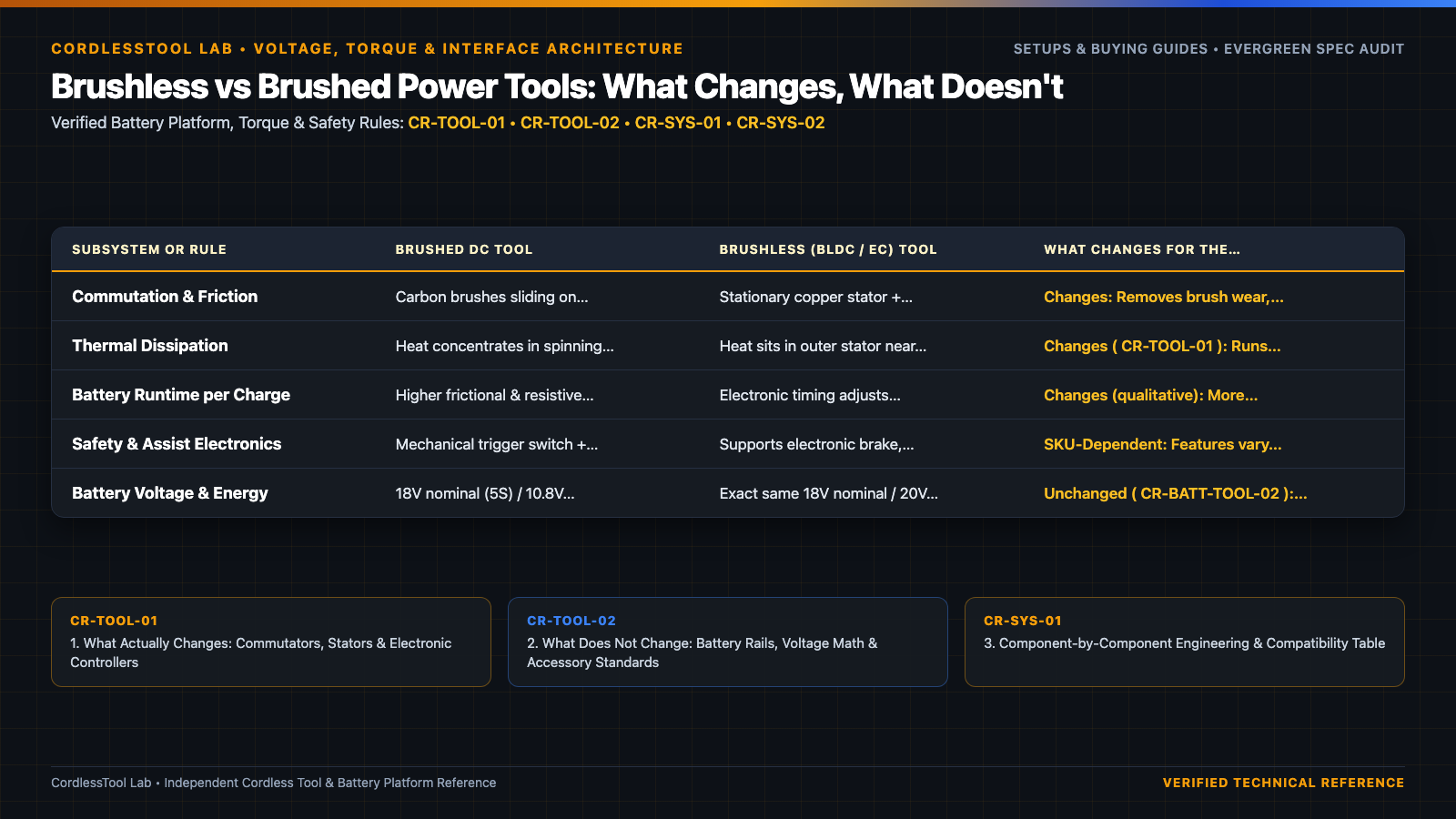
3. Component-by-Component Engineering & Compatibility Table
The matrix below separates verified mechanical and electronic changes from platform invariants across brushed and brushless cordless tools.
| Subsystem or Rule | Brushed DC Tool | Brushless (BLDC / EC) Tool | What Changes for the Buyer? |
|---|---|---|---|
| Commutation & Friction | Carbon brushes sliding on segmented copper commutator | Stationary copper stator + magnet rotor + MOSFET ESC | Changes: Removes brush wear, commutator arcing, and sliding drag. |
| Thermal Dissipation | Heat concentrates in spinning inner armature coils | Heat sits in outer stator near vents and gearcase | Changes (CR-TOOL-01): Runs cooler during sustained heavy cutting or grinding. |
| Battery Runtime per Charge | Higher frictional & resistive losses under load | Electronic timing adjusts current to load demand | Changes (qualitative): More work per charge on the same pack capacity. |
| Safety & Assist Electronics | Mechanical trigger switch + basic cutoff | Supports electronic brake, speed modes & kickback control | SKU-Dependent: Features vary by exact model and tier (CR-GRD-01, CR-DRV-04). |
| Battery Voltage & Energy | 18V nominal (5S) / 10.8V nominal (3S) | Exact same 18V nominal / 20V MAX or 10.8V/12V | Unchanged (CR-BATT-TOOL-02): Brushless never increases pack voltage or Wh. |
| Same-Family Pack Fitment | Fits brand OEM slide or pod packs | Fits the same OEM packs (high-output pairs best on heavy tools) | Unchanged (CR-BATT-TOOL-12): Existing OEM packs lock onto brushless tools. |
| Cross-Brand / Sibling Fit | Locked to brand rail & voltage family | Locked to brand rail & voltage family | Unchanged (CR-BATT-TOOL-01, -03): No cross-brand interchange. |
| Upfront Kit Budget Tier | Common in TIER-ENTRY (<$100) & TIER-STARTER | Spans TIER-STARTER through TIER-PRO / TIER-FLEET | Changes: Brushed lowers entry cost; brushless adds cost for controller PCB. |
4. Where Brushless Matters Most (High-Draw Saws, Grinders & Torque Scaling)
Not every tool category rewards a brushless motor equally. Duty cycle and continuous electrical draw dictate how quickly a brushed motor heats up and drops efficiency:
- Low-to-moderate intermittent tools (
JOB-LIGHT-DIY): Driving drywall screws, assembling flat-pack furniture, or drilling 1/8-inch pilot holes in pine pulls modest current for a few seconds at a time. A brushed drill/driver or compact brushless driver handles these tasks cleanly without thermal strain. - High-draw continuous cutting & grinding tools: A 7-1/4-inch (184 mm) circular saw ripping damp 2× framing lumber, a reciprocating saw plunging through nail-embedded framing, an angle grinder cutting steel bar, or an
SDS-plusrotary hammer boring anchors draws sustained high amperage. Here, brushless stator cooling and electronic current control prevent rapid heat soak and premature thermal shutdowns. - High-output battery pairing still governs peak output (
CR-BATT-TOOL-08,CR-BATT-TOOL-09): A brushless motor cannot pull high current out of an undersized single-row compact battery pack. Dropping a 1.5Ah or 2.0Ah compact pack onto a high-draw brushless circular saw or grinder creates voltage sag and early low-voltage cutout. Furthermore, manufacturers tie flagship torque ratings to specific battery tiers: Milwaukee rates its M18 FUEL29671/2-inch high-torque impact wrench at1,100 ft-lbsfastening and1,500 ft-lbsnut-busting with an M18XC5.0pack, versus1,200 ft-lbsfastening and1,600 ft-lbsnut-busting with aREDLITHIUM FORGEpack.
5. Combo-Kit Tiering Traps, Generations & Repairability Trade-Offs
Because “brushless” sells tools, retail combo kits often obscure what tier of brushless tool—or mixed brushed tool—sits inside the box. Before checking out in our best cordless combo kit under $500 guide, audit three marketplace realities:
- Combo-kit tier splitting (
CR-SYS-07): Entry and mid-priced combo kits frequently pair batteries with compact or entry-grade drills rather than the brand’s flagship model. For example, a DeWaltDCK240C2orDCK277D2starter combo kit inTIER-STARTER($100–$250) delivers compact or entry brushless/brushed duty—not the 3-speedDCD1007XR hammer drill (2,100 in-lbsmax brake torque,1,530 MWO,4.1 lb/1.86 kgbare) withANTI-ROTATION. Always check individual tool model numbers inside multi-tool kits, because large 6- to 10-tool sets sometimes mix brushless core drivers with brushed secondary saws or lights. - Model-generation drift (
CR-TOOL-02,G-17): Older-generation tools remain for sale alongside current releases under near-identical listing titles. Check exact SKU digits: Milwaukee’s Gen 4 M18 FUEL2904hammer drill (1,400 in-lbs,0–500 / 0–2,100 rpm,6.95 in/177 mm,3.3 lb/1.5 kgbare) superseded the Gen 32804, yet older kits still circulate online. Conversely, do not assume a newer model automatically posts a higher peak spec sheet figure: Makita’s 40V max XGTGDT02impact driver is rated at1,860 in-lbs(Makita method), lower than its predecessorGDT01at1,950 in-lbs. - Bare-tool vs. kit cost math (
CR-SYS-01,CR-SYS-02): Bare-tool listings (such as DeWalt-B, Milwaukee-20, or Makita-Z) are tool-only listings: battery and charger sold separately. If you do not yet own a compatible pack and 120V AC charger, buying a bare brushless tool plus an OEM starter pack often costs more than a matched combo kit. Always verify the exact variation’s “What’s in the box” contents rather than trusting thumbnail photos. - Long-term repairability trade-off: On older serviceable brushed tools, replacing a worn pair of carbon brushes is an inexpensive maintenance job. On brushless tools, the motor stator rarely fails, but the potted electronic control module (trigger + ESC + battery terminals) is typically replaced as a single sealed assembly whose part cost can rival a bare replacement tool once out of warranty.
6. Five Brushless Myths, Third-Party Adapters & Counterfeit Pack Risks
Buyer Protection Alert — Myths, Adapters & Non-OEM Batteries (G-25, CR-BATT-TOOL-10, CR-SYS-03):
- Myth 1 — “Brushless automatically means 2x runtime or stronger torque”: Under
CR-TOOL-01, brushless motors run cooler and extract more work per charge, but no universal percentage applies across all tools and loads. Rated torque also depends on gearbox reduction and battery pack class—never assume any entry brushless drill beats every brushed tool on raw stall torque without verified specs. - Myth 2 — “20V MAX brushless tools beat 18V brushless tools”: Both use 5S lithium-ion chemistry at 18V nominal (
CR-BATT-TOOL-02). Choose based on ergonomics, gearbox durability, and platform breadth—never the “20V” vs. “18V” integer. - Myth 3 — “Every brushless tool includes kickback control and an electric brake”: Electronic commutation makes features like DeWalt
ANTI-ROTATION, MilwaukeeAutoStop, or rapid wheel brakes possible, but brands omit them on many budget brushless SKUs. Confirm safety features model by model (CR-GRD-01,CR-DRV-04). - Myth 4 — “Cross-brand battery adapters safely run brushless tools across brands”: Third-party cross-brand adapters and Power-Wheels-style tap adapters are excluded from CordlessTool Lab recommendations (
CR-BATT-TOOL-10,G-25). Passive plastic adapters frequently omit brand-specific thermistor and low-voltage communication pins between the battery BMS and the brushless tool controller, creating cell over-discharge and thermal hazards while giving manufacturers grounds to deny warranty claims. - Myth 5 — “Third-party high-Ah replacement packs perform like OEM high-output packs”: Unbranded “replacement” batteries claiming 9.0Ah, 12.0Ah, or 15.0Ah at bargain prices often lack genuine high-discharge cells, thermal protection circuits, and recognized safety listings (
CR-SYS-03,G-25). Pair OEM brushless tools strictly with OEM batteries sold by the brand, Amazon directly, or an authorized dealer.
7. YMYL Tool Safety, CPSC Recalls & Amazon US Channel Warranties
Electronic motor control does not replace mechanical tool discipline or manufacturer safety procedures (G-24). For every cordless tool—brushed or brushless—follow the manufacturer’s instructions first:
- Guards, brakes & accessories: Keep Type 27 grinding guards and Type 1 cut-off guards installed for the matching wheel on angle grinders; never remove a circular saw lower guard or riving knife; verify chain brake function on chainsaws; fit the auxiliary side handle for large-bore drilling or rotary hammering (
CR-DRV-04); and wear eye, hearing, and dust PPE as the manual specifies. - Battery charging & thermal lockouts (
CR-BATT-05): Never tamper with or override a battery pack’s thermal cutoff, and never charge swollen, cracked, or water-damaged packs. If a charger pauses and blinks due to hot or cold pack temperatures, let the battery reach room temperature as the manual instructs and follow local lithium-ion recycling rules for damaged packs. - Open & mitigated CPSC safety recalls (
CR-SYS-06,G-12): Brushless motors never exempt a tool from mechanical recalls. For example, Milwaukee recalled its M18 FUEL top-handle chainsaws (2826-20,2826-20C,2826-20T,2826-21T, and2826-22T, announced October 2025) because the chain brake may not stop the chain when engaged—owners with a fourth serial character “A” must stop using the saw immediately and contact Milwaukee for a free recall repair (“B” units are unaffected). Similarly, Makita issued a September 2025 CPSC recall on cordless grease gun hoses that can develop a hole and eject grease, offering a free replacement hose. Always check CPSC.gov/Recalls by exact model and serial number before buying secondhand or operating stored equipment. - US warranty & third-party Amazon reseller caveats (
CR-SYS-05,G-26): On Amazon US, verify who actually sells and ships the listing. Milwaukee Tool restricts factory warranty coverage (5 years on M18 tools, 3 years on XC/HIGH OUTPUT/FORGE packs, 2 years on CP packs) to original purchasers buying from an authorized distributor—many third-party Amazon resellers are not authorized, which can leave claims tied to manufacture-date codes or declined. Meanwhile, Ryobi ONE+/40V and Ridgid 18V are Home Depot retail-exclusive brands in the US; Amazon offers for Ryobi or Ridgid come from unauthorized third-party, bulk-packaged, or reconditioned resellers, and Ridgid’s Lifetime Service Agreement (LSA) requires registration after buying from an authorized retailer (excluding third-party Amazon bulk listings).
8. Verified OEM Brushless Reference Kits & Bare-Tool Examples
To illustrate how brushless architecture scales across compact DIY bundles, multi-tool sets, high-draw bare saws, and high-voltage trade kits, the four verified Amazon US OEM listings below pass all platform, safety, and seller checks (CR-SYS-03, G-25). Remember that tool-only listings exclude batteries and chargers (CR-SYS-01).
1. Makita CX203SYB 18V LXT Sub-Compact Brushless 2-Pc. Combo Kit
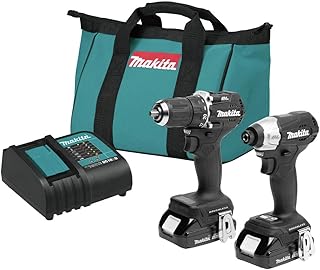
Platform Spec: STD-BATT-MAKITA-LXT-18V | 18V Nominal | Brushless Sub-Compact Drill & 1/4-Inch Hex Impact Driver | Includes (2) 1.5Ah Packs (27 Wh Each) & Charger | Price Tier: TIER-STARTER
The Makita CX203SYB shows why brushless design shines in compact, overhead, and cabinetry work without chasing heavy flagship bulk. Both tools use brushless motors on Makita’s 18V nominal LXT slide rail while pairing with lightweight 1.5Ah (27 Wh) packs for tight stud bays and ladder work (CR-BATT-TOOL-11). Because 1.5Ah compact packs are tuned for light fastening rather than continuous heavy cutting, plan to add higher-capacity 4.0Ah or 5.0Ah LXT packs later if you expand into circular saws or grinders (CR-BATT-TOOL-08). Remember that LXT batteries never fit Makita’s 40V max XGT tools (CR-BATT-TOOL-03).
2. DEWALT 20V MAX 3-Tool Brushless Power Tool Set (DCK360D3)

Platform Spec: STD-BATT-DEWALT-20V-MAX | 18V Nominal (20V MAX Label) | Brushless 1/2-Inch Drill, 1/4-Inch Hex Impact Driver & Oscillating Multi-Tool | Includes 3 Batteries & Charger | Price Tier: TIER-DIY
DeWalt’s DCK360D3 bundles three core remodeling tools—a 1/2-inch brushless drill, a 1/4-inch hex brushless impact driver (use 1/4-inch hex impact-rated bits per CR-ACC-DRV-01 and -02), and a brushless oscillating multi-tool (verify open-back vs. adapter interface per CR-ACC-SAW-06)—on the 18V nominal 20V MAX rail. It is also a clean example of rule CR-SYS-07: entry brushless combo sets lower upfront cost into TIER-DIY compared to buying individual flagship XR tools, and you can upgrade selectively to bare XR saws or FLEXVOLT-compatible packs on the exact same slide rail later (CR-BATT-TOOL-04, CR-BATT-TOOL-12).
3. DEWALT 20V MAX XR Brushless 7-1/4 in. Circular Saw, Tool Only (DCS590B)

Platform Spec: STD-BATT-DEWALT-20V-MAX | 18V Nominal (20V MAX Label) | Brushless High-Draw 7-1/4 in. (184 mm) Circular Saw | Tool-only listing: battery and charger sold separately | Price Tier: TIER-SAW-MID
A full-size 7-1/4-inch circular saw is where upgrading from brushed to brushless makes the clearest day-to-day thermal and cut-capacity difference. The DeWalt XR DCS590B pairs brushless electronic drive control with a 5/8-inch arbor blade interface (verify blade max rpm ≥ saw no-load rpm and use only wood-cutting blades listed in the manual per CR-ACC-SAW-01..03 and -07). Note rule CR-SYS-01: this -B SKU is a bare tool—if you do not already own 20V MAX 5.0Ah+ or XR POWERSTACK/FLEXVOLT packs and a charger, step up to the kit variation instead of running an undersized 1.5Ah–2.0Ah starter pack (CR-BATT-TOOL-08).
4. Makita 40V Max XGT Brushless 2-Pc. Combo Kit (GT200D)

Platform Spec: STD-BATT-MAKITA-XGT-40V | 36V Nominal (40V max XGT Label) | Brushless Hammer Driver-Drill & Impact Driver | Includes XGT Batteries & Charger | Price Tier: TIER-PROSUMER
For tradespeople stepping beyond 18V nominal systems into a higher-voltage brushless architecture, the Makita GT200D 40V max XGT kit demonstrates how brushless electronics pair with 10-cell (36V nominal) packs. Its hammer driver-drill (GPH01 class: rated 1,250 in-lbs Makita method, 0–650 / 0–2,600 rpm, 0–9,750 / 0–39,000 bpm) and 4-speed impact driver (GDT01 class: rated 1,950 in-lbs Makita method) deliver heavy-duty fastening without sharing batteries with 18V LXT (CR-BATT-TOOL-03). Use the auxiliary side handle as the manual directs when boring large holes (CR-DRV-04), and verify exact box pack capacities before purchase (CR-SYS-02).
9. Authoritative Non-Affiliate References
- DEWALT Official US Tool & Battery Specifications — 20V MAX (18V nominal) platform compatibility, XR vs. ATOMIC brushless specifications, and ANTI-ROTATION manual disclosures.
- Milwaukee Tool Official US Warranty & M18 Documentation — Authorized-distributor warranty eligibility, REDLITHIUM pack pairing disclosures, and M18 backward compatibility.
- Makita USA 18V LXT & 40V Max XGT Technical Documentation — Brushless Star Protection controls, nominal voltage ratings, and closed LXT/XGT family boundaries.
- OSHA Hand and Power Tools Safety Standards — Official US workplace guidance on guards, switches, and protective equipment for portable power tools.
- U.S. Consumer Product Safety Commission (CPSC) Recalls — Official recall lookup covering cordless chainsaws, outdoor equipment, grease guns, and battery packs.
How We Audited This Guide
- Workshop blueprints, upgrade roadmaps, and Amazon marketplace audits enforce single-platform battery lock-in budgets, third-party pack and adapter exclusion rules, Bare Tool trap checks, and PPE/kickback safety.
- Every cordless drill, impact driver, saw, grinder, battery pack, charger, outdoor power tool, and accessory spec was cross-checked against official OEM manuals, UL/ANSI ratings, and live Amazon US listings.
- Recommendations were evaluated against our weighted vertical scoring rubrics and 61 documented CR-* platform and safety rules; we never invent peak torque ft-lbs, cut counts, runtime minutes, or battery decibels.
10. Frequently Asked Questions
Are brushless power tools always worth the extra cost over brushed tools?
Not always. For light, occasional assembly, hanging hardware, and pilot holes in softwood, a budget brushed kit in TIER-ENTRY or TIER-STARTER works reliably. Brushless becomes clearly worth the upgrade for high-draw saws, angle grinders, rotary hammers, and frequent trade or remodeling work.
Will my older OEM brushed-tool batteries fit a new brushless tool?
Usually yes, provided both belong to the exact same OEM lithium-ion battery platform—such as DeWalt 20V MAX, Milwaukee M18, Makita 18V LXT, or Ryobi 18V ONE+ (CR-BATT-TOOL-12). Legacy NiCd/NiMH packs and different voltage families like M12 or 40V XGT do not cross-fit.
Does a brushless motor increase battery voltage or watt-hours?
No. Battery voltage and stored energy (Wh = nominal V × Ah) are fixed inside the battery pack. Both brushed and brushless 18V/20V MAX tools run at 18V nominal; brushless motors simply convert that stored energy with less friction and commutator waste heat.
Can a brushless tool fail differently than a brushed tool?
Yes. Brushed tools eventually wear down replaceable carbon brushes and commutators. Brushless tools eliminate brush wear, but if the encapsulated electronic controller board fails out of warranty, replacing the integrated electronics assembly often costs nearly as much as a bare-tool replacement.
Why do some brushless circular saws still shut down on compact batteries?
High-draw brushless saws pull heavy amperage during deep cuts, which causes voltage sag in small 1.5Ah or 2.0Ah single-row packs and triggers low-voltage or thermal protection (CR-BATT-TOOL-08). Pairing high-draw brushless tools with high-output OEM packs prevents premature cutouts.
Have a specific brushed-to-brushless platform transition question? Review our editorial standards on About CordlessTool Lab or reach the analyst desk via Contact Us.


