
Disclosure: As an Amazon Associate, CordlessTool Lab earns from qualifying purchases. If you buy through links on this page, we may earn a small commission at no extra cost to you. Commission rates (typically 3% in Tools & Home Improvement; verify Lawn & Garden category schedules per ASIN) never alter our engineering analysis or hardware recommendations.
Sorting out leaf blower cfm vs mph is the fastest way to avoid buying a cordless yard blower that looks strong on a retail carton yet stalls on damp oak leaves or drains its battery in minutes. Manufacturers print two headline ratings—CFM (cubic feet per minute) and MPH (miles per hour)—while tucking the crucial nozzle attachment, Turbo boost mode, and battery pack assumptions into fine print. Whether you are building a multi-tool outdoor kit from our best battery powered yard tools guide or evaluating picks inside our audited cordless leaf blower lineup, reading those two numbers together—and matching them to battery watt-hours—determines what actually moves across your lawn.
Quick Answer — CFM vs. MPH: Which Rating Matters More?
CFM measures air volume (how wide and deep a pile of leaves you can push), while MPH measures exit airspeed (how forcefully the jet lifts wet, matted debris). Neither rating works alone: compare blowers only on the same nozzle and Turbo mode (CR-OPE-01), targeting high CFM plus solid MPH for real yard clearing.
In This Guide
- 1. CFM vs. MPH Physics & Why Nozzle Geometry Changes Both Numbers
- 2. Newton Blowing Force & the ANSI/OPEI B175.2 Rating Basis
- 3. Battery Voltage, Watt-Hours & Worked Energy Examples (20V MAX vs. 56V/80V)
- 4. Blower Class, Rating Basis & Platform Compatibility Table
- 5. Five Blower Rating Myths, Same-Brand Traps & Adapter Warnings
- 6. Acoustic Limits, Manual-First PPE, CPSC Recalls & Seller Warranties
- 7. Verified OEM Blower Examples Across Four Airflow Classes
- 8. Authoritative Non-Affiliate References
- 9. Frequently Asked Questions
1. CFM vs. MPH Physics & Why Nozzle Geometry Changes Both Numbers
In fluid mechanics, leaf blower cfm vs mph describes two halves of a single airflow equation rather than competing features. CFM (cubic feet per minute) measures volumetric flow rate—the total volume of air exiting the blower tube every 60 seconds. Think of CFM as the width and weight of your broom: high-CFM axial fans move a broad column of air that sweeps dry maple leaves, pine needles, and light grass clippings across wide driveways and open turf in fewer passes.
MPH (miles per hour, or km/h) measures linear air velocity—how fast that stream travels as it leaves the nozzle opening. Think of MPH as the stiffness of the bristles or the spray setting on a garden hose: higher velocity creates sharper shear force at ground level to break wet, compacted oak leaves free from damp sod, crack joints, and gravel seams. Mathematically, airflow connects both terms through the nozzle’s cross-sectional exit area:
Volumetric Flow (CFM) = Nozzle Cross-Sectional Area (ft²) × Air Velocity (ft/min)
That single relationship explains the most common misunderstanding on blower spec sheets. When a manufacturer snaps a narrow tapered or concentrator tip onto a 3.5-inch (89 mm) or 4-inch (102 mm) axial tube, the constricted exit area forces air molecules to accelerate—spiking the headline MPH rating—while added backpressure frequently reduces open-tube CFM. Under rule CR-OPE-01, comparing one model’s open-tube CFM against a rival’s concentrator-tip MPH mixes incompatible measurement bases. Always check whether both figures were recorded in Turbo/Boost mode or continuous high mode, and note which nozzle attachment was fitted.
- Why high MPH + low CFM stalls on lawns: A compact workshop spot blower like DEWALT’s
DCE100Bproduces up to 135 MPH (217 km/h) through a narrow rubber nozzle, yet moves only 100 CFM. That concentrated jet blasts sawdust off a miter saw stand or clears porch corners effectively, but its tiny air column lacks the mass to push a carpet of yard leaves more than a few inches (CR-SYS-08). - Why tapered tips unlock higher speed on axial blowers: EGO Power+ rates its
LB5302at 530 CFM / 110 MPH (177 km/h) in Turbo mode, whereas its step-upLB6151moves 615 CFM and reaches 170 MPH (274 km/h) specifically when its tapered nozzle is attached per EGO Power+ official blower specifications. Removing that tip trades peak MPH for a wider clearing cone. - Why axial fans dominate modern cordless yard blowers: Older centrifugal (squirrel-cage) fans built high MPH inside narrow tubes at modest CFM. Modern brushless axial-turbine blowers position a straight-through impeller inside a wide barrel, moving 450 to 770+ CFM with minimal turbulence and significantly lower acoustic pitch.
2. Newton Blowing Force & the ANSI/OPEI B175.2 Rating Basis
Because chasing isolated CFM or MPH numbers led brands to quote readings taken inside the fan housing or with ultra-restrictive nozzles, outdoor equipment engineers increasingly evaluate Newton blowing force (N) alongside CFM and MPH. Rooted in the ANSI/OPEI B175.2 framework (originally authored for internal-combustion handheld and backpack blowers and widely adopted as a reference methodology across commercial cordless blowers), Newton force measures the actual horizontal thrust hitting a target plate at a fixed nozzle distance.
One Newton equals roughly 0.225 pound-force (3.6 oz / 0.10 kgf). Physically, thrust scales with air mass flow rate multiplied by exit velocity—meaning both high CFM and high MPH must be present simultaneously to generate strong pushing power:
- Dry leaves on driveways & short turf (~400–550 CFM / 110–130 MPH): Ideal for quick hardscape sweeps and dry fall leaves where moderate thrust moves light debris without scattering decorative mulch.
- Suburban wet turf & mixed debris (~600–650 CFM / 125–170 MPH): Generates noticeably higher Newton thrust, peeling damp leaves out of fescue or Bermuda grass while maintaining manageable ~7.5 lb to 8.5 lb (3.4 kg to 3.9 kg) operating weight.
- Heavy matted oak leaves & wide windrows (~700–770+ CFM / 170–180+ MPH): Delivers top-tier handheld axial thrust for half-acre to multi-acre cleanups, though higher current draw demands large-capacity battery packs to sustain Turbo passes.
Just as important is how manufacturers frame gas comparisons. Under rule CR-OPE-02, marketing badges such as “27cc gas-equivalent” or “more power than gas” are strictly the manufacturer’s internal claim—not an audited universal standard. The same measurement discipline applies across every cordless tool category: under CR-DRV-02 and G-15, brands measure drill and impact torque using different bench procedures (in-lbs at 12 in-lbs = 1 ft-lb, ft-lbs, Nm, or DeWalt’s UWO/MWO), and under G-03 / CR-BATT-TOOL-09, peak ratings always assume a specific reference battery pack (for example, Milwaukee rates its 2967 impact wrench at 1,100 ft-lbs / 1,491 Nm fastening with an XC5.0 pack vs. 1,200 ft-lbs / 1,627 Nm with an M18 FORGE pack). Never compare numbers across brands without confirming identical rating methods, nozzles, and batteries.
3. Battery Voltage, Watt-Hours & Worked Energy Examples (20V MAX vs. 56V/80V)
Sustaining 500 to 770 CFM on an axial brushless motor makes a leaf blower one of the highest continuous-draw tools in any cordless ecosystem. Unlike an impact driver that pulses for two seconds per fastener, a blower draws steady high amperage whenever the trigger or cruise lever is locked open—and Turbo mode pushes current draw to its ceiling (CR-BATT-OPE-01). To compare battery reserves fairly across 18V, 20V MAX, 40V, 56V, 60V, and 80V blowers, convert amp-hours (Ah) into nominal watt-hours (Wh):
Stored Energy (Wh, nominal) = Nominal Pack Voltage (V) × Capacity (Ah)
- Worked Example 1 — 20V MAX = 18V Nominal Parity (
CR-BATT-TOOL-02,CR-BATT-TOOL-08): Many buyers assume a “20V MAX” blower automatically beats an “18V” blower. In reality, DeWalt 20V MAX, Milwaukee M18, Makita 18V LXT, Ryobi 18V ONE+, and Craftsman V20 all wire five lithium-ion cells in series (5S × 3.6V = 18V nominal); “20V MAX” simply reflects peak unloaded voltage fresh off the charger. Pairing a DeWaltDCBL722B(450 CFM / 125 MPH) with a standard5.0Ahpack gives18V × 5.0Ah = 90 Whnominal. Slipping a compact2.0Ahdrill battery onto that same blower yields only18V × 2.0Ah = 36 Whacross a single parallel cell string (5S1P)—which depletes rapidly and risks early voltage-sag cutoff under continuous axial load. - Worked Example 2 — High-Voltage OPE Reserve Sizing (56V vs. 60V vs. 80V): Higher-voltage outdoor packs stack more cells in series to reduce current (amperes) for a given wattage output, limiting heat buildup inside the motor and pack. An EGO 56V
2.5Ahstarter pack (50.4V nominal × 2.5Ah) stores 126 Wh nominal (140 Wh on EGO’s 56V max-label basis). A Greenworks 60V2.5Ahpack (54V nominal × 2.5Ah) stores 135 Wh nominal (150 Wh label basis), while Greenworks’ 80V4.0Ahpack (72V nominal × 4.0Ah) stores 288 Wh nominal (320 Wh label basis)—more than triple the nominal energy of an 18V 5.0Ah pack. - Why Turbo runtime shrinks so dramatically (
G-01,CR-BATT-OPE-01): Never convert watt-hours into guessed minutes of runtime. Only quote maker-stated figures with the mode and battery explicitly named: for instance, EGO rates itsLB5302(530 CFM) with the included2.5Ahpack at up to 75 minutes on low speed (250 CFM), dropping to roughly 22 minutes on high and approximately 10 minutes in continuous 530 CFM Turbo. Reserving Turbo bursts for wet corners while locking the variable dial at 300–450 CFM stretches yard coverage dramatically.
Note also that battery packs above 100 Wh—including 6.0Ah+ 18V/20V packs (108 Wh+ nominal) as well as 56V 2.5Ah (126 Wh nominal) and 80V 4.0Ah (288 Wh nominal) OPE packs—exceed the standard FAA airline carry-on limit. Always verify current FAA PackSafe lithium battery regulations before flying with or shipping large yard packs.
4. Blower Class, Rating Basis & Platform Compatibility Table
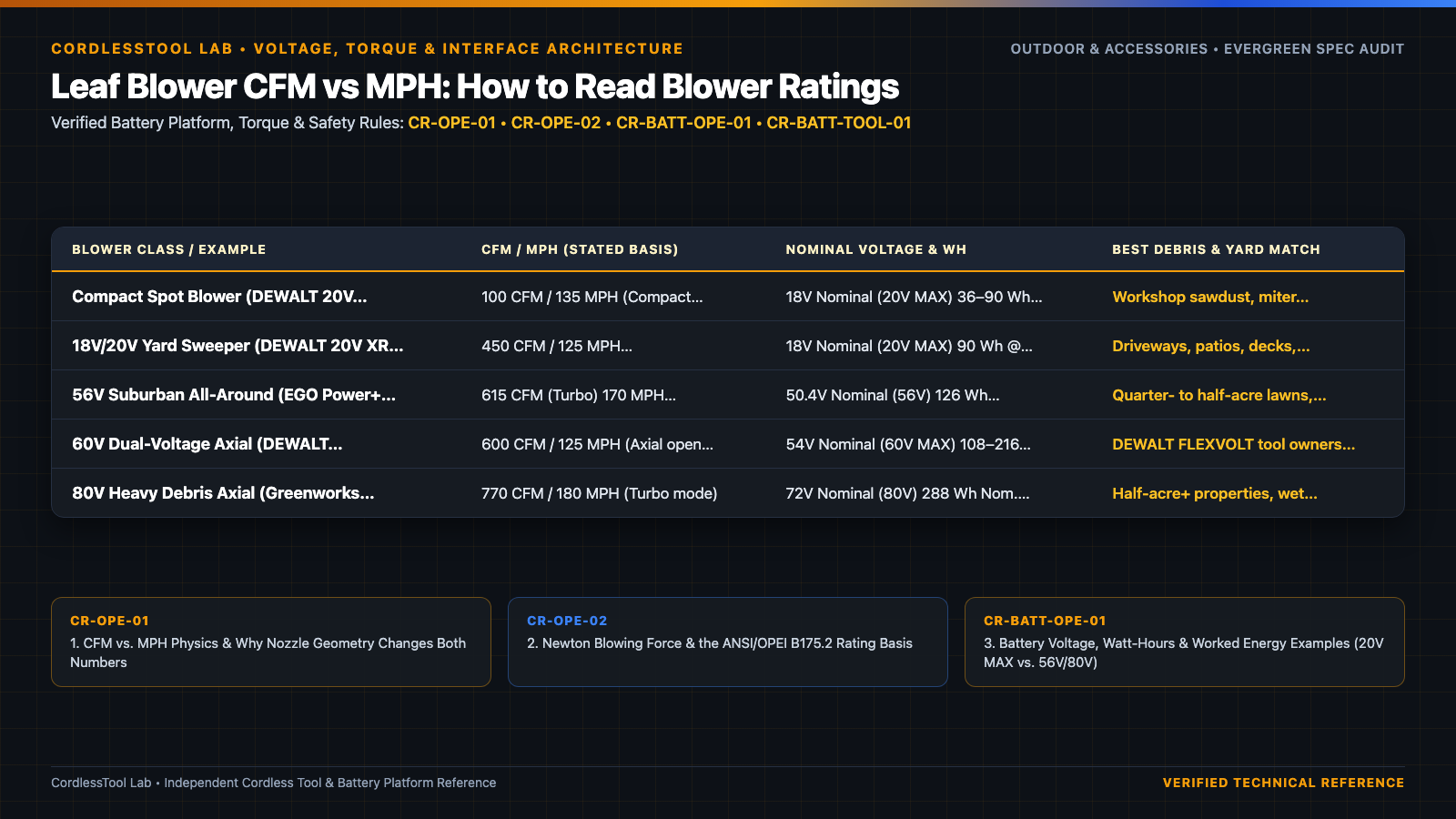
Before comparing spec sheets or shopping tool-only deals, map your airflow needs against battery voltage family, kit contents, and hard cross-compatibility rules. The engineering diagram and reference table below organize every major cordless blower tier.
| Blower Class / Example | CFM / MPH (Stated Basis) | Nominal Voltage & Wh | Best Debris & Yard Match | Incompatible or Risky Caveat |
|---|---|---|---|---|
| Compact Spot Blower (DEWALT 20V DCE100B) | 100 CFM / 135 MPH (Compact spot nozzle) | 18V Nominal (20V MAX) 36–90 Wh (2.0–5.0Ah) | Workshop sawdust, miter stands, truck beds, tight porch corners | Too low in CFM volume for lawn leaves (CR-SYS-08). Tool-only listing: battery and charger sold separately (CR-SYS-01). |
| 18V/20V Yard Sweeper (DEWALT 20V XR DCBL722B) | 450 CFM / 125 MPH (Concentrator nozzle) | 18V Nominal (20V MAX) 90 Wh @ 5.0Ah | Driveways, patios, decks, light dry leaves for existing 20V owners | Avoid compact 2.0Ah packs under continuous load (CR-BATT-TOOL-08). Bare tool excludes pack & charger; Craftsman V20 never fits (CR-BATT-TOOL-01). |
| 56V Suburban All-Around (EGO Power+ LB6151 Kit) | 615 CFM (Turbo) 170 MPH (Tapered tip) | 50.4V Nominal (56V) 126 Wh Nom. (2.5Ah Kit) | Quarter- to half-acre lawns, damp leaves, HOA-quiet 63 dB(A) clearing | Dedicated 56V ARC Lithium rail does not share packs with 18V/20V indoor tools (CR-SYS-04); continuous Turbo empties 2.5Ah quickly. |
| 60V Dual-Voltage Axial (DEWALT DCBL772B) | 600 CFM / 125 MPH (Axial open tube) | 54V Nominal (60V MAX) 108–216 Wh (FLEXVOLT) | DEWALT FLEXVOLT tool owners clearing open lawns without extra chargers | Standard 20V MAX packs will NOT power 60V tools (CR-BATT-TOOL-05), though FLEXVOLT packs run 20V tools (CR-BATT-TOOL-04). |
| 80V Heavy Debris Axial (Greenworks 80V 770 Kit) | 770 CFM / 180 MPH (Turbo mode) | 72V Nominal (80V) 288 Wh Nom. (4.0Ah Kit) | Half-acre+ properties, wet matted oak leaves, heavy turf windrows | Greenworks 80V packs do NOT fit Greenworks 40V or 60V tools (CR-BATT-TOOL-03); heavy pack raises tail weight (CR-BATT-TOOL-11). |
| Makita 36V X2 vs. 40V XGT (Dual-Bay vs. Single XGT) | Varies by SKU & nozzle (Compare Turbo vs. Turbo) | 36V Nom. (2×18V LXT) or 36V Nom. (10S XGT) | LXT shop owners stepping up via X2 vs. pro crews adopting XGT | Dual-battery 36V X2 blowers require both LXT bays filled (CR-BATT-TOOL-06). LXT and XGT packs never cross-fit (CR-BATT-TOOL-03). |
5. Five Blower Rating Myths, Same-Brand Traps & Adapter Warnings
Myth vs. Engineering Reality — Blower Ratings, Voltage Badges & Third-Party Workarounds
Before buying a cordless blower or spare battery online, separate verified aerodynamic and electrical rules from packaging hype (CR-OPE-01, CR-BATT-TOOL-03, CR-BATT-TOOL-10, G-25).
- Myth 1: “Higher MPH always beats higher CFM.” Engineering reality: High MPH without sufficient CFM creates a thin needle of air that peels small patches but cannot herd broad leaf piles across grass. Compare DEWALT’s
DCE100B(135 MPH / 100 CFM) against theDCBL722B(125 MPH / 450 CFM)—even though the compact blower has a higher MPH number, the 450 CFM axial unit clears driveways and lawns many times faster. - Myth 2: “Box CFM and MPH numbers from any two brands are directly comparable.” Engineering reality: Under rule
CR-OPE-01, nozzle shape and operating mode shift readings dramatically. One brand may quote open-tube CFM alongside tapered-tip MPH, while another quotes Turbo peaks that drain a small battery in under 10 minutes (CR-BATT-OPE-01). Match nozzle style and power mode before comparing models. - Myth 3: “A 20V MAX leaf blower has an electrical advantage over an 18V blower.” Engineering reality: Both 20V MAX and 18V cordless systems run five lithium-ion cells in series at 18V nominal (
CR-BATT-TOOL-02). Real blower thrust comes from impeller geometry, brushless motor efficiency, and low-impedance cell packs—not the integer on the battery decal. - Myth 4: “Staying inside the same brand means all yard and shop batteries interchange.” Engineering reality: Under
CR-BATT-TOOL-03, same-brand voltage families stay locked apart unless an explicit dual-voltage exception exists. Ryobi 18V ONE+ batteries never fit Ryobi 40V blowers; Greenworks 24V, 40V, 60V, and 80V packs never cross-fit; DeWalt 20V MAX packs never run 60V FLEXVOLT blowers (CR-BATT-TOOL-05), and Craftsman V20 batteries never fit DeWalt 20V MAX rails despite shared parent ownership (CR-BATT-TOOL-01). - Myth 5: “Third-party cross-brand battery adapters or generic replacement packs safely bypass platform lock-in.” Engineering reality: Neither OEM approves cross-brand battery adapters or Power Wheels-style voltage taps (
CR-BATT-TOOL-10). Passive plastic adapters bridge only positive and negative terminals, severing proprietary BMS thermistor and low-voltage cutoff communication—risking cell over-discharge, thermal stress, and refused warranty service. Likewise, unbranded Amazon “replacement for” packs routinely exaggerate capacity and lack verified OEM protection circuitry (CR-SYS-03). CordlessTool Lab excludes all non-OEM replacement batteries and cross-brand adapters from buying recommendations (G-25).
6. Acoustic Limits, Manual-First PPE, CPSC Recalls & Seller Warranties
Although cordless axial blowers eliminate two-stroke exhaust fumes and pull-cord recoil, high-velocity air jets still propel gravel, mulch, twigs, and fine dust while generating substantial ear-level sound pressure. Follow the manufacturer’s instruction manual first for nozzle assembly, debris clearing, charger temperature windows (CR-BATT-05), and guard/intake care, and wear ANSI-rated eye protection, hearing protection, closed-toe footwear, and dust masks as the manual specifies (G-24):
- Distance dB(A) ratings vs. NIOSH 85 dBA ear exposure: Manufacturers typically report blower sound pressure (such as 63 dB(A) on the EGO
LB6151or 62–66 dB(A) on the DEWALTDCBL722B) measured at distance under residential ordinance protocols—often 50 feet away. At the operator’s ear, sound levels sit markedly higher (for context, compact blowers like DEWALT’sDCE100Blist up to 96 dB(A) acoustic power, and gas blowers reach 95–106 dBA at the ear per NIOSH/CDC occupational noise standards). Because NIOSH sets 85 dBA over 8 hours as the hazardous threshold—and every 3 dBA increase halves safe unprotected exposure time—wear earplugs or earmuffs whenever operating high-output blowers in Turbo mode or enclosed spaces. - Battery charging & thermal protection rules: Never bypass charger thermal lockouts or attempt to force a swollen, cracked, or water-damaged lithium-ion pack onto a charger. If a charger signals a hot/cold pack delay, follow the OEM manual’s rest interval until the pack returns to room temperature, and dispose of damaged packs through municipal or retail battery-recycling programs.
- Third-party seller & retail-exclusive warranty rules (
CR-SYS-05,G-26): On Amazon US, Ryobi (ONE+ / 40V) and Ridgid (18V) are retail-exclusive brands distributed primarily through The Home Depot; marketplace listings from unauthorized third-party resellers frequently void manufacturer warranty eligibility and fail Ridgid’s Lifetime Service Agreement (LSA) registration rules. Milwaukee M18 and M12 listings on Amazon US are also heavily populated by unauthorized resellers—always confirm authorized distributor status on the brand’s US warranty portal and retain your receipt. - Active CPSC outdoor recall checks (
CR-SYS-06,G-12): Before buying older stock or secondhand outdoor gear, screen model and serial numbers on the U.S. CPSC Product Safety Recalls database. Key outdoor notices include: (1) the July 9, 2026 CPSC Recall #26-611 covering ~554,780 Kobalt 24V and 48V yard tools with USB-C batteries manufactured by Greenworks Tools (fire hazard when charging via USB-C while inserted in the tool; free replacement remedy); (2) SKIL 40V and DR Power 62V outdoor battery pack recalls; (3) the Ryobi 40V 24-inch hedge trimmer recall; and (4) the Milwaukee 2826-20 M18 FUEL top-handle chainsaw chain-brake recall. Stop using any affected unit immediately and follow the official manufacturer remedy.
7. Verified OEM Blower Examples Across Four Airflow Classes
The four verified Amazon US OEM listings below illustrate every leaf blower cfm vs mph concept explained above—spanning 100 CFM high-MPH spot tools, 450 CFM 18V-nominal bare blowers, 615 CFM tapered-nozzle 56V kits, and 770 CFM high-watt-hour 80V flagships. All four are genuine OEM listings (zero third-party batteries or cross-brand adapters per G-25), with bare-tool requirements and tier bands clearly labeled (CR-SYS-01, G-08).
1. EGO Power+ LB6151 56V 615 CFM Cordless Leaf Blower Kit (2.5Ah)

Platform & Airflow Spec: STD-BATT-EGO-56V (50.4V nominal) | Up to 615 CFM (Turbo) / 200–480 CFM (Variable Dial) | Up to 170 MPH (with tapered nozzle) | 63 dB(A) Rated | Kit with 1x 56V 2.5Ah Battery (126 Wh nominal / 140 Wh label) & 210W Charger | Price Tier: TIER-OPE-MID
The LB6151 demonstrates how a tapered nozzle elevates real-world lawn performance: it pairs 615 CFM of Turbo air mass with 170 MPH exit velocity when the tapered tip is fitted, giving suburban homeowners enough shear to peel damp maple leaves off turf at a neighbor-friendly 63 dB(A) rated floor. Remember that continuous Turbo empties the included 2.5Ah pack quickly (CR-BATT-OPE-01)—use the 200–480 CFM lock-on dial for dry hardscapes—and note that EGO 56V batteries remain isolated from 18V/20V indoor tool platforms (CR-SYS-04).
2. Greenworks 80V 770 CFM Brushless Leaf Blower Kit (4.0Ah)
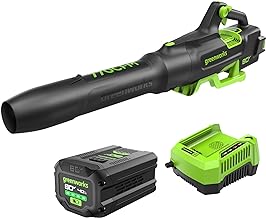
Platform & Airflow Spec: STD-BATT-GREENWORKS-80V (72V nominal) | Up to 770 CFM (Turbo) | Up to 180 MPH (Turbo) | Kit with 1x 80V 4.0Ah Battery (288 Wh nominal) & Rapid Charger | Price Tier: TIER-OPE-MID
When heavy wet oak leaves demand maximum Newton thrust, the Greenworks 80V BL80L414 kit combines 770 CFM air volume and 180 MPH airspeed in Turbo mode, backed by a generous 288 Wh nominal 4.0Ah battery and rapid charger. Under CR-OPE-02, treat Greenworks’ ~27cc gas-equivalent phrasing strictly as a maker comparison, and watch the same-brand voltage boundary (CR-BATT-TOOL-03): 80V packs will not interchange with Greenworks 40V or 60V yard tools, and the larger battery adds noticeable rear weight (CR-BATT-TOOL-11).
3. DEWALT 20V MAX XR DCBL722B 450 CFM Leaf Blower (Tool Only)

Platform & Airflow Spec: STD-BATT-DEWALT-20V-MAX (18V nominal) | Up to 450 CFM | Up to 125 MPH (with concentrator nozzle) | 66 dB(A) Rated | Tool-only listing: battery and charger sold separately | Price Tier: TIER-OPE-VALUE
For homeowners who already own DEWALT 20V MAX (18V nominal) drills and saws, the DEWALT DCBL722B delivers 450 CFM and 125 MPH with its concentrator nozzle attached—sufficient for driveways, patios, and light dry lawn sweeps without adding a separate yard battery ecosystem. Because this is a tool-only listing: battery and charger sold separately (CR-SYS-01), pair it with 5.0Ah (90 Wh nominal) or larger packs rather than 2.0Ah compact batteries (CR-BATT-TOOL-08), and confirm you do not confuse it with DeWalt’s 60V FLEXVOLT DCBL772B (which rejects 20V-only packs under CR-BATT-TOOL-05).
4. DEWALT 20V MAX DCE100B 100 CFM Compact Jobsite Blower (Tool Only)

Platform & Airflow Spec: STD-BATT-DEWALT-20V-MAX (18V nominal) | 100 CFM | Up to 135 MPH | ~2.5 lb (1.13 kg) bare | Tool-only listing: battery and charger sold separately | Price Tier: TIER-OPE-VALUE
The DCE100B is the clearest proof of why buyers must never shop by MPH alone. Although its 135 MPH spot-nozzle airspeed beats the 125 MPH rating on DEWALT’s larger DCBL722B, its tiny 100 CFM air volume restricts it to workbenches, miter saw dust, truck beds, and tight porch corners rather than lawn leaf clearing (CR-SYS-08). Note that this is a tool-only listing: battery and charger sold separately (CR-SYS-01), and wear hearing and eye protection as the manual specifies given its high-pitched 96 dB(A) acoustic output (G-24).
8. Authoritative Non-Affiliate References
For further technical verification from our CordlessTool Lab editorial team, consult these primary manufacturer, safety, and federal regulatory sources:
- EGO Power+ Official Leaf Blowers & 56V Specifications — LB6151 615 CFM / 170 MPH tapered-nozzle rating basis, LB5302 variable-speed runtime disclosures, and 56V ARC Lithium compatibility.
- DEWALT DCBL722B 20V MAX XR Official Product Sheet — 450 CFM / 125 MPH concentrator-nozzle basis, 66 dB(A) sound rating, and 18V nominal bare-tool configuration.
- NIOSH / CDC Noise and Occupational Hearing Loss Guidance — Official 85 dBA 8-hour Recommended Exposure Limit and 3 dBA exchange rate for power-tool hearing protection.
- FAA PackSafe Lithium-Ion Battery Rules — Official 100 Wh carry-on threshold affecting high-capacity 56V, 60V, and 80V OPE battery packs.
- U.S. Consumer Product Safety Commission (CPSC) Recalls Portal — Federal lookup for outdoor power equipment and lithium-ion battery recalls, including Recall #26-611.
How We Audited This Guide
- Outdoor power equipment and tool accessories were verified across battery Ah runtime fit, string trimmer bump-feed vs. blower CFM ratings, carbide tooth geometry, Impact Rated vs. chrome socket steel, and ANSI blade guard safety.
- Every cordless drill, impact driver, saw, grinder, battery pack, charger, outdoor power tool, and accessory spec was cross-checked against official OEM manuals, UL/ANSI ratings, and live Amazon US listings.
- Recommendations were evaluated against our weighted vertical scoring rubrics and 61 documented CR-* platform and safety rules; we never invent peak torque ft-lbs, cut counts, runtime minutes, or battery decibels.
9. Frequently Asked Questions
Is CFM or MPH more important for a cordless leaf blower?
CFM governs how wide and heavy a pile of dry leaves you can move at once, while MPH governs how hard the airstream breaks wet, matted leaves free. For real lawns, prioritize 550–770 CFM paired with at least 125–180 MPH under identical Turbo and nozzle settings.
Why does attaching a concentrator nozzle increase MPH on a leaf blower?
Airflow equals nozzle area multiplied by airspeed. Narrowing the exit opening forces air to accelerate through a smaller cross-section, boosting MPH velocity for stuck debris while increasing backpressure and slightly lowering open-tube CFM—which is why comparing mismatched nozzles misleads buyers.
What is Newton blowing force on a leaf blower spec sheet?
Newton blowing force (N), standardized under the ANSI/OPEI B175.2 methodology, measures total pushing thrust hitting a target plate. Because Newtons multiply mass airflow (CFM) by exit velocity (MPH), a compact 100 CFM / 135 MPH blower produces far less thrust than a 615 CFM lawn model.
Does a 20V MAX leaf blower run stronger than an 18V leaf blower?
No. Both 20V MAX and 18V packs use five lithium-ion cells wired in series at an identical 18V nominal rating. Real clearing thrust depends on brushless motor efficiency, axial fan geometry, and higher-capacity 5.0Ah+ (90 Wh+) packs rather than the voltage sticker.
Can I use a third-party battery adapter to run my 20V drill packs on a 56V or 80V blower?
No. Cross-brand adapters cannot bridge incompatible voltage families like 18V nominal into 56V or 80V blowers, and same-voltage adapters drop OEM thermal and low-voltage BMS pins. Neither brand approves adapters, and CordlessTool Lab excludes them and non-OEM batteries entirely.


