
On This Page
Disclosure: As an Amazon Associate, I earn from qualifying purchases. If you buy through links on this page, we may earn a small commission at no extra cost to you. Commission rates (3% for Tools & Home Improvement; Lawn & Garden rates vary per ASIN) never alter our technical evaluations or platform verdicts.
Settling the battery vs gas string trimmer debate comes down to cutting load, property acreage, and battery platform lock-in rather than raw voltage badges. High-voltage cordless trimmers—such as 56V and 60V MAX brushless units running 0.095-inch dual line across 15-inch to 17-inch swaths—now match light commercial gas trimmers on routine residential edging while eliminating fuel mixing, carburetor maintenance, and recoil pull cords. Gas 2-stroke trimmers still hold a clear endurance edge on multi-acre fence lines and heavy overgrowth where a two-minute tank refill beats carrying multiple spare battery packs.
Before comparing line diameters or shaft weights, check how a trimmer fits your wider outdoor ecosystem: our cordless yard tools platform hub maps how high-voltage outdoor gear pairs—or stays isolated—from standard 18V/20V garage hand tools (CR-SYS-04).
Quick Verdict Matrix: Battery vs. Gas String Trimmer by Yard Workload
Neither power source dominates every property. An 18V-nominal entry trimmer built for light sidewalk edging behaves completely differently from a 56V carbon-fiber unit or a 27.2cc commercial 2-stroke. Match your lot size, weed density, and existing battery rail to the scenarios below.
| Yard Scenario & Workload | Recommended Edge | Technical & Platform Rationale |
|---|---|---|
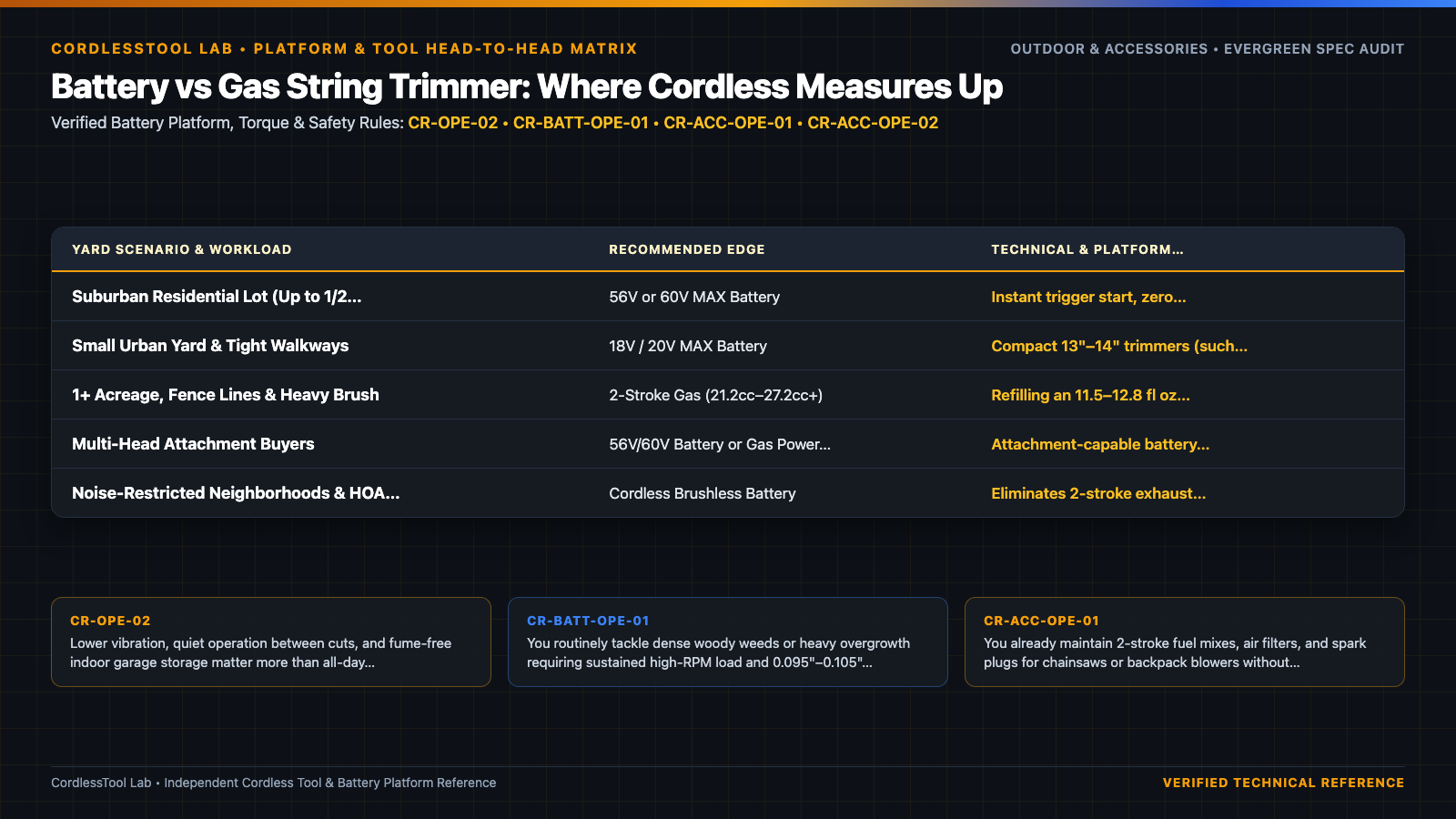
| Suburban Residential Lot (Up to 1/2 Acre) | 56V or 60V MAX Battery | Instant trigger start, zero 50:1 fuel mixing, and 15″–16″ swaths with 0.095″ line handle weekly turf and fence edging on a single mid-to-large pack. |
| Small Urban Yard & Tight Walkways | 18V / 20V MAX Battery | Compact 13″–14″ trimmers (such as the 7.4 lb DeWalt DCST925M1) keep weight down and share packs with existing 18V/20V garage tools, though 0.080″ line caps heavy brush duty. |
| 1+ Acreage, Fence Lines & Heavy Brush | 2-Stroke Gas (21.2cc–27.2cc+) | Refilling an 11.5–12.8 fl oz fuel tank takes two minutes and keeps dry tool weight steady without hauling heavy backup packs. |
| Multi-Head Attachment Buyers | 56V/60V Battery or Gas Power Head | Attachment-capable battery heads replace dedicated edgers and pole saws, provided you verify coupler fit first (CR-ACC-OPE-05). |
| Noise-Restricted Neighborhoods & HOA Hours | Cordless Brushless Battery | Eliminates 2-stroke exhaust fumes, high-pitched engine idle noise, and hot muffler storage hazards in attached garages. |
| Existing DeWalt 20V MAX Owners | 60V MAX FLEXVOLT (DCST972) | FLEXVOLT batteries power the 60V trimmer and drop onto 20V MAX drills in 20V mode (CR-BATT-TOOL-04), though 20V-only packs will not run the 60V trimmer (CR-BATT-TOOL-05). |
Side-by-Side Verified Spec & Platform Comparison
To prevent apples-to-oranges comparisons, the table below splits cordless trimmers into their actual battery tiers—18V nominal entry, 56V dedicated OPE, and 60V MAX FLEXVOLT—alongside two widely documented 2-stroke gas benchmarks (the 21.2cc Echo SRM-225 and 27.2cc STIHL FS 56 RC-E). All figures reflect official manufacturer specifications in US imperial units; cross-brand cutting-speed measurements under identical weed load have no verified data available yet.
| Specification | Entry 18V / 20V MAX (DeWalt DCST925M1) | 56V Dedicated OPE (EGO ST1623T) | 60V MAX FLEXVOLT (DeWalt DCST972) | 2-Stroke Gas Benchmarks (Echo SRM-225 / STIHL FS 56 RC-E) |
|---|---|---|---|---|
| Power Architecture | 18V Nominal (20V MAX) brushed motor | 56V ARC Lithium brushless motor | 54V Nominal (60V MAX) brushless motor | 21.2cc (Echo) / 27.2cc, 1.1 bhp (STIHL) 2-stroke |
| Cutting Swath | 13 inches | 16 inches (auto-sensing LINE IQ) | 15 / 17 inches adjustable | 17 inches (Echo) / 16.5 inches (STIHL) |
| Rated Max Line Diameter | 0.080 inch (dual line) | 0.095 inch (spiral-twist dual line) | 0.095 inch (ships with 0.080 inch) | 0.095 inch standard (commercial units up to 0.105 inch) |
| Head & Line Loading | Bump-feed spool | POWERLOAD auto-wind (bulk line) + LINE IQ | Quick-load dual-line bump spool | Speed-Feed 400 (Echo) / AutoCut C (STIHL) |
| Weight (Bare / With Pack or Dry) | 7.4 lb (assembled tool weight) | 7.5 lb bare / ~12.3 lb with 4.0Ah pack | 9.6 lb bare (adds ~2.55–3.45 lb w/ FLEXVOLT pack) | 11.5 lb dry w/ head (Echo) / ~10.6 lb dry bare (STIHL) |
| Energy Pack / Fuel Tank | 4.0Ah 20V MAX (72 Wh nominal) | 4.0Ah 56V (BA2242T) + 320W charger | Requires FLEXVOLT pack (6.0Ah or 9.0Ah at 20V rating) | 12.8 fl oz (Echo) / 11.5 fl oz (STIHL) 50:1 pre-mix |
| Rated Runtime / Endurance | No verified data available yet | Up to 60 min rated w/ included 4.0Ah pack (load-dependent) | No verified data available yet (mode & swath dependent) | Continuous until fuel exhaustion; ~2-minute tank refill |
| Attachment Capability | Dedicated fixed shaft | Dedicated carbon-fiber shaft (MST1501 adds Multi-Head) | Universal attachment-capable shaft | Dedicated shaft (split-shaft gas PAS models exist separately) |
| US Warranty Terms | 3-yr limited / 1-yr free service | 5-yr tool / 3-yr pack & charger / lifetime shaft (reg. req.) | 3-yr limited / 1-yr free service | 5-yr consumer / 2-yr commercial (Echo); 2-yr consumer (STIHL) |
1. Cutting Power, Swath Width & “Gas-Equivalent” Marketing Claims
Shoppers researching a battery vs gas string trimmer quickly encounter bold claims that a cordless trimmer delivers “more power than a 25cc or 30cc gas unit.” Under compatibility rule CR-OPE-02, treat every gas-equivalent claim strictly as the manufacturer’s own marketing comparison rather than a standardized engineering rating. Unlike engine displacement (cc) or brake horsepower (bhp), cordless brands publish no uniform industry torque standard for string trimmers, and cross-brand cutting output under identical weed density has no verified data available yet.
In real yard work, three mechanical specs govern how aggressively a trimmer clears thick grass and woody stalks: line diameter, cutting swath, and motor architecture.
- Line Diameter Limits (
CR-ACC-OPE-01): Entry 18V-nominal cordless trimmers such as the DeWaltDCST925M1typically max out at0.080-inchline across a 13-inch swath. That thinner filament slices soft turf cleanly but frays and snaps quickly against chain-link fencing, concrete curbs, or thick crabgrass. Stepping up to 56V (EGO ST1623T) or 60V MAX (DeWalt DCST972) opens compatibility for0.095-inchcommercial-grade line—the exact diameter used on the EchoSRM-225. Never load line thicker than the head’s maximum rating (CR-ACC-OPE-01): stuffing 0.105-inch line into a 0.095-inch head causes binding and feeding failures. - Spool & Head Design (
CR-ACC-OPE-02): Cordless trimmer heads have outgrown finicky manual-wind spools. The EGOST1623Tpairs aPOWERLOADmotorized auto-wind head withLINE IQsensors that automatically feed 0.095-inch bulk line to maintain a 16-inch swath without bumping—for a deeper look at how that head operates, see our EGO ST1623T string trimmer audit. Because auto-wind heads load bulk line directly, never waste money on pre-wound replacement spools made for a different head model (CR-ACC-OPE-02). - Motor Architecture (
CR-TOOL-01): Brushed motors (still used on entry kits like the DeWaltDCST925M1) generate higher internal heat and friction under sustained grass load than electronically commutated brushless motors found on 56V and 60V trimmers. Brushed units handle light residential borders at a lower kit cost, whereas brushless high-voltage trimmers preserve RPM better when wading into overgrown perimeter weeds.
2. Runtime Economics: Battery Watt-Hours vs. Two-Minute Fuel Refills
Runtime is the single most exaggerated metric in outdoor power equipment. Under CR-BATT-OPE-01, cordless runtime depends on four variables working together: battery stored energy (watt-hours), trimmer line diameter, cutting swath width, and throttle speed setting. A battery trimmer running a 17-inch swath with 0.095-inch line at full throttle draws dramatically more current than a 13-inch trimmer feathering 0.080-inch line along a walkway.
Understanding stored energy clears up marketing confusion immediately (CR-BATT-TOOL-02). Labels like DeWalt 20V MAX and Craftsman V20 describe unloaded peak cell voltage right off the charger; their actual working voltage is 18V nominal (five lithium-ion cell groups in series). Likewise, DeWalt 60V MAX operates at 54V nominal. Using Wh = nominal_v × Ah:
- A 20V MAX
4.0Ahbattery (bundled with theDCST925M1) stores 72 Wh nominal (18V × 4.0Ah)—enough for quick touch-ups on small yards, but tight if tackling tall perimeter weeds. - EGO pairs the
ST1623Twith a 56V4.0AhARC Lithium pack (BA2242T) andCH3200320W charger, rating the kit for up to 60 minutes of continuous runtime (manufacturer-rated figure; heavier grass and high-speed mode shorten actual endurance). - DeWalt’s
FLEXVOLT DCB609pack (rated 9.0Ah in 20V mode / 3.0Ah in 60V mode, labeled 180 Wh by DeWalt / 162 Wh nominal) delivers high-current output for the 60VDCST972, though DeWalt does not publish a universal minute count across varying grass conditions (no verified data available yet).
For a typical suburban lot under half an acre, a single 4.0Ah or 5.0Ah high-voltage pack normally finishes weekly trimming and edging before needing a charge. Once property size crosses an acre—or when clearing waist-high ditch weeds—the economics invert. Adding extra high-capacity OEM packs in the TIER-BATT-MID to TIER-BATT-PREMIUM bracket pushes cordless upfront cost well past a mid-duty gas trimmer, whereas a gas unit like the Echo SRM-225 or STIHL FS 56 RC-E refills its 11.5–12.8 fl oz tank in two minutes from a single pre-mix can and runs uninterrupted all afternoon. Explore how high-capacity trimmers compare side by side in our best battery string trimmer roundup.
3. Weight Balance, Noise & Seasonal Maintenance
Comparing tool weight requires checking whether a spec sheet lists bare dry weight or operating weight with a battery and cutting head installed:
- Operating Weight Parity: An Echo
SRM-225weighs11.5 lbdry with its cutting head (before adding nearly a pound of fuel), and a STIHLFS 56 RC-Elists roughly10.6 lbdry bare. Meanwhile, the EGOST1623Tweighs7.5 lbbare, jumping to roughly12.3 lbonce its4.8 lb4.0Ah battery locks onto the rear housing. The DeWaltDCST972Bstarts heavier at9.6 lbbare, reaching roughly12.15–13.05 lbwith a 6.0Ah or 9.0Ah FLEXVOLT pack. High-voltage cordless trimmers are not featherweights—their advantage is rear-mounted battery balance and dramatically lower hand-arm vibration rather than lower total scale weight. - Noise & Exhaust: A 2-stroke gas trimmer fires thousands of combustion cycles per minute right behind your right elbow, producing sharp exhaust noise, vibration, and unburned two-cycle oil fumes. Brushless battery trimmers spin only when you squeeze the trigger, stay silent between fence posts, and eliminate hot exhaust mufflers.
- Routine Upkeep: Gas ownership requires mixing 50:1 oil-to-fuel ratios (or buying costly canned engineered fuel), draining or stabilizing ethanol gasoline before winter storage, cleaning air filters, gapping spark plugs, and rebuilding gummed carburetors after neglected off-seasons. Battery ownership removes engine servicing entirely: brush grass clippings off cooling vents, swap worn trimmer line, and store lithium-ion packs indoors within the temperature and state-of-charge range specified in your owner’s manual.
4. Platform Lock-In, Multi-Head Couplers & Amazon Channel Risks
Because batteries account for a major share of cordless cost, platform compatibility rules decide whether a battery string trimmer is a smart buy or an expensive dead end:
- Separate Yard vs. Hand-Tool Platforms (
CR-SYS-04,CR-BATT-TOOL-03): Buying into EGO 56V (ST1623TorMST1501) or Ryobi 40V places your yard equipment on a dedicated outdoor platform. Your 18V/20V garage drill batteries will not fit—even within the same brand, Ryobi18V ONE+batteries never fit Ryobi40Voutdoor tools (CR-BATT-TOOL-03). Adding a second platform is completely valid, provided you buy a kit with its own packs and charger rather than a bare tool. - DeWalt FLEXVOLT One-Way Rule (
CR-BATT-TOOL-04,CR-BATT-TOOL-05): DeWalt’s60V MAXtrimmers (DCST972B) require aFLEXVOLTbattery—standard 20V MAX packs will not fit or power them. However, those FLEXVOLT packs backward-fit all DeWalt 20V MAX drills, saws, and drivers in 20V mode (adding extra bulk and weight). - Multi-Head Attachment Couplers (
CR-ACC-OPE-05): If you plan to run an edger, pole saw, or hedge trimmer off one power head, verify the coupler standard first. EGO’sMST1501Multi-Head usesSTD-ATTACH-EGO-MULTIHEADand accepts only EGO Multi-Head attachments—not MilwaukeeQUIK-LOKor RyobiExpand-Itshafts. By contrast, DeWalt specifies theDCST972as universal attachment-capable; always confirm square-drive shaft and sleeve dimensions in the manual before ordering third-party attachments. - Bare-Tool & Variation Traps (
CR-SYS-01,CR-SYS-02): Model suffixes separate turnkey kits from bare tools. On Amazon US, DeWalt’sDCST972Bis a tool-only listing: battery and charger sold separately, so first-time buyers should check kit variations (such asDCST972X1orDCKO266X1) and verify the exact pack capacity inside “What’s in the box.” - Authorized-Dealer Warranty Caveats (
CR-SYS-05): DeWalt and EGO Power+ maintain active Amazon US listings backed by factory limited warranties when bought through authorized channels (EGO’s lifetime carbon-fiber shaft coverage requires registration within 90 days of purchase). Conversely, retail-exclusive brands like Ryobi and Ridgid sell primarily through The Home Depot in the US, and Milwaukee M18 tools carry full US warranty coverage only when purchased from an authorized Milwaukee distributor—third-party Amazon marketplace resellers often void OEM warranty eligibility or Ridgid’s Lifetime Service Agreement.
5. Safety Rules, Non-OEM Pack Bans & CPSC Recall Screening
String trimmers spin nylon filament at several thousand RPM close to stones, wire fencing, and ankles. Whether running lithium-ion or 2-stroke gas, follow these non-negotiable equipment rules:
- Guards, Shields & PPE (Manufacturer-Instruction-First): Always operate with the manufacturer’s debris shield and line cut-off blade properly installed—never remove or bypass the guard to run longer line or unauthorized metal blades. Wear ANSI-rated eye protection, hearing protection, long pants, and sturdy closed-toe footwear as the tool manual specifies, and keep bystanders and pets well outside the manual’s stated debris zone.
- Zero Non-OEM Replacement Packs or Adapters (
CR-SYS-03,CR-BATT-TOOL-10): Avoid unbranded third-party “replacement batteries” and passive cross-brand plastic battery adapters on Amazon. Passive adapters bypass brand-specific thermal and low-voltage battery-management communication, risk pack damage, and void OEM warranties—we never recommend them in buying setups. Charge OEM batteries strictly on approved OEM chargers, and allow hot or freezing packs to reach room temperature if the charger blinks a thermal pause (CR-BATT-05). Stop using any swollen, cracked, or water-damaged battery immediately per the manufacturer’s manual and local recycling rules. - CPSC Recall Screening (
CR-SYS-06): In our verification sweep, neither EGO’s nor DeWalt’s standalone cordless string trimmers carried an open string-trimmer recall. However, outdoor equipment buyers—especially on multi-tool bundles or secondhand platforms—should verify serial numbers against the U.S. CPSC Recalls database for neighboring OPE notices: Milwaukee recalled ~90,860 US units of its M18 FUEL top-handle chainsaw (2826-20series, CPSC Recall No. 26-064, October 2025, fourth serial digitA, free repair); DeWalt recalled ~46,200 battery walk-behind mowers (DCMWP234U2,DCMWP600X2,DCMWSP256U2,DCMWSP650Y2, August 2024, date codes2023 32–2024 13, free handle repair); EGO recalled itsHT2410hedge trimmer in June 2023; and Greenworks-built Kobalt 24V/48V yard tools using USB-C packs were recalled in July 2026 for fire hazards during in-tool USB-C charging.
Final Verdict: Battery vs. Gas String Trimmer
Choose a Battery String Trimmer If…
- You maintain a residential lot up to roughly half an acre and want instant trigger starts with zero carburetor or 50:1 fuel-mixing chores.
- You step into a 56V (EGO) or 60V MAX (DeWalt FLEXVOLT) brushless platform capable of driving
0.095-inchdual line across 15″–17″ swaths. - Lower vibration, quiet operation between cuts, and fume-free indoor garage storage matter more than all-day off-grid refueling.
Choose a Gas String Trimmer If…
- You clear multi-acre fence lines, ditches, or commercial lawn routes where two-minute tank refills beat packing multiple heavy batteries.
- You routinely tackle dense woody weeds or heavy overgrowth requiring sustained high-RPM load and 0.095″–0.105″ line capacity.
- You already maintain 2-stroke fuel mixes, air filters, and spark plugs for chainsaws or backpack blowers without friction.
Verified OEM Cordless String Trimmers on Amazon US
If your yard workload favors cordless power, the four OEM listings below span every major voltage tier—dedicated 56V residential, 60V MAX FLEXVOLT attachment-capable, 56V Multi-Head, and entry 18V-nominal—with verified model numbers and direct Amazon US provenance.
1. EGO Power+ ST1623T 16-Inch 56V Cordless String Trimmer Kit
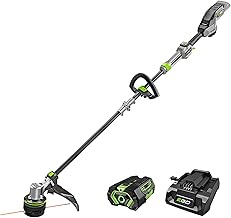
Key Specs: EGO 56V ARC Lithium | 16-inch swath | 0.095-inch spiral-twist dual line | POWERLOAD + LINE IQ head | 7.5 lb bare (~12.3 lb w/ 4.0Ah pack) | Configuration: Complete Kit (1× 56V 4.0Ah BA2242T pack + CH3200 320W Fast Charger) | Price Tier: TIER-OPE-MID
The ST1623T matches mid-duty gas cutting width (16 inches) and 0.095-inch line thickness while eliminating manual spool winding via POWERLOAD and automatic LINE IQ feeding, backed by EGO’s 5-year tool and 3-year battery warranty (plus lifetime shaft coverage upon 90-day registration). Cons: (1) Dedicated 56V OPE platform does not share batteries with 18V/20V garage drills (CR-SYS-04); (2) Check current generation availability before purchasing, as some retailers mark ST1623T limited-stock alongside newer EGO releases (CR-TOOL-02).
2. DEWALT DCST972B 60V MAX FLEXVOLT Attachment-Capable String Trimmer

Key Specs: DeWalt 60V MAX FLEXVOLT (54V nominal) | 15/17-inch adjustable swath | 0.080-inch installed (accepts 0.095-inch line) | 0–4,650 / 0–5,800 RPM brushless | 9.6 lb bare | Configuration: tool-only listing: battery and charger sold separately | Price Tier: TIER-OPE-VALUE (bare tool; kit equivalents land in TIER-OPE-MID/PREMIUM)
Built for DeWalt FLEXVOLT owners who want gas-class swath width (up to 17 inches) and universal attachment capability alongside backward compatibility for 20V MAX tools on the same FLEXVOLT packs (CR-BATT-TOOL-04). Cons: (1) Bare listing excludes battery and charger, and standard 20V MAX packs will not run this 60V MAX tool (CR-SYS-01, CR-BATT-TOOL-05); (2) At 9.6 lb bare before attaching a 2.55–3.45 lb FLEXVOLT pack, it runs heavier than compact residential trimmers.
3. EGO Power+ MST1501 56V Multi-Head 15-Inch String Trimmer Combo Kit

Key Specs: EGO 56V ARC Lithium | 15-inch swath | 0.095-inch line | PH1400 Multi-Head Power Head + STA1500 trimmer | Configuration: Complete Kit (1× 56V 5.0Ah pack + standard charger) | Price Tier: TIER-OPE-MID
Instead of buying separate gas engines for edging, pole sawing, and brushing, the MST1501 bundles EGO’s Multi-Head power head with a 15-inch 0.095-inch trimmer and a larger 5.0Ah battery right out of the box. Cons: (1) Multi-Head coupler (STD-ATTACH-EGO-MULTIHEAD) locks strictly to EGO attachments rather than universal square-drive shafts (CR-ACC-OPE-05); (2) Heavier front-to-rear coupler assembly than a dedicated single-piece carbon-fiber trimmer.
4. DEWALT DCST925M1 20V MAX 13-Inch String Trimmer Kit

Key Specs: DeWalt 20V MAX (18V nominal) | Brushed gear-drive motor | 13-inch swath | 0.080-inch dual line | 5,300 / 6,300 RPM | 7.4 lb | Configuration: Complete Kit (1× 4.0Ah 72 Wh nominal pack + charger + 225 ft 0.080″ line) | Price Tier: TIER-OPE-VALUE
Designed for small urban lots and existing DeWalt 20V MAX tool owners, this value kit includes a 4.0Ah pack, 120V AC charger, and 225 feet of spare 0.080-inch line for clean sidewalk borders without starting a second battery ecosystem. Cons: (1) Brushed motor and 0.080-inch line cap performance in heavy, overgrown weeds compared to 56V/60V brushless units (CR-TOOL-01, CR-SYS-08); (2) Single 72 Wh nominal battery limits continuous runtime on larger residential yards (CR-BATT-OPE-01).
How We Audited This Guide
- Outdoor power equipment and tool accessories were verified across battery Ah runtime fit, string trimmer bump-feed vs. blower CFM ratings, carbide tooth geometry, Impact Rated vs. chrome socket steel, and ANSI blade guard safety.
- Every cordless drill, impact driver, saw, grinder, battery pack, charger, outdoor power tool, and accessory spec was cross-checked against official OEM manuals, UL/ANSI ratings, and live Amazon US listings.
- Recommendations were evaluated against our weighted vertical scoring rubrics and 61 documented CR-* platform and safety rules; we never invent peak torque ft-lbs, cut counts, runtime minutes, or battery decibels.
Frequently Asked Questions: Battery vs. Gas String Trimmers
Are 56V and 60V battery trimmers as powerful as gas trimmers?
High-voltage 56V and 60V brushless trimmers running 0.095-inch line across 15-inch to 17-inch swaths handle typical residential grass and fence edges comparably to entry commercial gas units. However, “gas-equivalent” claims are manufacturer comparisons rather than a verified cross-brand torque standard (CR-OPE-02).
How long does a battery string trimmer run on one charge?
Runtime tracks pack watt-hours, line thickness, swath width, and throttle speed (CR-BATT-OPE-01). EGO rates the ST1623T up to 60 minutes with its included 56V 4.0Ah battery, whereas thick weeds and high-speed triggers drain packs noticeably faster—carry a spare OEM pack for larger lots.
Can I put thicker 0.105-inch line in any battery string trimmer?
No. Under compatibility rule CR-ACC-OPE-01, trimmer line diameter must never exceed the head’s maximum rating. Most residential 56V and 60V heads max out at 0.095-inch line, while 18V/20V entry heads cap at 0.080-inch; oversized line jams feeding mechanisms and strains motors.
Will DeWalt 20V MAX drill batteries power the 60V MAX DCST972 trimmer?
No. Under CR-BATT-TOOL-05, DeWalt 60V MAX FLEXVOLT trimmers strictly require a 20V/60V MAX FLEXVOLT battery pack. Standard 20V MAX packs will not fit or run 60V tools, although FLEXVOLT packs backward-fit standard 20V MAX drills and drivers in 20V mode.
Are third-party replacement batteries safe for cordless string trimmers?
We recommend only OEM batteries made by the tool brand and sold through the brand, Amazon retail, or an authorized dealer (CR-SYS-03). Unbranded replacement packs and cross-brand battery adapters lack verified BMS protection communication and can void tool warranties.


