Disclosure: As an Amazon Associate, CordlessTool Lab earns from qualifying purchases. If you buy through links on this page, we may earn a small commission at no extra cost to you. Note that outdoor power equipment listings may fall under Lawn & Garden rather than the 3% Tools & Home Improvement commission tier; fee rates never alter our technical evaluations or cost analyses.
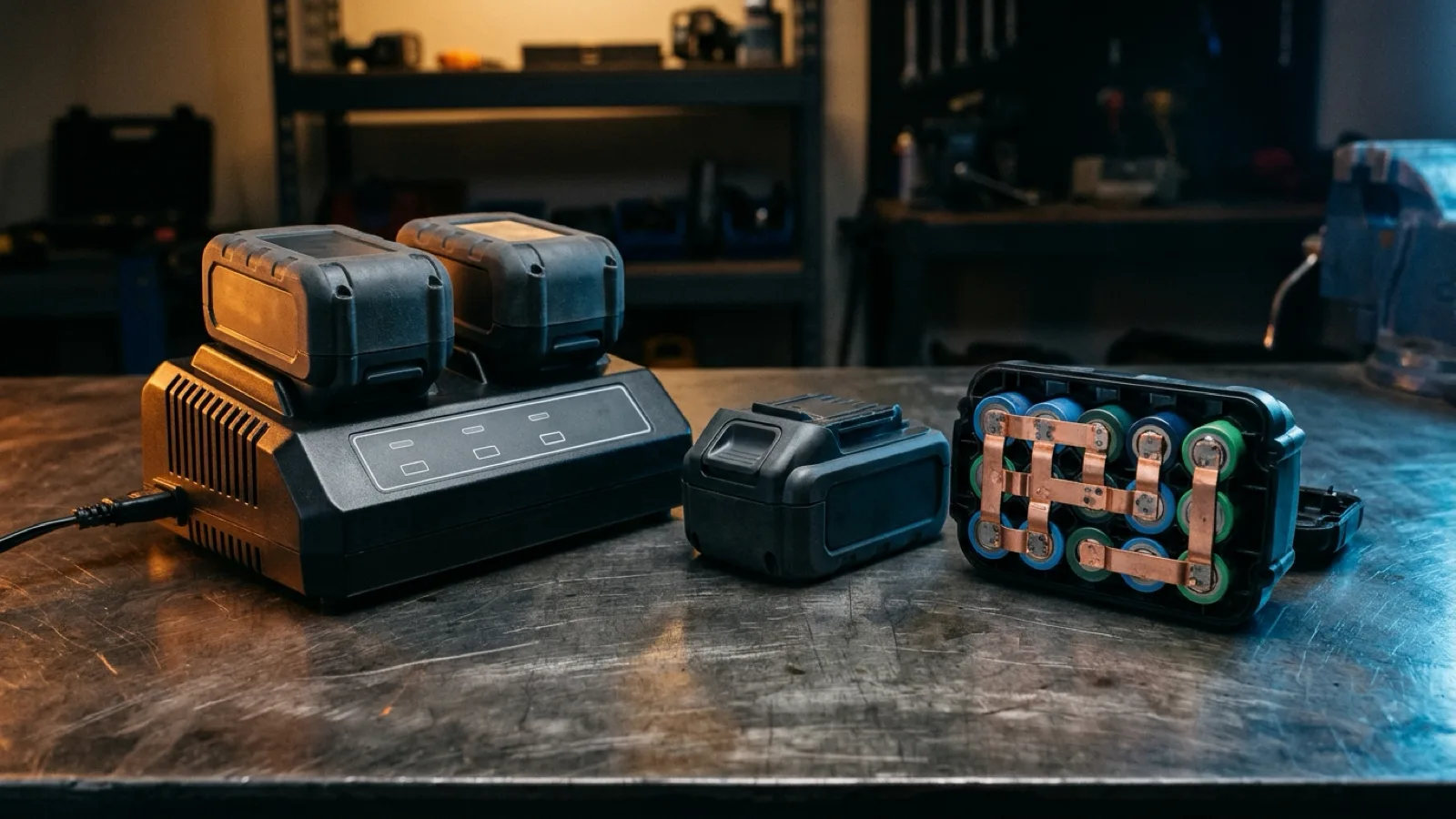
Evaluating the true battery vs gas lawn mower cost requires looking past the sticker on the box to five-year energy, seasonal maintenance, and battery-pack replacement math. While a cordless lawn mower kit carries a higher upfront price tier than an entry gas push deck, electricity costs pennies per mow and eliminates oil changes, spark plugs, air filters, and carburetor rebuilds. Before selecting a deck, check our cordless battery-powered yard tools hub to see how outdoor voltage rails fit into your broader tool garage.
Quick Answer — Is a Battery Lawn Mower Cheaper Than Gas Over Time?
For residential lawns up to roughly 1/2 acre, yes: a battery mower typically saves money over five years because charging draws roughly 0.3 to 0.5 kWh per cut and engine tune-ups drop to zero. On 1+ acre properties requiring multiple spare packs—or if a replacement OEM battery is needed early—gas mowers stay competitive on total ownership cost.
In This Cost & Engineering Guide
- 1. Upfront Purchase Tiers & The “Bare Tool” Cost Trap
- 2. Energy Math: Watt-Hours & Kilowatt-Hours vs. Pump Gasoline
- 3. Annual Maintenance & Shared Deck Upkeep
- 4. Battery Replacement Cost, Second Packs & Platform Leverage
- 5. Structured 5-Year Cost & Compatibility Decision Matrix
- 6. Six Battery Mower Cost Myths vs. Engineering Reality
- 7. Safety Rules, CPSC Recalls & Retail Warranty Risks
- 8. Verified OEM Cordless Mower Kits Across Budget Tiers
- 9. Authoritative Non-Affiliate References
- 10. Frequently Asked Questions
1. Upfront Purchase Tiers & The “Bare Tool” Cost Trap
The first fork in battery vs gas lawn mower cost happens on day one. Entry residential 4-cycle gas push mowers with steel decks have long held a low upfront barrier, whereas quality brushless cordless walk-behind kits cluster in TIER-OPE-MID ($200–$400 kit with battery and charger) for 17-inch to 21-inch (432 mm to 533 mm) push decks and TIER-OPE-PREMIUM ($400+ kit) for self-propelled 21-inch to 25-inch (533 mm to 635 mm) units.
The reason cordless kits carry higher initial prices is simple: you are buying the mower chassis plus a high-energy lithium-ion power plant and a 120V AC rapid charger upfront rather than purchasing fuel gradually at the pump. Two listing traps routinely distort day-one cost comparisons:
- Tool-only (bare-tool) mower listings (
CR-SYS-01): Many online mower listings display an attractive price because they ship as a tool-only listing: battery and charger sold separately. For example, adding a standalone 56V or 60V 5.0Ah–7.5Ah OEM battery pack (TIER-BATT-MIDat $80–$180 orTIER-BATT-PREMIUMat $180+ per pack) alongside a 320W–550W rapid charger can push total outlay well past a complete factory kit. Bare mowers make financial sense only if you already own compatible high-capacity outdoor batteries on that exact platform. - Dual-battery slots and kit pack count (
CR-BATT-TOOL-06,CR-SYS-02): Some cordless mowers include two battery ports. Read the kit’s “What’s in the box” specification and owner’s manual carefully before checkout: certain dual-voltage 36V (18V X2) mowers require both slots filled simultaneously to run, while sequential dual-port mowers switch automatically from bay one to bay two. Verify whether a listing ships one battery or two before assuming kit parity. - Motor architecture & deck class (
CR-TOOL-01): Entry brushed-motor battery mowers sit lower in initial cost but run hotter and deliver less work per charge under dense turf load than electronically commutated brushless mowers. For lawns thicker than light suburban turf, stepping into a brushless 56V, 60V, or 80V kit avoids premature under-power frustration (CR-SYS-08).
2. Energy Math: Watt-Hours & Kilowatt-Hours vs. Pump Gasoline
Once the mower is in your garage, recurring energy cost swings decisively toward cordless lithium-ion. To calculate true charging expense—and to avoid misleading marketing voltage labels—use stored energy in watt-hours (Wh) rather than volts or amp-hours alone (CR-BATT-TOOL-02, 03 §3.4 e):
Stored Energy (Wh, nominal) = Nominal Voltage (V) × Capacity (Ah)
Just as workshop brands label five-cell 18V nominal packs as 20V MAX (meaning DeWalt 20V MAX and Milwaukee M18 share the exact same 18V nominal chemistry), outdoor mower voltage badges reflect maximum no-load cell counts: Greenworks 40V runs at 36V nominal (10S), EGO 56V runs at 50.4V nominal (14S, labeled at 56V), Greenworks 60V runs at 54V nominal (15S), and Greenworks 80V runs at 72V nominal (20S). Always state whether a Wh number uses the maker’s label basis or nominal cell basis.
- Worked Example 1 — Electricity Cost on a 56V 7.5Ah Self-Propelled Kit: The EGO Power+
LM2135SPships with aBA4200T56V 7.5Ah battery rated at420 Whon EGO’s label basis (50.4V nominal × 7.5Ah = 378 Wh nominal). Dividing 420 Wh by 1,000 yields0.42 kWhof pack capacity. Accounting for typical lithium-ion charger and power-supply conversion losses (~85% efficiency), a full zero-to-100% recharge on a 120V AC household outlet pulls roughly0.49 kWhfrom the wall. At a representative US residential electricity rate near 16 to 17 cents per kWh per U.S. Energy Information Administration (EIA) monthly electricity data, one full recharge costs roughly 8 cents. Even across 35 weekly mows per year, annual electricity totals under $3 to $4 per season. - Worked Example 2 — Dual-Pack 60V Nominal Energy Math: A dual-battery 60V kit bundling two
4.0Ahpacks (such as the Greenworks Pro 60VMO60L424) stores2 × (54V nominal × 4.0Ah) = 432 Wh nominal combined. Recharging both depleted packs draws roughly0.51 kWhfrom the wall—still under 10 cents per full mowing session. - Gasoline & Engineered Fuel Reality: A residential 140cc to 190cc 4-cycle walk-behind gas mower typically consumes roughly 5 to 12 gallons of fuel per season depending on lot size, blade drag, and mowing frequency. At $3 to $4 per gallon of pump E10 gasoline plus fuel stabilizer—or significantly higher if you buy canned ethanol-free 4-cycle fuel to protect carburetors—annual fuel spend ranges from roughly $20 to $50+ for pump gas (and $100+ with canned alkylate fuel).
Two engineering caveats keep comparisons honest. First, under CR-BATT-OPE-01, cordless runtime depends directly on grass height, moisture, cut-height setting, and whether self-propel drive is engaged. Never convert watt-hours into guaranteed minutes or square footage unless tied to the maker’s stated pack and operating mode (G-01, G-03, CR-BATT-TOOL-09): for example, EGO rates the push LM2114 up to 55 minutes with its 6.0Ah pack (336 Wh label) versus up to 50 minutes on the self-propelled LM2114SP with the same 6.0Ah pack. Second, under CR-OPE-02 and CR-DRV-02, treat “gas-equivalent cc” marketing claims strictly as the brand’s own comparison; likewise, while EGO publishes rated blade torque in ft-lbs (7.0 ft-lbs / 9.5 Nm on the LM2135SP with 7.5Ah pack; 6.0 ft-lbs / 8.1 Nm on the LM2114 series—remembering 12 in-lbs = 1 ft-lb), brands use different measurement protocols, so cross-brand spec-sheet torque rankings are invalid without an identical bench standard (G-15, G-16).
3. Annual Maintenance & Shared Deck Upkeep
Routine maintenance is where gas mowers quietly surrender their upfront price advantage—both in cash outlay and weekend wrenching time.
- 4-Cycle Gas Annual Engine Service: Even a reliable push gas mower requires an annual oil change (15–20 fl oz of SAE 30 or 10W-30 plus oil-pan cleanup and recycling), a paper or foam air filter, a spark plug every one to two seasons, and ethanol fuel stabilizer before winter storage. Buying a DIY annual tune-up kit runs roughly $20 to $35 per year, while dropping the mower at a small-engine shop for a spring service or carburetor cleanout after stale-gas gumming regularly costs $75 to $150+ per visit. Over five seasons, routine engine care adds $100 to $300+ in real cash even before factoring in recoil starter cords or cracked fuel lines.
- Cordless Brushless Drivetrain Service: A brushless cordless lawn mower has zero motor oil, zero spark plugs, zero air filters, zero fuel hoses, and zero carburetor jets. Annual drivetrain maintenance consists of brushing dried grass off cooling vents and checking fasteners per the owner’s manual.
- Shared Wear Items (Tie): Both gas and battery mowers require blade sharpening or replacement, underside deck scraping, and occasional wheel or bag upkeep. Keep a spare OEM blade sized to your exact deck (21 in. / 533 mm or 17 in. / 432 mm) and follow manual torque specs for the blade bolt.
4. Battery Replacement Cost, Second Packs & Platform Leverage
Honest battery vs gas lawn mower cost math must account for the single largest long-term cordless expense: OEM battery packs. Lithium-ion packs are consumable chemical reservoirs whose usable capacity gradually declines over hundreds of charge cycles and calendar years—especially if stored hot in an uninsulated shed or left fully depleted all winter.
- Standalone OEM Pack Cost (
TIER-BATT-MID/TIER-BATT-PREMIUM): Replacing a single high-capacity 56V, 60V, or 80V OEM mower pack (5.0Ah to 7.5Ah) sits inTIER-BATT-MID($80–$180) toTIER-BATT-PREMIUM($180+ per pack). On a quarter-acre yard where the original kit battery lasts five to seven years, replacement cost lands late in the mower’s lifecycle—or coincides with buying a second yard tool kit. However, if your yard is large enough to require buying one or two extra OEM packs upfront, battery capital can erase five-year maintenance savings quickly. - Platform Lock-In & Cross-Tool Amortization (
CR-SYS-04,CR-BATT-TOOL-03): Outdoor batteries stay locked inside their specific voltage family. Your 18V/20V garage drill packs will not run 56V, 60V, or 80V mowers, and even within the same brand, Ryobi18V ONE+never fits Ryobi40V, just as Greenworks40V,60V, and80Vpacks never interchange (CR-BATT-TOOL-03). Yet once you buy an EGO 56V or Greenworks 60V mower kit, you already own the high-Wh pack and rapid charger—meaning you can add bare-tool string trimmers, leaf blowers, or hedge trimmers without re-buying batteries. See our EGO 56V yard-care setup blueprint to map how sharing one pack across three yard tools lowers total platform cost. - Charger Turnaround & Thermal Delays (
CR-BATT-03,CR-BATT-05): Rapid chargers (such as EGO’s 550W CH5500 or Greenworks’ dual-port rapid charger) cost more upfront inside premium kits than basic 210W–320W chargers, yet they prevent you from having to buy a second expensive pack just to finish a weekend mow after a short pause. Note that if a pack comes off the mower hot, the charger pauses charging automatically until cells return to the manual’s temperature window (CR-BATT-05).
5. Structured 5-Year Cost & Compatibility Decision Matrix
The engineering diagram and structured table below summarize how upfront kit tiers, fuel versus kWh energy math, annual upkeep, and platform compatibility rules shift the five-year financial break-even point across residential yard sizes.
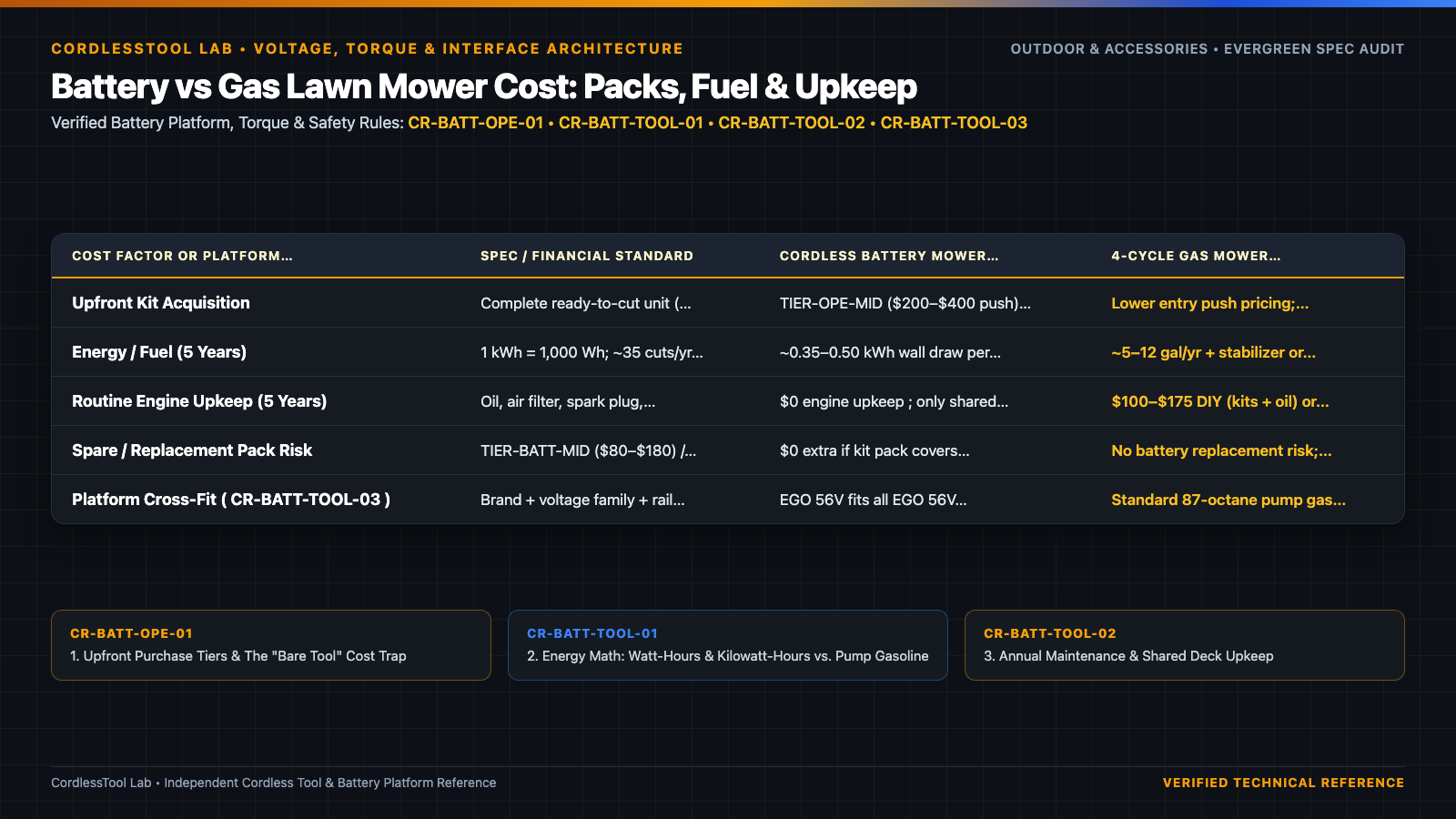
| Cost Factor or Platform Class | Spec / Financial Standard | Cordless Battery Mower Reality | 4-Cycle Gas Mower Reality & Caveats |
|---|---|---|---|
| Upfront Kit Acquisition | Complete ready-to-cut unit (CR-SYS-01, CR-SYS-02) | TIER-OPE-MID ($200–$400 push) to TIER-OPE-PREMIUM ($400+ SP); bare listings exclude costly pack & charger. | Lower entry push pricing; self-propelled 160cc–190cc gas units overlap TIER-OPE-MID/PREMIUM. |
| Energy / Fuel (5 Years) | 1 kWh = 1,000 Wh; ~35 cuts/yr residential | ~0.35–0.50 kWh wall draw per cut (~8–10 cents/charge); roughly $15–$25 over 5 years. | ~5–12 gal/yr + stabilizer or canned fuel; roughly $100–$250+ over 5 years (higher with canned fuel). |
| Routine Engine Upkeep (5 Years) | Oil, air filter, spark plug, carb care | $0 engine upkeep; only shared blade sharpening & deck cleaning apply. | $100–$175 DIY (kits + oil) or $350–$600+ shop tune-ups if carb gums after winter. |
| Spare / Replacement Pack Risk | TIER-BATT-MID ($80–$180) / PREMIUM ($180+) | $0 extra if kit pack covers your lot for 5+ yrs; +$180–$300+ if a second pack or early replacement is required. | No battery replacement risk; long-term carb, recoil cord, or cable wear after year 5. |
Platform Cross-Fit (CR-BATT-TOOL-03) | Brand + voltage family + rail lock | EGO 56V fits all EGO 56V tools; Greenworks 40V, 60V, and 80V stay strictly isolated from one another. | Standard 87-octane pump gas (with stabilizer) fuels gas trimmers/blowers; 2-stroke tools still need 50:1 mix. |
| Net 5-Year Break-Even Winner | Total Cost of Ownership (TCO) | Wins on lots up to 1/2 acre when one kit (or dual-pack kit) finishes the yard cleanly. | Competitive on 1+ acre lots or steep wet brush where 3+ high-Wh battery packs would be needed. |
6. Six Battery Mower Cost Myths vs. Engineering Reality
Myth vs. Engineering Reality — Voltage Labels, Bare Listings & Non-OEM Packs
Marketing voltage stickers and bargain marketplace listings routinely hide real ownership costs. Audit every claim against battery physics and OEM warranty rules before buying (CR-BATT-TOOL-02, CR-SYS-03, CR-BATT-TOOL-10, G-25).
- Myth 1: “20V MAX beats 18V automatically, and 60V always cuts longer than 56V.” Engineering reality: In workshop tools, DeWalt 20V MAX and Milwaukee M18 are both 18V nominal systems (
CR-BATT-TOOL-02); the label difference is marketing, not extra power. Likewise, a Greenworks 60V (54V nominal) 4.0Ah pack holds ~216 Wh nominal, whereas an EGO 56V (50.4V nominal) 7.5Ah pack holds ~378 Wh nominal (420 Wh label). Always compare watt-hours, not the voltage integer alone. - Myth 2: “Higher amp-hours equals more cutting power without considering nominal voltage.” Engineering reality: Amp-hours measure charge capacity at a given voltage. A 5.0Ah 18V pack stores 90 Wh nominal, while a 5.0Ah 54V nominal (60V) pack stores 270 Wh nominal—three times the stored energy (
03§3.4 e). - Myth 3: “‘Gas-equivalent 160cc’ claims guarantee identical cutting speed.” Engineering reality: Under
CR-OPE-02, gas-equivalent ratings are strictly manufacturer marketing comparisons, not standardized independent measurements. Look for the maker’s rated torque with a named reference pack (CR-BATT-TOOL-09) and verified blade architecture (such as dual-blade Select Cut or SmartCut hubs). - Myth 4: “Buying a bare-tool mower and cheap generic Amazon batteries saves hundreds.” Engineering reality: Unbranded “replacement” lithium-ion batteries and cross-brand or Power-Wheels plastic adapters carry severe safety, BMS-mismatch, and warranty risks (
CR-SYS-03,CR-BATT-TOOL-10). Passive adapters drop manufacturer thermal and low-voltage communication pins, risking cell damage and voided warranties. CordlessTool Lab excludes all non-OEM packs and adapters from buy recommendations (G-25). - Myth 5: “Any brand’s 18V/20V drill batteries work on its yard mowers.” Engineering reality: Same-brand logos never guarantee fit across voltage families (
CR-BATT-TOOL-03). Ryobi 18V ONE+ packs never fit Ryobi 40V mowers, and Greenworks 40V, 60V, and 80V batteries use incompatible slide rails. - Myth 6: “Dual-port mowers run on whichever single battery you slide in.” Engineering reality: Under
CR-BATT-TOOL-06, dual-pack 36V (18V X2) mowers require two charged batteries simultaneously to start, whereas sequential dual-port mowers draw from one bay at a time. Always verify slot rules and included pack counts in the manual before ordering (CR-SYS-02).
7. Safety Rules, CPSC Recalls & Retail Warranty Risks
Walk-behind lawn mowers—both battery and gas—spin steel blades at high tip speeds and carry strict YMYL safety requirements. Always follow the manufacturer’s instruction manual first (G-24):
- Blade, Guard & PPE Discipline: Never bypass the dual-action bail switch, rear discharge flap, or side-discharge guard. Before clearing wet grass clumps or servicing the blade, release the bail lever, wait for complete blade stop, remove the battery pack (or disconnect the spark-plug boot on gas units), and pull the safety key as the manual specifies. Wear eye protection, hearing protection, long pants, and sturdy closed-toe footwear as the manufacturer’s manual specifies, and follow OSHA landscape and mower safety guidance on slopes.
- Battery Charging & Storage Care (
CR-BATT-01,CR-BATT-05): Charge packs only on OEM-listed compatible chargers inside the manual’s ambient temperature window. If a pack is swollen, cracked, or water-damaged, stop using it immediately—never attempt DIY cell repair or wire jump-starting—and dispose of it through manufacturer or municipal lithium-ion recycling programs. - CPSC Recall Screening (
CR-SYS-06,G-12): Before buying new clearance stock or secondhand cordless mowers, check serial numbers against the U.S. Consumer Product Safety Commission (CPSC) Recalls database. Documented outdoor equipment notices include DeWalt’s August 2024 recall of ~46,200 battery walk-behind mowers (DCMWP234U2,DCMWP600X2,DCMWSP256U2,DCMWSP650Y2, date codes2023 32–2024 13, water-intrusion blade start hazard, free repair); SKIL’s December 2024 recall of 40V 5.0AhBY8708-00mower batteries (fire/burn hazard); Greenworks-made Kobalt 24V/48V yard tools with USB-C packs (Recall No. 26-611, July 2026, fire hazard while charging via USB-C in the tool); and DR Power 62V 5.0Ah LiPRO packs (June 2025, refund remedy). - Third-Party Marketplace & Retail-Exclusive Warranty Rules (
CR-SYS-05,G-26): Warranty replacement value is part of five-year ownership cost. In the US, Ryobi and Ridgid are retail-exclusive brands distributed primarily through The Home Depot, while Milwaukee M18/M12 tools require purchase from an authorized distributor for full warranty coverage. Buying Ryobi, Ridgid, or Milwaukee kits from unauthorized third-party Amazon marketplace resellers risks losing OEM warranty protection or Ridgid’s Lifetime Service Agreement eligibility. Stick to authorized Amazon retail or brand-direct storefronts such as EGO Power+ and Greenworks Pro.
8. Verified OEM Cordless Mower Kits Across Budget Tiers
To ground the battery vs gas lawn mower cost math in real hardware, the four verified Amazon US OEM kits below illustrate how battery watt-hours, charger speed, and push versus self-propelled drivetrains map onto TIER-OPE-MID and TIER-OPE-PREMIUM. Every listing includes an OEM battery and charger so you avoid standalone pack sticker shock (CR-SYS-01). For a full 10-model ranking, read our best battery lawn mower audit.
1. EGO Power+ LM2135SP 21-Inch Select Cut Self-Propelled Kit (7.5Ah)

Cost & Platform Profile: EGO 56V ARC Lithium (50.4V nominal) | 21-in. (533 mm) Select Cut Dual-Blade Deck | Self-Propelled Touch Drive | 7.0 ft-lbs (9.5 Nm) rated torque with included 7.5Ah BA4200T pack (420 Wh label / ~378 Wh nominal) + 550W Rapid Charger | Rated up to 60 min | 5-yr tool / 3-yr battery US warranty | Price Tier: TIER-OPE-PREMIUM ($400+ Kit)
Despite sitting in TIER-OPE-PREMIUM upfront, the LM2135SP lowers five-year total cost on 1/4- to 1/2-acre lawns by bundling a high-reserve 7.5Ah pack and 550W rapid charger right in the box—preventing an immediate second-battery purchase. Per EGO Power+ official mower specifications and EGO warranty terms, registering the kit secures 5-year tool and 3-year battery coverage. Trade-offs: (1) Single battery port offers no automatic dual-pack switchover; (2) Dedicated 56V rail stays separate from 18V/20V garage drills (CR-SYS-04).
2. Greenworks Pro 60V 21-Inch Self-Propelled Dual-Battery Kit (2x 4.0Ah)

Cost & Platform Profile: Greenworks Pro 60V (54V nominal) | 21-in. (533 mm) 4-in-1 Deck | Rear-Wheel Self-Propelled | Includes 2x 60V 4.0Ah packs (~432 Wh nominal combined) + Dual-Port Rapid Charger | 4-yr tool & battery US warranty | Price Tier: TIER-OPE-PREMIUM ($400+ Kit)
Bundling two 4.0Ah batteries and a dual-port rapid charger in one kit makes this 60V self-propelled setup especially cost-efficient if you plan to expand into a bare 60V string trimmer or leaf blower. Confirm the variation includes both 4.0Ah packs (CR-SYS-02, CR-BATT-TOOL-06), and note per Greenworks North America that 60V packs will not fit 40V or 80V tools (CR-BATT-TOOL-03). Trade-offs: (1) 4-year tool warranty trails EGO’s 5-year tool term; (2) Single-blade cut leaves slightly coarser mulch in thick grass than dual-blade hubs.
3. EGO Power+ LM2112 21-Inch Cordless Push Mower Kit (4.0Ah)

Cost & Platform Profile: EGO 56V ARC Lithium (50.4V nominal) | 21-in. (533 mm) Polymer 3-in-1 Deck | Manual Push | 6.0 ft-lbs (8.1 Nm) rated torque (800W brushless) | Includes 56V 4.0Ah BA2242T (224 Wh label) + 320W Charger | Rated up to 35 min | Price Tier: TIER-OPE-MID ($200–$400 Kit)
For flat residential yards up to 1/4 acre, skipping self-propel drive drops the upfront entry price into TIER-OPE-MID—accelerating break-even against a push gas mower to roughly two to three seasons while delivering EGO’s 5-year tool warranty. Trade-offs: (1) The 4.0Ah battery caps EGO’s rated cut time at 35 minutes in dry grass, so larger or wet lawns risk mid-mow pauses (CR-BATT-OPE-01); (2) Manual push requires steady effort on slopes.
4. Greenworks Pro 60V 21-Inch Brushless Push Mower Kit (5.0Ah)

Cost & Platform Profile: Greenworks Pro 60V (54V nominal) | 21-in. (533 mm) 4-in-1 Deck | Manual Push | Brushless 2,800–3,200 RPM | Includes 1x 60V 5.0Ah pack (~270 Wh nominal) + Charger | Rated up to 45 min | 4-yr tool & battery US warranty | Price Tier: TIER-OPE-MID ($200–$400 Kit)
Pairing a 5.0Ah (~270 Wh nominal) battery with a 21-inch brushless push chassis inside TIER-OPE-MID gives budget-minded owners up to 45 minutes of maker-rated runtime without paying self-propel premiums. Trade-offs: (1) Single battery leaves no backup pack while recharging; (2) 60V packs are incompatible with Greenworks 40V and 80V tools (CR-BATT-TOOL-03).
9. Authoritative Non-Affiliate References
- EGO Power+ Official Walk-Behind Mower Specifications — Official 56V ARC Lithium pack ratings, rated torque with reference batteries, and LM2135SP / LM2114 / LM2112 runtime specifications.
- EGO Power+ US Warranty Policy — Official 5-year tool and 3-year battery/charger residential limited warranty terms and registration rules.
- Greenworks Tools North America Platforms & Warranty Portal — Official 40V, 60V Pro, and 80V Pro platform boundaries and 4-year residential limited coverage.
- U.S. Energy Information Administration (EIA) — Electric Power Monthly — Official US residential kilowatt-hour (kWh) electricity pricing benchmarks for home battery charging cost calculations.
- U.S. Consumer Product Safety Commission (CPSC) Recalls Database — Official recall screening for DeWalt walk-behind mowers, SKIL 40V 5.0Ah mower packs, Kobalt 24V/48V USB-C yard tools, and DR Power 62V packs.
How We Audited This Guide
- Outdoor power equipment and tool accessories were verified across battery Ah runtime fit, string trimmer bump-feed vs. blower CFM ratings, carbide tooth geometry, Impact Rated vs. chrome socket steel, and ANSI blade guard safety.
- Every cordless drill, impact driver, saw, grinder, battery pack, charger, outdoor power tool, and accessory spec was cross-checked against official OEM manuals, UL/ANSI ratings, and live Amazon US listings.
- Recommendations were evaluated against our weighted vertical scoring rubrics and 61 documented CR-* platform and safety rules; we never invent peak torque ft-lbs, cut counts, runtime minutes, or battery decibels.
10. Frequently Asked Questions
How much does it cost in electricity to charge a battery lawn mower?
Recharging a typical 224 Wh to 420 Wh mower battery pulls roughly 0.27 to 0.50 kWh from a 120V AC household outlet after charger efficiency losses. At average US residential electricity rates, that equals roughly 5 to 10 cents per full charge—or under $4 across an entire mowing season.
Do battery lawn mowers save money compared to gas over five years?
On lawns up to roughly 1/2 acre, yes. Eliminating gasoline, fuel stabilizer, SAE oil changes, air filters, spark plugs, and spring carburetor cleanouts typically saves $200 to $500+ over five years—more than offsetting the higher initial cost of a mid- or premium-tier cordless kit.
How expensive is a replacement OEM lawn mower battery?
Standalone 56V, 60V, or 80V OEM mower batteries (4.0Ah to 7.5Ah) typically fall in the mid-to-premium battery tier ($80–$180+ for standard capacities and $180+ for high-Ah packs). That is why choosing a complete kit with adequate watt-hours upfront—and avoiding bare-tool traps—protects five-year value.
Can I save money by buying generic third-party mower batteries on Amazon?
No—CordlessTool Lab excludes non-OEM replacement batteries and cross-brand adapters. Unbranded packs lack verified manufacturer thermal and low-voltage protection communication under continuous mower draw, frequently exaggerate capacity, and can void tool warranties. Stick strictly to OEM packs from authorized dealers.
When is a gas lawn mower still cheaper than a battery mower?
Gas mowers remain more cost-effective on properties of 1 acre or larger, steep wet terrain, or overgrown brush where finishing in one session would require purchasing three or more extra high-capacity OEM battery packs. A gas tank refills in two minutes without adding battery capital.


