
When your impact driver won’t hold bits, the failure almost always traces to one of three mechanical breaks: a bit shank missing the standard 1/4-inch hex power groove, packed sawdust or metal filings jamming the spring-loaded sleeve, or a missing steel detent ball and fatigued retaining clip inside the anvil nose. Before touching the quick-release collar, slide the battery pack completely off the tool and follow the manufacturer’s manual throughout every inspection step. If you are comparing impact-driver and drill-driver tool holders across cordless platforms, start with our cordless drill and driver pillar hub.
Safety First — Remove the Battery Pack Before Collet Inspection (G-24):
Always remove the battery pack before clearing debris, pulling back the quick-release collar, or prying a retaining circlip off the anvil. Collet springs and split retaining rings sit under tension and can launch sharp metal hardware unexpectedly—wear ANSI Z87.1 eye protection and work gloves as the manual specifies. Never modify round-shank drill bits on a grinder, tape a stuck sleeve closed, or wedge non-hex bits into an impact collet (CR-ACC-DRV-01).
In This Collet & Shank Repair Guide
- 1. Fast Symptom Triage Table & How the 1/4-Inch Hex Collet Locks
- 2. Step 1 & 2: Isolate the Battery & Audit Bit Shank Standards
- 3. Step 3: Clean Packed Debris & Apply Dry Lubrication Safely
- 4. Step 4 & 5: Inspect Retaining Ring, Spring, Ball & Anvil Pocket
- 5. Brand Manual Rules, Warranty Boundaries & CPSC Recall Check
- 6. Post-Repair Retention Checklist & Official Citations
- 7. Frequently Asked Questions
1. Fast Symptom Triage Table & How the 1/4-Inch Hex Collet Locks
Unlike a 3-jaw keyless drill chuck that squeezes round or hex shanks with three converging steel jaws, an impact driver uses a solid forged anvil with a 1/4-inch internal hexagonal socket (STD-SHANK-HEX-1-4). When you push a power bit into the socket, an angled taper inside the sliding outer collar forces one or two small hardened steel detent balls inward into the machined groove cut around the bit’s shank. A coil spring pushes the collar forward to trap those balls in the recess, while a thin steel retaining ring (circlip) at the front lip keeps the collar and spring from sliding off the anvil.
Because retention relies on exact groove spacing and free sleeve travel, most “broken chuck” complaints turn out to be either a mismatched bit shank or packed debris rather than a catastrophic gearbox fault. Run through the symptom table below from lowest risk to highest mechanical intervention before ordering replacement parts or opening the nose cone.
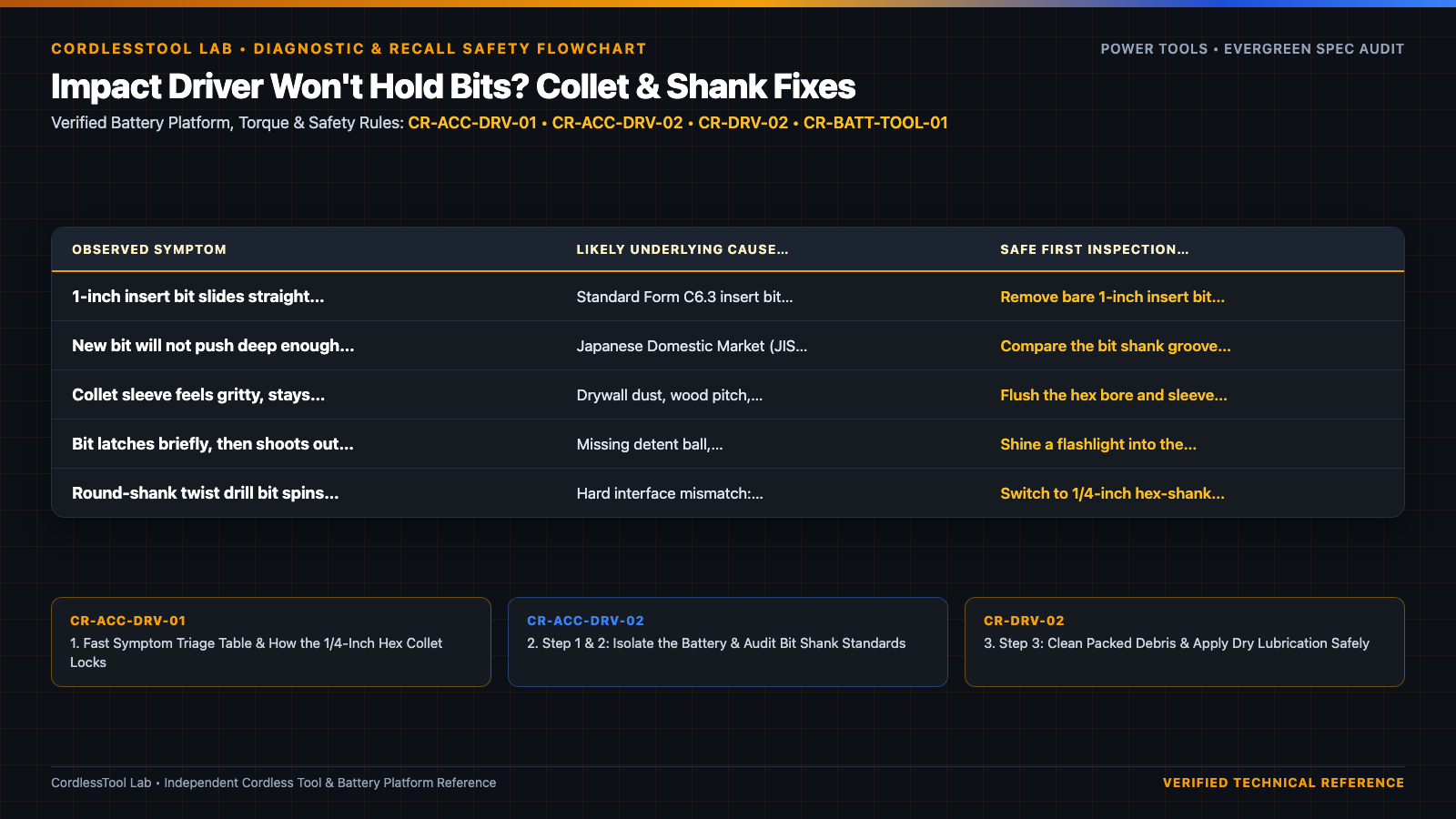
| Observed Symptom | Likely Underlying Cause / KM Rule | Safe First Inspection Step (Battery Removed) |
|---|---|---|
| 1-inch insert bit slides straight out with zero click | Standard Form C6.3 insert bit lacks a machined ball-detent groove (STD-SHANK-HEX-1-4) | Remove bare 1-inch insert bit and seat it inside an impact-rated 1/4-inch hex locking or magnetic bit holder with a power groove. |
| New bit will not push deep enough for collar to snap forward | Japanese Domestic Market (JIS Type A) 13 mm groove vs. North American/ISO 9.5 mm E6.3 groove, or mushroomed bit corners (CR-ACC-DRV-02) | Compare the bit shank groove position against a known-good US power bit and inspect hex flats for twisted burrs. |
| Collet sleeve feels gritty, stays stuck forward, or will not retract | Drywall dust, wood pitch, rust, or gummy grease jamming the sleeve spring | Flush the hex bore and sleeve gap using safety glasses as the manual specifies, then work the sleeve manually to restore travel. |
| Bit latches briefly, then shoots out under light pull or reverse spin | Missing detent ball, fatigued/broken ball clip spring, or popped front circlip | Shine a flashlight into the hex throat to verify the steel ball protrudes into the bore when the sleeve sits forward. |
| Round-shank twist drill bit spins freely or falls out | Hard interface mismatch: impact drivers accept 1/4-inch hex shanks only (CR-ACC-DRV-01) | Switch to 1/4-inch hex-shank drill bits or move the round-shank bit into a 3-jaw drill/driver chuck. |
| Collet wobbles severely even with a new power bit | Wallowed-out detent ball pocket or worn internal hex flats on the anvil | Check whether a replacement spring and ball hold firmly; if the ball slot is ovaled, replace the OEM anvil assembly or visit service. |
2. Step 1 & 2: Isolate the Battery & Audit Bit Shank Standards
Before assuming the driver’s internal hardware has failed, rule out the accessory itself. Roughly half of bit-retention issues happen when a healthy quick-release collet meets an incompatible shank profile or a fatigued non-impact bit.
Step 1: Disconnect the Battery Pack and Wear Eye Protection
Every major manufacturer—including DeWalt, Milwaukee, and Makita—states in its operator’s manual that you must remove the battery pack before installing, removing, or inspecting bit-holder parts. Pressing the trigger accidentally while fingers or picks are inside the hex socket can pinch skin or launch a loose bit. Put on ANSI Z87.1 safety glasses as the manual specifies before shining a light down the nose cone or pulling the sleeve back.
Step 2: Verify 1/4-Inch Hex Form E6.3 Groove & Impact Rating (CR-ACC-DRV-01, CR-ACC-DRV-02)
Under compatibility rule CR-ACC-DRV-01, an impact driver accepts 1/4-inch hex-shank bits only (STD-SHANK-HEX-1-4). Never try to clamp round-shank or three-flat drill bits inside an impact collet, and never grind hex flats onto a round shank—uneven surfaces bind the detent ball and create severe wobble. Even within 1/4-inch hex accessories, three distinct shank geometries exist, and only one locks directly into a standard North American impact driver:
- Form E6.3 Power Bits (9.5 mm / 3/8-inch Power Groove — Correct Direct Fit): Standard 2-inch, 3-inch, and 6-inch North American impact driver bits, nut setters, and hex-shank drill bits feature a machined radial notch centered roughly 9.5 mm from the butt end of the hex shaft. When pushed into the collet, the steel detent ball drops cleanly into this recess and resists a firm tug.
- Form C6.3 Insert Bits (1-inch Bits Without a Groove — Requires Holder): Short 1-inch insert bits have a straight hexagonal body with a small corner detent notch or no radial power groove at all. Unless your specific impact driver explicitly uses an internal magnet-and-ring insert pocket (rare on modern quick-release anvils), dropping a bare 1-inch bit directly into the collet leaves nothing for the detent ball to grab. Always seat 1-inch insert bits inside an impact-rated 1/4-inch hex locking bit holder that itself carries a 9.5 mm Form E6.3 groove.
- JIS Type A Bits (13 mm Groove — Regional Mismatch): Tools built for the Japanese domestic market (JDM) often position the locking groove roughly 13 mm (or up to 14 mm on certain bits) from the shank end. Inserting a 13 mm JIS bit into a US-spec 9.5 mm collet puts solid hex flat directly under the detent ball, preventing the outer collar from snapping forward. Conversely, dropping a US 9.5 mm bit into a JDM 13 mm collet lets the bit slide past the ball pocket or wobble sharply.
Equally important is rule CR-ACC-DRV-02: use impact-rated bits built with a torsion zone and ductile alloy steel. Standard hardened chrome-vanadium bits made for clutch-controlled drill/drivers fit a 1/4-inch hex socket physically, but repeated rotational hammering causes their hex corners to mushroom, twist, or shear. Once a bit shank mushrooms slightly at the drive flats or swells near the groove, it jams inside the anvil walls or refuses to let the detent ball seat fully. If your current bits show twisted flutes or smeared hex corners, replace them with a verified set from our impact-rated driver bit set guide (typically sitting in the TIER-ACC-VALUE to TIER-ACC-MID budget bands rather than unverified unbranded packs).
3. Step 3: Clean Packed Debris & Apply Dry Lubrication Safely
If a fresh, impact-rated Form E6.3 power bit still refuses to latch—or if the outer sleeve grinds and hangs partway forward—contaminants packed inside the sliding collar are the most common culprit. Overhead drywall work drops fine gypsum powder directly into the nose cone, while deck framing and metal self-tapping screws introduce pine pitch, rust scale, and fine steel shavings that magnetize onto bit holders and wedge under the detent ball.
External Flush Protocol (Zero Disassembly Required)
- Confirm Battery Removal & Point Nose Downward: With the battery pack removed and safety glasses on, hold the impact driver nose-down over a trash bin or shop towel so loosened grit falls outward rather than deeper toward the front anvil bearing.
- Pull the Sleeve & Brush the Hex Bore: Retract the outer collet collar fully and inspect the inside corners of the 1/4-inch hex bore with a bright flashlight. Use a non-marring nylon brush or dry cotton swab to scrape compacted drywall cake and sawdust out of the six hex corners and the circular ball window.
- Flush With Plastic-Safe Cleaner or Low-Pressure Air: If resin or old grease has glued the detent ball inside its hole, apply a small burst of plastic-safe electrical contact cleaner or isopropyl alcohol into the bore while cycling the outer sleeve back and forth. Avoid flooding rubber nose-cone bumpers with harsh acetone or aggressive chlorinated brake solvents that swell elastomer boots or wash grease out of the sealed front hammer-case bearing behind the collet.
- Lubricate Sparingly With Dry PTFE or Light Machine Oil: Once dry, apply a minimal film of dry PTFE spray or a single drop of light machine oil onto the detent ball and inner collar track. Never pack heavy axle grease or thick lithium grease into the quick-release collet—thick grease acts like flypaper for sawdust and fine masonry grit, recreating the exact jam you just cleared.
After cleaning, push a clean Form E6.3 power bit into the bore until the sleeve snaps crisply forward, then perform a firm manual pull check on the bit shank as DeWalt and Milwaukee manuals instruct. If the bit locks solidly and releases smoothly when you pull the sleeve, your collet only needed decontamination.
4. Step 4 & 5: Inspect Retaining Ring, Spring, Ball & Anvil Pocket
When external flushing frees the sleeve but bits still pull right out—or when the front sleeve slides loosely with zero spring tension—internal collet retention hardware has broken or escaped. Most 1/4-inch hex quick-release chucks share a straightforward stack of four replaceable parts: a front retaining circlip (snap ring), a cupped washer or sleeve guide, a coil compression spring, and one or two steel detent balls (with a retaining leaf spring or ball collar on some designs).
Step 4: Visual Flashlight Check Inside the Bore
With the battery pack removed, peer straight down the 1/4-inch hex opening while slowly pulling and releasing the outer sleeve:
- Empty Ball Hole: On one flat (or two opposite flats) of the internal hex wall, you should see a shiny round steel ball protruding slightly into the hex cavity when the sleeve is released forward. If you see a dark circular hole with no ball inside, the front circlip popped off or rotated, allowing the ball to drop out on the jobsite.
- Dead or Crooked Sleeve Travel: If the outer collar wobbles sideways or stays limp in any position, the coil compression spring inside the sleeve has snapped or bound against a bent retaining washer.
- Unseated Front Retaining Ring: Look at the very tip of the metal anvil nose just ahead of the sliding collar. A partially unseated split retaining ring lets the collar creep past its stop, preventing the inner taper from pressing the detent ball into the bit groove.
Step 5: Collet Rebuild vs. Complete OEM Anvil Replacement
Before disassembling the collet nose, check your tool’s warranty status and manual rules (detailed in Section 5 below). If your tool is outside factory warranty and you choose to service the external collet stack using an OEM parts diagram from the manufacturer’s support portal, work inside a clear plastic bag or deep tray with ANSI eye protection on so the compression spring and steel ball cannot fly across the shop.
- External Collet Kit Replacement (When Ball or Spring Failed): Use a fine pick to unseat the front retaining ring carefully, slide the outer sleeve and coil spring off the nose, inspect the ball pocket, clean all grooves, seat the new OEM steel ball and spring, slide the collar back down against spring pressure, and snap a fresh OEM retaining ring squarely into the nose groove. Confirm the circlip sits flush all the way around its channel so it cannot launch under impact vibration.
- Complete OEM Anvil Replacement (When the Ball Pocket Is Wallowed Out): High-mileage impact drivers eventually deform the thin steel lip around the detent ball window. Once that hole stretches into an oval—or once the internal 1/4-inch hex socket rounds out enough to cause severe bit wobble—installing a new spring and ball will fail within days because the ball drops straight through the enlarged window. Swapping the entire OEM anvil assembly (or submitting the driver to an authorized service center) restores factory tolerances safely.
Never substitute hardware-store E-clips, bent paperclips, or mismatched ball-bearing sizes into a high-speed impact anvil. At 3,800 rpm and over 4,000 impacts per minute, an undersized or soft retaining clip can shear and eject metal fragments during operation.
5. Brand Manual Rules, Warranty Boundaries & CPSC Recall Check
Quick-release collets look similar across major cordless brands, yet insertion behavior, manual rules, battery compatibility, and warranty policies differ in ways that affect how you maintain or replace parts.
Insertion Differences & Rated Spec Context Across Major Platforms
Many current brushless impact drivers use a push-in (one-handed drop-load) collet design, while older or compact models require pulling the collar forward during insertion. For example, our DeWalt DCF860 impact driver audit notes that DeWalt’s 20V MAX XR model—rated up to 2,500 in-lbs by DeWalt, up to 3,800 rpm, and up to 4,500 ipm across 3 speeds (4.8-inch head length, 2.4 lb bare weight; note that DCF860B is a tool-only listing: battery and charger sold separately)—uses a 1/4-inch hex quick-release bit holder where DeWalt’s manual directs users to push the bit in until it locks and pull firmly to confirm retention, or pull the collar forward for removal. Similarly, Milwaukee’s operator’s manuals for the M18 FUEL 2953-20 and predecessor 2853-20 (tool-only listing: battery and charger sold separately) explain that pressing a power-groove bit directly into the 1/4-inch hex chuck often seats without pulling the collar, while pulling the sleeve forward releases the bit—always with the M18 battery pack removed first.
On Makita’s 40V max XGT line—such as the 4-speed GDT02 (rated 1,860 in-lbs by Makita) and its predecessor GDT01 (rated 1,950 in-lbs by Makita)—always check whether an imported online listing is a North American US model (9.5 mm E6.3 collet) rather than a Japanese domestic market import built around 13 mm JIS shanks. Whenever you compare drivers across DeWalt, Milwaukee, and Makita, remember rule CR-DRV-02: each manufacturer measures torque using its own method and reference battery (CR-BATT-TOOL-09), so spec-sheet in-lbs figures cannot be ranked across brands. Also remember voltage-label parity under CR-BATT-TOOL-02: DeWalt 20V MAX and Milwaukee M18 both operate at 18V nominal (five lithium-ion cells in series), so the “20V” label reflects peak resting charge rather than higher voltage. Physical pack rails remain strictly brand-locked (CR-BATT-TOOL-01) and voltage-family locked (CR-BATT-TOOL-03—M12 packs never fit M18 tools, and 18V LXT packs never fit 40V XGT tools).
Warranty, Third-Party Resellers & Non-OEM Battery Cautions (CR-SYS-05, G-25, G-26)
- Check Factory Warranty Before Opening the Housing (
CR-SYS-05): External cleaning and replacing an accessible front retaining clip with OEM parts is routine upkeep, but splitting the clam-shell housing or opening the hammer gearcase to swap an anvil yourself can void remaining manufacturer warranty coverage. Under warranty terms, Milwaukee M18/M12 tools, Ryobi ONE+ tools, and Ridgid 18V tools (including Ridgid’s Lifetime Service Agreement registration requirements) depend on purchase new from an authorized retailer or distributor; units bought from unauthorized third-party marketplace resellers may be denied factory warranty service (G-26). - Avoid Non-OEM Packs and Cross-Brand Adapters (
CR-SYS-03,CR-BATT-TOOL-10,G-25): While troubleshooting drivetrain slips or erratic power, inspect your battery pack too. Unbranded third-party “replacement” batteries and cross-brand plastic battery adapters frequently omit genuine OEM thermal and overcurrent communication handshakes, risk cell overheating under high-draw impacting (CR-BATT-TOOL-08), and void tool warranties. Stick strictly to OEM packs from authorized sellers.
Official CPSC Safety Recall Check (CR-SYS-06, G-12)
Per our safety verification protocol (CR-SYS-06), a review of the U.S. Consumer Product Safety Commission (CPSC) database shows no active CPSC recall specifically targeting 1/4-inch hex impact driver collets for bit-retention failure. However, cordless drills, battery packs, chargers, and specialized accessories across brands are occasionally recalled independently. Before servicing or discarding an older tool or battery pack, verify your exact model number and date code directly on cpsc.gov/Recalls and your brand’s official safety notice page.
6. Post-Repair Retention Checklist & Official Citations
Before reinstalling the battery pack and driving structural screws or lag fasteners overhead, complete every step in this post-repair verification checklist:
- [ ] Battery Remained Out During Inspection: Pack stayed disconnected during debris flushing, ball inspection, and retaining-ring installation.
- [ ] Shank & Impact Rating Confirmed: Bit uses a 1/4-inch hex shank with a 9.5 mm Form E6.3 groove (or a 1-inch Form C6.3 insert bit locked inside an impact-rated bit holder) and carries an impact rating (
CR-ACC-DRV-01,CR-ACC-DRV-02). - [ ] Retaining Clip & Ball Seated Flush: Front circlip sits evenly around its groove, sleeve snaps crisply forward under spring tension, and steel detent ball engages cleanly.
- [ ] Firm Pull Check Passed: With the bit seated and sleeve forward, a sharp manual tug cannot pull the bit out of the anvil.
- [ ] PPE & Manual Compliance Verified: Eye protection, hearing protection, and work gloves worn as the manufacturer’s manual specifies before resuming work.
Authoritative Non-Affiliate References
- DeWalt US Support Portal — Quick-Release 1/4-Inch Hex Bit Holder Manuals & Warranty Terms
- DeWalt ServiceNet — Official Exploded Parts Diagrams, Retaining Rings & Anvil Assemblies
- Milwaukee Tool Support & eService — M18 FUEL 1/4-Inch Hex Impact Driver Manuals & Parts Lists
- Makita U.S.A. Technical Support — Cordless Impact Driver Instruction Manuals & Service Locator
- U.S. Consumer Product Safety Commission (CPSC) — Official Recall Search Database
- OSHA Hand and Power Tools Safety Overview — Maintenance & PPE Guidance
How We Audited This Guide
- Cordless drills, saws, and grinders were audited across brushless motor efficiency, max chuck/blade/arbor sizing, electronic kickback protection, Bare Tool vs. Kit value, and manufacturer US warranty terms.
- Every cordless drill, impact driver, saw, grinder, battery pack, charger, outdoor power tool, and accessory spec was cross-checked against official OEM manuals, UL/ANSI ratings, and live Amazon US listings.
- Recommendations were evaluated against our weighted vertical scoring rubrics and 61 documented CR-* platform and safety rules; we never invent peak torque ft-lbs, cut counts, runtime minutes, or battery decibels.
7. Frequently Asked Questions
Why does my impact driver drop 1-inch bits right out of the chuck?
Most 1-inch Form C6.3 insert bits have no radial power groove for the collet’s steel detent ball to grip. Drop them into an impact-rated 1/4-inch hex locking bit holder that features a standard 9.5 mm Form E6.3 groove rather than placing bare insert bits straight into the anvil.
Can I use round-shank drill bits in a 1/4-inch hex impact driver?
No. Under compatibility rule CR-ACC-DRV-01, impact drivers accept 1/4-inch hex-shank bits only. Round-shank twist bits cannot lock into the hex socket or detent ball, and grinding flats onto round shanks creates severe wobble. Use 1/4-inch hex-shank drill bits or a 3-jaw drill/driver chuck instead.
Why won’t my Makita or imported JDM impact driver latch US hex bits?
Japanese domestic market (JIS Type A) impact drivers place the detent groove roughly 13 mm from the bit end, compared with 9.5 mm on North American Form E6.3 bits. That 3.5 mm offset keeps the detent ball from aligning cleanly—match JIS bits to JDM tools or use US-spec tools with US bits.
Should I pack grease inside my impact driver’s quick-release collet?
No. Heavy grease inside the 1/4-inch hex bore traps sawdust, drywall powder, and metal filings, quickly jamming the sleeve and detent ball. Remove the battery pack, flush contaminants with plastic-safe contact cleaner while wearing eye protection, and apply only a minimal dry PTFE film or single drop of light oil.
When should I replace the whole anvil instead of a collet spring kit?
If inspecting the empty bore shows that the circular window holding the steel detent ball has stretched oval—or if new bits still wobble excessively—a spring and ball rebuild kit will not hold. Replace the complete OEM anvil assembly or send the tool to a manufacturer authorized service center.


