
On This Page
Disclosure: As an Amazon Associate, I earn from qualifying purchases. If you buy through links on this page, we may earn a small commission at no extra cost to you. Commission rates never alter our technical evaluations or tool recommendations.
Settling the drill vs impact driver choice starts with how each drivetrain delivers torque and holds accessories, not which tool looks stronger on a spec sheet. A cordless drill/driver (or hammer drill) applies continuous, clutch-regulated rotation through a three-jaw chuck—making it essential for clean round holes, metal fabrication, and delicate finish screws. An impact driver uses a compact hammer-and-anvil (or hydraulic oil-pulse) mechanism behind a 1/4-inch quick-release hex collet to sink long deck screws and structural lags with minimal wrist twist.
For most DIYers and tradespeople, these two tools complement rather than replace each other. If you only buy one first, your project mix decides: pick a versatile drill from our best cordless drill hub if you bore holes and assemble furniture, or pair it with a compact driver from our cordless impact driver guide as soon as decking, framing, or heavy fasteners enter your schedule.
Quick Verdict Matrix: Which Tool Fits Which Job
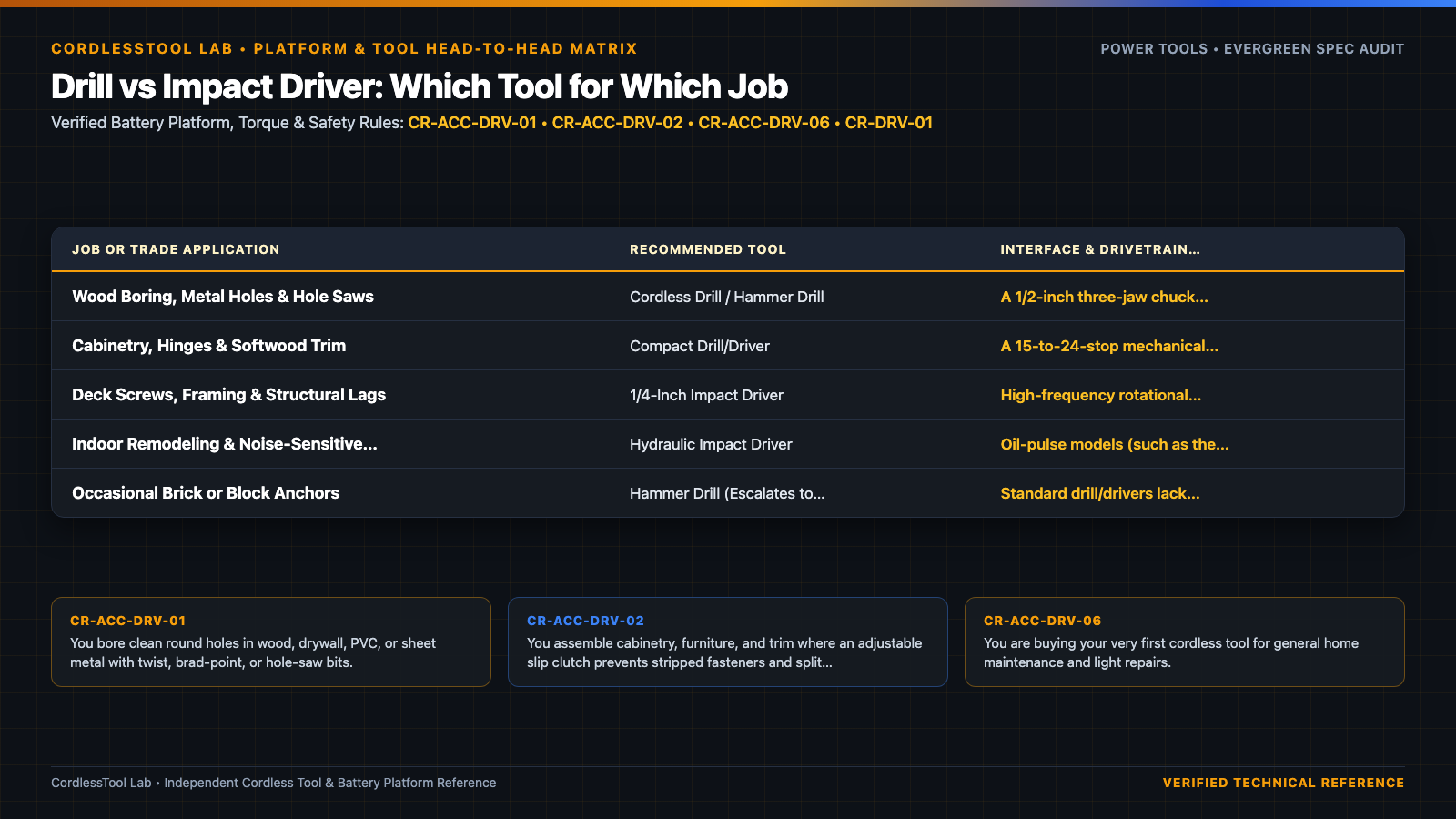
Neither tool wins every workshop task. Because a drill prioritizes concentric hole accuracy and adjustable slip-clutch protection while an impact driver prioritizes high-torque fastening speed and short front-to-back reach, match your daily workload against the job matrix below before committing to a single bare tool or a two-tool kit.
| Job or Trade Application | Recommended Tool | Interface & Drivetrain Rationale |
|---|---|---|
| Wood Boring, Metal Holes & Hole Saws | Cordless Drill / Hammer Drill | A 1/2-inch three-jaw chuck clamps round, 3-flat, and hex shanks concentrically (CR-ACC-DRV-06) with 2–3 steady gear speeds and zero impacting chatter. |
| Cabinetry, Hinges & Softwood Trim | Compact Drill/Driver | A 15-to-24-stop mechanical slip clutch disengages cleanly at low torque before snapping brass hinge screws or splitting MDF and pine trim. |
| Deck Screws, Framing & Structural Lags | 1/4-Inch Impact Driver | High-frequency rotational impacts drive 3-inch to 6-inch structural screws smoothly without twisting your wrist, while a ~5-inch head clears tight stud bays. |
| Indoor Remodeling & Noise-Sensitive Sites | Hydraulic Impact Driver | Oil-pulse models (such as the DEWALT DCF870B) replace metal-on-metal anvil blows with fluid pulses for noticeably quieter indoor fastening. |
| Occasional Brick or Block Anchors | Hammer Drill (Escalates to SDS-Plus) | Standard drill/drivers lack axial blows and dull masonry bits quickly (CR-DRV-01); hammer drills handle light anchors, while frequent concrete requires an SDS-plus rotary hammer. |
| Automotive Lug Nuts & Suspension Bolts | Impact Wrench + Torque Wrench | 1/4-inch hex impact drivers and thin socket adapters are under-built for wheel lugs; step up to a square-anvil impact wrench with Cr-Mo sockets and finish with a calibrated torque wrench (CR-DRV-03). |
Side-by-Side Verified Mechanical & Compatibility Table
All figures below follow official US manufacturer documentation in imperial units and 18V-nominal battery context (where 20V MAX equals 18V nominal under load per CR-BATT-TOOL-02). Because brands calculate drill and impact torque using different proprietary methods (CR-DRV-02), never rank one brand over another from paper inch-pound numbers alone.
| Technical Attribute | Cordless Drill / Hammer Drill | Cordless Impact Driver (Mechanical / Hydraulic) |
|---|---|---|
| Tool Holder Standard | 3-Jaw Keyless Chuck: 1/2-inch (full-size) or 3/8-inch (compact) | 1/4-inch Quick-Release Hex Collet (STD-SHANK-HEX-1-4) |
| Accepted Bit Shanks | Round, 3-flat, and hex shanks ≤ chuck capacity (CR-ACC-DRV-06) | 1/4-inch hex-shank bits only; never clamp round shanks (CR-ACC-DRV-01) |
| Torque Delivery Mechanism | Continuous geared rotation + mechanical slip clutch (plus axial BPM collar on hammer drills) | Rotational hammer-and-anvil blows (IPM) or hydraulic oil-pulse fluid drive |
| Speed & Control Settings | Variable trigger + 2 or 3 mechanical gears + 11–24 clutch settings | Variable trigger + 3–4 electronic speed/assist modes (no mechanical slip clutch) |
| Representative OEM Benchmark | DEWALT DCD1007B: 2,100 in-lbs max brake torque / 1,530 MWO (DeWalt method), 0–450 / 1,200 / 2,000 RPM, 7.6 in., 4.1 lb bare | DEWALT DCF845B: 1,825 in-lbs (DeWalt method), 0–3,400 RPM, 0–4,200 IPM, 5.1 in., 2.0 lb bare (DCF870B hydraulic: 0–3,000 RPM, 4.45 in., 2.57 lb bare) |
| Combo-Kit Compact Benchmark | Milwaukee 2801-20 (inside 2892-22CT kit): 500 in-lbs (Milwaukee method), 0–500 / 1,800 RPM, 6.5 in. | Milwaukee 2850-20 (inside 2892-22CT kit): 1,600 in-lbs (Milwaukee method), 0–3,400 RPM, 0–4,200 IPM, 5.1 in. |
| High-Load Wrist Kickback Risk | High on large hole saws or spade bits; fit the side handle and prioritize electronic anti-rotation control (CR-DRV-04) | Very low wrist reaction during normal driving; radial impacts absorb resistance inside the hammer housing |
| Typical Bare-Tool Budget Tier | TIER-DRV-VALUE (entry) to TIER-DRV-PREMIUM (3-speed flagship) | TIER-DRV-VALUE (brushed/entry) to TIER-DRV-MID / TIER-DRV-PREMIUM (hydraulic/flagship) |
1. Torque Delivery & Wrist Reaction: Steady Rotation vs. Rotational Impacts
The fundamental divide in a drill vs impact driver matchup sits right behind the chuck or collet. A cordless drill/driver couples a brushed or brushless DC motor through a planetary reduction gearbox directly to a three-jaw chuck. When you drill into oak or steel, torque stays smooth and uninterrupted—every ounce of resistance at the cutting edge pushes back directly through the tool housing into your wrist and forearm.
That direct mechanical link creates two strengths and one major hazard. First, uninterrupted rotation lets twist bits, brad-point bits, and hole saws slice cleanly without beating the cutting edges or walking across smooth metal. Second, an adjustable slip clutch (typically 11 to 24 positions on modern drills) interrupts drive torque at a repeatable threshold so small cabinet screws stop flush instead of stripping out soft pine. However, when a 2-inch self-feed bit or hole saw snags on a framing nail, direct torque can wrench the drill violently—which is why CR-DRV-04 requires fitting the manufacturer’s auxiliary side handle for large-bore work and seeking electronic anti-rotation shutoff systems such as DEWALT’s ANTI-ROTATION E-CLUTCH on the DCD1007B or Milwaukee’s AutoStop on the Gen 4 2904.
An impact driver eliminates most of that continuous wrist fight. When fastener resistance climbs above a spring-loaded threshold, an internal hammer disengages from the anvil, spins up, and strikes the anvil tangentially thousands of times per minute (up to 4,200–4,500 IPM on high-output mechanical models). Each micro-impact delivers a sharp burst of rotational force into the screw head while leaving very little reactive torque in your hand. Newer hydraulic oil-pulse drivers like the DEWALT DCF870B replace direct steel-on-steel hammer strikes with pressurized hydraulic fluid pulses—per DEWALT, operating up to 57% quieter than standard mechanical models like the DCF787 while maintaining controlled fastener seating in tight 4.45-inch spaces.
Motor topology also shifts real-world thermal headroom across both categories. Under CR-TOOL-01, brushless drills and brushless impact drivers generally run cooler and deliver more work per battery charge than older brushed entry models, though brushed tools remain serviceable for light, occasional household tasks in the TIER-ENTRY band.
2. Tool Holders & Bit Interface Rules (CR-ACC-DRV-01, 02 & 06)
Accessory compatibility depends strictly on the standardized tool holder interface—never on brand logos printed on a bit case. Mixing up chuck and collet standards is the fastest way to snap bits, ruin workpieces, or stall a weekend project.
- Impact Driver Collet Limit (
CR-ACC-DRV-01— HARD): An impact driver accepts1/4-inch hex-shankbits with a quick-release retention groove (STD-SHANK-HEX-1-4) and nothing else. Round-shank twist bits, spade bits with round shanks, and SDS masonry bits will not lock inside an impact collet. If you want to drill occasional pilot holes with an impact driver, buy hex-shank drill bits—and recognize that slight collet play still leaves cleaner, rounder holes to a three-jaw drill. - Impact-Rated Torsion Bits Required (
CR-ACC-DRV-02— SOFT): Standard hardened driver bits fit a 1/4-inch hex collet physically, but they are brittle under thousands of rotational hammer blows per minute and snap or cam out quickly. Use impact-rated bits with engineered torsion zones (such as DEWALT FlexTorq or Milwaukee Shockwave impact-duty sets), follow the bit maker’s load rating, and wear eye protection as each tool manual specifies. - Three-Jaw Chuck Capacity Rule (
CR-ACC-DRV-06— HARD): A drill’s three-jaw keyless chuck clamps round, three-flat, and 1/4-inch hex shanks evenly, provided the shank diameter is less than or equal to the chuck’s maximum capacity. A3/8-inchchuck common on 12V subcompact drills will not close onto a1/2-inchshank auger or reduced-shank metal bit; moving to a full-size1/2-inchratcheting metal chuck (STD-CHUCK-3JAW-1-2) resolves shank clearance, though you must still stay inside the drill’s rated wood and steel diameter limits in the manual.
3. Where Both Tools Stop: Masonry Anchors & Automotive Fasteners
Many shoppers confuse a hammer drill with a rotary hammer—or assume a 1/4-inch impact driver can double as an automotive lug-nut gun. Both mistakes run directly into mechanical limits.
First, consider concrete and brick under CR-DRV-01. A basic drill/driver with no hammer symbol on its mode collar spins smoothly without axial blows; pressing it against poured concrete or brick overheats carbide masonry bits and crawls through holes. Stepping up to a hammer drill adds rapid axial percussion (often 30,000–38,250 BPM) through serrated clutch plates, which handles occasional Tapcon screws or small shelf anchors in brick and block. However, if your project involves frequent or larger-diameter anchor holes in poured concrete, escalate to a dedicated piston-driven SDS-plus rotary hammer (STD-SHANK-SDS-PLUS)—never force SDS-plus bits into a three-jaw chuck expecting rotary-hammer output.
Second, do not mistake a 1/4-inch hex impact driver for a square-anvil impact wrench on vehicle suspension bolts or wheel lug nuts. Even high-torque 1/4-inch impact drivers shed energy through narrow 1/4-inch hex-to-square socket adapters that wobble and shear under heavy automotive loads. Removing seized caliper brackets or lug nuts calls for a 3/8-inch or 1/2-inch square-anvil impact wrench paired with thick-walled chrome-molybdenum (Cr-Mo) impact sockets rather than chrome hand sockets (CR-ACC-DRV-04, CR-ACC-DRV-05). Just as critical under CR-DRV-03: an impact wrench is never a torque-measuring instrument—use it to spin nuts on lightly or break them loose, then final-tighten lug nuts and critical fasteners with a calibrated torque wrench to the vehicle manufacturer’s specified value.
4. Voltage Parity, Torque Spec Traps & Bare vs. Combo-Kit Economics
Before adding tools to your cart, clear four marketplace traps that distort drill and impact driver comparisons:
- 20V MAX Equals 18V Nominal (
CR-BATT-TOOL-02): DEWALT prints20V MAX(peak initial open-circuit voltage on a fresh five-cell pack), whereas Milwaukee and Makita print18V(nominal working voltage under load). Both systems wire five lithium-ion cell groups in series delivering 18 volts nominal on the job. A5.0Ahbattery holds90 Whof stored energy on either rail—yet their slide interfaces never interchange (CR-BATT-TOOL-01). - Incompatible Brand Torque Claims (
CR-DRV-02): Never pick a drill or driver solely because one brand’s spec sheet prints a higher inch-pound rating. DEWALT publishesmax brake torque(such as2,100 in-lbson theDCD1007B) alongside proprietaryMWOpower ratings, while Milwaukee and Makita publishin-lbsderived from separate measurement protocols. Cross-brand performance claims require identical third-party measurement rigs with stated reference packs, and whenever a maker ties output to a battery—such as Milwaukee rating its29671/2-inch impact wrench at1,200 ft-lbsfastening /1,600 ft-lbsnut-busting withFORGEpacks versus1,100 / 1,500 ft-lbswithXC5.0packs—always check the reference battery first. - Combo-Kit Tiers & Model Generations (
CR-SYS-07,CR-TOOL-02): Many two-tool starter combo kits bundle compact or mid-line tools rather than the brand’s flagship hardware. For example, Milwaukee’s2892-22CTcombo kit pairs the compact brushless2801-20drill/driver and2850-20impact driver with twoCP2.0packs—solid for general remodeling, but distinct from M18 FUEL flagship tools like the Gen 42904hammer drill (which replaced Gen 32804) and2953impact driver. Similarly, DEWALT’sDCD10073-speed hammer drill superseded the olderDCD998, yet both still appear in search results. - Bare-Tool Lockout & Pack Pairing (
CR-SYS-01,CR-BATT-TOOL-08,CR-SYS-04): Choose your battery platform first, then match bare tools (B,-20,Z) only to batteries and chargers you already own. If you buy a bare heavy-duty hammer drill like theDCD1007B, pairing it with a small 2.0Ah pack can cause early thermal or voltage cut-out during large hole-saw cuts—step up to a 5.0Ah XR, POWERSTACK, or POWERPACK battery for heavy boring, while keeping compact packs for overhead impact driving (CR-BATT-TOOL-11).
5. Amazon US Warranty Channels, Battery Warnings & CPSC Recalls
Buying drills and impact drivers online introduces channel and safety checks that matter just as much as torque and chuck specs:
- Authorized Seller & Retail-Exclusive Warranty Rules (
CR-SYS-05): Per DEWALT’s official US warranty terms, tools and qualifying batteries purchased from Amazon first-party retail or DEWALT’s official Amazon Brand Store carry a 3-year limited warranty and 1-year free service contract. By contrast, Milwaukee Tool’s US warranty policy (5 years on M18 tools, 2 years on compact CP packs, 3 years on XC/FORGE packs) requires purchase from an authorized Milwaukee distributor—because third-party Amazon resellers are often not authorized distributors, check seller status carefully before relying on factory coverage. Likewise, Home Depot retail-exclusive brands such as Ryobi and Ridgid appear on Amazon primarily through unauthorized third-party or bulk resellers, putting Ryobi warranty claims and Ridgid’s Lifetime Service Agreement (LSA) registration at risk. - Strict Exclusion of Non-OEM Packs & Adapters (
CR-SYS-03,CR-BATT-TOOL-10): Never buy unbranded third-party “replacement batteries” boasting inflated 9.0Ah–15.0Ah capacities or passive plastic adapters built to snap one brand’s battery onto another brand’s drill or ride-on toy. Neither toolmaker approves cross-brand adapters; passive bridges interrupt pack-to-tool thermal and low-voltage protection signals, create cell overheating hazards, and void OEM warranties. - Manual-First Operation & Recall Verification (
CR-SYS-06): Wear eye, hearing, and hand protection as the manufacturer’s manual specifies, keep vents clear, and pause charging if a hot or cold battery triggers a thermal blink warning (CR-BATT-05). No open 2025–2026 CPSC recalls were identified for the featured DEWALTDCD1007B,DCF845B,DCF870B, or Milwaukee2892-22CTtools during our verification sweep—though buyers should avoid uncertified, unbranded “21V” imported drill kits flagged in federal safety warnings and confirm any tool’s serial range against the U.S. CPSC Recalls database.
Final Verdict: Choose a Drill vs. Choose an Impact Driver
Choose a Cordless Drill First If…
- You bore clean round holes in wood, drywall, PVC, or sheet metal with twist, brad-point, or hole-saw bits.
- You assemble cabinetry, furniture, and trim where an adjustable slip clutch prevents stripped fasteners and split lumber.
- You want one tool capable of accepting round, three-flat, and hex shanks—plus occasional masonry pilot holes if you pick a hammer drill.
- You are buying your very first cordless tool for general home maintenance and light repairs.
Choose an Impact Driver (or 2-Tool Kit) If…
- You drive dozens of 3-inch deck screws, framing fasteners, or structural ledger lags where a drill strains your wrist or cams out.
- You work inside tight stud bays, cabinets, or overhead framing where a ~4.5-to-5.1-inch head length beats a 7-inch drill body.
- You already own a drill and compatible OEM batteries and want a fast, dedicated 1/4-inch hex fastener driver on the same rail.
- You are starting from scratch on projects involving both hole boring and heavy screw driving—a two-tool combo kit eliminates constant bit swapping.
Verified OEM Drills, Impact Drivers & Combo Kits on Amazon US
The four verified OEM listings below represent each distinct path in the drill vs. impact driver decision: a 3-speed heavy-duty hammer drill, a 3-speed mechanical impact driver, a quiet hydraulic oil-pulse impact driver, and a two-tool brushless starter combo kit. Read more about our evaluation standards on the CordlessTool Lab editorial overview.
1. DEWALT 20V MAX XR 1/2-Inch 3-Speed Brushless Hammer Drill (DCD1007B)

Key Specs: 18V Nominal (20V MAX) | 2,100 in-lbs max brake torque / 1,530 MWO (DeWalt method) | 0–450 / 0–1,200 / 0–2,000 RPM & 0–38,250 BPM | 1/2-inch metal ratcheting chuck | 7.6 in. length, 4.1 lb bare | Configuration: tool-only listing: battery and charger sold separately | Price Tier: TIER-DRV-PREMIUM
Engineered for heavy wood boring, large hole saws, and occasional brick or block anchors, the DCD1007B pairs a three-speed all-metal transmission with DEWALT’s electronic ANTI-ROTATION E-CLUTCH system and an included auxiliary side handle (CR-DRV-04). Its 1/2-inch metal chuck grips round, three-flat, and hex shanks firmly without slippage (CR-ACC-DRV-06). Cons: (1) Bare-tool package includes no battery or charger (CR-SYS-01), and heavy boring favors 5.0Ah XR, POWERSTACK, or POWERPACK batteries over compact 2.0Ah packs (CR-BATT-TOOL-08); (2) At 7.6 inches long and 4.1 lb bare, it feels noticeably bulky inside tight cabinet corners compared with an impact driver.
2. DEWALT 20V MAX XR 1/4-Inch 3-Speed Brushless Impact Driver (DCF845B)

Key Specs: 18V Nominal (20V MAX) | 1,825 in-lbs rated torque (DeWalt method) | 0–1,500 / 0–2,800 / 0–3,400 RPM & 0–4,200 IPM | 1/4-inch quick-release hex collet | 5.1 in. length, 2.0 lb bare | Configuration: tool-only listing: battery and charger sold separately | Price Tier: TIER-DRV-MID
For existing DEWALT 20V MAX owners adding a dedicated fastener driver, the DCF845B trims head length to 5.1 inches and bare weight to 2.0 lb while offering three electronic speed modes to dial back power on delicate screws or unleash full 3,400 RPM / 4,200 IPM output on structural deck screws and lags. Cons: (1) Bare listing omits batteries and a charger (CR-SYS-01); (2) Quick-release collet accepts 1/4-inch hex-shank bits only (CR-ACC-DRV-01) and relies on impact-rated torsion bits to avoid premature bit breakage (CR-ACC-DRV-02).
3. DEWALT 20V MAX XR 1/4-Inch Quiet Hydraulic Impact Driver (DCF870B)

Key Specs: 18V Nominal (20V MAX) | Oil-pulse hydraulic mechanism | 0–3,000 RPM | 1/4-inch hex quick-release collet | 4.45 in. length, 2.57 lb bare | 9-LED work light ring | Configuration: tool-only listing: battery and charger sold separately | Price Tier: TIER-DRV-PREMIUM
When indoor carpentry, cabinetry, or occupied remodel sites make standard anvil clatter unbearable, the DCF870B swaps mechanical hammer impacts for an oil-pulse hydraulic drive rated by DEWALT for up to 57% quieter operation than standard models like the DCF787, while squeezing front-to-back head length down to 4.45 inches. Cons: (1) Tool-only listing requires existing DEWALT 20V MAX packs and a charger (CR-SYS-01); (2) Costs more than standard mechanical impact drivers and weighs 0.57 lb more bare than the DCF845B due to its sealed hydraulic fluid housing.
4. Milwaukee M18 Compact Brushless 2-Tool Combo Kit (2892-22CT)

Key Specs: 18V Nominal Milwaukee M18 | Includes 2801-20 1/2-inch Drill/Driver (500 in-lbs, 0–500 / 1,800 RPM, 6.5 in.) + 2850-20 1/4-inch Impact Driver (1,600 in-lbs, 0–3,400 RPM, 0–4,200 IPM, 5.1 in.) | Configuration: Full 2-Tool Starter Kit with (2) M18 CP2.0 2.0Ah packs, M18/M12 multi-voltage charger, and contractor bag | Price Tier: TIER-STARTER
If you want both tools ready to run out of one bag, Milwaukee’s 2892-22CT lets you leave a twist bit chucked in the compact brushless 2801-20 drill while driving screws with the 2850-20 impact driver—and its dual-family charger supports both M18 slide packs and M12 stem packs. Cons: (1) Compact brushless kit tools sit below Milwaukee’s M18 FUEL flagship tier (CR-SYS-07), omit a hammer-drill mode for brick/block (CR-DRV-01), and ship with 2.0Ah compact packs rather than 5.0Ah high-capacity batteries; (2) Milwaukee’s US factory warranty requires an authorized distributor purchase, so verify the Amazon seller before checkout (CR-SYS-05).
How We Audited This Guide
- Cordless drills, saws, and grinders were audited across brushless motor efficiency, max chuck/blade/arbor sizing, electronic kickback protection, Bare Tool vs. Kit value, and manufacturer US warranty terms.
- Every cordless drill, impact driver, saw, grinder, battery pack, charger, outdoor power tool, and accessory spec was cross-checked against official OEM manuals, UL/ANSI ratings, and live Amazon US listings.
- Recommendations were evaluated against our weighted vertical scoring rubrics and 61 documented CR-* platform and safety rules; we never invent peak torque ft-lbs, cut counts, runtime minutes, or battery decibels.
Frequently Asked Questions: Drill vs. Impact Driver
Can an impact driver replace a regular cordless drill?
No. An impact driver accepts 1/4-inch hex-shank bits only and lacks a slip clutch or true concentric chuck stability. While hex-shank drill bits work for rough pilot holes, a regular drill/driver handles clean woodworking holes, metal boring, and delicate cabinetry screws far more accurately.
Why do standard screwdriver bits break inside an impact driver?
Standard drill-driver bits are hardened for steady rotation and shatter or twist under thousands of sudden rotational hammer blows per minute. Always choose impact-rated bits engineered with torsion-zone steel (CR-ACC-DRV-02) and wear eye protection as your tool manual specifies.
Which tool is better for drilling into concrete or brick?
Neither a standard drill/driver nor an impact driver is built for concrete. For occasional small holes in brick or block, use a hammer drill with a carbide masonry bit; for frequent or larger concrete anchors, step up to an SDS-plus rotary hammer (CR-DRV-01).
Can I remove car lug nuts with a 1/4-inch impact driver?
Do not rely on a 1/4-inch hex impact driver for wheel lug nuts. Socket adapters frequently twist or shear under high automotive torque. Use a 1/2-inch or 3/8-inch impact wrench with Cr-Mo impact sockets, then final-tighten lug nuts with a calibrated torque wrench per the vehicle manual (CR-DRV-03).
Does a 20V MAX drill have more power than an 18V impact driver or drill?
No. 20V MAX and 18V describe the exact same five-cell lithium-ion nominal voltage under working load (CR-BATT-TOOL-02). One label states peak no-load voltage off the charger while the other states nominal operating voltage—neither label predicts drilling speed or fastening torque.


